
FFWC F1C Power
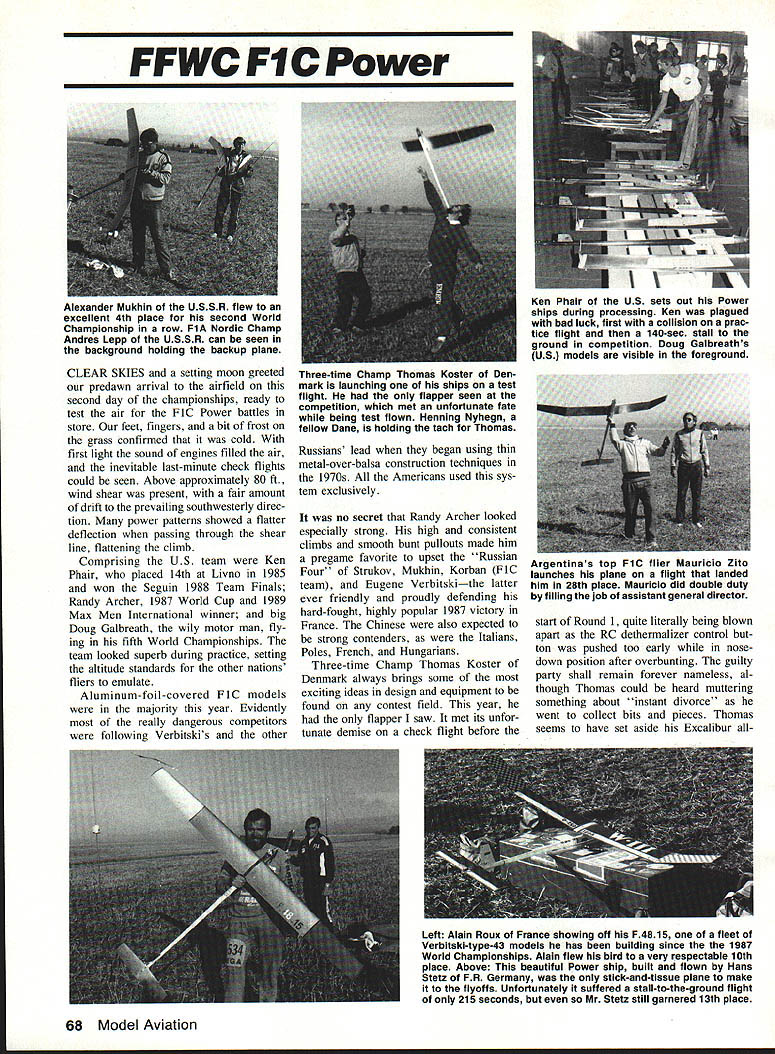
Clear skies and a setting moon greeted our predawn arrival at the airfield on the second day of the championships, ready to test the air for the F1C Power battles in store. Frost on the grass confirmed that it was cold. With first light the sound of engines filled the air and the inevitable last-minute check flights could be seen. Above approximately 80 ft., wind shear was present, with a fair amount of drift to the prevailing southwesterly direction. Many power patterns showed a flatter deflection when passing through the shear line, flattening the climb.
Comprising the U.S. team were:
- Ken Phair, who placed 14th at Livno in 1985 and won the Seguin 1988 Team Finals
- Randy Archer, 1987 World Cup and 1989 Max Men International winner
- Doug Galbreath, the wily motor man, flying in his fifth World Championships
The team looked superb during practice, setting the altitude standards for the other nations' fliers to emulate.
Aluminum-foil-covered F1C models were in the majority this year. Evidently most of the really dangerous competitors were following Verbitski's and the other Russians' lead when they began using thin metal-over-balsa construction techniques in the 1970s. All the Americans used this system exclusively.
It was no secret that Randy Archer looked especially strong. His high and consistent climbs and smooth bunt pullouts made him a pregame favorite to upset the "Russian Four" of Strukov, Mukhin, Korban, and Eugene Verbitski—the latter ever friendly and proudly defending his hard-fought, highly popular 1987 victory in France. The Chinese were also expected to be strong contenders, as were the Italians, Poles, French, and Hungarians.
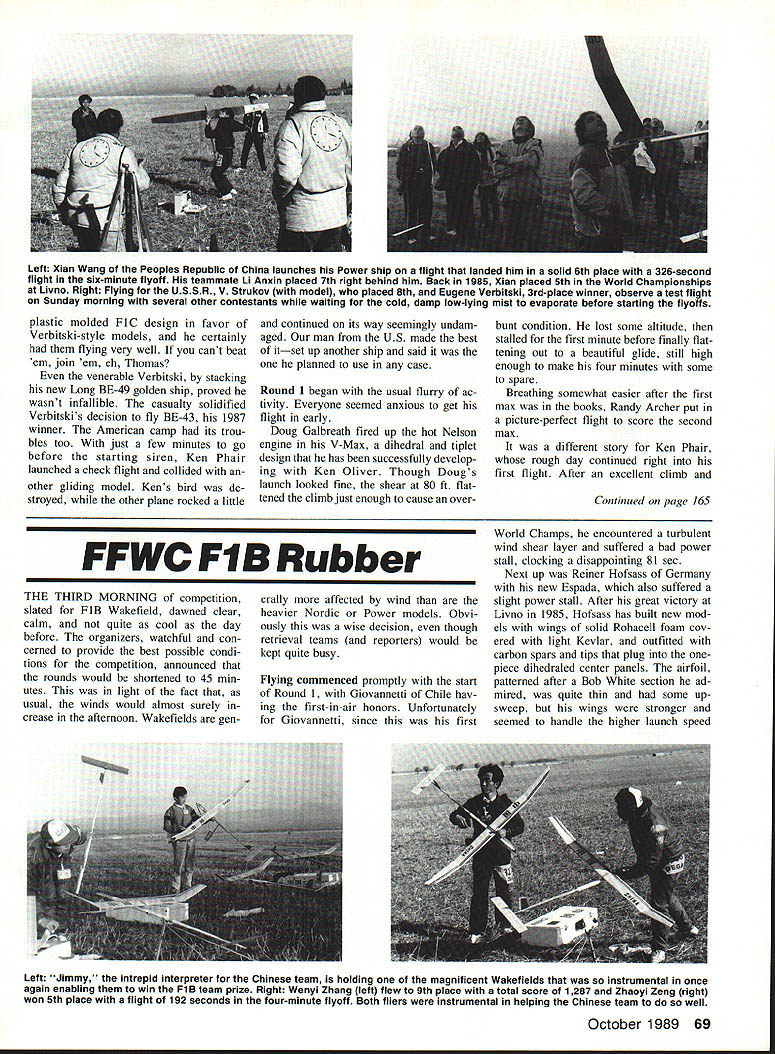
Three-time champ Thomas Koster of Denmark always brings some of the most exciting ideas in design and equipment to be found on any contest field. This year he had the only flapper I saw. It met its unfortunate demise on a check flight before the start of Round 1, quite literally being blown apart as the RC dethermalizer control button was pushed too early while in nosedown position after overbunting. Thomas could be heard muttering something about "instant divorce" as he went to collect bits and pieces. Thomas seems to have set aside his Excalibur altogether.
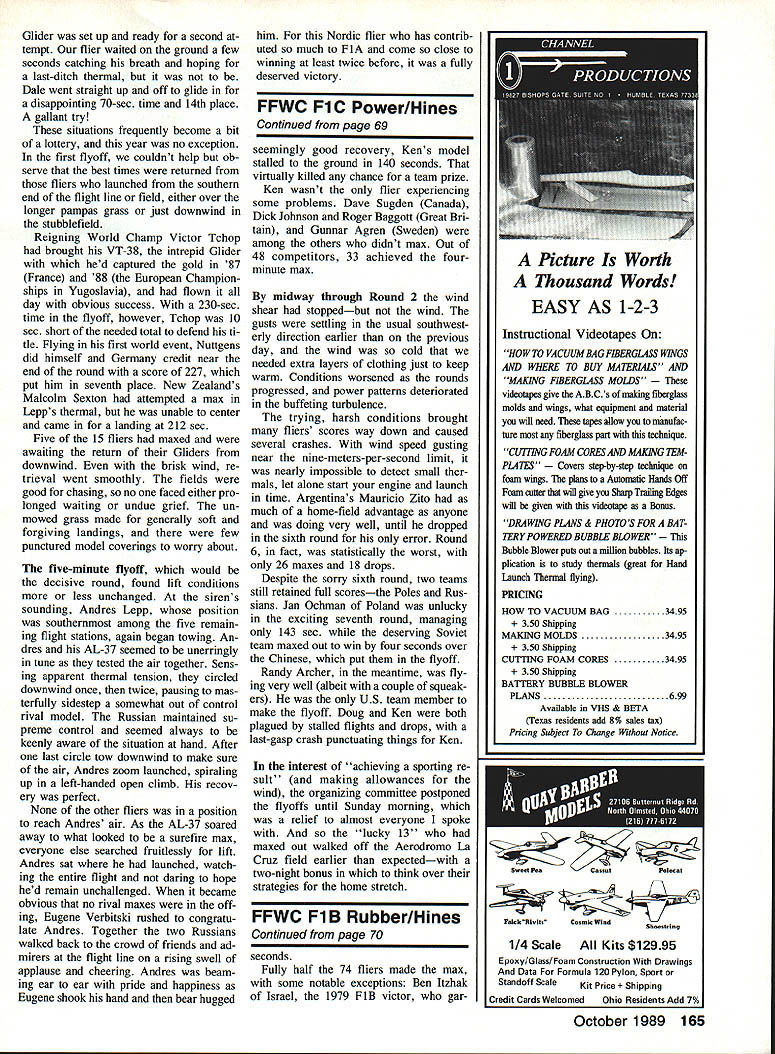
American camp had its troubles too. Just a few minutes before the starting siren, Ken Phair launched a check flight and collided with another gliding model. Ken's bird destroyed the other plane, rocked a little, and continued on its way seemingly undamaged. Ken made the best of it and set up another ship he said he planned to use.
Round 1 began with the usual flurry of activity. Everyone seemed anxious to get a flight early. Doug Galbreath fired up a hot Nelson engine on a V‑Max dihedral tiplet design that has been successfully developed by Ken Oliver. Though Doug's launch looked fine, shear at 80 ft. flattened the climb just enough to cause an overbunt condition; he lost some altitude and stalled in the first minute before finally flattening out to a beautiful glide, still high enough to make four minutes with some spare.
Breathing somewhat easier after the first max scores, Randy Archer put in a picture‑perfect flight to score the second max. Different story for Ken Phair; his rough day continued on his first flight. After an excellent climb he encountered a turbulent wind shear layer and suffered a bad power stall, clocking a disappointing 81 seconds.
Next up was Reiner Hofsass of Germany with his new Espada, which also suffered a slight power stall. After his great victory at Livno in 1985, Hofsass has built new models with wings of solid Rohacell foam covered with light Kevlar, and outfitted with carbon spars and tips that plug into the one‑piece dihedraled center panels. The airfoil, patterned after a Bob White section he admired, was quite thin and had some upsweep, but his wings were stronger and seemed to handle the higher launch speed better.
FFWC F1C Power / Hines
Despite a seemingly good recovery on a later flight, Ken's model stalled to the ground in 140 seconds. That virtually killed any chance for a team prize.
Ken wasn't the only flier experiencing problems. Dave Sugden (Canada), Dick Johnson and Roger Baggott (Great Britain), and Gunnar Agren (Sweden) were among the others who didn't max. Out of 48 competitors, 33 achieved the four‑minute max.
By midway through Round 2 the wind shear had stopped—but not the wind. The gusts were settling in the usual southwesterly direction earlier than on the previous day, and the wind was so cold that we needed extra layers of clothing just to keep warm. Conditions worsened as the rounds progressed, and power patterns deteriorated in the buffeting turbulence.
The trying, harsh conditions brought many fliers' scores way down and caused several crashes. With wind speed gusting near the nine‑meters‑per‑second limit, it was nearly impossible to detect small thermals, let alone start your engine and launch in time. Argentina's Mauricio Zito had as much of a home‑field advantage as anyone and was doing very well, until he dropped in the sixth round for his only error. Round 6, in fact, was statistically the worst, with only 26 maxes and 18 drops.
Despite the sorry sixth round, two teams still retained full scores—the Poles and the Russians. Jan Oechsner of Poland was unlucky in the exciting seventh round, managing only 143 seconds, while the deserving Soviet team maxed out to win by four seconds over the Chinese, which put them in the flyoff.
Randy Archer, in the meantime, was flying very well (albeit with a couple of squawks). He was the only U.S. team member to make the flyoff. Doug and Ken were both plagued by stalled flights and drops, with a last‑gasp crash punctuating things for Ken.
In the interest of "achieving a sporting result" (and making allowances for the wind), the organizing committee postponed the flyoffs until Sunday morning, which was a relief to almost everyone I spoke with. And so the "lucky 13" who had maxed out walked off the Aerodrome La Cruz field earlier than expected—with a two‑night bonus in which to think over their strategies for the home stretch.
Transcribed from original scans by AI. Minor OCR errors may remain.

