
FFWC Technical: F1A Glider
Martyn Cowley
Overview
Without doubt, the area of greatest progress in F1A gliders seen at Livno was the widespread use of innovative composite construction. At the 1985 Championships this trend encompassed all three classes. Composite construction using carbon, Kevlar, fiberglass and lightweight rigid-foam plastics allows greater design freedom. The principal benefits are:
- greater strength and stiffness
- often reduced weight
- significantly reduced building time in many cases
- increased accuracy and reproducibility when molds are used
The Dutch and Nordic fliers have been trend-setters for over a decade; Russian designers have pressed the frontier further with very high-aspect-ratio wings built around Kevlar D-boxes.
Russian Kevlar D-box wings
Russian fliers continue to push high-aspect-ratio design. Victor Isaenko (famous for the sliding-plate tow hook) and Victor Tchop flew models of 87 in. to 97 in. span throughout the event. Isaenko’s 97-in. model has a root chord of 5.9 in., a straight taper to a 3.9 in. tip, and uses an airfoil about 6.5% thick. Despite this slender section, the wing is torsionally very stiff and extremely light—about 6.3 oz. for such a long wing—thanks to the Kevlar D-box construction.
The D-box leading-edge structure typically consists of two laminations of Kevlar at +/-45° (Kevlar 450), yielding roughly .010 in. thickness and with no balsa sheeting beneath. Kevlar is laid up wet with epoxy inside a V-shaped mold incorporating a .040 in. leading-edge radius. After initial curing the Kevlar remains flexible enough to be glued around ribs and the front spar as a continuous piece, combined with carbon-fiber cap spars. This approach preserves the airfoil while simplifying and speeding construction. Experimentation is underway with airfoils under 4% thickness for next-generation zoom-launch performance.
Ribless sandwich-skin wings
Dutch fliers have long favoured sheeted-wing construction. Modern developments use composite molded upper and lower skins to lock in camber and eliminate internal ribs. Typical skins are sandwiches of lightweight glass cloth (about .75 oz./sq. yd.) on both sides of an expanded-foam core (~.070 in.). These sandwich skins are so rigid that internal ribs are unnecessary, producing elegant, strong wings that may become standard for Nordic fliers.
One practical molding method uses 2 lb./cu. ft. Styrofoam molds hot-wire cut to camber. Glass cloth is wetted with thinned epoxy and laid at 45° each side of the core, then clamped between flexible PVC sheets and a rubber pressure pad to cure. The spar, assembled separately with carbon caps glued to a full-depth balsa web wrapped with Kevlar roving, is later clamped between the cured skins for final bonding. Typical 80-in. wings built this way can weigh around 5.2–5.6 oz.
Chinese champions and hidden composites
Chinese champions Yue Liang and Kai Sun presented models that appeared traditionally built but used considerable carbon-fiber reinforcement beneath the surface. Typical features:
- Main spars with pre-cured unidirectional carbon caps, about .012 in. on top and .006 in. beneath.
- Wood described as tung, a Chinese equivalent of balsa that is slightly denser and used in thinner sizes to compensate.
- Covering commonly bamboo paper: long fibers make it stronger than regular tissue; it is applied dry and doped rather than water-shrunk to avoid warps.
- Airfoil: a modified Babic section (very similar to the Sokolov section), with a thread turbulator at 9%.
In calm conditions at Livno some Chinese teams used timer-operated variable-incidence tails to add roughly 2° incidence during circle tow, activated immediately upon release.
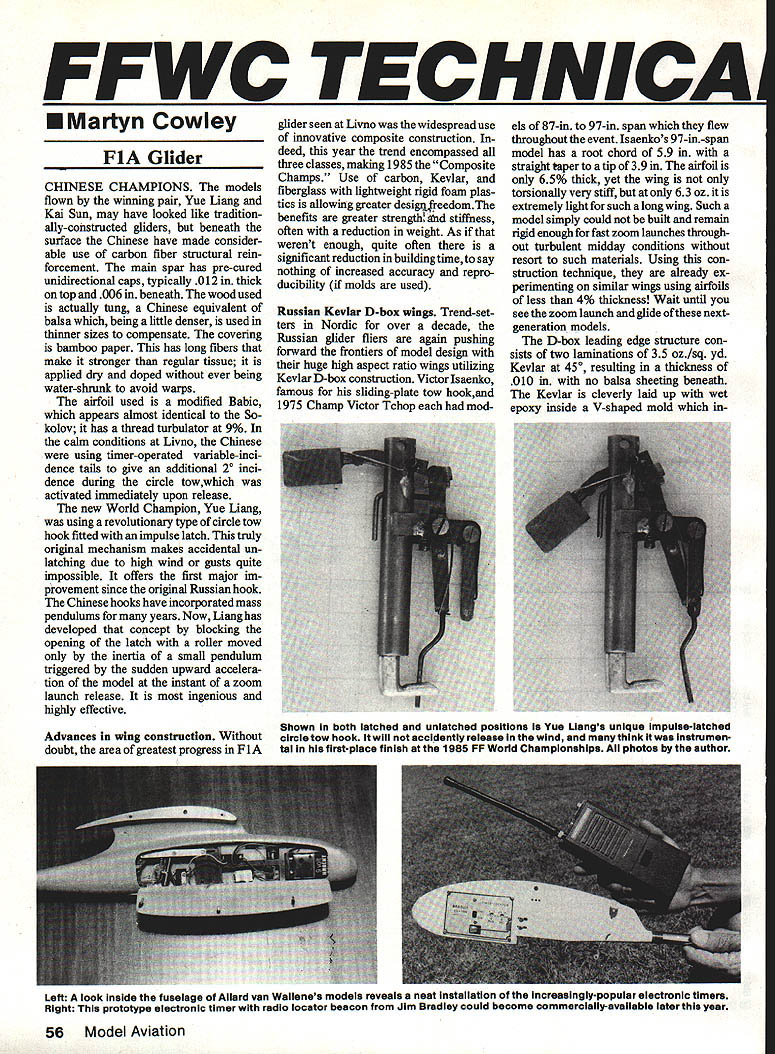
#### Yue Liang’s impulse-latch tow hook
Yue Liang introduced a novel circle-tow hook with an impulse latch that virtually eliminates accidental unlatching from high winds or gusts. Building on the Chinese use of mass-pendulum release concepts, Liang’s mechanism blocks the latch opening with a roller moved only by the inertia of a small pendulum. The pendulum is triggered by the sudden upward acceleration at the instant of a zoom-launch release, allowing a reliable, instantaneous release. The design is both ingenious and highly effective.
Thermal-location system (Lothar’s setup)
Development is not limited to airframes. Lothar further improved a system that helps locate thermals by displaying rising temperature and falling wind speed measured both at the launch point and 50 yards upwind, recorded on a chart recorder. His latest equipment transmits upwind information by radio link; he also collected data from Reiner’s unit. Such systems are not infallible—skill is still required to interpret changing conditions—but they have dominated recent Wakefield Championships. The advice to serious Wakefield competitors: invest in a similar unit and start practicing.
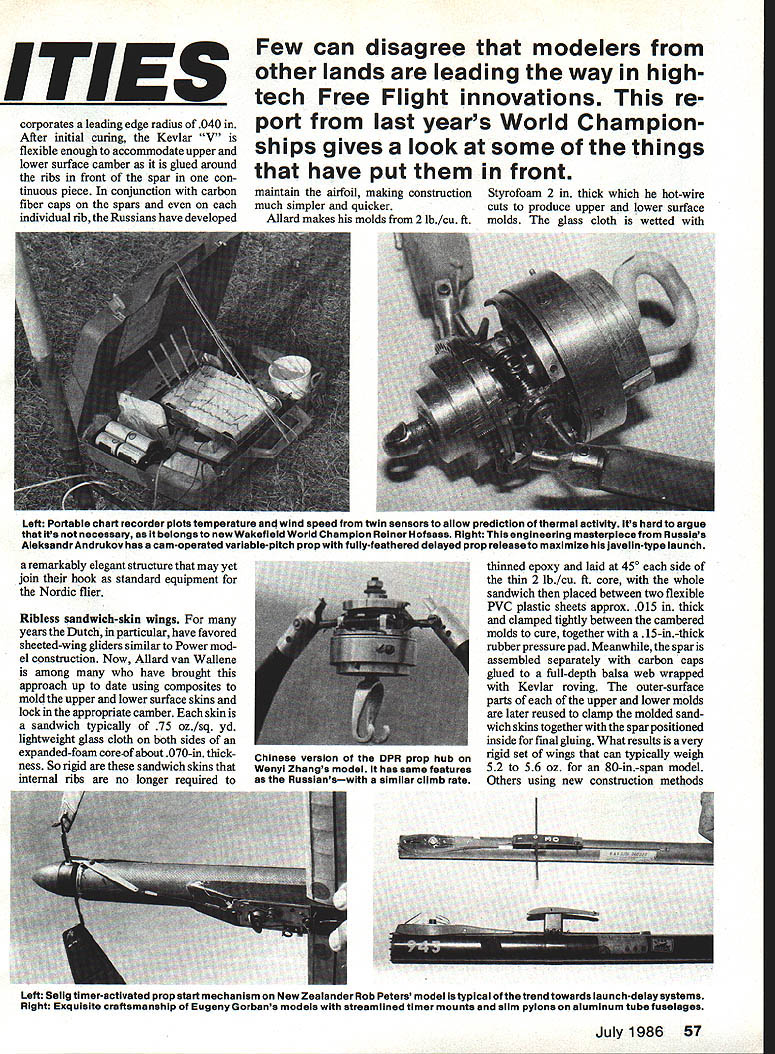
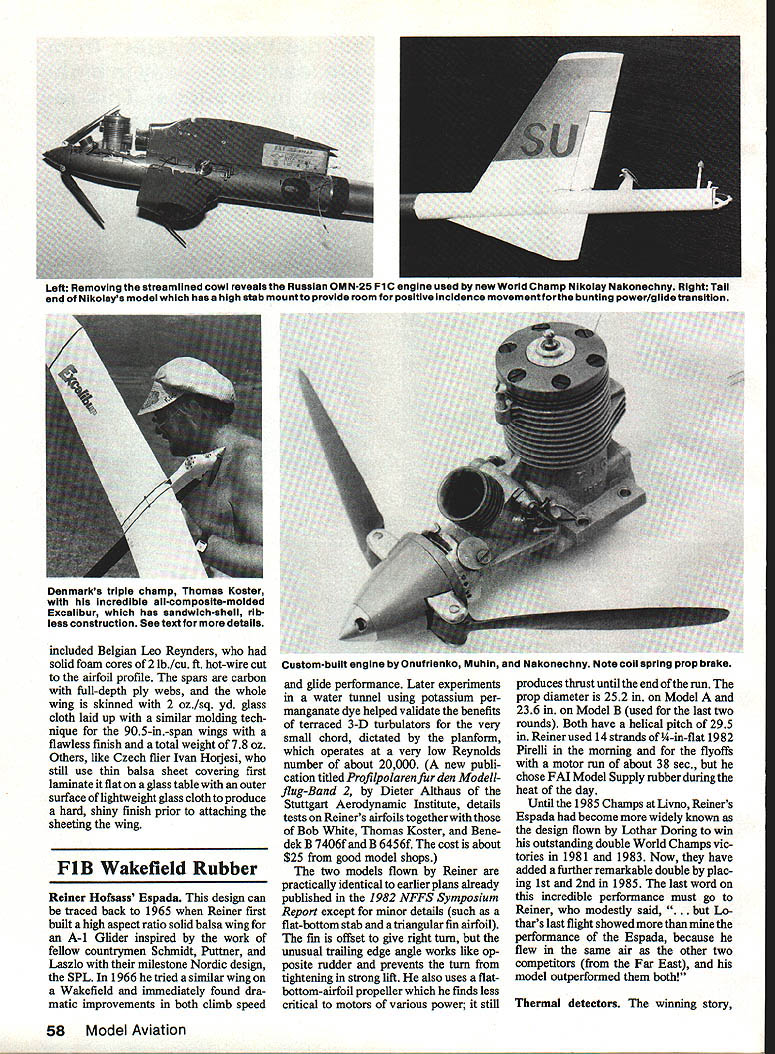
Andrukov’s variable-pitch DPR mechanism
Aleksandr (Alek) Andrukov has refined the delayed-prop-release (DPR) concept to maximize energy extraction from the rubber motor. His refined system incorporates a cam-operated variable-pitch propeller and is timed to work with an energetic javelin launch for maximal climb altitude.
Key operational sequence:
- Launch is made very hard and near-vertical with prop blades open to full diameter but feathered in pitch; the prop is not yet turning.
- A clockwork timer imposes about a 0.8 s delay while the model climbs to roughly 20 ft.
- The prop starts and the pitch is immediately increased by ~3° above design.
- Over the next ~3 s the pitch reduces to the design angle.
- During the remaining power run (about 38–42 s total) the pitch is gradually reduced by a further ~3°.
Other timed functions: the auto-rudder moves right, the variable-incidence tail increases by ~1° after about 4 s, and the right wing (held at +0.5° during climb) returns to zero as the prop folds for the glide.
Mechanical details:
- High initial rubber torque advances the prop-pitch cam against a strong coil spring inside the spinner; as torque falls the spring returns the cam.
- Prop pitch is controlled by a miniature roller-bearing lever that follows the cam profile; changing the cam shape alters pitch history.
- A ratchet allows extra hand turns to be added after winding to prevent torque loss while waiting for lift.
- The complete nose block weighs about 1.8 oz; a newer version is about 1.6 oz.
Alek’s design is elegant and effective, though he admits a simpler plain-bearing design can offer similar benefits. Many teams—China, Holland, Israel, Switzerland, West Germany, New Zealand and others—were already using DPR Wakefields inspired by his work.
Wenyi Zhang’s cam-operated variable-incidence wing
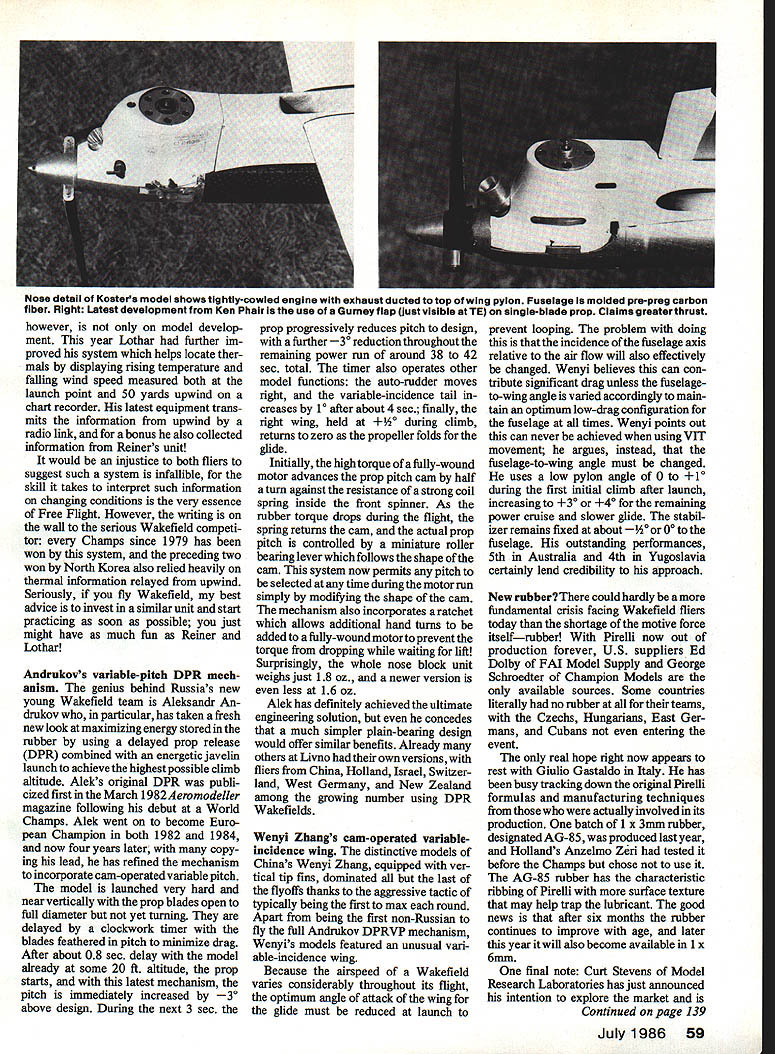
Wenyi Zhang of China used cam-operated variable-incidence wings with vertical tips. His models dominated many flyoffs by often being first to max each round. Zhang’s approach recognizes that Wakefield airspeed varies greatly during flight, so the wing’s optimum angle of attack for the glide must be reduced at launch to avoid looping. Changing wing incidence alone alters the fuselage-to-airflow angle and can increase fuselage drag. Zhang’s solution is to vary the fuselage-to-wing angle:
- Use a low pylon angle of about 0° to +1° during the initial climb.
- Increase to about +3° or +4° for the remaining power cruise and slower glide.
- The stabilizer remains fixed at about -2° to 0° relative to the fuselage.
This approach has performed very well both in Australia and at the Yugoslavia contest, lending credibility to Zhang’s concept.
New rubber and supply concerns
A fundamental crisis facing Wakefield fliers is the shortage of high-quality rubber. Pirelli production has ceased. Current U.S. suppliers include Ed Dolby (FAI Model Supply) and George Schroeder (Champion Models). Some countries had no rubber for their teams; the Czechs, Hungarians, East Germans and Cubans did not enter the event.
Giulio Gastaldi in Italy has pursued the original Pirelli formulas and manufacturing techniques. One batch (1 x 3 mm), designated AG-85, was produced last year. AG-85 shows the characteristic Pirelli ribbing and extra surface texture that may help retain lubricant; it continued to improve over six months of aging. A 1 x 6 mm size was planned for later availability.
Curt Stevens of Model Research Laboratories has announced his intention to investigate the market and, if tests are promising, contemplate significant investment. By the end of the year clearer options should be known.
Transcribed from original scans by AI. Minor OCR errors may remain.

