
FIA Technicalities
by Martyn Cowley
Even a big report on the World Championships — something the author has done before — never seems to give enough room to describe many of the innovations and techniques seen. This article looks again at the 1983 Free Flight World Championships, with special emphasis this month on the A-2 Glider event (F1A).
The champion
The current F1A Glider World Champion, Matt Gewain, is only the second American to win the title since the Nordic event became a World Championship in 1946. The first was the late Gerry Ritz in 1959. Matt has been a leading free flier in Florida, where he now lives; all three of the 1983 U.S. team members came from the same state.
Like the other two Florida fliers, Matt’s models make heavy use of carbon-fiber reinforcement. This material has become desirable for reinforcing wings, making strong, lightweight structures able to withstand the enormous loads imposed during zoom launches.
Carbon-fiber reinforcement and suppliers
Pre-cured carbon-fiber is the easiest form for modelers to use and is now available by mail order. Sheets of uni-directional pre-cured fibers, .008–.010 in. thick, can easily be stripped to small widths suitable for capping spars. Thick cyanoacrylate glues work best, or slow-cure epoxy.
- Supplier: Jim Bradley, 1337 Pine Sap Rd., Orlando, FL 32817. Also available from Twinn-K, distributor to model shops.
Matt used a Dremel Moto-Tool with a router attachment to inset carbon-fiber strips into the wing trailing edge and to reinforce the main spar.
Structural techniques
Matt reported that earlier Pacer models developed spanwise shear cracks in the center panel sheeting until he incorporated a carbon-fiber shear web. This consists of two layers glued at 45° to each other under the balsa sheet.
The main spar is a substantial spruce member tapering from 3/16 x 1/16 in. Dihedral breaks save weight. Matt’s models use a large-diameter steel wing joiner rod; the trailing edge of each wing half is taped. The wing mount to the fuselage allows side-adjusted incidence independently, which helps perfect the zoom-launch transition.
Trimming technique
Matt describes his trimming procedure as follows:
- Shim under the wing trailing edge with 1/64-in. ply to adjust lateral trim.
- Vary rudder delay to get lateral trim. Models use Ivan Herejsi’s style timer-delay rudder set — you can hear the click just before the model rolls out of the zoom to glide overhead.
- Change the center of gravity (CG) by moving nose weight to change pitch trim during the zoom:
- Forward CG produces higher pitch-up and improves stall recovery.
- A rearward CG produces a flatter, less loopy zoom.
Championships, conditions, and tactics
Matt commended the Australians for a well-run World Championships and thanked U.S. team members and supporters. A significant problem at the event was breaking tail booms in the windy weather; many models dethermalized on landings during windy practice days. His recommendations:
- Fly your best thermal model trimmed for calm-to-moderate winds throughout the championship.
- In windy rounds, pick thermals and ground-verify lift by doing two circles on the line before release.
- A model trimmed for windy weather will often have less overall performance and may miss maximums.
- In the 7th and 8th rounds the lift was very weak; tactical ability to locate stronger lift made the difference.
- Circle towing in high winds increased the chance of problems and dropped flights; even outstanding fliers dropped maxes because of the wind.
Towline towing (handline vs winch)
Towline-style towing of F1A gliders using a handline (no winch) is becoming universal. Many fliers prefer to pull the line hand-over-hand while running — a quick and easy method.
The real advantage of towing without a winch comes at release. Accelerating the glider toward the top of the tow to achieve a zoom release into a climbing turn is a long-favored tactic. With a handline, the flier can release his end of the towline so greater launch height can be achieved without grabbing slack line prior to release.
Another benefit: if trouble occurs while towing, a flier using only a line can release his end to prevent line tangling. (Releasing a winch is penalized with a zero score under the “no throwing the winch” rule.)
It was surprising at the Australian WC how many fliers showed poor towline technique. To accelerate their models, many hauled in handfuls of line instead of first positioning the model and then using a fast sprint to accelerate it. Those wasted yards of line negated any zoom advantage.
Good form example:
- The Chinese ran with the end of the line held high at arm’s length just before release, positioning the end 6–7 ft above ground. With an F1A glider sink rate of about 1 ft/sec, a good zoom of 15–20 ft translates to roughly 15–20 seconds gained. Line stretch under high tension at launch can add another 10–15 ft.
A good towline style at release can pay off with significantly higher flight times, independent of the individual model.
Timer-start setups and releasable tow hooks
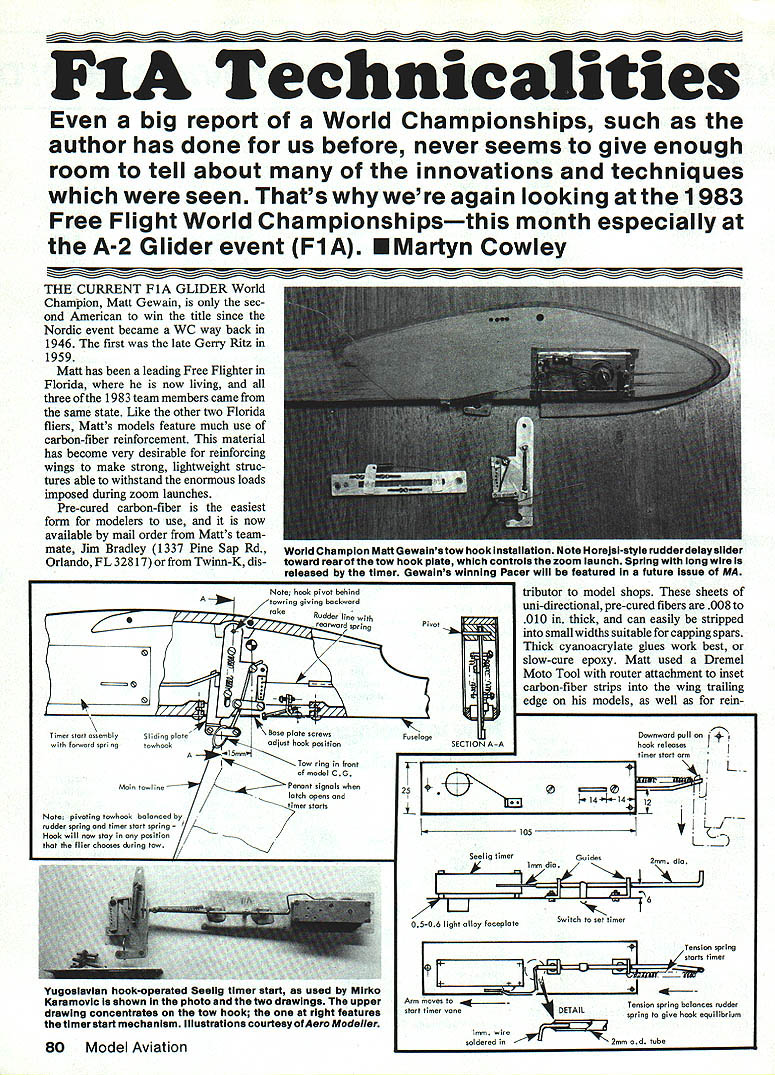
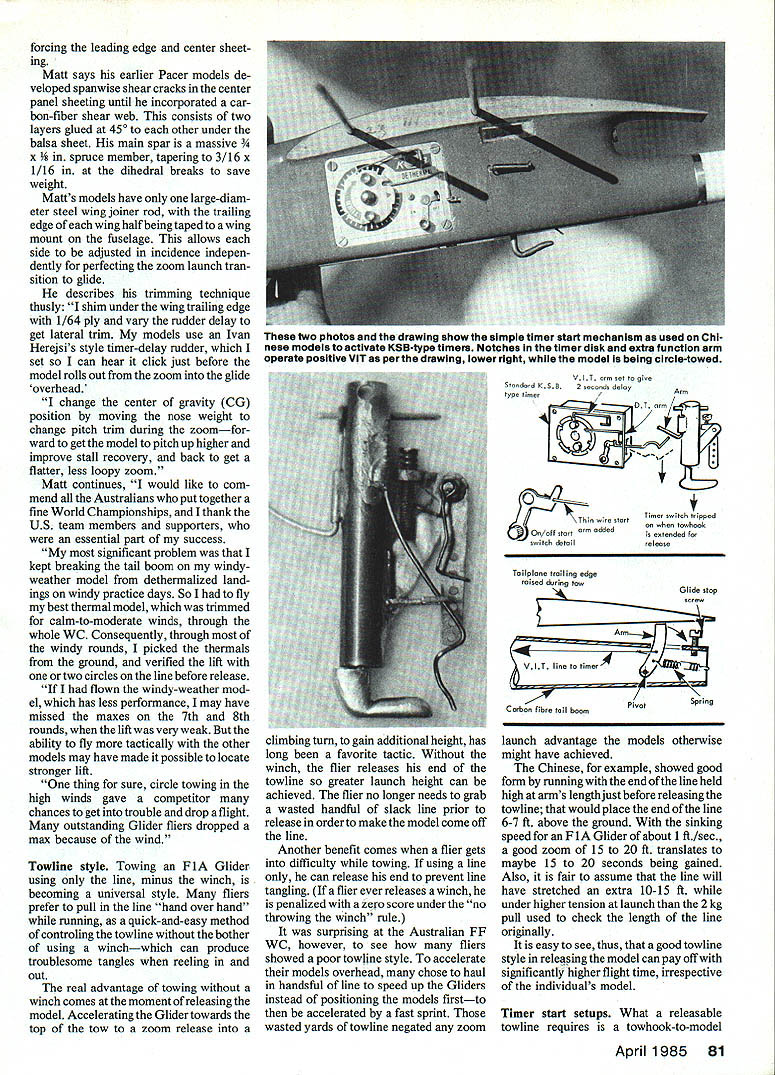
A releasable towline requires a towhook-to-model setup that allows the line to fall away freely without hanging up. Once that is achieved, the big problem becomes how to start the dethermalizer timer. The old pin-and-line system won’t work because the flier, having let go of his end of the line, can no longer tug on it to pull the pin.
Most fliers using a latch-type towhook now have some type of timer-start mechanism that is not operated until the tension in the towline, just before the zoom, opens the latch.
A further problem in windy conditions: if a gust unexpectedly unlatches the tow hook, the dethermalizer timer will be started. Since most timers are set near the 3-minute mark, the flier may feel compelled to release immediately (whether he wants to or not) to avoid dethermalizing short of 3 minutes.
Electric timers
Electric timers provide a solution to several of these problems but introduce other risks (for example, a model flyaway if the flier releases the line without starting the timer or the towline is cut).
Electric timers can be set to run down continually during the tow. Every time the flier pulls on the towline, a micro-switch resets the clock to a full 3 minutes. In this way, if the hook is unlatched in a gust, further pulls will still reset the timer and the flier has the option to continue towing (straight only) to increase the chances of making a good score.
Two electronic timers mentioned:
- Thomas Koster’s timer: $55.00, including battery and start switch (trickle charger extra $30.00). Available from Koster Digital, P.O. Box 54, DK-3400 Hillerod, Denmark.
- Ken Bauer’s timer (California): about $30.00 when available (no accessories).
More electronics: locate-and-retrieve aids
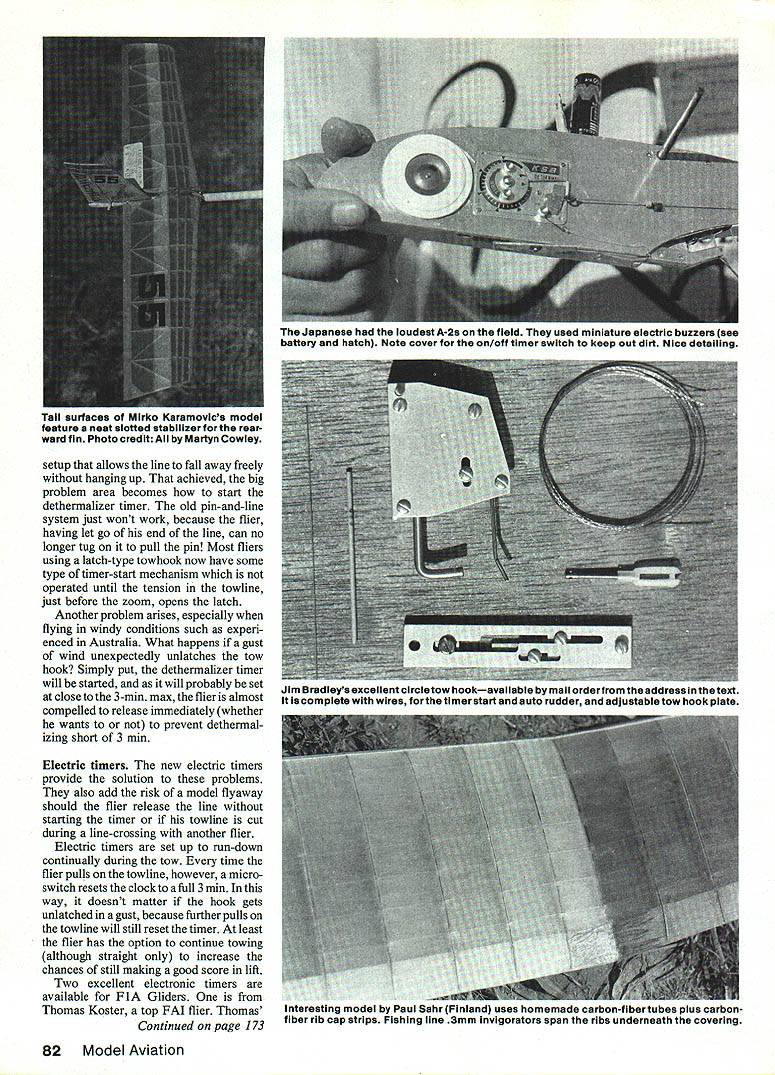
With a battery on board, additional options become feasible. Many competitors at the Australian WC used miniature buzzers to help locate models downwind (notably the Dutch and Japanese teams). Australia’s Vin Morgan used a small radio transmitter producing a trackable signal — a device that may be illegal in some countries.
An emerging idea: install a thermistor lift-detection device wired directly to the retrieval buzzer. Such an “electronic Nordic” would allow the flier to monitor the air being towed through by listening to the pitch change of the buzzer. In marginal conditions, this extra input could help confirm the center of a thermal located with an electric circle-tow glider.
Tow-hook designs and the Yugoslav approach
Many good fliers were unable to cope with high winds in Australia with conventional circle-tow models. A simple straight-tow model would have been more suitable: high wind can lift models straight to the top of the line, then the glider can enter an unwanted circle as the rudder kicks over.
Only the Yugoslavian team seemed to have complete mastery of the conditions, using the original Iessanko concept where the timer-start spring in front balances the auto-rudder spring at the back. With this system the hook is in equilibrium fore and aft. If the hook is pulled forward for straight tow, it stays there and allows the model to kite overhead. Only when the model flies upwind or when the flier runs back (pulling backward on the line) does the hook swing back to initiate a circle. This gives the flier better control, allowing selection of the exact moment to begin circling — especially important in windy weather.
Note on rake: these hook setups do not require a “forward rake” (pivot ahead of the tow-ring attachment point), which would make the hook too stable and hard to pull back into circle mode. Instead, the Yugoslavian hook uses a “backward rake,” an inherently unstable configuration stabilized by the balanced pull of the timer-start and auto-rudder springs. This setup worked well for all the Yugoslavs, including Mirko Karanovic, who placed third.
Notable entries: Paul Lagan
Paul Lagan, now an Australian national, produced another exceptional performance: fourth in F1B in 1979, third in F1A in 1981, and second in F1A in 1983. Although he flew an AL-29 and a Robin in the contest, his most interesting model was his new “Big Apple.” The design draws inspiration from Lee Hines’ Big Max, Andres Lepp’s AL-29 and AL-33, the German SPL design, and his own initials (PL). Paul says this new model has a 10–15 second advantage over his previous models.
Final notes
- Towline-style towing without a winch continues to gain popularity; hand-over-hand pulling is common.
- Good towline technique, careful trimming, balanced tow-hook setups, and the smart use of electronics can all make significant differences in competition outcomes, especially under difficult wind conditions.
Transcribed from original scans by AI. Minor OCR errors may remain.

