
Fifteen Hours on a Tightrope
By Richard Weber
Overview
When the Shark 1500 lifted off after release at 8:31:27 a.m. on October 19, 1978, a remarkable aerial drama slowly unfolded. The airplane would remain aloft past midnight, finally landing at 12:19:17 a.m., a new FAI R/C duration record of 15 hours, 47 minutes, and 50 seconds.
Background: The FAI R/C Duration Challenge
The FAI R/C duration record is the ultimate test of model aircraft reliability and economy. Can a large model be made strong yet light enough to carry adequate fuel within the FAI 11‑pound limit? Can an engine fly a heavy plane for 10–20 minutes on each fluid ounce of fuel? Will it keep running hour after hour in climb and dive, in changing temperature and humidity? Can radio‑control systems operate at day ranges exceeding a mile on a reasonably small battery? Will good weather hold out for a long flight? Can a pilot fly nonstop day and night without a single serious error? These are the questions that challenge the aspiring duration flier.
A noble history is recorded in the list of FAI R/C duration records. Most of the information in this list was kindly provided by Maynard Hill. Some highlights:
- Walt Good's 1952 flight set a record with his Rudder Bug and a .29 ignition engine.
- Ken Willard reclaimed the record for the USA in 1958, flying a sesquiplane and a .19 glow engine.
- Maynard Hill raised the record in 1964 using a .49 glow.
- Bill Bertrand set a record in 1967.
- Maynard Hill returned the favor in 1969 with a .49 converted to ignition.
- West Germany's W. Kaiser flew a record in 1972 with a .19 glow.
- In 1973, M. Hirota of Japan took the record with a .30 glow.
- In 1974 Lars Giertz recaptured the record for the USA after extraordinary persistence: nine unsuccessful official attempts (seven destroyed airplanes) before succeeding on his tenth try with a 12‑ft wingspan design powered by a .15 diesel running about 13.8 minutes per fluid ounce of fuel.
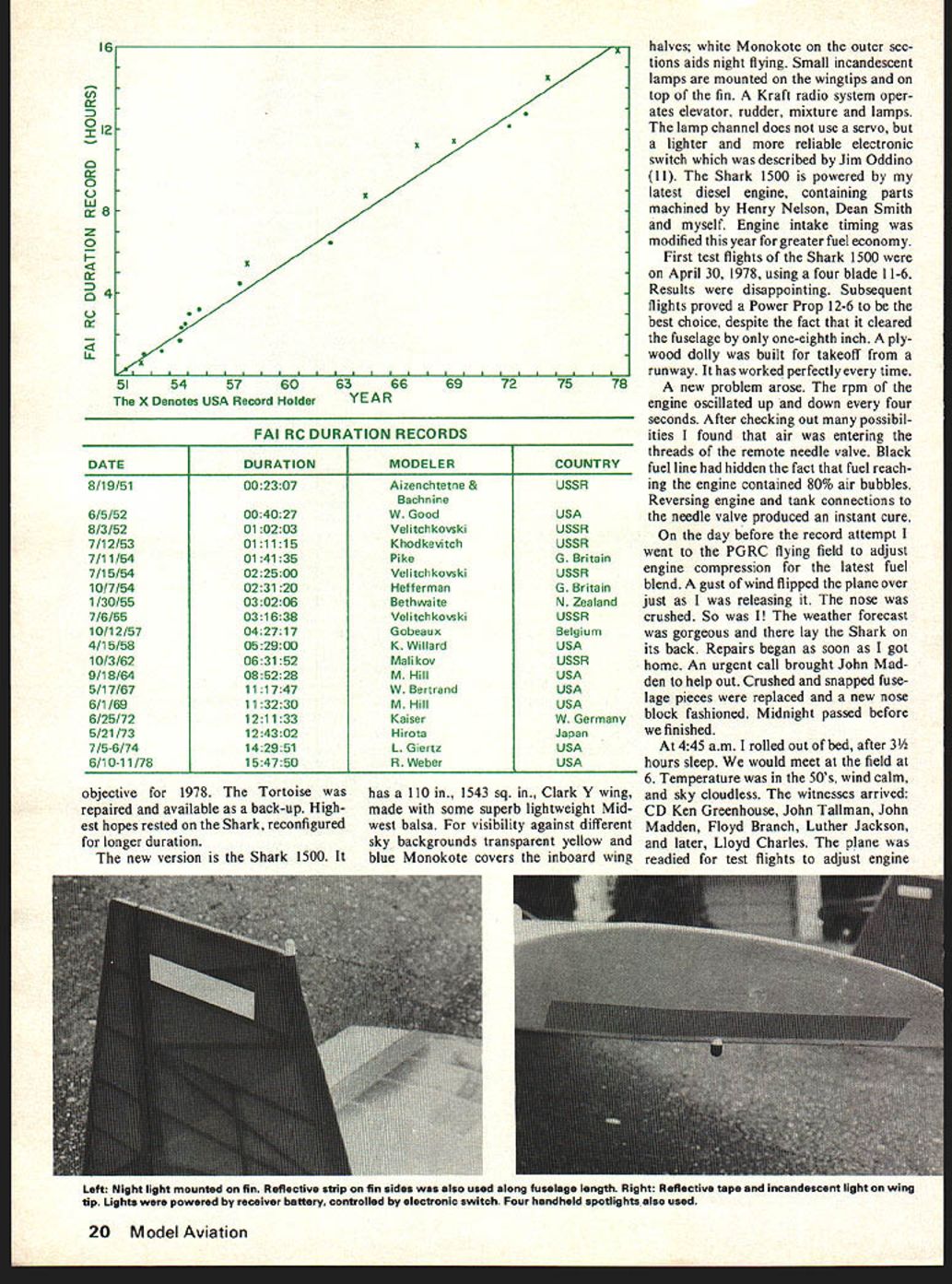
A graph of R/C duration records reveals several facts: nine records were set in the first five years; the next ten records took 23 years. The early years were dominated by other countries, particularly the USSR; since 1958 the USA has held the record much of the time. A straight line fitted to the data suggests an average increase of about 35 minutes per year—projecting to over 28 hours by the year 2000 and perhaps beyond. A questionable FAI rule requiring only one pilot may retard growth of the duration record more than aeronautical limitations.
My Work on FAI Records (1973–1978)
My work on FAI records began in 1973. By mid‑1976 my Tortoise had established three FAI R/C nonstop distance records; the longest flight, 424 miles, lasted nearly 11 hours. The Tortoise later received a longer 90‑inch wing from my unfinished seaplane Shark for an attempt at the duration record.
First attempt (September 4, 1976): we discovered low downdrafts that forced the Tortoise down to 10–15 feet above the ground for extended periods. Thermals required shallow dives to keep the plane in sight. The engine died after seven hours because a fuel pressure regulator failed.
One week later a stall soon after takeoff caused major damage, ending the flights for the year. I shifted focus to shorter seaplane records while improving reliability. This decision paid off: Shark established FAI seaplane records on all three 1977 attempts. R/C landplane duration became my primary objective for 1978, with the Tortoise repaired as a backup and highest hopes resting on the reconfigured Shark—the Shark 1500.
The Shark 1500
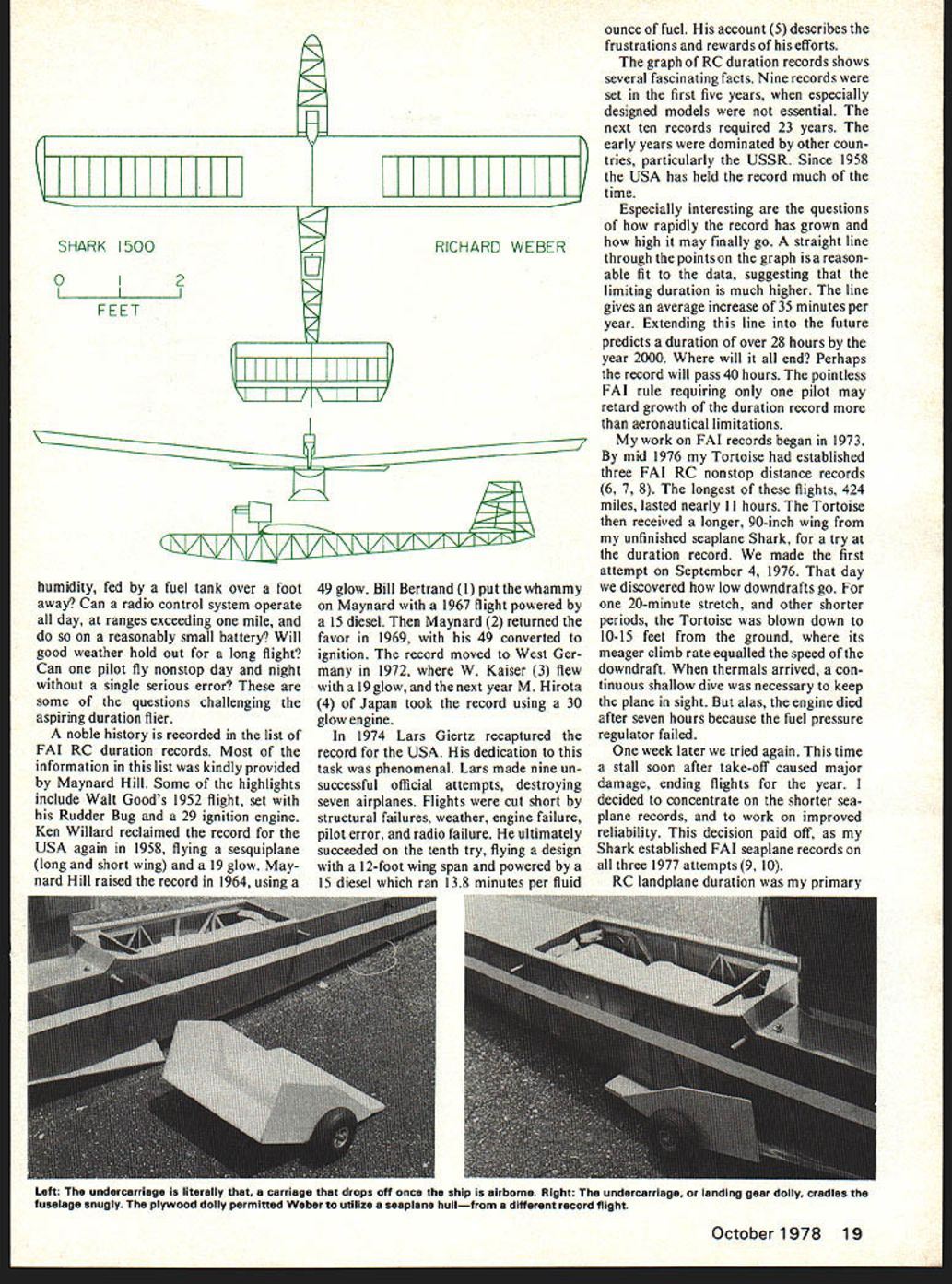
The new Shark 1500 is a long‑wing duration design:
- Wing: 110 in., 1,543 sq. in., Clark Y airfoil, built from superb lightweight Midwest balsa.
- Covering: transparent yellow and blue Monokote on inboard wing halves for visibility against different sky backgrounds; white Monokote on outer sections to aid night flying.
- Lighting: small incandescent lamps on the wingtips and on top of the fin.
- Radio: Kraft radio system operating elevator, rudder, mixture, and lamps. The lamp channel uses a lighter, more reliable electronic switch (as described by Jim Oddino) rather than a servo.
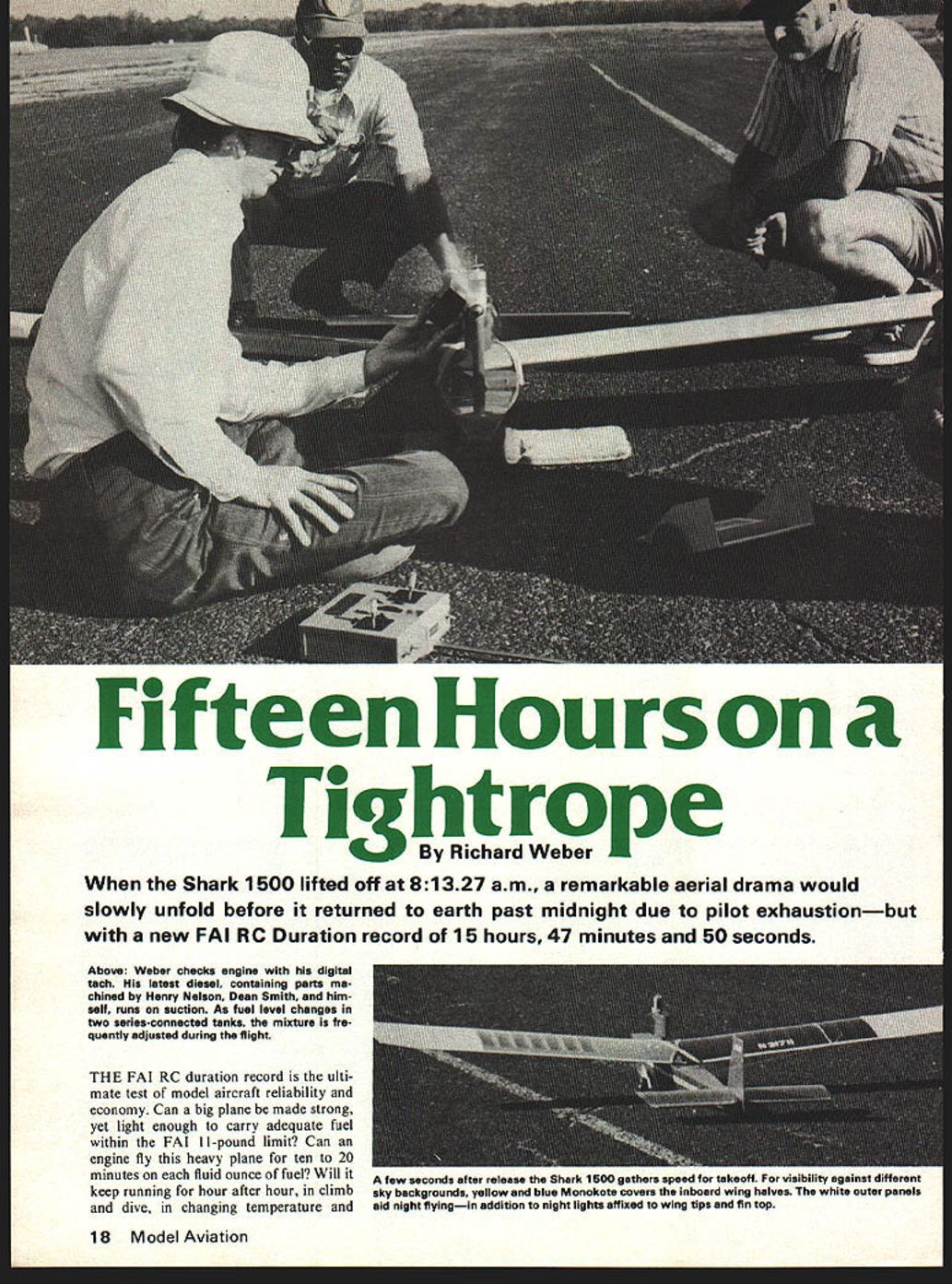
- Powerplant: my latest diesel engine with parts machined by Henry Nelson, Dean Smith, and myself; intake timing was modified for greater fuel economy.
First test flights (April 30, 1978) used a four‑blade 11‑6 prop with disappointing results. Subsequent flights showed a Power‑Prop 12‑6 to be the best choice despite clearing the fuselage by only one‑eighth inch. A plywood dolly was built for runway takeoff and worked perfectly.
Preflight Problems and Repairs
A new engine problem arose: rpm oscillated every four seconds. Investigation revealed air entering the threads of the remote needle valve. Black fuel line had hidden the fact that fuel reaching the engine contained about 80% air bubbles. Reversing the engine and tank connections to the needle valve fixed the problem instantly.
On the day before the record attempt I went to the field to adjust engine compression for the current fuel blend. A gust flipped the plane while I was releasing it; the nose was crushed. Repairs began immediately: John Madden came to help, crushed and snapped fuselage pieces were replaced, and a new nose block fashioned. Midnight passed before we finished.
The Record Attempt — October 19, 1978
I rose at 4:45 a.m. after about 3½ hours of sleep. We met at the field at 6:00 a.m. Temperature was in the 50s, wind calm, sky cloudless. Witnesses and crew included:
- CD Ken Greenhouse
- John Tallman
- John Madden
- Floyd Branch
- Luther Jackson
- Lloyd Charles (arrived later)
After final test flights and adjustments I checked the fuel system and packed the airplane with the full fuel load. Total weight was 4,970 grams. The engine was started, mixture adjusted, and rpm checked. Digital watches were poised.
At 8:31:27 a.m. I released the Shark from the dolly. I held it firmly with down elevator; lift‑off occurred 18 seconds after release. Climb‑out was steady, nearly one foot per second. Engine power was ample—more than the Tortoise had in 1976 with only a 90‑inch wing.
Mixture setting was critical. The fuel system operates on engine suction. As fuel level changes in the two series‑connected tanks, the mixture must be adjusted: too lean and the engine will die immediately; too rich and it will die later from accumulated combustion deposits ("crud"). That thin line had to be walked all day.
Late morning thermal activity brought the first serious problem. Gentle dives out of thermals often developed into steeper dives. Increasing up elevator had little effect; then, suddenly, the plane would pull out with a violent "kangaroo" hop, placing unthinkable stress on the wing of the 11‑pound airplane. One afternoon dive reached the point where full up elevator was insufficient; quickly adding full up trim saved the plane and the flight.
The sudden pullout occurred when the rubber bands allowed the wing to lift off its saddle, increasing angle of attack. We suspected the new nose block was exerting more down force at the front, upsetting marginal stability. Only the day after the flight was the root cause determined: the wing had a dent from hitting the back of the engine pylon after lifting about one inch off the saddle. The dent showed the wing had slid backward so the trailing edge was not seated properly. This changed the angle between wing and stabilizer by about 2 degrees and caused the dive instability. Large elevator travel and normal trim adjustments for thermals and changing CG hid the problem during flight.
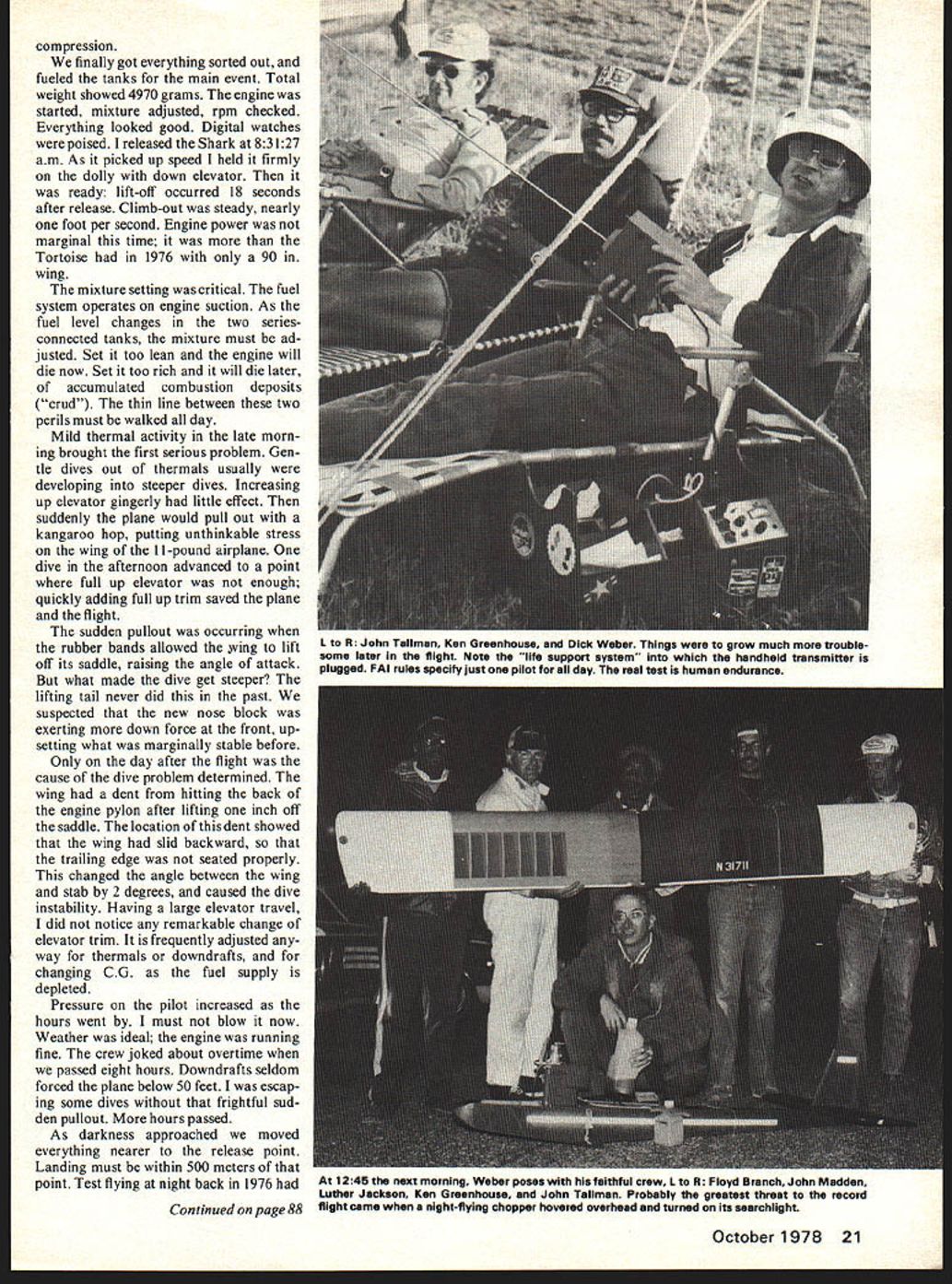
As the hours passed pressure on the pilot increased. Weather was ideal and the engine was running fine. The crew joked about overtime after eight hours. Downdrafts seldom forced the plane below 50 feet. I was escaping some dives without that frightful sudden pullout.
Night Flying
As darkness approached we moved equipment nearer the release point—landing had to be within 500 meters of that point. Night test flying in 1976 had been satisfactory with either on‑board lamps or 12‑volt spotlights on the ground; we prepared both.
It was much harder than expected. With three lamps on the plane and three spotlights on the ground I needed a clearer head and more reflective tape. Visual cues were limited and tracking the plane mentally was difficult. I set incremental goals—two more hours, then another half hour—to keep focused. The crew brought out a fourth spotlight we had been saving; I needed more light to keep going.
Even at night there were distractions. Unidentified flying objects made noises over the spotlights. A nearby NASA laser tracking station pulsed red and green beams at a passing satellite. Shortly after 11 p.m. a helicopter flew past with no lights, then turned on a huge spotlight several miles away and began sweeping. It came within about 500 feet and shined directly at us for several minutes. I tried to keep my back to it—its light made the model nearly invisible and might blow the Shark down if it kept moving. After the longest few minutes I can remember, it left. My nerves were shot, but I still had only five more minutes to the record.
Landing and Result
Once the new record was reached I prepared to land, but the crew urged me to continue; after a short walk to clear my head I decided to fly past midnight, aiming for another half hour. Around 12:15 a.m. I was groggy and decided to bring her down. The mixture was pushed full lean and the engine stopped. The landing was made at 12:19:17 a.m., 120 meters from the release point.
Total duration: 15 hours, 47 minutes, 50 seconds. The plane was opened and enough fuel remained for more than four hours of flight. Fuel consumption at the relatively high power setting had been 14.8 minutes per fluid ounce.
Photos were taken, cars packed, and we all went home to recuperate. It was a very long day.
Maybe next June I'll try again up north with more daylight. Any group in New England, Ontario, or Quebec with a large runway and interest to support a record attempt is encouraged to write me, c/o Model Aviation.
References
- William Bertrand, "Eleven Hours of Luck," American Aircraft Modeler, March 1968.
- Maynard Hill, "Eleven and a Half Hours of Exciting Boredom," Flying Models, September 1969.
- Werner Thies, "Flugkapitan Winfried Kaiser Weltrekorder von Dienst," Flug, May 1973.
- Maynard Hill, "R/C Channel Chatter," Flying Models, December 1972.
- Lars Giertz, "The Flight of Skyhook VIII," Model Airplane News, December 1974.
- Richard Weber, "652 Miles Per Gallon," Model Aviation, November 1975.
- Richard Weber, "The Longest Flight," Flying Models, September 1976.
- Richard Weber, "Tortoise Recaptures a World Record from the Russians," Model Aviation, October 1976.
- Richard Weber, "Shark Attacks a Record," Model Aviation, December 1977.
- Richard Weber, "Seaplane Record Blitz," R/C Modeler, February 1978.
- Jim Oddino, "Radio Spectrum," R/C Modeler, October 1977.
Transcribed from original scans by AI. Minor OCR errors may remain.

