
The First Fair
Introduction
The story of Fairchild Aviation does not start with the production of aircraft. Rather, it began with the Fairchild aerial camera — the reason the early Fairchild aircraft were designed and built.
Sherman Mills Fairchild was born on April 7, 1896, in Oneonta, NY, the son of George W. Fairchild, founder and first chairman of the board of the IBM Corporation. Young Fairchild became a mechanical tinkerer with a factory full of machines and equipment to tempt an inventive mind. While still in his teens and at Harvard University, he developed a method for synchronizing a camera shutter with the flash for indoor photography.
With aerial photography being used in Europe during World War I for reconnaissance, Fairchild’s interest turned to aerial cameras. After improving the standard cameras used by the Army and Navy, he began developing a new camera of his own design. This camera featured the first successful between-the-lens shutter, which greatly improved aerial photography. Sherman Fairchild received encouragement from Dr. Herbert Ives, director of electro-optical research at Bell Telephone Laboratories. The Army’s Billy Mitchell also became interested, and the new aerial camera was acquired by the Army Air Corps.
While the Army could use a few of these cameras, Fairchild’s invention had no large military market. To remedy this, he turned to aerial map making and emphasized civilian applications.
Early Companies and Operations
The Fairchild Aerial Camera Company was formed in 1920. Early mapping contracts, with little experience, made little money for the new company. In fact, the first large contract — to map the City of Newark, NJ for $7,000 — cost the company nearly $30,000.
Aerial photography in the early days was plagued by two problems: poor camera equipment and unstable airplanes on which to mount them. Sherman Fairchild solved many of the camera problems himself. His company, Fairchild Aerial Surveys, then moved to design a plane that provided the stability and reliability necessary for aerial photography, and introduced innovations such as an enclosed cockpit, foldable wings, and ailerons that could be lowered as flaps.
Most early mapping flights were done in a Standard J-1 with a Curtiss C-6 engine of 160 hp or a Curtiss Oriole with the same engine. The Standard J-1 had flat sides and offered better ground viewing; the Oriole, being faster and with round sides, made camera operation difficult. Both aircraft required climbs to 10,000–14,000 ft, leaving very little fuel for the mapping mission. There were no production cabin aircraft at the time, since it was generally thought pilots out in the slipstream could feel air pressures on their faces.
In 1922, contracts surveying Canada led to the formation of Fairchild Aerial Surveys Ltd., Canada. Standard J-1s were sent on the job and operated on skis during winter months. These photo missions eventually led to the conclusion that the aircraft in use were not suited to the job and were reducing operational efficiency.
Business improved in 1923. Since machines were merely rented, Curtiss Flying Service decided to look into purchasing aircraft that could be modified for the task. The first aircraft owned by the Fairchild Aerial Camera Company (the parent) was a Fokker Express-type two-seater. Anthony Fokker managed to get several trainloads of aircraft out of Germany after WWI and rebuilt three-place ships. The pilot had an open front cockpit; the passengers had an enclosed canopy. For survey work the rear was used; the camera was mounted with the lens protruding from the bottom of the aircraft. The photographer was enclosed while the pilot had some warmth. In fact, the Express had no firewall between the engine and the crew.
In 1924, Fairchild Aerial Surveys, Inc. was formed in the U.S., separated from Fairchild Aerial Camera Company. The new corporation bought several Huff-Daland Petrel biplanes, powered by the more reliable Wright E-4, 190 hp water-cooled engine. They were modified by moving the pilot’s position forward and the photographer’s position further aft to allow more room for the large Fairchild aerial camera and the cameraman. The pilot’s cockpit was also fitted with a glass floor section forward to help tracking of the flight. Range was increased and overall capability improved, but the crew remained exposed to cold at high altitude and winter operations still left much to be desired.
The Huff-Dalands were built in Ogdensburg, N.Y., which was fairly close to both the U.S. and Canadian operations for service. Huff-Daland later moved into Pennsylvania and became better known as the Keystone Aircraft Company, builders of the famous Keystone bombers.
From this experience it became increasingly clear that a satisfactory aircraft would have to be designed specifically for aerial mapping. Sherman Fairchild decided to hire an aeronautical engineer and design and build the aircraft under the Fairchild name.
Designing a Purpose-Built Camera Platform
Early in 1925, Norman McQueen was hired and given a drafting board in the Fairchild Aerial Surveys office at 270 W. 38th St., New York City. Much input from flight crews in both Canadian and American operations helped ensure that McQueen’s design truly fit the need.
This new aircraft combined many new and useful features, successfully brought together for the first time:
- A high-lift Göttingen 387 airfoil.
- Elliptical wing tips for pressure distribution and good lateral stability.
- Full-length ailerons; through a system patented by mapping pilot Richard Depew, the ailerons could be lowered as flaps while still operating as ailerons. When lowered, the system would also trim the horizontal stabilizer automatically.
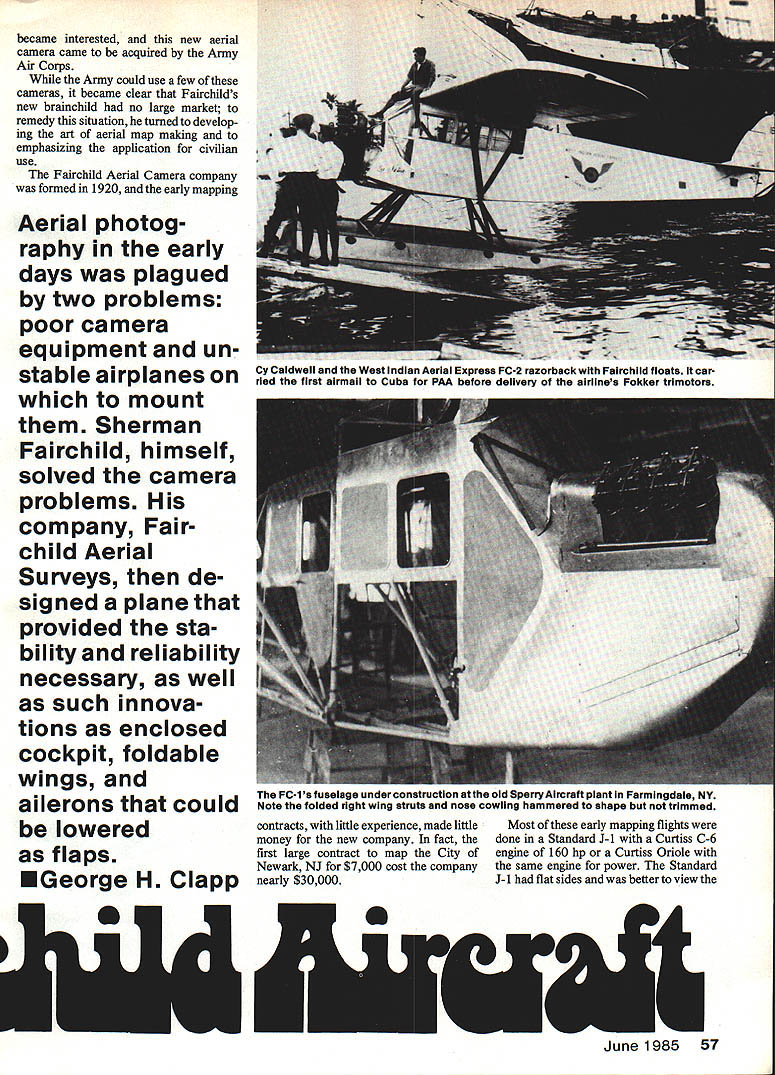
- Wooden wings with faired tubular steel wing struts; wings could fold without removing or dismantling parts, and the struts remained connected and braced when folded.
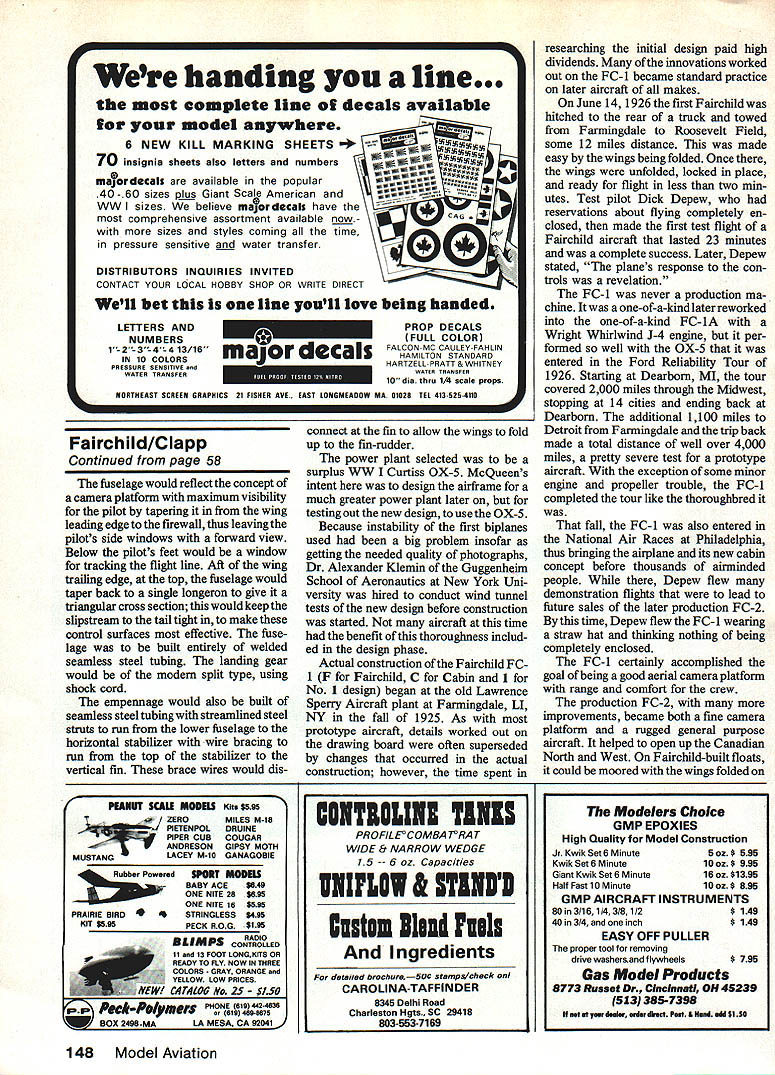
- A fuselage designed as a camera platform: tapered forward from the wing leading edge to the firewall to give the pilot maximum forward visibility; a window below the pilot’s feet for tracking the flight line; tapering to a single longeron at the wing trailing edge to give a triangular rear cross-section, keeping the slipstream to the tail for effective control surfaces.
- Fuselage built entirely of welded seamless steel tubing.
- Split-type landing gear using shock cord.
- An empennage built of seamless steel tubing with streamlined sheet struts from the lower fuselage to the horizontal stabilizer and wire bracing from the stabilizer top to the vertical fin; these brace wires would disconnect at the fin to allow the wings to fold up to the fin/rudder.
- Initial powerplant: surplus WWI Curtiss OX-5, with the airframe intended to accept a more powerful engine later.
Because instability of the first biplanes had been a major problem for obtaining quality photographs, Dr. Alexander Klemin of the Guggenheim School of Aeronautics at New York University was hired to conduct wind tunnel tests of the new design before construction. Not many aircraft of the time benefited from such thoroughness in the design phase.
Construction and Flight Testing
Actual construction of the Fairchild FC-1 (F for Fairchild, C for Cabin, 1 for No. 1 design) began at the old Lawrence Sperry Aircraft plant at Farmingdale, L.I., N.Y., in the fall of 1925. As with most prototypes, details on the drawing board were often changed during construction; however, the time spent researching the initial design paid high dividends. Many innovations worked out on the FC-1 became standard practice on later aircraft of all makes.
On June 14, 1926, the first Fairchild was hitched to the rear of a truck and towed from Farmingdale to Roosevelt Field, a distance of some 12 miles. This was made easy by the wings being folded. Once there, the wings were unfolded, locked in place, and ready for flight in less than two minutes. Test pilot Dick Depew, who had no reservations about flying completely enclosed, made the first test flight of the Fairchild aircraft, which lasted 23 minutes and was a complete success. Depew later stated, “The plane’s response to the controls was a revelation.”
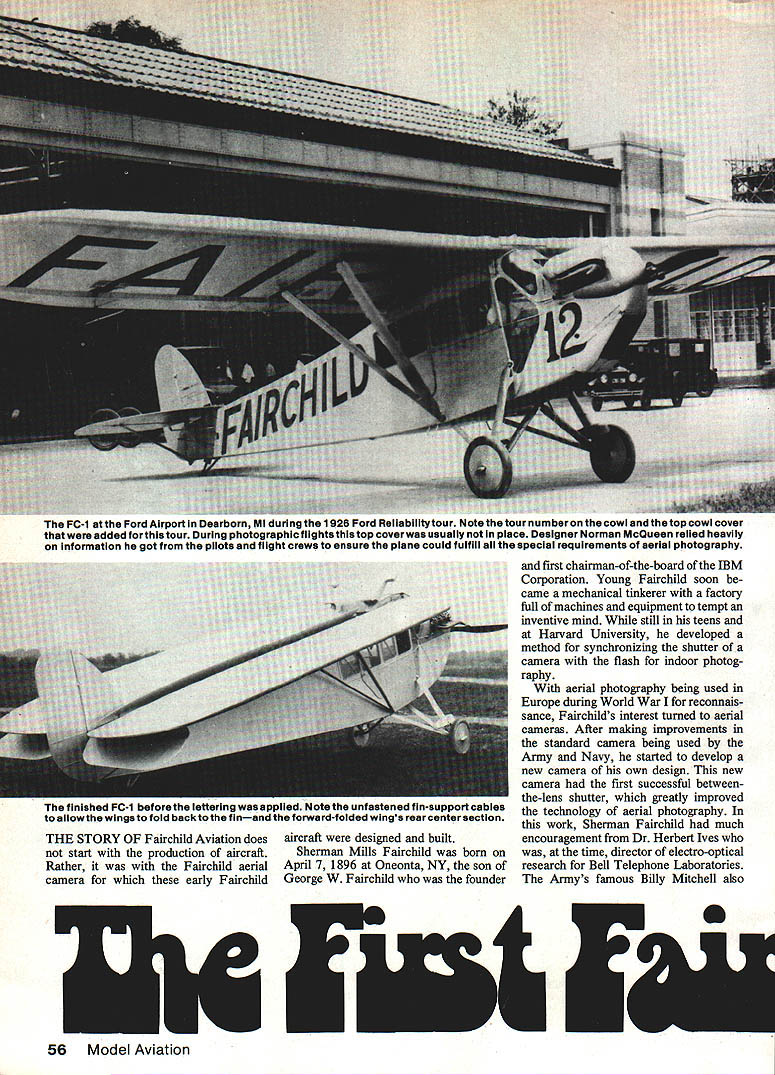
The FC-1 was never a production machine. It was a one-of-a-kind airplane later reworked into the one-of-a-kind FC-1A with a Wright Whirlwind J-4 engine, but it performed so well with the OX-5 that it was entered in the Ford Reliability Tour of 1926. Starting at Dearborn, Mich., the tour covered 2,000 miles through the Midwest, stopping at 14 cities and ending back at Dearborn. The additional 1,100 miles to Detroit from Farmingdale and the trip back made a total distance of well over 4,000 miles — a severe test for a prototype aircraft. With the exception of some minor engine and propeller trouble, the FC-1 completed the tour successfully.
That fall, the FC-1 was also entered in the National Air Races at Philadelphia, bringing the airplane and its new cabin concept before thousands. Depew flew many demonstration flights there, which led to future sales of the later production FC-2. By this time Depew flew the FC-1 wearing a straw hat and thinking nothing of being enclosed.
The FC-1 accomplished the goal of being a good aerial camera platform with range and comfort for the crew.
The FC-2 and Operational Use
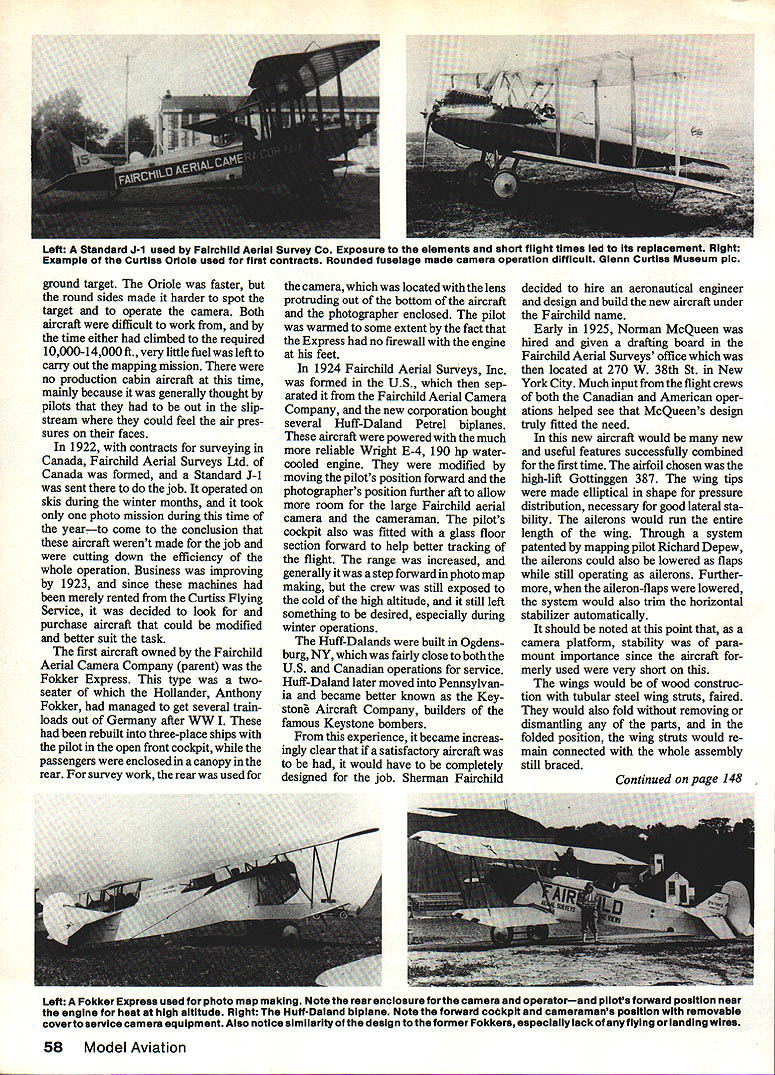
The production FC-2, with many improvements, became both a fine camera platform and a rugged general-purpose aircraft. It helped open up the Canadian North and West. On Fairchild-built floats, it could be moored with the wings folded on the many small lakes without fear of wind damage. It was also used extensively to help form the first airlines in this hemisphere.
Full-size copies (28 x 40 in.) of the author’s original drawings for the following Fairchild aircraft may be purchased:
- FC-1 prototype
- Production FC-2 Razor Back (Lindbergh tour of the U.S.)
- FC-2 four-longeron of Colonial Airways
- FC-2W2, which Admiral Byrd took to the South Pole in 1929 for mapping
Send $1 for a descriptive pamphlet and price list to: George H. Clapp, 11 Collins Terr., Central Square, NY 13036.
Editor’s Note
This article is a capsule version of a much more extensive article on Fairchild All-Purpose Monoplanes by George H. Clapp, which appears in the recently released Historical Aviation Album, Vol. XVII — produced by Paul R. Matt. The HAA has much more information and many more pictures than could be included here — and it includes other significant historical works as well. More information appeared in the “Just For the Fun of It” column of the April 1985 issue.
You can obtain your copy of The Historical Aviation Album, Volume XVII, by sending $10 to Historical Aviation Album, P.O. Box 33, Temple City, CA 91780.
Transcribed from original scans by AI. Minor OCR errors may remain.

