
First International F3H Contest
Larry Jolly
Background
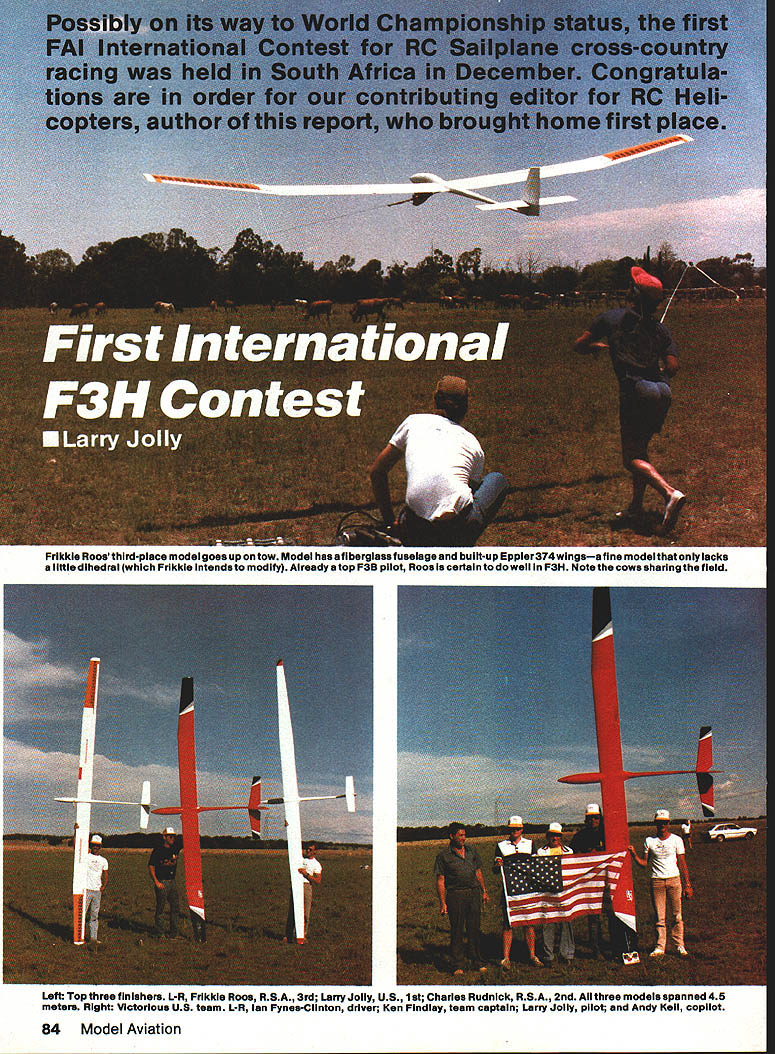
Possibly on its way to World Championship status, the first FAI International Contest for RC sailplane cross-country racing (FAI class F3H) was held in Pretoria, South Africa, in December 1985. The event was organized to demonstrate sufficient international interest and to test provisional rules before possible full recognition by the FAI.
FAI qualification procedure:
- A meeting of the FAI Committee for International Aeromodelling (CIAM) to determine interest.
- If interest is shown and rules appear equitable, the event is given provisional status.
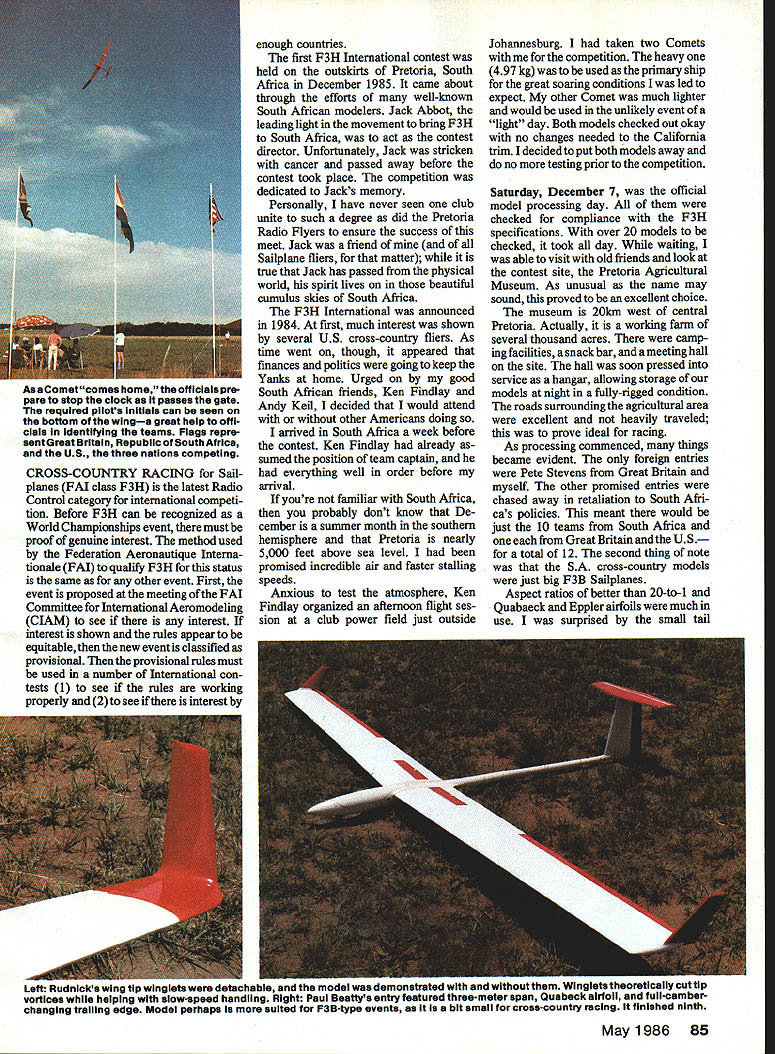
- Provisional rules must be used in a number of international contests to verify rule effectiveness and to ensure enough countries participate.
Organization and site
The contest was organized largely through the efforts of South African modeler Jack Abbot, who was to act as contest director. Jack was stricken with cancer and passed away before the contest; the competition was dedicated to his memory. The Pretoria Radio Flyers club rallied to ensure the meet’s success.
The site, the Pretoria Agricultural Museum (a working farm some 20 km west of central Pretoria), proved ideal. It had camping facilities, a snack bar and a meeting hall that served as an overnight hangar for fully rigged models. December is summer in the southern hemisphere, and Pretoria’s elevation (nearly 5,000 ft) promised strong soaring conditions and higher stalling speeds.
South African cross-country models tended toward large F3B-type sailplanes with aspect ratios better than 20:1 and use of Quabeck and Eppler airfoils; small tail surfaces and fully cambered trailing edges were common on racing ships.
Entrants and equipment
Initial international interest included several U.S. fliers, but finance and political issues limited participation. Ultimately the contest featured teams from South Africa, Great Britain, and the United States. Several promised foreign entries were withdrawn in protest of South African policies, leaving a smaller field.
Many competitors used camber-changing full-span trailing edges to vary speed in flight. Because F3H allows in-flight speed changes by altering camber or trim, elapsed times were converted to points to determine placings.
Model processing (Saturday, Dec. 7)
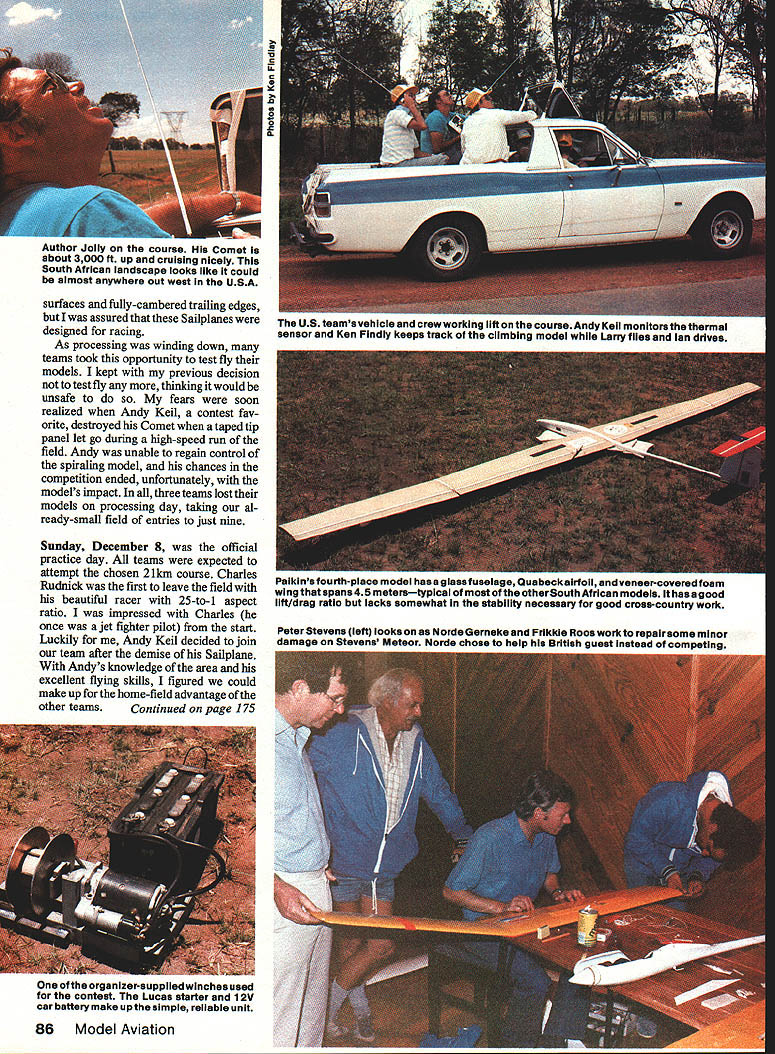
Model processing took the full day as over twenty models were checked for compliance with F3H specifications. During processing some teams test flew their models; several suffered structural failures. Andy Keil, a contest favorite, destroyed his Comet when a taped tip panel let go during a high-speed field run. In all, three teams lost models on processing day, reducing the entry list further.
Practice day (Sunday, Dec. 8)
Sunday was the official practice day. Teams were expected to attempt a chosen 21 km course. Charles Rudnick launched first with a racer of about 25:1 aspect ratio. Only Rudnick and I completed the full 21 km course; I returned one minute faster than Rudnick. After the loss of some models, Andy Keil joined our U.S. team to help compensate for local knowledge advantages of the South African pilots.
Official competition
Heavy summer rains Sunday night left the fields soggy and forced a postponement of the scheduled Monday start; the contest was reduced from eight rounds to six. When racing began the weather and variable winds made flying demanding and hard on equipment. Tip failures, landing damage, and radio trouble were common.
Competition highlights and task summaries:
- Task scoring: Elapsed times for each round were converted to points; the highest total after six rounds won.
- Weather and short tasks: Overcast skies and occasional drizzle produced one very short task in which most pilots could only manage about 7 km; many planes suffered damage in the rough terrain.
- Long tasks: Other days had long tasks and strong winds. Notable tasks and results included:
- A 42.4 km task in which I managed to complete the course while Rudnick landed 1.2 km short. Paikin and Roos reached about 19 km and 12 km, respectively.
- A 44.5 km task during which Rudnick finished in 1 hr 44 min. I needed one more thermal than Rudnick to get home and decided to land short to avoid losing more time; the rules made time a factor for multiple finishers. Because I landed one meter short, Rudnick received 1,000 points and I received 999—well within the rules.
- A 51.7 km task where the first four miles were directly into a 15 mph headwind; no competitor completed the full course. I went the farthest that day at 38.9 km.
- The final day was windier; a 42.4 km task again proved difficult and only Prikkie Roos and I made the first turn, recording about 8.1 km (Roos) and 21.5 km (me), respectively.
Tactics and equipment: Because camber adjustment could produce large speed differentials, trim and tactical use of camber-changing surfaces were crucial. South African pilots’ local knowledge and familiarity with the local airmass gave them an advantage, while British and American teams also put up strong performances despite losses.
Results and assessment
Team results:
- 1st — United States
- 2nd — South Africa
- 3rd — Great Britain
Individual podium:
- Larry Jolly (U.S.A.)
- Charles Rudnick (R.S.A.)
- Prikkie Roos (R.S.A.)
The event demonstrated that F3H has the essentials of an exciting international class. The provisional rules worked reasonably well, though a few refinements were suggested and will be presented to the FAI.
Acknowledgements
The South African organizers ran an excellent contest and expressed interest in hosting the first F3H World Championships once the class is qualified. I want to thank Ken Findlay, Andy Keil, and my driver Ian Fynes-Clinton for their support and companionship, and to commend Jack Abbot, Lee Renaud, and Dan Pruss for their hard work in advancing cross-country RC soaring.
Accumulative Scores
(5,000 points possible)
- Jolly, U.S.A., 4,999
- Rudnick, R.S.A., 3,887
- Roos, R.S.A., 2,827
- Paikin, R.S.A., 1,410
- Lightfoot, R.S.A., 1,116
- Stevens, G.B., 661
- Thompson, R.S.A., 492
- Tompkins, R.S.A., 174
- Beatty, R.S.A., 129
Transcribed from original scans by AI. Minor OCR errors may remain.

