
First at Last!
THE BATTLE of Britain, Spitfires, Hurricanes and the famous No. 71 Eagle Squadron of the Royal Air Force are all part of the heritage of America's first ace of World War II, William R. Dunn. At age 61 he has given up flying fighters and is now an active radio-control modeler, AMA 82765. A member of the Pikes Peak RC Club in Colorado Springs, Colorado, he is content with designing, building and flying RC models and acting as a judge at club contests in between numerous other activities and interests.
Retired from the United States Air Force as a Lieutenant Colonel, he is a veteran of 38 years of military service during which he served in the armed forces of three countries, fought in three wars and found himself wounded four times. Quite a record!
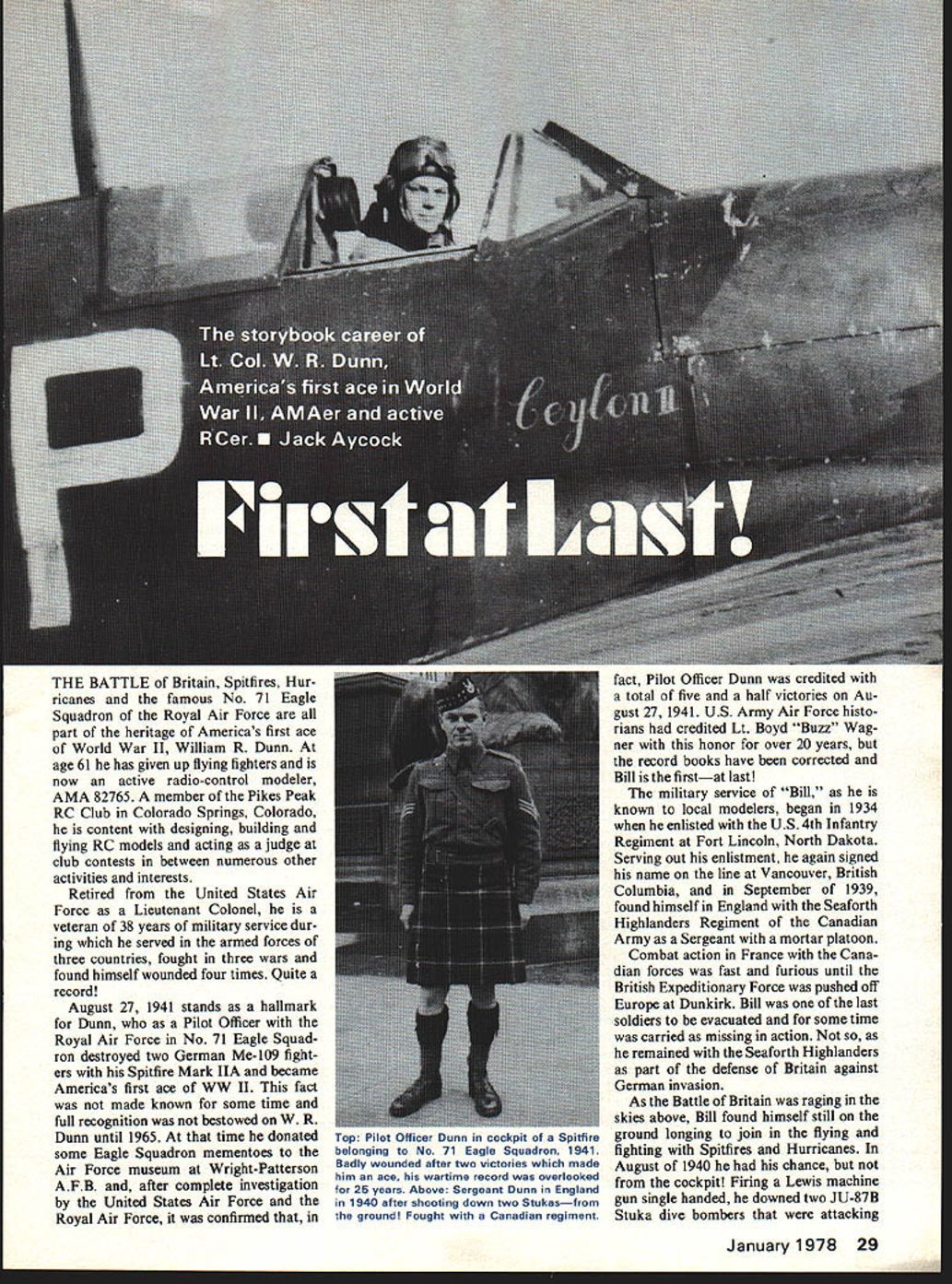
August 27, 1941 stands as a hallmark for Dunn, who as a Pilot Officer with the Royal Air Force in No. 71 Eagle Squadron destroyed two German Me-109 fighters with his Spitfire Mark IIA and became America's first ace of World War II. This fact was not made known for some time and full recognition was not bestowed on W. R. Dunn until 1965. At that time he donated some Eagle Squadron mementoes to the Air Force museum at Wright-Patterson A.F.B. and, after complete investigation by the United States Air Force and the Royal Air Force, it was confirmed that, in fact, Pilot Officer Dunn was credited with a total of five and a half victories on August 27, 1941. U.S. Army Air Force historians had credited Lt. Boyd "Buzz" Wagner with this honor for over 20 years, but the record books have been corrected and Bill is the first—at last!
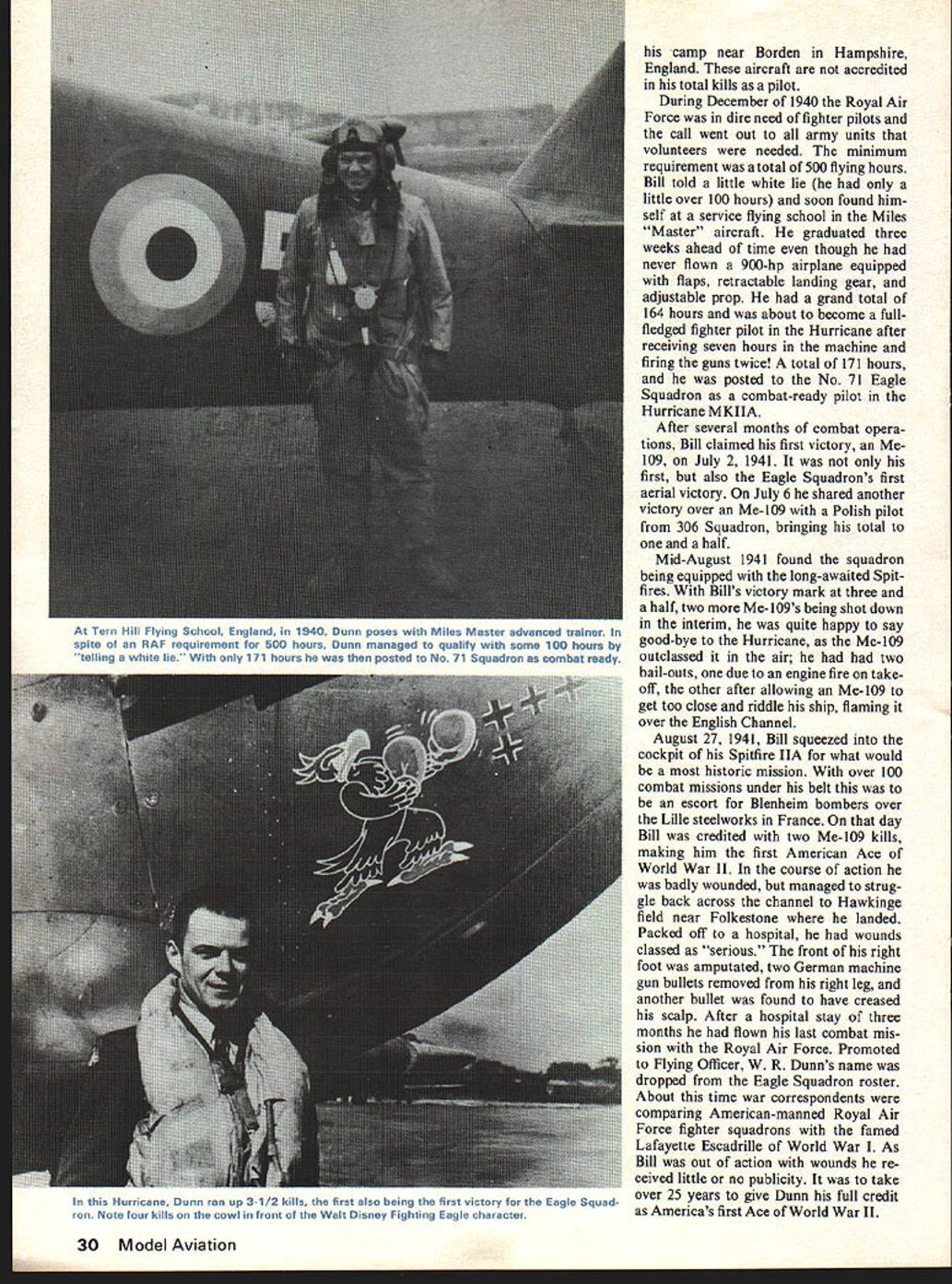
The military service of "Bill," as he is known to local modelers, began in 1934 when he enlisted with the U.S. 4th Infantry Regiment at Fort Lincoln, North Dakota. Serving out his enlistment, he again signed his name on the line at Vancouver, British Columbia, and in September of 1939, found himself in England with the Seaforth Highlanders Regiment of the Canadian Army as a Sergeant with a mortar platoon.
Combat action in France with the Canadian forces was fast and furious until the British Expeditionary Force was pushed off Europe at Dunkirk. Bill was one of the last soldiers to be evacuated and for some time was carried as missing in action. Not so, as he remained with the Seaforth Highlanders as part of the defense of Britain against German invasion.
As the Battle of Britain was raging in the skies above, Bill found himself still on the ground longing to join in the flying and fighting with Spitfires and Hurricanes. In August of 1940 he had his chance, but not from the cockpit! Firing a Lewis machine gun single-handed, he downed two JU-87B Stuka dive bombers that were attacking.
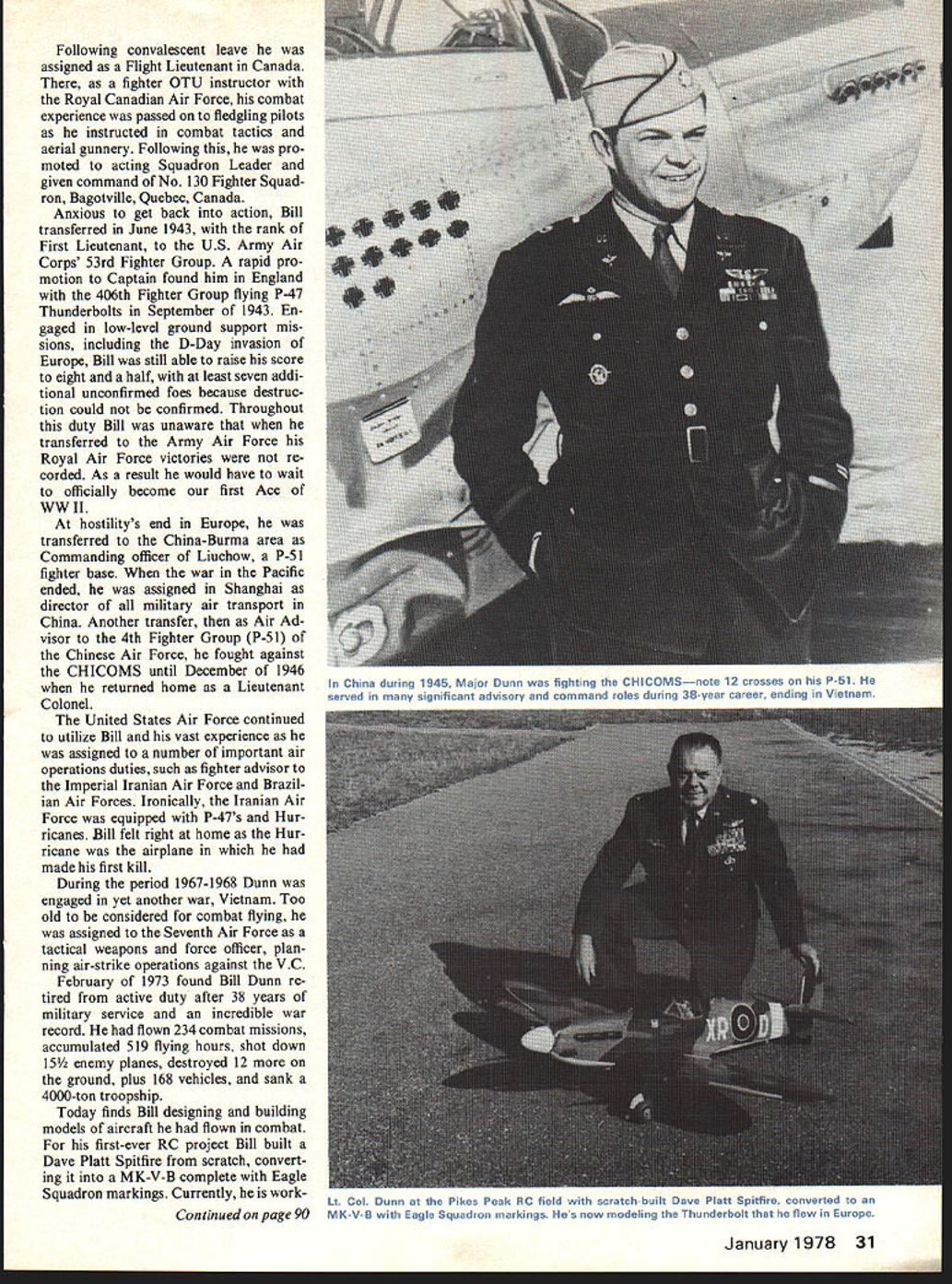
During December 1940 Royal Air Force dire need fighter pilots called out; army units, volunteers needed; minimum requirement, total 500 flying hours. Bill told a little white lie—little over 100 hours—and soon found himself in service flying school, Miles Master aircraft, graduated three weeks ahead of time, though never having flown a 900-hp airplane equipped with flaps, retractable landing gear and an adjustable prop; grand total 164 hours; about to become a full-fledged fighter pilot, Hurricane after receiving seven hours machine gunnery, guns twice; total 171 hours; posted No. 71 Eagle Squadron combat-ready pilot, Hurricane Mk IIA.
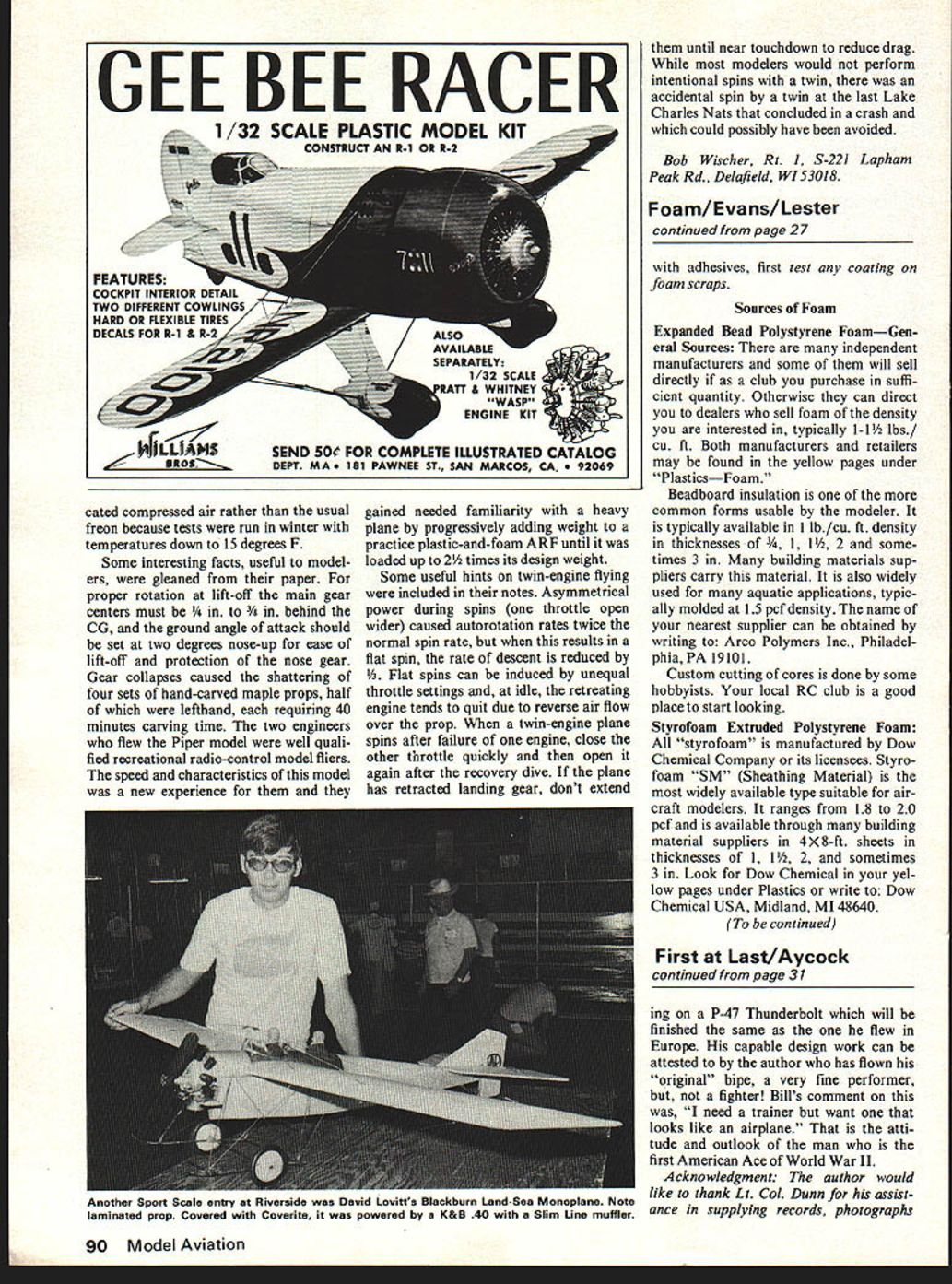
After several months of combat operations Bill claimed his first victory, Me-109, July 2, 1941, and the Eagle Squadron's first aerial victory came July 6, when he shared another victory over a Me-109 with a Polish pilot of 306 Squadron, bringing his total to a half. Mid-August 1941 found the squadron being equipped with long-awaited Spitfires. Bill's victory mark was three and a half—two Me-109s being shot down; interim quite happy; say good-bye to the Hurricane. On August 27, 1941 Bill was credited with two Me-109 kills, making him America's first ace of World War II. Action this day, Bill flew over 100 combat missions; escort Blenheim bombers over Lille steelworks, France; badly wounded, he mana ged to struggle back across the channel to Hawkinge field near Folkestone where he landed. Packed off to a hospital, he had wounds classed as "serious." The front of his right foot was amputated, two German machine‑gun bullets removed from his right leg, and another bullet was found to have creased his scalp. After a hospital stay of three months he had flown his last combat mission with the Royal Air Force. Promoted to Flying Officer, W. R. Dunn's name was dropped from the Eagle Squadron roster.
About this time war correspondents were comparing American‑manned Royal Air Force fighter squadrons with the famed Lafayette Escadrille of World War I. As Bill was out of action with wounds he received little or no publicity. It was to take over 25 years to give Dunn his full credit as America's first Ace of World War II. Following convalescent leave he was assigned as a Flight Lieutenant in Canada. There, as a fighter OTU instructor with the Royal Canadian Air Force, his combat experience was passed on to fledgling pilots as he instructed in combat tactics and aerial gunnery. Following this, he was promoted to acting Squadron Leader and given command of No. 130 Fighter Squadron, Bagotville, Quebec, Canada.
Anxious to get back into action, Bill transferred in June 1943, with the rank of First Lieutenant, to the U.S. Army Air Corps' 53rd Fighter Group. A rapid promotion to Captain found him in England with the 406th Fighter Group flying P-47 Thunderbolts in September of 1943. Engaged in low-level ground support missions, including the D-Day invasion of Europe, Bill was still able to raise his score to eight and a half, with at least seven additional unconfirmed foes because destruction could not be confirmed. Throughout this duty Bill was unaware that when he transferred to the Army Air Force his Royal Air Force victories were not recorded. As a result he would have to wait to officially become our first Ace of WW II.
At hostility's end in Europe, he was transferred to the China-Burma area as Commanding officer of Liuchow, a P-51 fighter base. When the war in the Pacific ended, he was assigned in Shanghai as director of all military air transport in China. Another transfer, then as Air Advisor to the 4th Fighter Group (P-51) of the Chinese Air Force, he fought against the CHICOMS until December of 1946 when he returned home as a Lieutenant Colonel.
The United States Air Force continued to utilize Bill and his vast experience as he was assigned to a number of important air operations duties, such as fighter advisor to the Imperial Iranian Air Force and Brazilian Air Forces. Ironically, the Iranian Air Force was equipped with P-47's and Hurricanes. Bill felt right at home as the Hurricane was the airplane in which he had made his first kill.
During the period 1967-1968 Dunn was engaged in yet another war, Vietnam. Too old to be considered for combat flying, he was assigned to the Seventh Air Force as a tactical weapons and force officer, planning air-strike operations against the V.C.
February of 1973 found Bill Dunn retired from active duty after 38 years of military service and an incredible war record. He had flown 234 combat missions, accumulated 519 flying hours, shot down 15½ enemy planes, destroyed 12 more on the ground, plus 168 vehicles, and sank a 4000-ton troopship.
Today finds Bill designing and building models of aircraft he had flown in combat. For his first-ever RC project Bill built a Dave Platt Spitfire from scratch, converting it into a MK-V-B complete with Eagle Squadron markings. Currently, he is work-
First at Last!
ing on a P-47 Thunderbolt which will be finished the same as the one he flew in Europe. His capable design work can be attested to by the author who has flown his "original" bipe, a very fine performer, but, not a fighter! Bill's comment on this was, "I need a trainer but want one that looks like an airplane." That is the attitude and outlook of the man who is the first American Ace of World War II.
Acknowledgment: The author would like to thank Lt. Col. Dunn for his assistance in supplying records, photographs and recollections for the above article.
Transcribed from original scans by AI. Minor OCR errors may remain.

