
The First Nats
There was some misunderstanding concerning when and where the "first" National Model Airplane Championships took place. To some it was 1928, under the sponsorship of the Airplane Model Airplane League of America—this certainly was the start of a consistent series of national meets, with large participation from around the country, and a major list of events and awards. However, others say it all began with the first official recognition by the National Aeronautic Association (parent organization of the AMA) through the inclusion of a major model aircraft flying competition in the NAA‑sanctioned National Air Races of 1923. AMA's Executive Council in 1975 sided with those who favored the 1923 beginning, by declaring the 1976 Nats to be the 50th.
HAVE YOU EVER asked yourself how the "Nationals" started? The first one did not pop up like a spring mushroom. It was the result of much effort and planning. Like Kilroy, I was there, and I will try to answer the question for you.
Model aviation as a sport took root in the United States in 1907. There was a rapid nationwide growth with model clubs in many large cities. In May 1913, the Illinois Model Aero Club (I.M.A.C.), in cooperation with the Aero Science Club of New York, formed the "Model Aero Clubs of America." The purpose and function of the M.A.C.A. closely paralleled the AMA of today.
This early organization conducted elaborate annual nationwide competitions in the years 1915, 1916, and 1919. Substantial cash prizes were awarded winners of various events, and a large sterling silver trophy went to the club whose members scored the most total points. I would like to think of these early meets with hundreds of contestants as the first Nationals. I will only concede that they were the background and inspiration for the first Nationals as conducted by AMA and NAA.
When the First World War ended the series of annual meets was interrupted. Most modelers became either pilots, instructors, or were otherwise engaged in the war effort. Most model clubs ceased to exist. One club, however, was fortunate. Due to satellite chapters in Chicago high schools and playgrounds, the Illinois Model Aero Club survived. IMAC, its ranks decimated, still retained a young, progressive group. The remaining members kept the Club alive and planned post‑war needs. A model aviation book of plans, instructions, records of models and model aeronautic theory was published. This book served to instruct post‑war modelers in order to promote competition. The book has been reprinted as part of the 50th Nationals Souvenir Book available $4.00 from AMA's Supply Service Section.
Without competition, model aviation would probably have died out rather quickly. Lessons learned at the earlier nationwide meets of 1915, 1916, and 1919 made the need for the National Aeronautic Association, the parent organization of model aviation, crystal clear. It seemed there was no other acceptable choice. It became the dream goal of the IMAC group of boys in Chicago to accomplish the task. Correspondence with people at NAA headquarters in Washington, D.C., found few sympathetic and produced no concrete results. The 1922 National Air Races scheduled a chance to sell the NAA on running a national model air race, but they tried much too late. However, they tried again in 1923; earlier contacts were expanded, clout of prominent people in aviation solicited f One promising ray of hope developed. We got a tentative offer of prize money and a trophy IF the St. Louis Air Board and an Air Race Contest Committee could be induced to schedule a model airplane "Race." This offer was from a Mr. Bernard Mulvihill, Vice‑President of NAA.
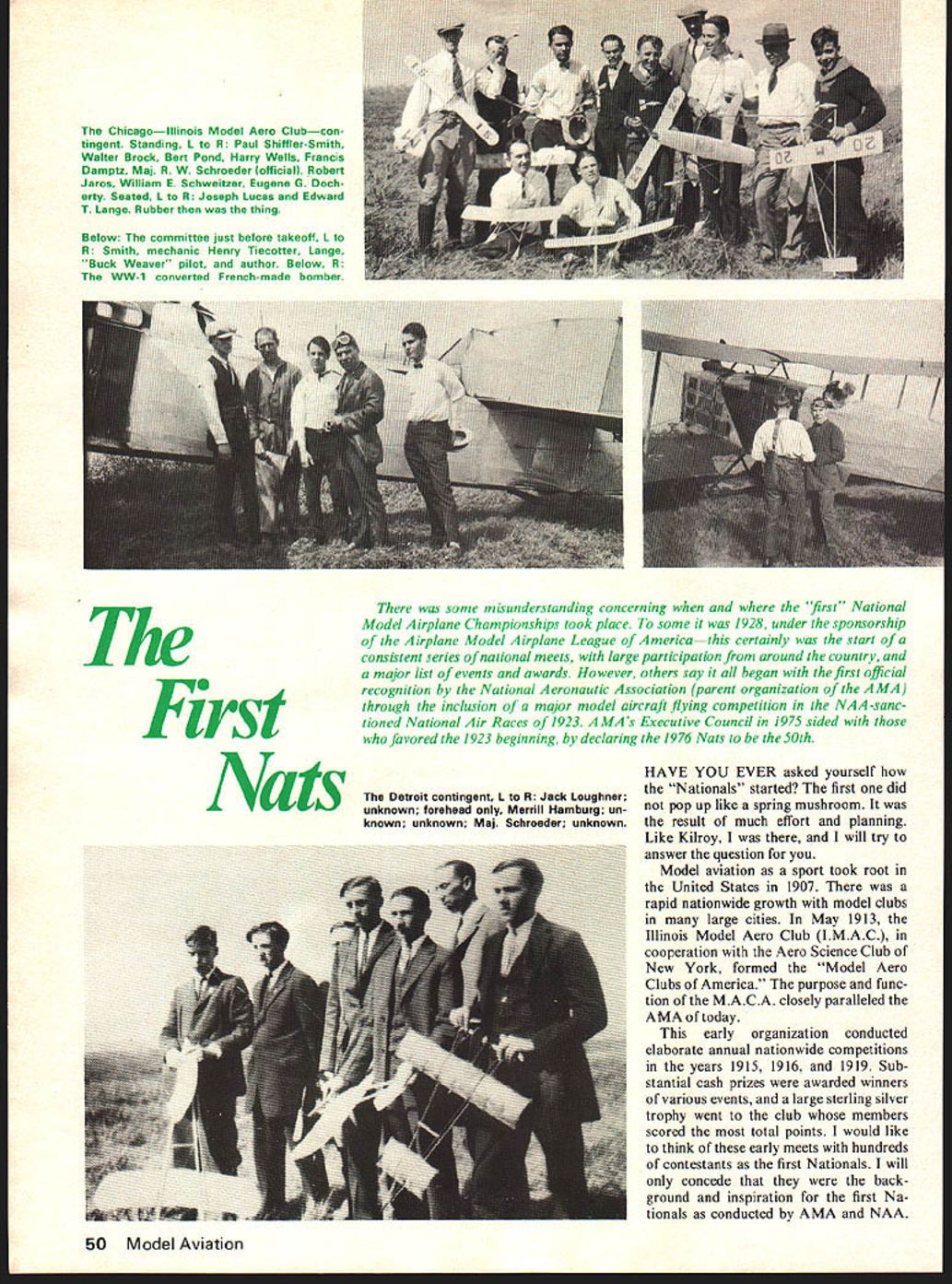
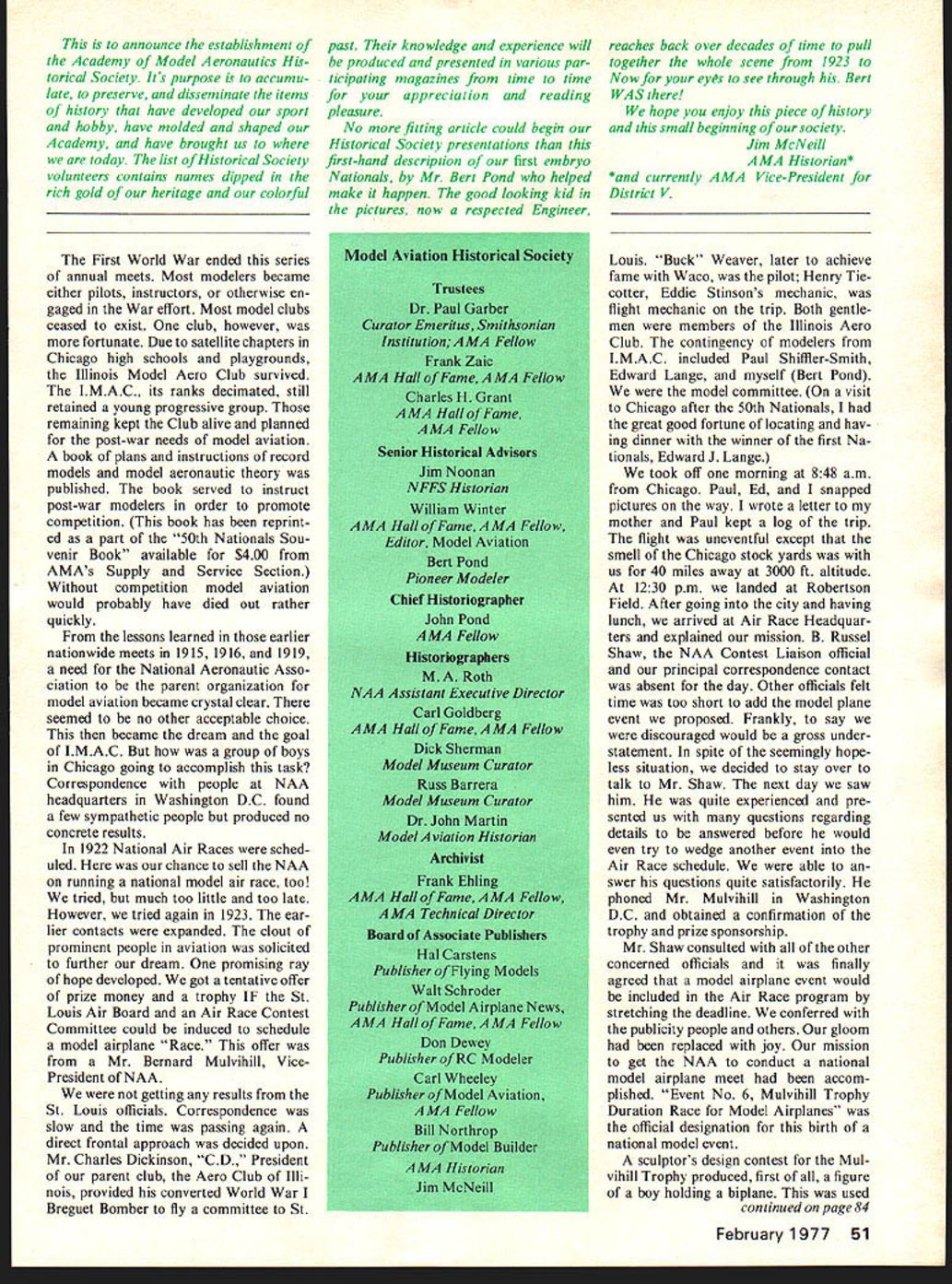
We were not getting any results from the St. Louis officials. Correspondence was slow and the time was passing again. A direct frontal approach was decided upon. Mr. Charles Dickinson, "C.D.," President of our parent club, the Aero Club of Illinois, provided his converted World War I Breguet Bomber to fly a committee to St. Louis. "Buck" Weaver, later to achieve fame with Waco, was the pilot; Henry Tietcotter, Eddie Stinson's mechanic, was flight mechanic on the trip. Both gentlemen were members of the Illinois Aero Club. The contingency of modelers from I.M.A.C. included Paul Shiffler‑Smith, Edward Lange, and myself (Bert Pond). We were the model committee. (On a visit to Chicago after the 50th Nationals, I had the great good fortune of locating and having dinner with the winner of the first Nationals, Edward J. Lange.)
We took off one morning at 8:48 a.m. from Chicago. Paul, Ed, and I snapped pictures on the way. I wrote a letter to my mother and Paul kept a log of the trip. The flight was uneventful except that the smell of the Chicago stock yards was with us for 40 miles away at 3,000 ft. altitude. At 12:30 p.m. we landed at Robertson Field. After going into the city and having lunch, we arrived at Air Race Headquarters and explained our mission. B. Russel Shaw, the NAA Contest Liaison official and our principal correspondence contact was absent for the day. Other officials felt time was too short to add the model plane event we proposed. Frankly, to say we were discouraged would be a gross understatement. In spite of the seemingly hopeless situation, we decided to stay over to talk to Mr. Shaw. The next day we saw him. He was quite experienced and presented us with many questions regarding details to be answered before he would even try to wedge another event into the Air Race schedule. We were able to answer his questions quite satisfactorily. He phoned Mr. Mulvihill in Washington, D.C., and obtained a confirmation of the trophy and prize sponsorship.
Mr. Shaw consulted with all of the other concerned officials and it was finally agreed that a model airplane event would be included in the Air Races program by stretching the deadline. We conferred with the publicity people and others. Our gloom had been replaced with joy. Our mission to get the NAA to conduct a national model airplane meet had been accomplished. "Event No. 6, Mulvihill Trophy Duration Race for Model Airplanes" was the official designation for this birth of a national model event.
A sculptor's design contest for the Mulvihill Trophy produced, first of all, a figure of a boy holding a biplane. This was used
First Nats/Pond continued from page 51
for initial publicity. Later, another design, that of the Greek God Icarus strapping on one of his wings, was chosen for use and won the artist a $500 sculptor's prize.
The model contestants had $300 in prizes to compete for. The results of the 1923 Nationals were as follows:
1st Edward Lange Chicago I.M.A.C. 4 min., 22 3/5 sec.
2nd Robert Jaros Chicago I.M.A.C. 3 min., 59 1/5 sec.
3rd Bertram Pond Chicago I.M.A.C. 3 min., 52 sec.
4th Joseph Lucas Chicago I.M.A.C. 2 min., 14 2/5 sec.
5th William Schweitzer Chicago I.M.A.C. 1 min., 53 sec.
6th Harry D. Wells Chicago I.M.A.C. 1 min., 46 1/5 sec.
7th Carl Rossmann Chicago I.M.A.C. 1 min., 40 sec.
8th Walter Brock Chicago I.M.A.C. 1 min., 36 sec.
9th Paul Shiffer-Smith Chicago I.M.A.C. 1 min., 31 3/5 sec.
10th Allyn Smith St. Louis 37 1/5 sec.
11th Lawrence Gerst St. Louis 20 4/5 sec.
12th Paul Oldendorph St. Louis 17 4/5 sec.
In addition, Edward Lange won custody of the Mulvihill Trophy for one year. This beautiful award was cast by the Kunst Foundry in New York.
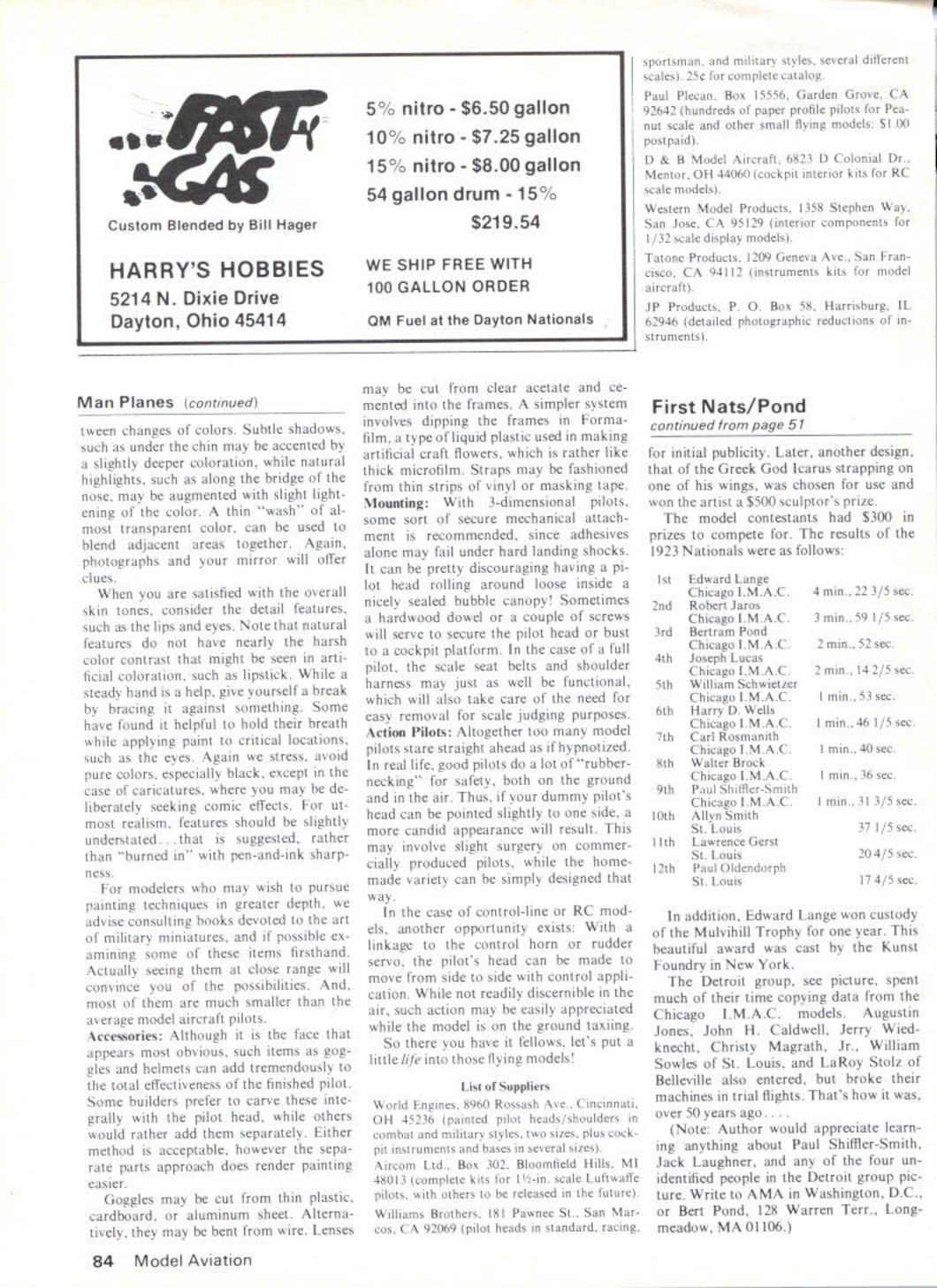
The Detroit group, see picture, spent much of their time copying data from the Chicago I.M.A.C. models. Augustin Jones, John H. Caldwell, Jerry Wiedknecht, Christy Masgrath, Jr., William Sowles of St. Louis, and LaRoy Stolz of Belleville also entered, but broke their machines in trial flights. That's how it was, over 50 years ago.
(Note: Author would appreciate learning anything about Paul Shiffer-Smith, Jack Laughner, and any of the four unidentified people in the Detroit group picture. Write to AMA in Washington, D.C., or Bert Pond, 128 Warren Terr., Longmeadow, MA 01106.)
Transcribed from original scans by AI. Minor OCR errors may remain.

