
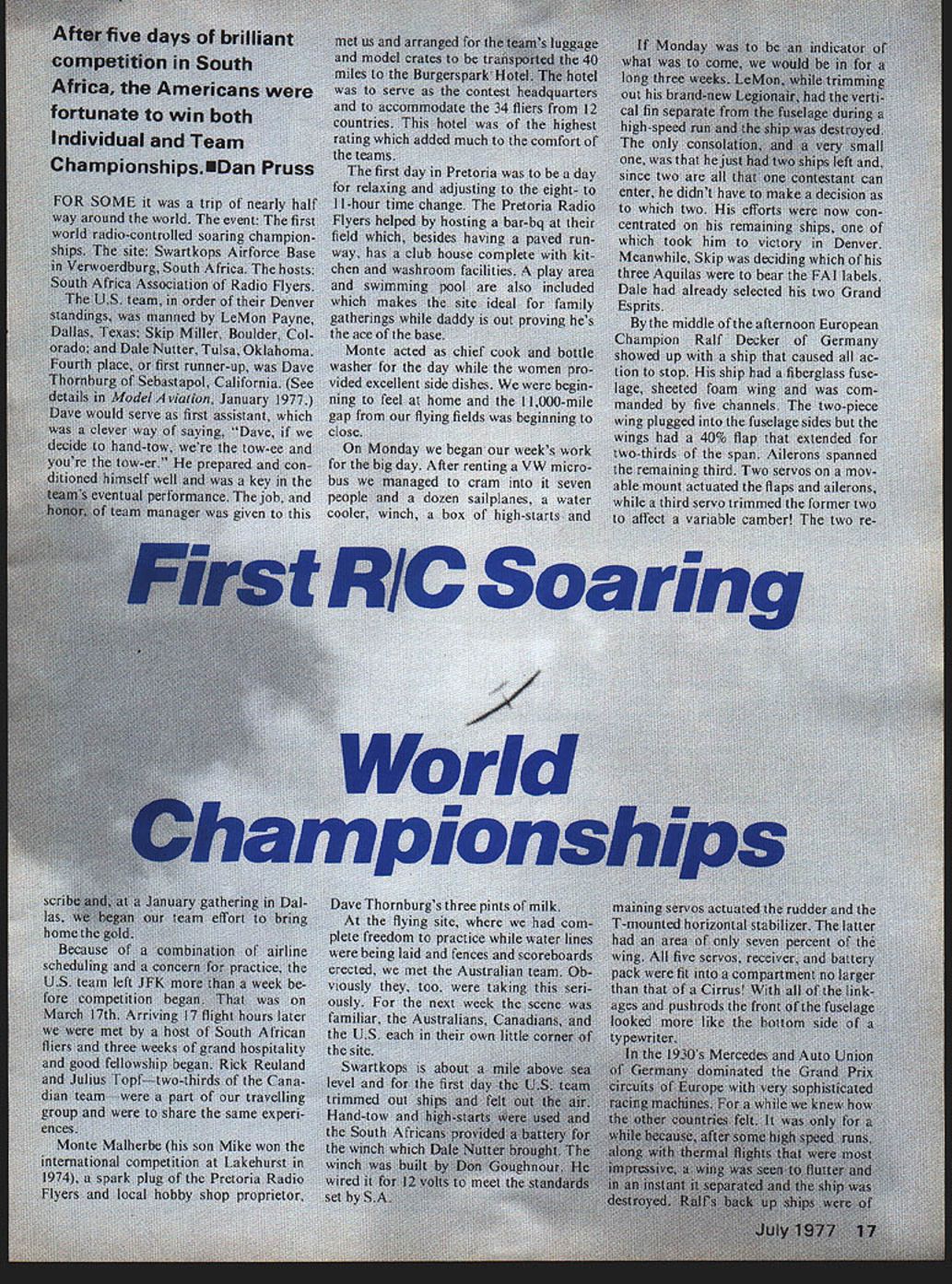
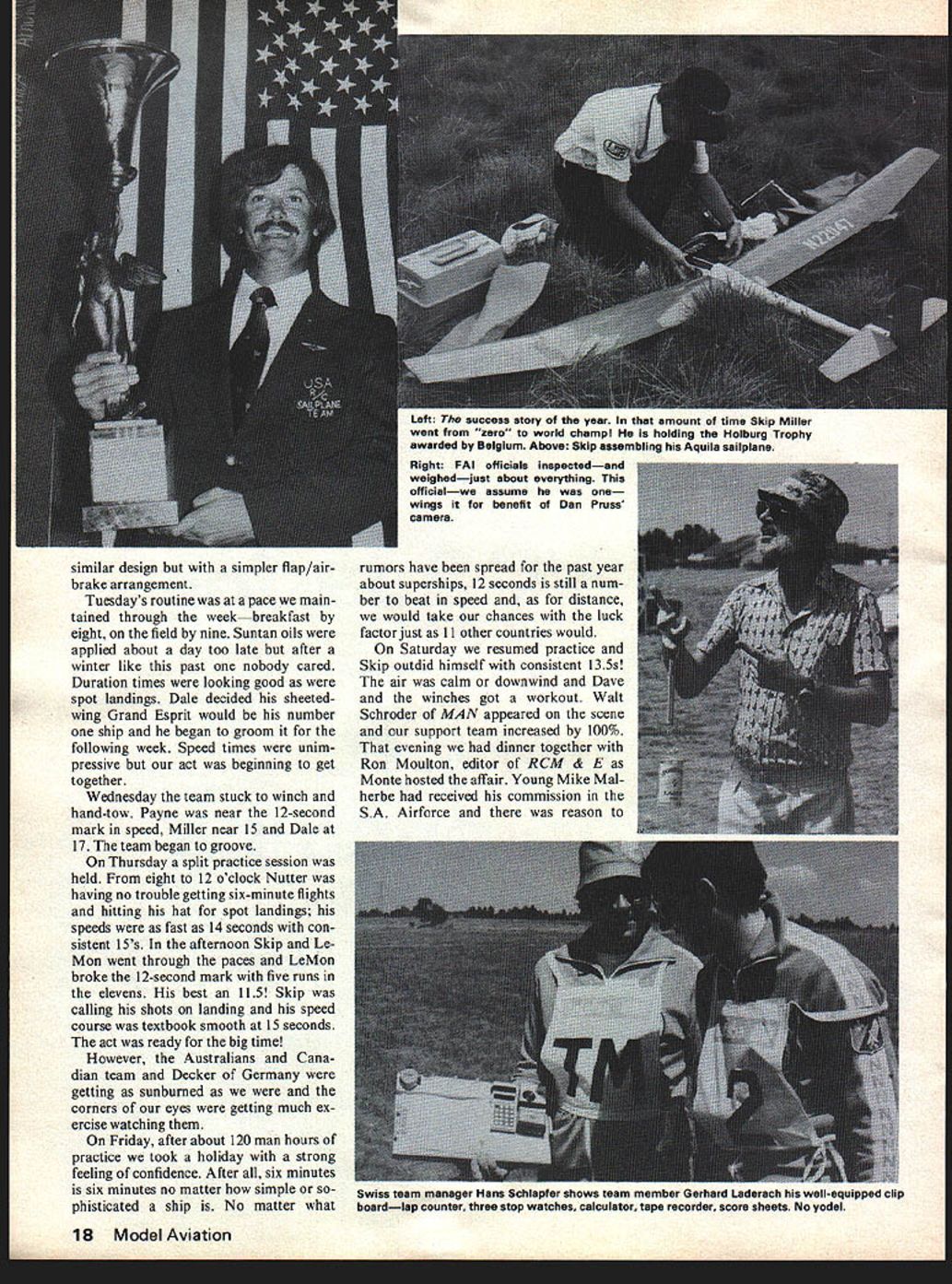
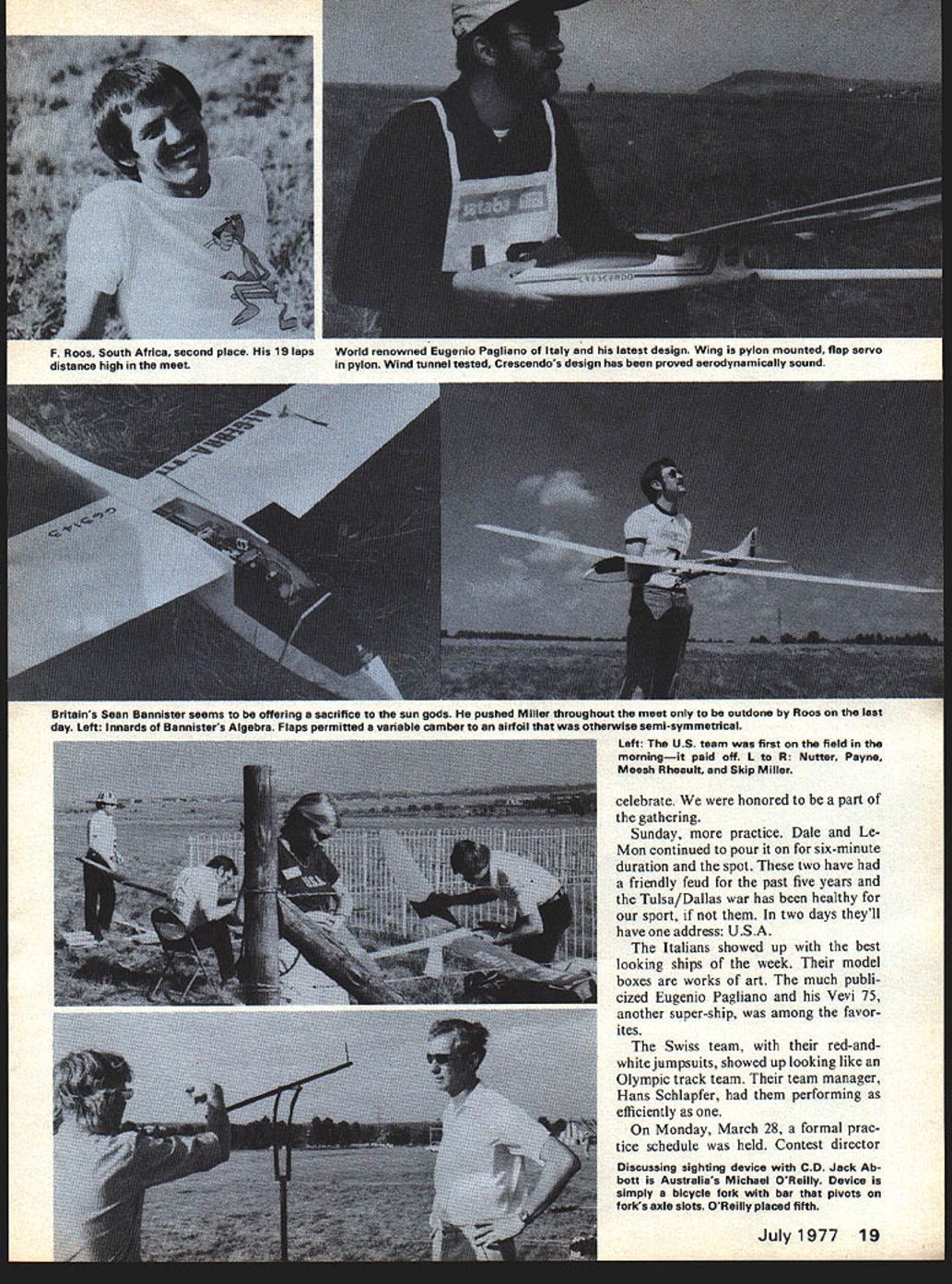
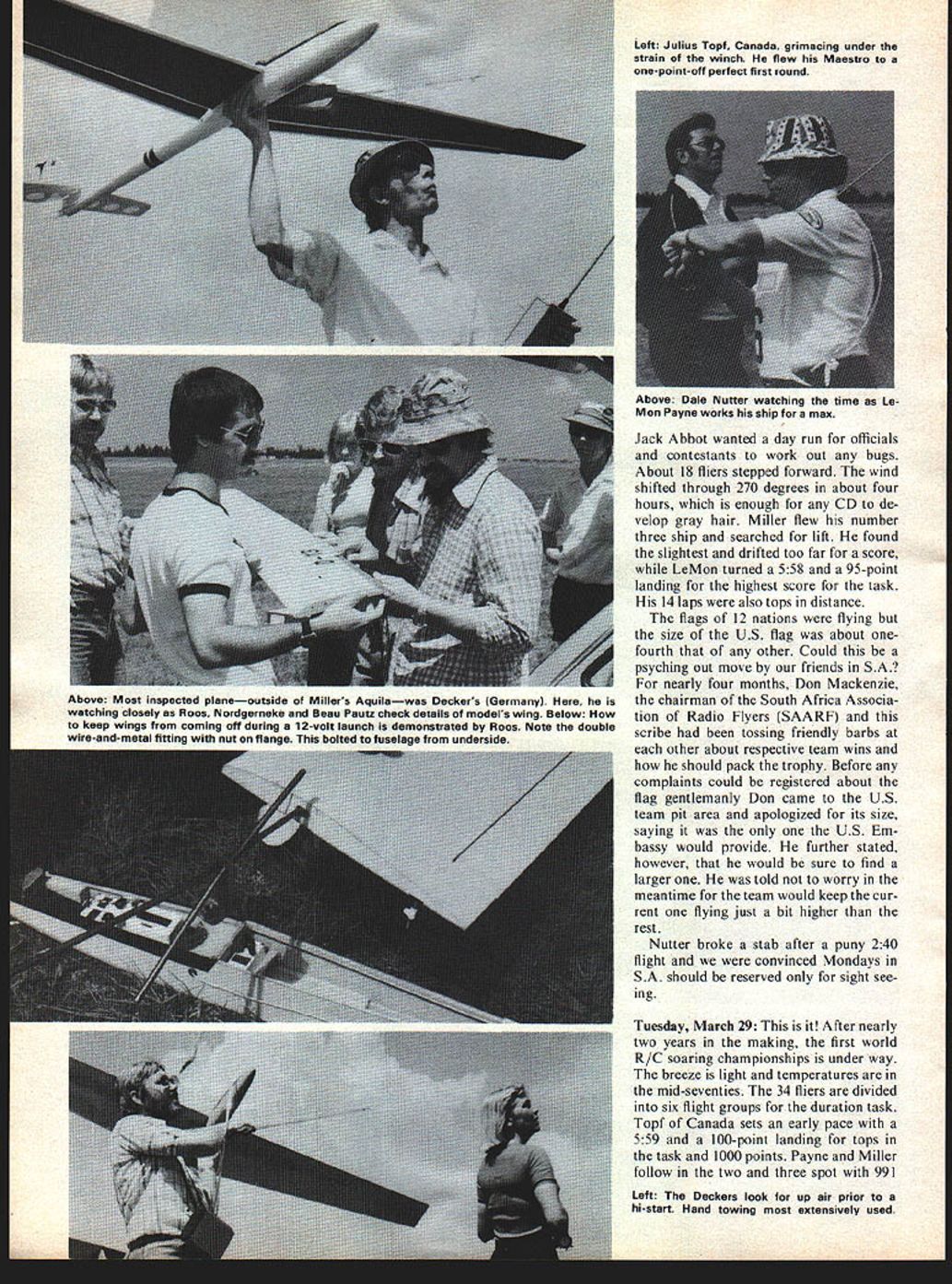
First R/C Soaring World Championships
After five days of brilliant competition in South Africa, the Americans were fortunate to win both Individual and Team Championships. ■ Dan Pruss
FOR SOME it was a trip of nearly halfway around the world. The event: The first world radio-controlled soaring championships. The site: Swartkops Air Force Base in Verwoerdburg, South Africa. The hosts: South Africa Association of Radio Flyers.
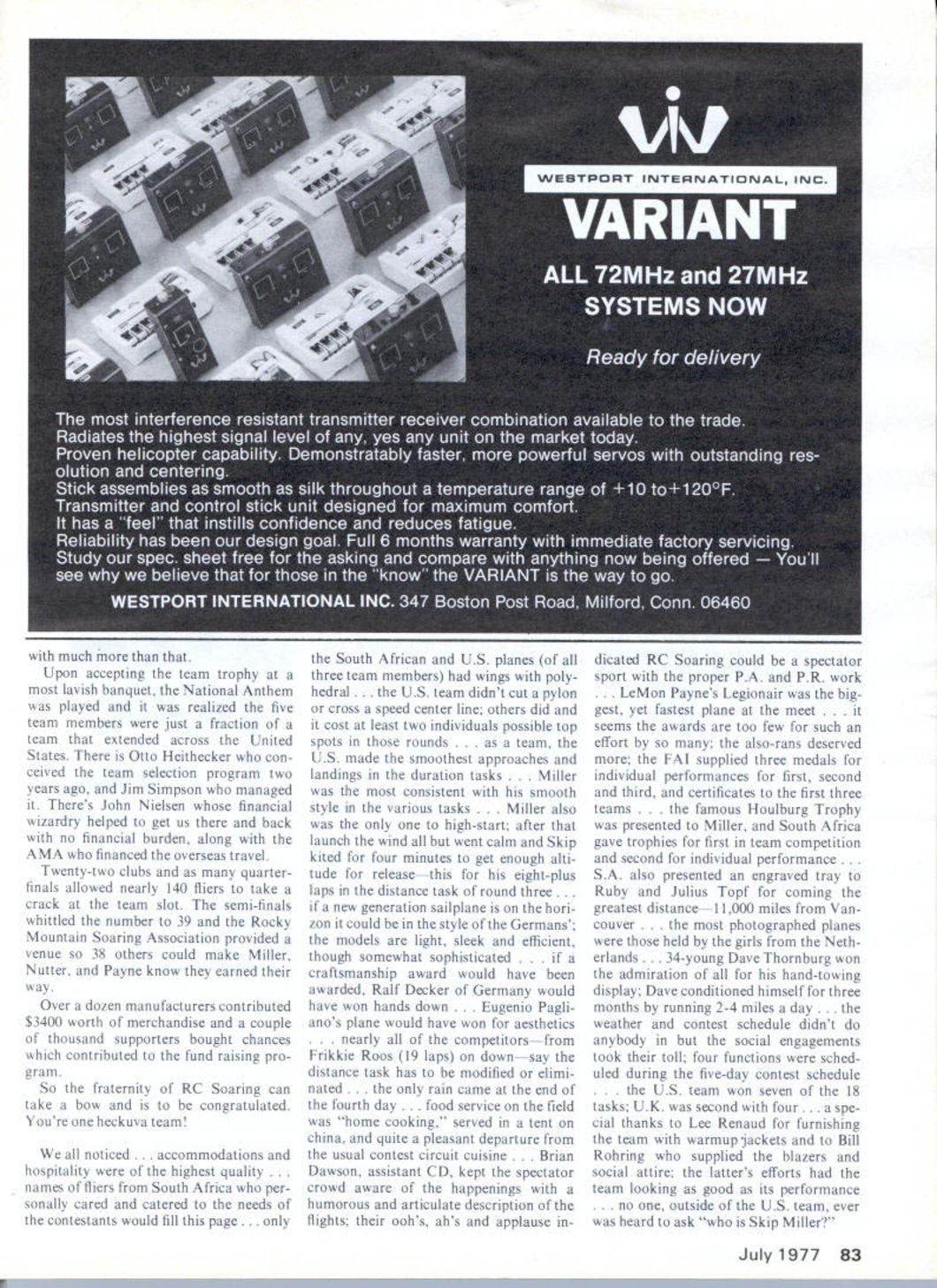
The U.S. team, in order of their Denver standings, was manned by LeMon Payne, Dallas, Texas; Skip Miller, Boulder, Colorado; and Dale Nutter, Tulsa, Oklahoma. Fourth place, or first runner-up, was Dave Thornburg of Sebastopol, California. (See details in Model Aviation, January 1977.) Dave would serve as first assistant, which was a clever way of saying, "Dave, if we decide to hand-tow, we're the tow-ee and you're the tow-er." He prepared and conditioned himself well and was a key in the team's eventual performance. The job, and honor, of team manager was given to this scribe and, at a January gathering in Dallas, we began our team effort to bring home the gold.
Because of a combination of airline scheduling and a concern for practice, the U.S. team left JFK more than a week before competition began. That was on March 17th. Arriving 17 flight hours later we were met by a host of South African fliers and three weeks of grand hospitality and good fellowship began. Rick Reuland and Julius Topf—two-thirds of the Canadian team—were a part of our travelling group and were to share the same experiences.
Monte Malherbe (his son Mike won the international competition at Lakehurst in 1974), a spark plug of the Pretoria Radio Flyers and local hobby shop proprietor, met us and arranged for the team's luggage and model crates to be transported the 40 miles to the Burgerspark Hotel. The hotel was to serve as the contest headquarters and to accommodate the 34 fliers from 12 countries. This hotel was of the highest rating which added much to the comfort of the teams.
The first day in Pretoria was to be a day for relaxing and adjusting to the eight- to 11-hour time change. The Pretoria Radio Flyers helped by hosting a bar-b-q at their field which, besides having a paved runway, has a club house complete with kitchen and washroom facilities. A play area and swimming pool are also included which makes the site ideal for family gatherings while daddy is out proving he's the ace of the base.
Monte acted as chief cook and bottle washer for the day while the women provided excellent side dishes. We were beginning to feel at home and the 11,000-mile gap from our flying fields was beginning to close.
On Monday we began our week's work for the big day. After renting a VW microbus we managed to cram into it seven people and a dozen sailplanes, a water cooler, winch, a box of high-starts and Dave Thornburg's three pints of milk.
At the flying site, where we had complete freedom to practice while water lines were being laid and fences and scoreboards erected, we met the Australian team. Obviously they, too, were taking this seriously. For the next week the scene was familiar, the Australians, Canadians, and the U.S. each in their own little corner of the site.
Swartkops is about a mile above sea level and for the first day the U.S. team trimmed out ships and felt out the air. Hand-tow and high-starts were used and the South Africans provided a battery for the winch which Dale Nutter brought. The winch was built by Don Goughnour. He wired it for 12 volts to meet the standards set by S.A.
If Monday was to be an indicator of what was to come, we would be in for a long three weeks. LeMon, while trimming out his brand-new Legionar, had the vertical fin separate from the fuselage during a high-speed run and the ship was destroyed. The only consolation, and a very small one, was that he just had two ships left and, since two are all that one contestant can enter, he didn't have to make a decision as to which two. His efforts were now concentrated on his remaining ships, one of which took him to victory in Denver. Meanwhile, Skip was deciding which of his three Aquilas were to bear the FAI labels. Dale had already selected his two Grand Esprits.
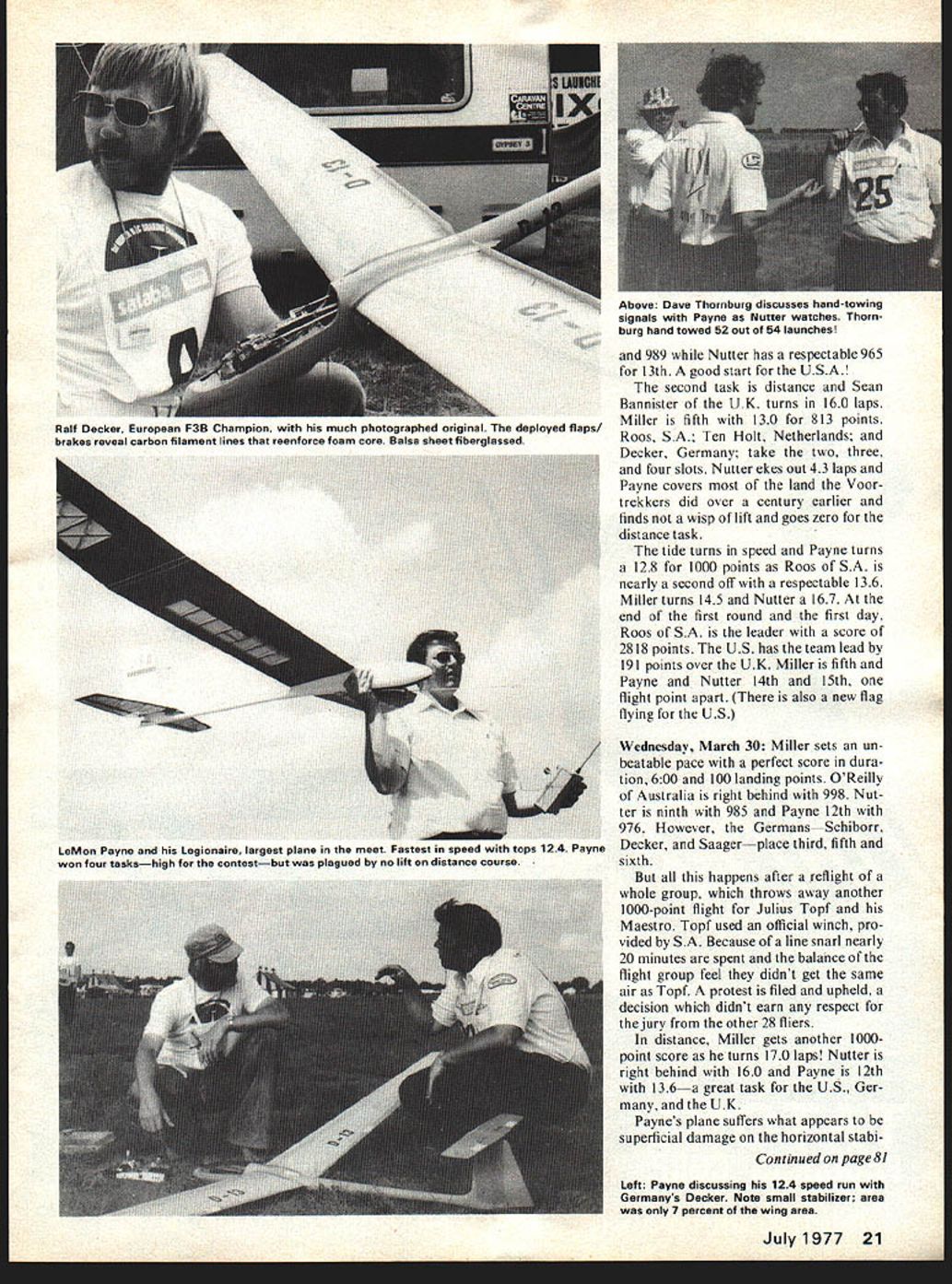
By the middle of the afternoon European Champion Ralf Decker of Germany showed up with a ship that caused all action to stop. His ship had a fiberglass fuselage, sheeted foam wing and was commanded by five channels. The two-piece wing plugged into the fuselage sides but the wings had a 40% flap that extended for two-thirds of the span. Ailerons spanned the remaining third. Two servos on a moveable mount actuated the flaps and ailerons, while a third servo trimmed the former two to affect a variable camber! The two remaining servos actuated the rudder and the T-mounted horizontal stabilizer. The latter had an area of only seven percent of the wing. All five servos, receiver and battery pack were fit into a compartment no larger than that of a Cirrus! With all of the linkages and pushrods the front of the fuselage looked more like the bottom side of a typewriter.
In the 1930's Mercedes and Auto Union of Germany dominated the Grand Prix circuits of Europe with very sophisticated racing machines. For a while we knew how the other countries felt. It was only for a while because, after some high speed runs, along with thermal flights that were most impressive, a wing was seen to flutter and in an instant it separated and the ship was destroyed. Ralf's back up ships were of similar design but with a simpler flap/airbrake arrangement.
Tuesday's routine was at a pace we maintained through the week—breakfast by eight, on the field by nine. Suntan oils were applied about a day too late but after a winter like this past one nobody cared. Duration times were looking good as were spot landings. Dale decided his sheeted-wing Grand Esprit would be his number one ship and he began to groom it for the following week. Speed times were unimpressive but our act was beginning to get together.
Wednesday the team stuck to winch and hand-tow. Payne was near the 12-second mark in speed, Miller near 15 and Dale at 17. The team began to groove.
On Thursday a split practice session was held. From eight to 12 o'clock Nutter was having no trouble getting six-minute flights and hitting his hat for spot landings; his speeds were as fast as 14 seconds with consistent 15's. In the afternoon Skip and LeMon went through the paces and LeMon broke the 12-second mark with five runs in the elevens. His best an 11.5! Skip was calling his shots on landing and his speed course was textbook smooth at 15 seconds. The act was ready for the big time!
However, the Australians and Canadian team and Decker of Germany were getting as sunburned as we were and the corners of our eyes were getting much exercise watching them.
On Friday, after about 120 man hours of practice we took a holiday with a strong feeling of confidence. After all, six minutes is six minutes no matter how simple or sophisticated a ship is. No matter what rumors have been spread for the past year about superships, 12 seconds is still a number to beat in speed and, as for distance, we would take our chances with the luck factor just as 11 other countries would.
On Saturday we resumed practice and Skip outdid himself with consistent 13.5s! The air was calm or downwind and Dave and the winches got a workout. Walt Schroder of MAN appeared on the scene and our support team increased by 100%. That evening we had dinner together with Ron Moulton, editor of RCM&E, as Monte hosted the affair. Young Mike Malherbe had received his commission in the S.A. Airforce and there was reason to celebrate. We were honored to be a part of the gathering.
Sunday, more practice. Dale and Le- Mon continued to pour it on for six-minute duration and the spot. These two have had a friendly feud for the past five years and the Tulsa/Dallas war has been healthy for our sport, if not them. In two days they'll have one address: U.S.A.
The Italians showed up with the best looking ships of the week. Their model boxes are works of art. The much publi- cized Eugenio Pagliano and his Vevi 75, another super-ship, was among the favor- ites.
The Swiss team, with their red-and- white jumpsuits, showed up looking like an Olympic track team. Their team manager, Hans Schlapfer, had them performing as efficiently as one.
On Monday, March 28, a formal prac- tice schedule was held. Contest director Julius Topf, Canada, grimacing under strain, winch flew Maestro one-point-off perfect first round. Jack Abbot wanted day run officials contestants work out bugs. About 18 fliers stepped forward. Wind shifted through 270 degrees about four hours—enough for the CD to develop gray hair. Miller flew the number three ship, searched lift, found the slightest drift, drifted too far to score. LeMon turned 5:58; 95-point landing—highest score. Task 14 laps also tops distance. Flags—12 nations flying. Size U.S. flag about one-fourth other. Could psyching-out move friends? SA nearly four months. Don Mackenzie, chairman South Africa Association Radio Flyers (SAARF), scribe tossing friendly barbs at others about respective team wins should pack trophy. Before complaints could be registered about flag, gentlemanly Don came to U.S. team pit area and apologized for its size, saying the U.S. Embassy would provide further. Stated, however, he would sure find larger. Told not to worry— meantime team would keep. Nutter broke a stab after a puny 2:40 flight and we were convinced Mondays in S.A. should be reserved only for sight seeing.
Tuesday, March 29: This is it! After nearly two years in the making, the first world R/C soaring championships is under way. The breeze is light and temperatures are in the mid-seventies. The 34 fliers are divided into six flight groups for the duration task. Topf of Canada sets an early pace with a 5:59 and a 100-point landing for tops in the task and 1000 points. Payne and Miller follow in the two and three spot with 991 and 989 while Nutter has a respectable 965 for 13th. A good start for the U.S.A.!
The second task is distance and Sean Bannister of the U.K. turns in 16.0 laps. Miller is fifth with 13.0 for 813 points. Roos, S.A.; Ten Holt, Netherlands; and Decker, Germany; take the two, three, and four slots. Nutter ekes out 4.3 laps and Payne covers most of the land the Voortrekkers did over a century earlier and finds not a wisp of lift and goes zero for the distance task.
The tide turns in speed and Payne turns a 12.8 for 1000 points as Roos of S.A. is nearly a second off with a respectable 13.6. Miller turns 14.5 and Nutter a 16.7. At the end of the first round and the first day, Roos of S.A. is the leader with a score of 2818 points. The U.S. has the team lead by 191 points over the U.K. Miller is fifth and Payne and Nutter 14th and 15th, one flight point apart. (There is also a new flag flying for the U.S.)
Wednesday, March 30:
Miller sets an unbeatable pace with a perfect score in duration, 6:00 and 100 landing points. O'Reilly of Australia is right behind with 998. Nutter is ninth with 985 and Payne 12th with 976. However, the Germans—Schiborr, Decker, and Saager—place third, fifth and sixth.
But all this happens after a reflight of a whole group, which throws away another 1000-point flight for Julius Topf and his Maestro. Topf used an official winch, provided by S.A. Because of a line snarl nearly 20 minutes are spent and the balance of the flight group feel they didn't get the same air as Topf. A protest is filed and upheld, a decision which didn't earn any respect for the jury from the other 28 fliers.
In distance, Miller gets another 1000-point score as he turns 17.0 laps! Nutter is right behind with 16.0 and Payne is 12th with 13.6 — a great task for the U.S., Germany, and the U.K.
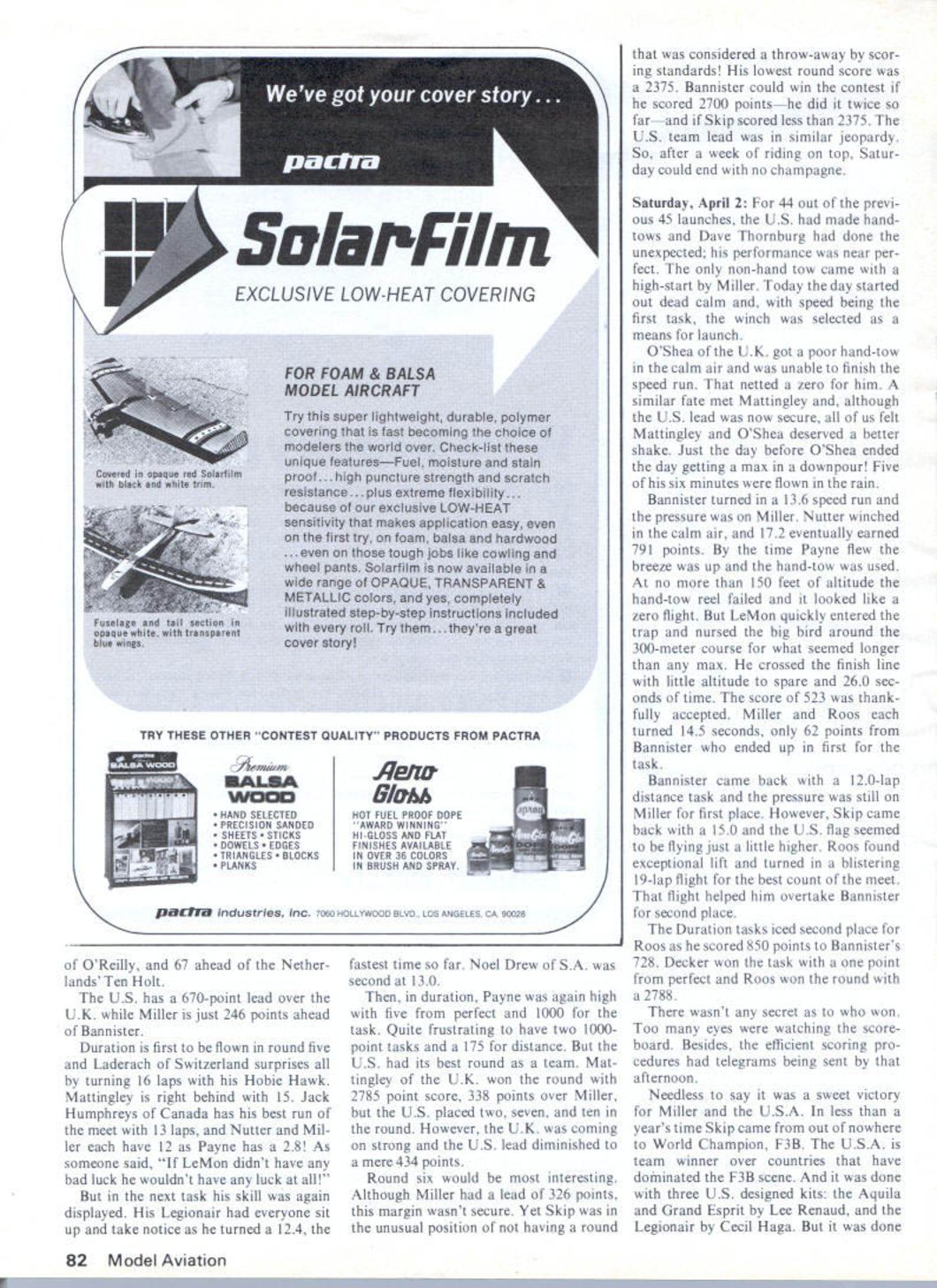
Payne's plane suffers what appears to be superficial damage on the horizontal stabilizer. His repair is for naught. As he enters the speed course the stab is seen to flutter. Backing off, LeMon turns a conservative 17.8 but saves the ship and scores 798 points. High speed is a 14.2 by Neville Mattingly of the U.K. Miller has a 15.0 and Nutter a 16.6 and Miller's score of 2947 will be the highest score for any round in the championships.
At the end of the day it's Miller in first, Nutter in fourth and Payne in 14th to give the U.S.A. a slim 118-point lead over the U.K. Roos of S.A. and O'Reilly of Australia are two and three, and Bannister of the U.K. is fifth. Decker of Germany is tenth.
Thursday, March 31: Smith of Australia flies his Maestro to a five from perfect, but best of the task and 1000 points. Nutter is second with 998. Givone of Italy and Decker tie for third, each with 996. Miller and Payne keep the pace with 978 and 965 for 10th and 14th. Topf again has a respectable 987 and Humphreys and Reuland of Canada finish 12th and 13th.
Smith of Australia has his second 1000-point task with 16.4 laps in distance. Casadei of Italy is second with 15.0 and Payne, Miller and Nutter turn in 8.8, 8.3, and 5.0.
Bannister ties Payne's round-one speed mark at 12.8 while Payne's again-repaired stab still gives him fits and the 18.1-second run renders him 707 points. Smith of Australia wins round three and standings at the end of round three—discounting the lowest round—has Miller in the lead by 62 points over U.K.'s Bannister. Roos is third, followed by Smith, Australia and Schiborr, Germany. Only 265 points separate first and fifth places! The U.S. has 15,344 points but only 93 over second place U.K.
Another speed task is flown to begin round four and for this Payne changes his horizontal stabilizer. He breaks his own record with a 12.7! Miller pushes his Aquila to a 13.6 and second fastest, while Nutter's Esprit is eighth with 15.1. Mattingly and Bannister continue to push with a 14.8 and 15.0. Andre Gouverneur of Belgium, the youngest competitor at 16, turns in a respectable 15.2 and ninth fastest.
Duration is the fifth and last task of the day. Due to group rotation, Miller is in the last group to be called and chances are he won't fly until five o'clock. Spavins of S.A. is already five off a perfect task and Ten Holt of the Netherlands and Bannister of the U.K. right behind. Nutter and Payne are short of their usual paces and it looks as though the U.S. will have a weak task score.
The last group is in the air just after 5:20 p.m. Saager of Germany is first to land with under four minutes of flight time. Next is Baumgartner of Switzerland at four minutes plus. Greis of Luxembourg and Roos fall short, and O'Reilly, Australia, gets 432 out of the possible 460 points. But Miller milks out the lightest lift and not only makes but does it with style: a perfect 6:00 max and a 100-point landing. It's the last flight of the day at 5:30 p.m. Miller's two perfect duration scores are the only two recorded at the meet.
Friday, April 1: It's April Fool's Day and no fewer than eight protests are filed to rile up the indefatigable Jack Abbot. It's all in fun and Jack in retaliation issues a score sheet full of errors. That backfires because those whose score is less than expected come at him carrying long ropes.
The scoring at this meet was the best ever experienced. A Hewlett-Packard computer was utilized and in most cases within minutes after a task was completed a complete printout was available to the team managers. Each sheet included contestant number and name, duration points and score, distance laps and score, speed in seconds and score, total points and placements. Throw-away scores were considered and final placings up to a round were also printed.
To complete round four, distance was first held on Friday and O'Reilly of Australia and his Multiplex LS-1 bumped Miller from the best in distance slot as he recorded 18.0 laps! Payne couldn't buy lifts and took three laps and was happy. Miller had 15 and Nutter had 13. Miller won round four with 2767 points, just 39 ahead. of O'Reilly, and 67 ahead of the Netherlands' Ten Holt.
The U.S. has a 670-point lead over the U.K. while Miller is just 246 points ahead of Bannister.
Duration is first to be flown in round five and Laderach of Switzerland surprises all by turning 16 laps with his Hobie Hawk. Mattingley is right behind with 15. Jack Humphreys of Canada has his best run of the meet with 13 laps, and Nutter and Miller each have 12 as Payne has a 2.8! As someone said, "If LeMon didn't have any bad luck he wouldn't have any luck at all!"
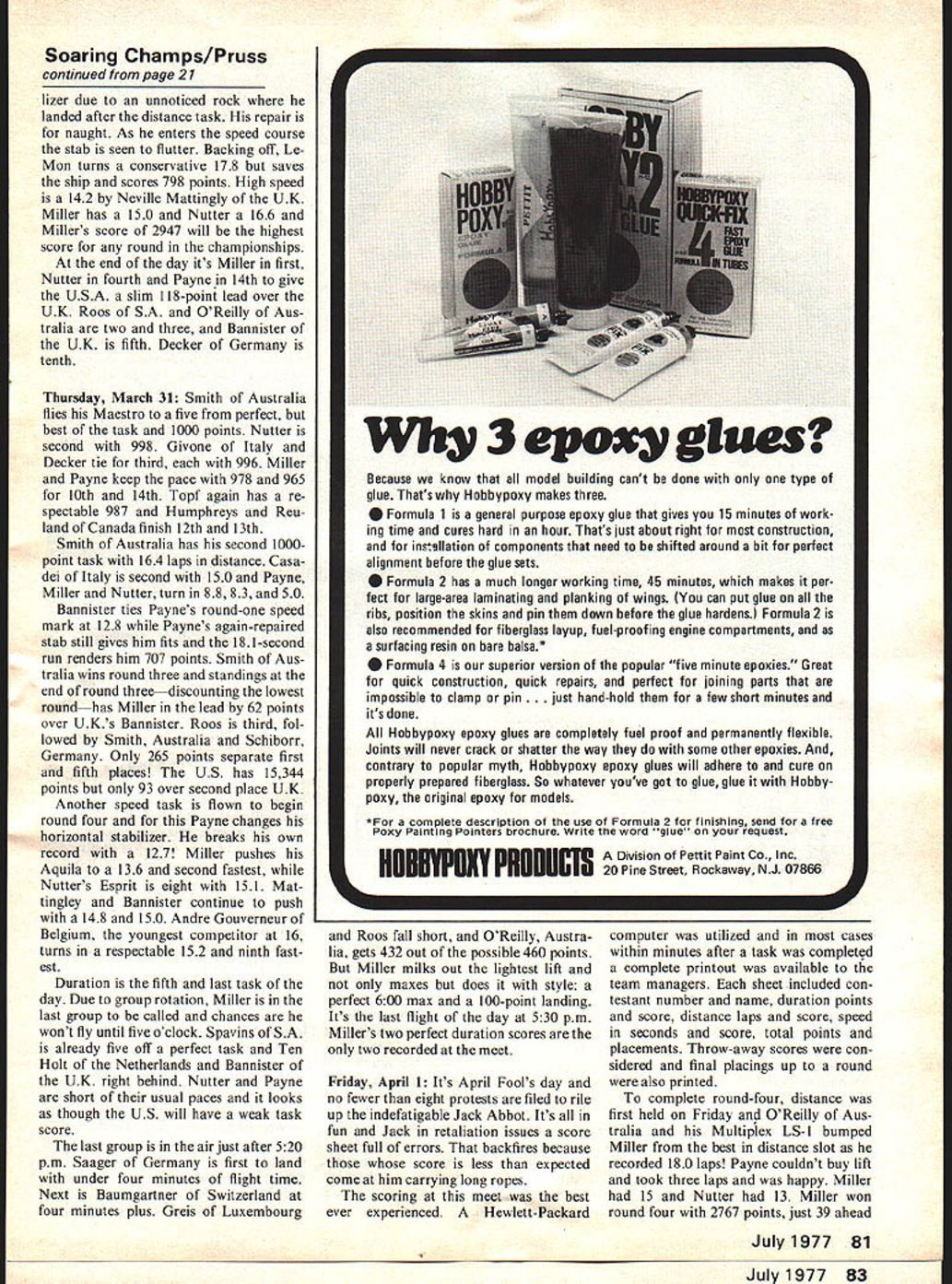
But in the next task his skill was again displayed. His Legionair had everyone sit up and take notice as he turned a 12.4, the fastest time so far. Noel Drew of S.A. was second at 13.0.
Then, in duration, Payne was again high with five from perfect and 1000 for the task. Quite frustrating to have two 1000-point tasks and a 175 for distance. But the U.S. had its best round as a team. Mattingley of the U.K. won the round with 2785 point score, 338 points over Miller, but the U.S. placed two, seven, and ten in the round. However, the U.K. was coming on strong and the U.S. lead diminished to a mere 434 points.
Round six would be most interesting. Although Miller had a lead of 326 points, this margin wasn't secure. Yet Skip was in the unusual position of not having a round that was considered a throw-away by scoring standards! His lowest round score was a 2375. Bannister could win the contest if he scored 2700 points—he did it twice so far—and if Skip scored less than 2375. The U.S. team lead was in similar jeopardy. So, after a week of riding on top, Saturday could end with no champagne.
Saturday, April 2: For 44 out of the previous 45 launches, the U.S. had made hand-tows and Dave Thornburg had done the unexpected; his performance was near perfect. The only non-hand tow came with a high-start by Miller. Today the day started out dead calm and, with speed being the first task, the winch was selected as a means for launch.
O'Shea of the U.K. got a poor hand-tow in the calm air and was unable to finish the speed run. That netted a zero for him. A similar fate met Mattingley and, although the U.S. lead was now secure, all of us felt Mattingley and O'Shea deserved a better shake. Just the day before O'Shea ended the day getting a max in a downpour! Five of his six minutes were flown in the rain.
Bannister turned in a 13.6 speed run and the pressure was on Miller. Nutter winched in the calm air, and 17.2 eventually earned 791 points. By the time Payne flew the breeze was up and the hand-tow was used. At no more than 150 feet of altitude the hand-tow reel failed and it looked like a zero flight. But LeMon quickly entered the trap and nursed the big bird around the 300-meter course for what seemed longer than any max. He crossed the finish line with little altitude to spare and 26.0 seconds of time. The score of 523 was thankfully accepted. Miller and Roos each turned 14.5 seconds, only 62 points from Bannister who ended up in first for the task.
Bannister came back with a 12.0-lap distance task and the pressure was still on Miller for first place. However, Skip came back with a 15.0 and the U.S. flag seemed to be flying just a little higher. Roos found exceptional lift and turned in a blistering 19-lap flight for the best count of the meet. That flight helped him overtake Bannister for second place.
The Duration tasks iced second place for Roos as he scored 850 points to Bannister's 728. Decker won the task with a one point from perfect and Roos won the round with 2788.
There wasn't any secret as to who won. Too many eyes were watching the scoreboard. Besides, the efficient scoring procedures had telegrams being sent by that afternoon.
Needless to say it was a sweet victory for Miller and the U.S.A. In less than a year's time Skip came from out of nowhere to World Champion, F3B. The U.S.A. is Team winner over countries that have dominated the F3B scene. And it was done with three U.S. designed kits: the Aquila and Grand Esprit by Lee Renaud, and the Legionair by Cecil Haga. But it was done with much more than that.
Upon accepting the team trophy at a most lavish banquet, the National Anthem was played and it was realized the five team members were just a fraction of a team that extended across the United States. There is Otto Heithecker who conceived the team selection program two years ago, and Jim Simpson who managed it. There's John Nielsen whose financial wizardry helped to get us there and back with no financial burden, along with the AMA who financed the overseas travel.
Twenty-two clubs and as many quarter-finals allowed nearly 140 fliers to take a crack at the team slot. The semi-finals whittled the number to 39 and the Rocky Mountain Soaring Association provided a venue so 38 others could make Miller, Nutter, and Payne know they earned their way.
Over a dozen manufacturers contributed $3400 worth of merchandise and a couple of thousand supporters bought chances which contributed to the fund raising program.
So the fraternity of RC Soaring can take a bow and is to be congratulated. You're one heckuva team!
We all noticed ... accommodations and hospitality were of the highest quality ... names of fliers from South Africa who personally cared and catered to the needs of the contestants would fill this page ... only the South African and U.S. planes (of all three team members) had wings with polyhedral ... the U.S. team didn't cut a pylon or cross a speed center line; others did and it cost at least two individuals possible top spots in those rounds ... as a team, the U.S. made the smoothest approaches and landings in the duration tasks ... Miller was the most consistent with his smooth style in the various tasks ... Miller also was the only one to high-start; after that launch the wind all but went calm and Skip kited for four minutes to get enough altitude for release — this for his eight-plus laps in the distance task of round three ... if a new generation sailplane is on the horizon it could be in the style of the Germans; the models are light, sleek and efficient, though somewhat sophisticated ... if a craftsmanship award would have been awarded, Ralf Decker of Germany would have won hands down ... Eugenio Pagliano's plane would have won for aesthetics ... nearly all of the competitors — from Frikkie Roos (19 laps) on down — say the distance task has to be modified or eliminated ... the only rain came at the end of the fourth day ... food service on the field was "home cooking," served in a tent on china, and quite a pleasant departure from the usual contest circuit cuisine ... Brian Dawson, assistant CD, kept the spectator crowd aware of the happenings with a humorous and articulate description of the flights; their ooh's, ah's and applause indicated RC Soaring could be a spectator sport with the proper P.A. and P.R. work.
LeMon Payne's Legionair was the biggest, yet fastest plane at the meet ... it seems the awards are too few for such an effort by so many; the also-rans deserved more; the FAI supplied three medals for individual performances for first, second and third, and certificates to the first three teams ... the famous Houlburg Trophy was presented to Miller, and South Africa gave trophies for first in team competition and second for individual performance ... S.A. also presented an engraved tray to Ruby and Julius Topf for coming the greatest distance — 11,000 miles from Vancouver ... the most photographed planes were those held by the girls from the Netherlands ... 34-year-old Dave Thornburg won the admiration of all for his hand-towing display; Dave conditioned himself for three months by running 2-4 miles a day ... the weather and contest schedule didn't do anybody in but the social engagements took their toll; four functions were scheduled during the five-day contest schedule ... the U.S. team won seven of the 18 tasks; U.K. was second with four ... a special thanks to Lee Renaud for furnishing the team with warmup jackets and to Bill Rohring who supplied the blazers and social attire; the latter's efforts had the team looking as good as its performance ... no one, outside of the U.S. team, ever was heard to ask "who is Skip Miller?"
Transcribed from original scans by AI. Minor OCR errors may remain.

