
Five Fields
By Stephen E. Kanyusik
With the specter of losing our flying fields, we can't help but think back to how easy it was to find a flying site in the early days of our model flying life. There was an abundance of places to fly, and people were most cooperative when you had to enter their property to retrieve a wayward model. We have stories of errant models that caught a great thermal and flew out of sight. Then several weeks or even months later, the owner would receive a card from a good distance away notifying him that his model had been found. It was a very different time.
One of the most luxurious activities that one who is retired can indulge in is reminiscing. When we were young, it was called daydreaming. To some it was a flagrant waste of valuable time and was somewhat frowned upon. As a youth I wasted a lot of my school hours on this practice. No, I didn't need the practice—I was an expert at it. School was just a place where I spent time until I could get out and do something that I enjoyed.
I think I was like a lot of others in my era. We had the activities that boys liked to do: sports, climbing trees, and imagining that we were Lindbergh flying in his little Ryan over the vast expanse of the Atlantic Ocean. We would sway with the movement of the tree in the wind, dreaming of the far-away place that our arboreal craft was taking us.
There were daily papers with their "extras," announcing the news flashes of the day almost at the time they were happening. "Extra, Extra, Wiley Post breaks the around-the-world record, alone!" We would run to get a couple of pennies to buy a paper. I can still clearly recall the headlines announcing the tragic crash of the Hindenburg. When an Extra hit the streets it was a memorable event.
In the Thirties I started as a Comet, Megow, and Cleveland builder. These were shelf models that we built to hang from the ceiling and to fly in our world of imagination. As I grew older I was exposed to gas-engine models that would actually fly.
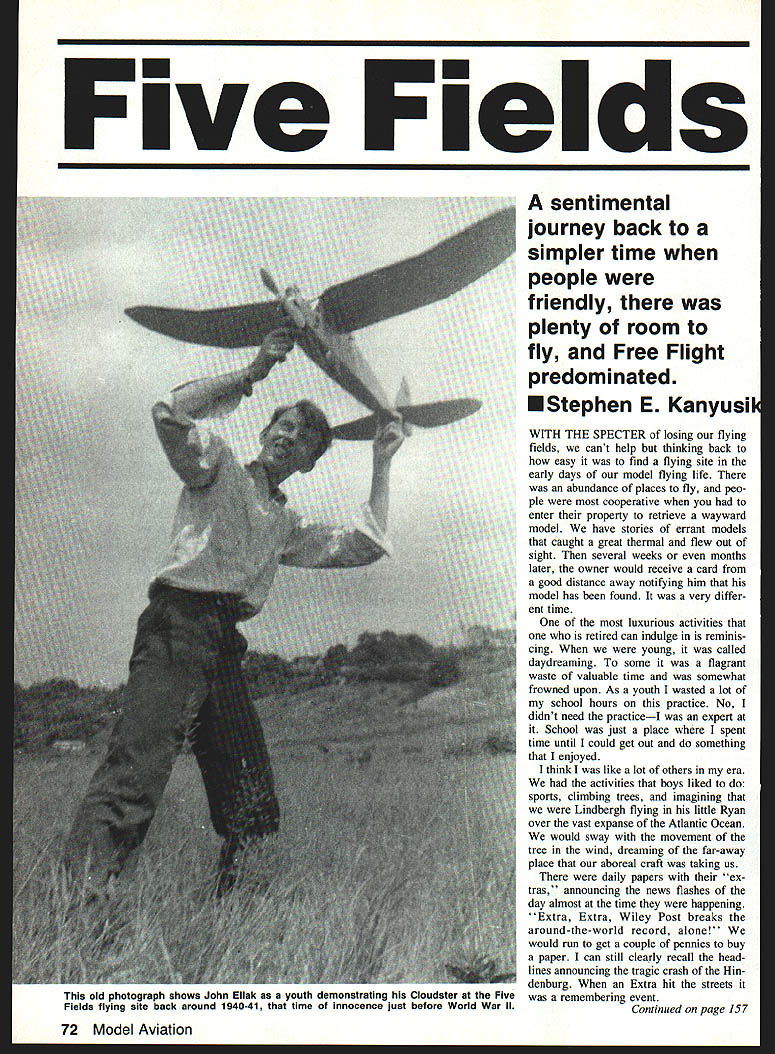
My first exposure to this advanced facet of modeling was with a group called the McKeesport Keystone Clippers. They're still going strong, with some fifty years of modeling memories. Wow! What a collection of daydreams. They used to fly models at a place on the edge of town called Five Fields. On Sundays in the fall there would be numerous simultaneous football games at this place. Nowadays it would be called a sports complex. In those days it was just Five Fields.
I remember when I was permitted to crank the prop of a gas engine belonging to a member of the club. No, it wasn't a Brown Jr. or an Ohlsson & Rice engine. It was a plain old G.H.Q. I can remember tinkering and cranking that stubborn piece of unsophisticated casting and not even getting a pop out of it. While I was laboring over that G.H.Q., other members had Comet Zippers climb the thermals and fly away out of sight.
Climbing and spiraling in the air. How gracefully the Free Flight models performed their ballet-like maneuvers—for the most part. Sometimes a model would get over-banked in a turn, and we would witness the re-kitting of a model.
One member had a low-wing Pacemaker at the field. This was a very radical airplane at a time when almost all models were high-wings. This model was thought to be a better, more efficient flier. It was painted in a bright blue and yellow prewar military aircraft paint scheme.
On its first hand-launched flight it screamed into the sky, then in a shallow arching turn the model headed down, down towards the ground. In this fatal maneuver the plane looked smooth and graceful. We were all transfixed, as if hypnotized, watching the demise of the airplane. Then just before hitting the ground the Pacemaker righted itself and bumped to a hard landing, suffering damage to the landing gear and left wing tip. "Blankety-blank low-wingers — they never fly right," fumed the owner. "I'd sell it for fifty cents if anybody would offer it," he continued. Quick as a wink, I took him up on his offer. I ended up with a snazzy, repairable gas model.
Later on I came to own and fly models such as the Cleveland Cloudster, the Comet Zipper, and finally, just before we were all interrupted by the war, a Cleveland Playboy.
Other fond memories revolve around the Pittsburgh–Allegheny County Airport flight path that we lived near. We saw all the early transports as they landed and took off—the Boeing 247 that was in the race with Douglas, the last of the vintage Ford Trimotors, the Stinson Model A, and American Airlines' large and cumbersome biplane Curtiss Condor. And of course the DC-2s and DC-3s. We saw balloon races and great dirigibles like the Graf Zeppelin and Hindenburg. This mix presents quite a memory fix.
Modeling in those days was not as complicated as it is now. We were never overly concerned with safety, though we did practice it. Safety was everyone's responsibility. Liability insurance wasn't even thought of. Seems like nothing sueable ever happened to us. When we had to chase and retrieve an errant model, property owners weren't hostile. They were always more than helpful. Spectators were just that—seemingly glad to watch and not interfere.
I went back to visit Five Fields a couple of years ago for the first time in forty years. No longer will people be able to fly there unless the high school that is planted in the old flying field can be removed. But as I sat on the hill I watched the birds, imagining them as the graceful Free Flight models that once, many years ago, executed their intricate maneuvers from this field. One can still dream, can't one?
Transcribed from original scans by AI. Minor OCR errors may remain.

