
A FLAG FOR SRF RADIOS
SWITCHABLE radio frequency (SRF) RC systems have been with us for some time. In the 1960s, crystal swapping on 27 MHz became legal and was commonly used in such activities as RC car and boat racing, where it is still used and considered a necessity. Crystal-swapping is still legal on 27 MHz today.
Around 1970 Kraft, then Heathkit, began selling radios that included a switch to select either of two built‑in 72 MHz crystals. Transmitter crystal swapping on 72 MHz was not legal (and still isn't), but the factory‑installed switching was, and still is, legal.
Shortly afterward (they were common by 1975) some Japanese imports appeared with removable crystals that permitted crystal swapping within the 27 MHz or 72 MHz bands. The 72 MHz transmitter crystal swapping was (and still is) illegal.
Kraft and Heath counter‑offered interchangeable modules which allowed one module‑equipped transmitter to access a single RC channel whether 27 MHz, 6 meters (53 MHz), or 72 MHz. Interchangeable modules remain legal on both sides of the Pacific; switched interchangeable 72 MHz RF board modules remain legal.
In January 1984 Kraft announced its SRF system featuring synthesized RF generators. The generators, whether placed in the transmitter or receiver, use a 10.240 MHz crystal to produce the frequency needed. A great furor erupted because the synthesizer is physically able to access RC channels not legally available under the presently sanctioned AMA Phase‑In Plan. The AMA Phase‑In Plan was designed to protect use of old, wide‑band equipment as long as practical and legally possible. Any synthesized RC system used in accordance with the plan will function as a 10‑channel SRF during the period 1984–87. AMA‑sanctioned "Aircraft‑Only" channels permitted during that period are: RC12, RC38, RC42, RC44, RC46, RC48, RC50, RC52, RC54, RC56.
Kraft's synthesizer isn't set up to access old even‑numbered frequencies (72.08, etc.) and can't access RC40 because of frequency‑synthesis mathematics. A synthesizer for the 75 MHz "Non‑Aircraft" channels was anticipated; such units would be similarly restricted to RC62, RC64, RC66, RC68, RC70, RC74, RC76, RC78, RC80, RC82, RC84. RC72 will be prohibited (as it is now) to avoid interference with 75.640 MHz (green/white), an "Aircraft Only" channel.
Testing by the Kraft organization, Bob Aberle, Norm Rosenstock and others has shown that many properly aligned old‑style RC systems aren't disturbed by Kraft SRF. Kraft SRF operated on odd‑numbered RC channels about 20 kHz away; this seems due to the fact the synthesized frequency is very accurate and held by Kraft within about 100 Hz nominal. The very narrow‑band nature of SRF means it often will not even operate a crystal‑controlled KPR‑8FD receiver on the same channel.
By actual test, the synthesized system is far less of a threat than some people supposed. From the evidence, it seems more likely that the synthesized system will be interfered with by poorly maintained, out‑of‑tolerance, old‑style equipment than vice‑versa, if the SRF unit is operated on a non‑sanctioned channel. However, the AMA Phase‑In Plan was intended to avoid other problems, most importantly 3rd‑order intermodulation (IM) interference.
Beginning in 1988, synthesized systems will function as 22‑channel systems, because they will then be permitted to access the 75 MHz "Non‑Aircraft" channels. Additional channels will be "activated" by the AMA in response to the FCC's order to abandon RC operations on 72.08, 72.16, 72.24, 72.32, 72.40, and 72.96 MHz on December 20, 1987. The additional channels (available to RC fliers only) will be RC14, RC16, RC18, RC20, RC22, RC24, RC26, RC28, RC30, RC32, RC34, and RC36. On December 20, 1990, the synthesized system will come into fuller use, accessing 49 of the then‑to‑be‑sanctioned 50 channels (but it still won't be able to access RC40).
Late in 1983 the AMA 1984‑85 rule book was revised to spell out precisely what is, and is not, sanctioned in the Phase‑In Plan for the 1984‑85 season. A section was added dealing with SRF radios. In summary, the AMA 1984‑85 rule book states that owners of SRF radios (whether the switching is done by module swapping, built‑in switching, or by synthesis) will be required to declare themselves as users of one of the sanctioned channels in the AMA Phase‑In Plan. The transmitter processors at contests will then verify that the transmitter is transmitting on the designated channel, with the correct technical characteristics, and that the antenna carries the correct flag. The transmitter will be sealed on that channel for the duration of the event.
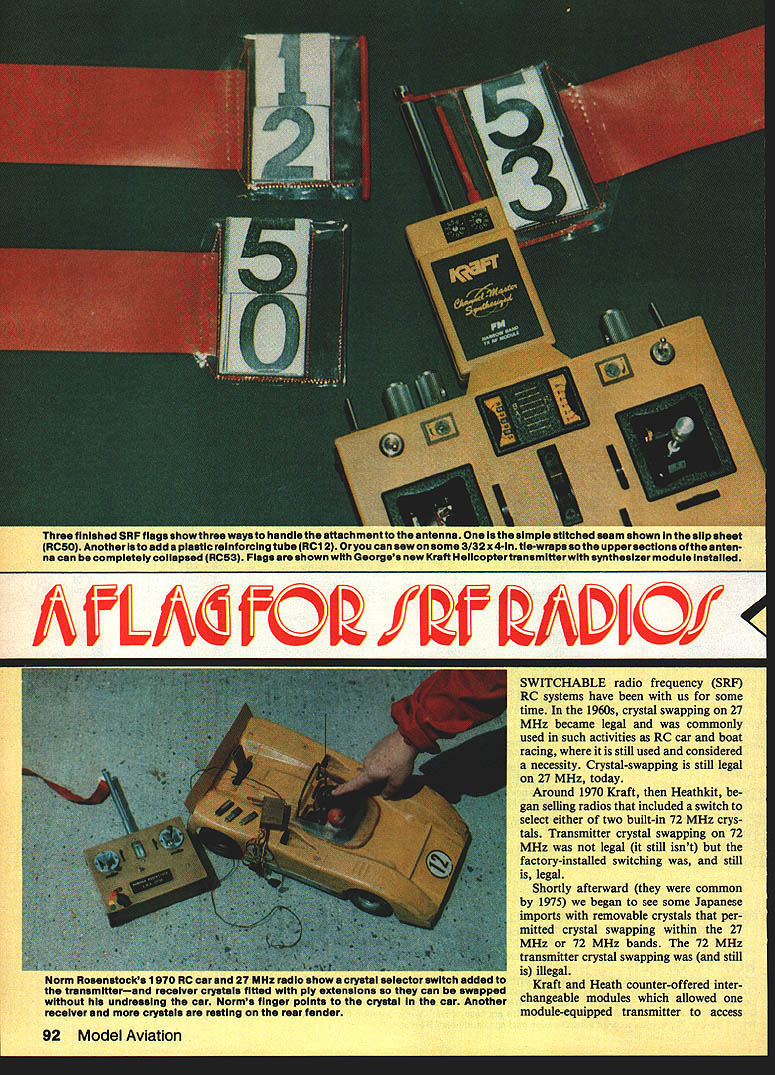
Figure 3 (page 129 of the 1984‑85 rule book) designates a special flag for SRF radios. This article describes ways to build the correct flag for an SRF radio.
If your RC system features modules or RF decks (or the illegal interchangeable crystals), but you only have one set (matched transmitter and receiver units), then there is no need to rush out to get an SRF flag for it. You may continue to use the single‑channel flag, signifying your intention to operate as a single‑channel RF system. But you shouldn't take offense if your transmitter is treated as an SRF transmitter (with seals) during transmitter processing for any AMA‑sanctioned contest.
If you do have more than one set of frequency‑determining elements, and you are willing to use them to resolve conflicts at a contest, then you should mount the SRF flag. The Contest Director may then ask you to move to a less‑populated channel, at which time your transmitter will be reprocessed (if necessary) and sealed on the alternate channel. Treating your system as an SRF system will make heat or round scheduling easier; it can benefit everyone and make contests better.
There is plenty of evidence from RC car and boat racing to show that channel‑hopping helps and that transmission on the "wrong frequency" is rare, even though a lot of last‑minute crystal and module swapping goes on. Real people are far more careful than skeptics give them credit for. If you think that evidence is trivial, then you just haven't felt the razor edges of the prop and rudder of an 80‑mph hydro yet. Transmitter processing and impounding like that used at an AMA Nationals is usually seen at RC car and boat contests. Go see for yourself. Then build yourself an SRF flag and join the fun.
George M. Myers
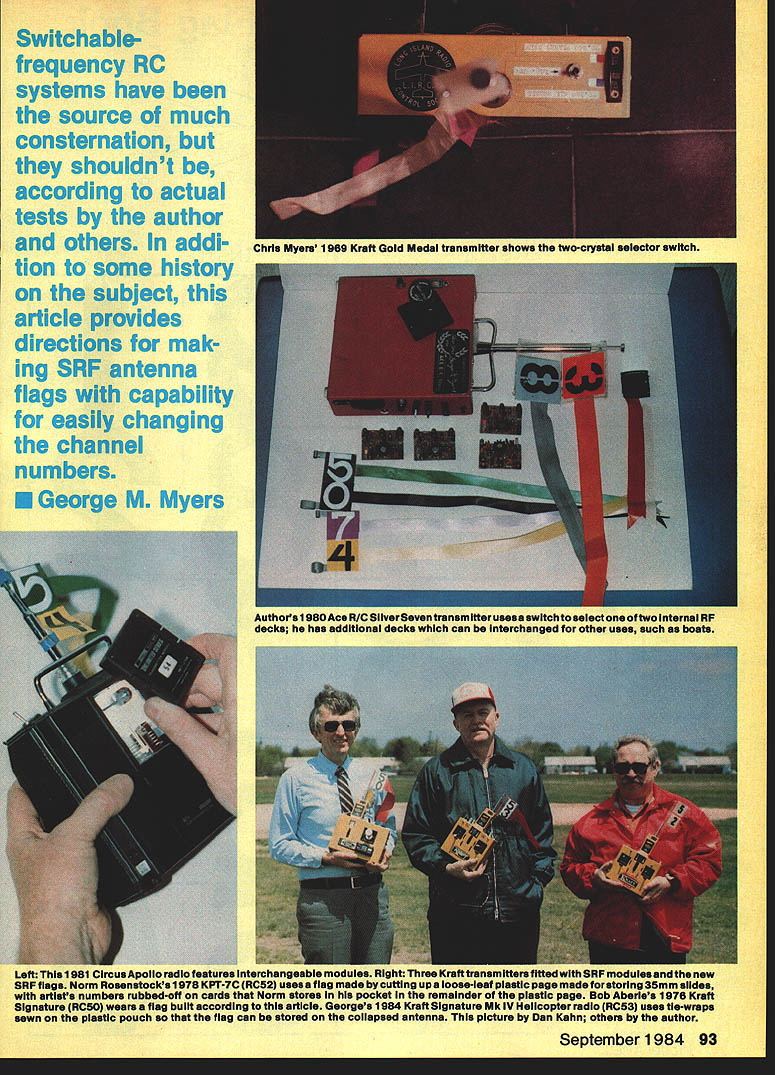
Chris Myers' 1969 Kraft Gold Medal transmitter shows the two‑crystal selector switch.
Author's 1980 Ace R/C Silver Seven transmitter uses a switch to select one of two internal RF decks; he has additional decks which can be interchanged for other uses, such as boats.
Left: This 1981 Circus Apollo radio features interchangeable modules. Right: Three Kraft transmitters fitted with SRF modules and the new SRF flags. Norm Rosenstock's 1978 KPT‑7C (RC52) uses a flag made by cutting up a loose‑leaf plastic page made for storing 35mm slides, with artist's numbers rubbed off on cards that Norm stores in his pocket. In the remainder of the plastic page Bob Aberle's 1976 Kraft Signature (RC50) wears a flag built according to this article. George's 1984 Kraft Signature Mk IV Helicopter radio (RC53) uses tie‑wraps sewn on the plastic pouch so that the flag can be stored on the collapsed antenna. Photo by Dan Kahn; others by the author.
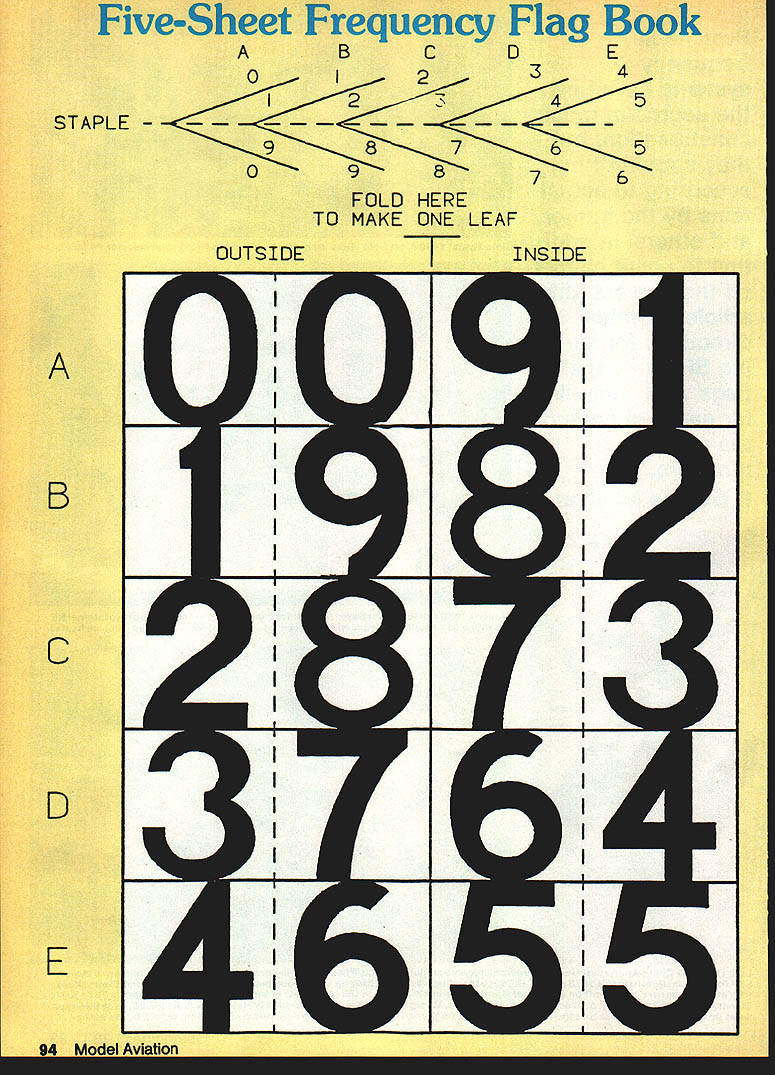
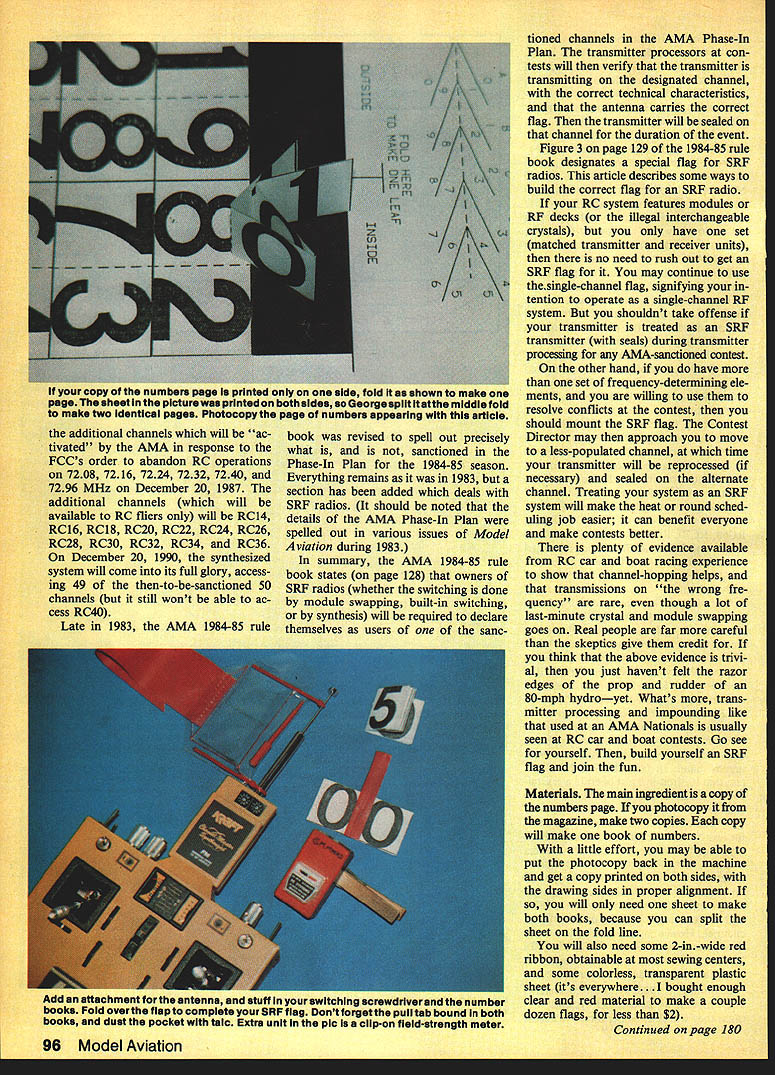
Five-Sheet Frequency Flag Book
A B C D E
STAPLE - FOLD HERE TO MAKE ONE LEAF
OUTSIDE INSIDE
A 0 0 9 1 B 1 9 8 2 C 2 8 7 3 D 3 7 6 4 E 4 6 5 5
This layout produces a small book of number cards that fit into the flag pocket and allow quick channel selection. Each folded leaf yields the necessary digit combinations for every single RC channel, whether 27 MHz, 6‑meters (53 MHz), or 72 MHz. Photocopy the numbers page to make two copies; each copy will make one book of numbers.
Materials
- A copy (or two) of the numbers page. If you can photocopy both sides in proper alignment, one sheet may suffice for two books (split on the fold line).
- About 2‑inch‑wide red ribbon (available at sewing centers).
- Colorless, transparent plastic sheet (clear vinyl). A small amount will make a number of flags; inexpensive at craft or hardware stores.
- Sewing thread and a sewing machine capable of sewing vinyl (set up as described below).
- Small staples for the number-book binding.
- Talcum powder (to dust the pocket and ease removal).
- ZAP (or similar) glue for securing thread ends.
- Small screwdriver or channel‑selecting wand (hex‑end cut from a plastic tuning wand works well).
Construction
- Lay out a piece of colorless, transparent plastic sheet 4-1/2 x 6 in., and fold it to 3 x 4-1/2 in.
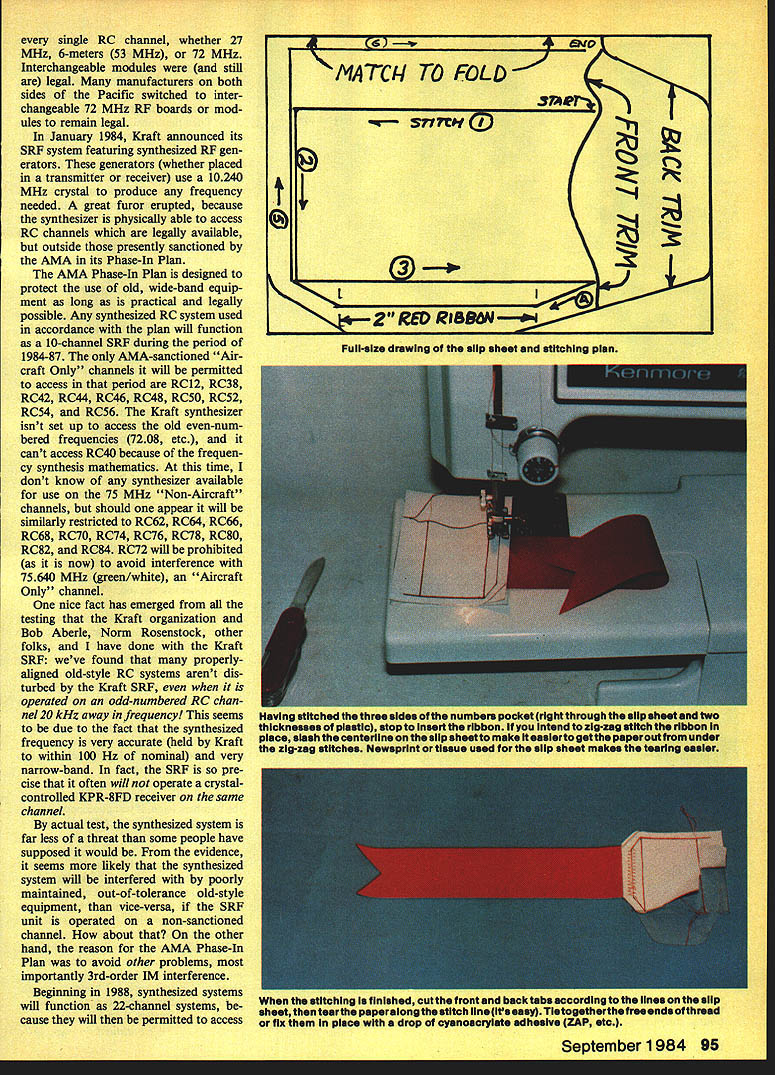
- Cut out a copy of the slip sheet (the printed pattern with stitching and cut lines), and place it on the folded plastic, making sure the correct edge is lined up with the fold. The slip sheet will help prevent the vinyl from sticking to the sewing machine foot and will protect the stitches while sewing.
- Set your sewing machine for about 30 stitches per inch, and sew the seams right through the slip sheet. Leave the needle down when needed so you can lift the foot to turn corners.
- Put the red pennant in place after sewing Seam 3 and before starting Seam 4. A pin or piece of tape can help keep it from slipping while you sew.
- Cut the front and back layers as indicated on the slip sheet to make the finger grooves and tab. Tear off the slip sheet.
- Tie the free ends of the thread, and glue them in place with ZAP (or similar adhesive).
- Remove the button from the tip of your transmitter antenna. Slip the SRF flag over the antenna, then replace the button.
- Cut out and staple two books of numbers. Include a 1/2 x 3‑in. strip of plastic in the binding for the two books of numbers, linking them together at the fold to make removal easier. Dust the pocket with talcum powder to ease card removal. Fold the books to the correct numbers, and stuff them in the pocket. The "digits" number goes in first; the "tens" number should be on top, going in last (for Channel 52, put the 5 above the 2).
- Stuff your screwdriver in the pouch, and fold the flap over to keep everything in the flag. The author made a channel‑selecting screwdriver by cutting the hex end from a plastic tuning wand.
- Fold the flap over to secure the contents. Since vinyl tends to stick to itself, no other fastening is usually necessary. If your plastic doesn't stick to itself, tuck the flap in over the number books.
That's all there is to it.
Transcribed from original scans by AI. Minor OCR errors may remain.

