
Flaglor's Gee Bee Model Y Senior Sportster
By Henry Haffke
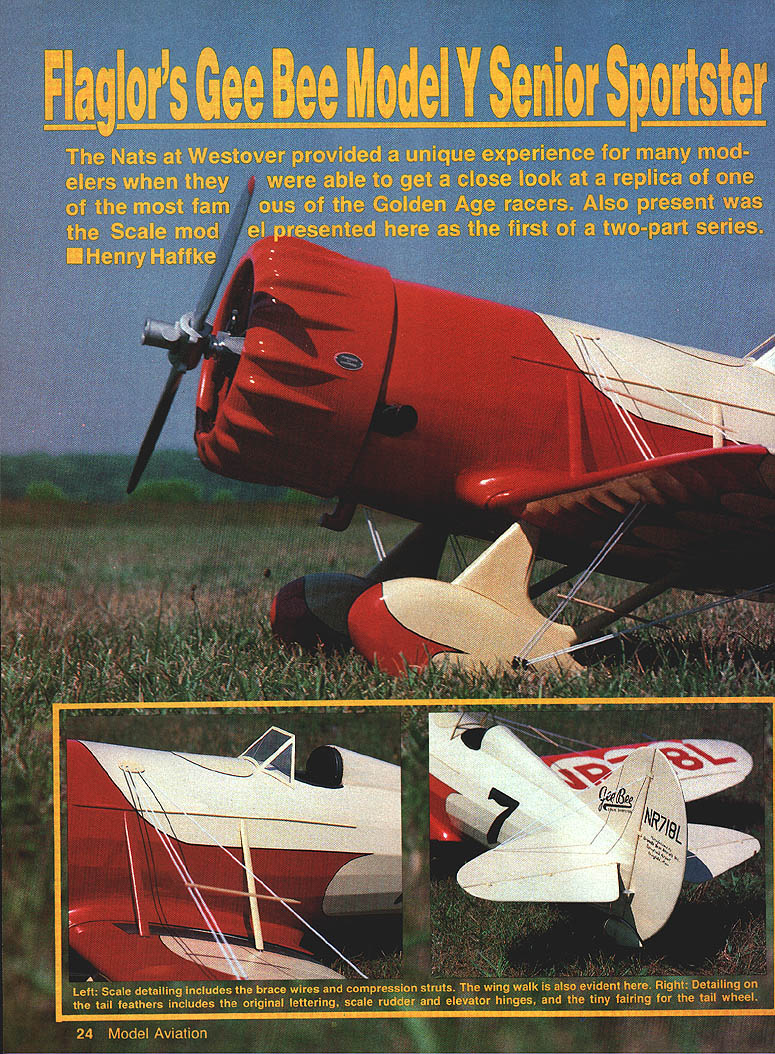
The Nats at Westover provided a unique experience for many modelers who were able to get a close look at a replica of one of the most famous Golden Age racers. Also present was the scale model presented here as the first of a two-part series.
I built my first model Gee Bee in 1975. Since that time I have designed and built no less than ten different Gee Bee models. They have all been very rewarding planes that were a lot of fun to fly. All have been flown in scale meets all over the East; their contest record has been very successful, to say the least.
Building my first Gee Bee models got me involved in a search for documentation, as very little was available on most of these aircraft. The 1931 Thompson Trophy–winning Gee Bee Model Z "City of Springfield" and the 1932 Thompson–winning Gee Bee R-1 (and its sister ship, the R-2) could be well documented; much has been published on these sensational aircraft.
My first Gee Bees, however, were of the earlier Sportster series. Almost nothing could be found in the way of photos and information on these obscure aircraft. After nearly two years of hunting, I located Bob Granville, and he put me in touch with his brother, Ed. They were the only living members of the original five Granville brothers who built those fabulous airplanes in Springfield, MA in the early 1930s.
From these two men I was able to get many photos and much information on the little-known Sportsters. Ed passed away a short time after I came in contact with him, but his wife continued to help in the search for material. Bob Granville and I became good friends, and he attended several model meets with me over the next few years. Bob put me in touch with others who could add to my collection of Gee Bee material.
As time went on I began to see that much of what had been written about the Gee Bee aircraft was grossly inaccurate. I had thought of writing a book on the earlier Sportsters, which was an interesting story in itself. As my firsthand information increased and I realized the terrible injustice that had been done to the Gee Bee aircraft and the men who built them, I decided that the real story should be told.
I decided to write the entire story of all the Gee Bees. I talked to Bob Granville about this and asked him if he would like to co-author the book with me. I wanted to start the book with some background on the five brothers in their younger days and thought he could do better at this than I could. He agreed, and we started to hunt up more information. Bob put me in touch with more people who were involved with the Gee Bees in differing capacities. I got to know people who had owned various Gee Bees, people who had worked in the Gee Bee factory, pilots (both men and women) who raced them, and even pilots who had accidents in Gee Bees. I gathered a mountainous pile of information.
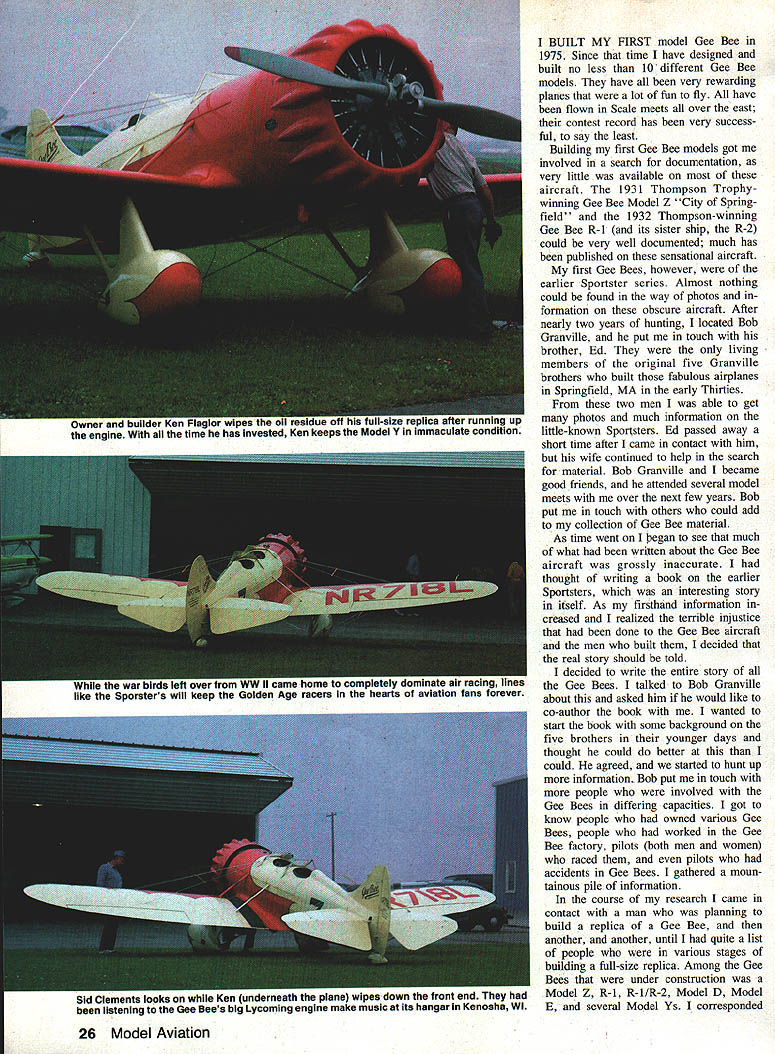
In the course of my research I came in contact with a man who was planning to build a replica of a Gee Bee, and then another, and another, until I had quite a list of people who were in various stages of building a full-size replica. Among the Gee Bees that were under construction were a Model Z, R-1, R-1/R-2, Model D, Model E, and several Model Ys. I corresponded farther with one project more than any of the others I had been talking to. I immediately contacted Ken and made arrangements to meet him the following week. He gave me the entire history of his project as we looked the plane over from top to bottom.
Ken has a strong background in the aviation field. He learned to fly in gliders in 1948 and soon qualified in powered planes. He bought a glider and a Waco UPF-7 for a tow plane. The Waco was destroyed in 1955 while Ken was towing a glider; fortunately his injuries were not serious. While hunting for a new tow plane he found a Fleet 16-B biplane. He did a lot of work on it, including the installation of a 220-hp Continental engine. The aircraft became an excellent tow plane. Ken's brother named the plane the Flaglor High Tow. Ken received the Best Workmanship award for the High Tow at the 1957 EAA Convention. He later sold the craft, and it is still towing gliders on Long Island, NY.
Ken's next project was building a Cherokee glider. He installed two go-kart engines on it for power. In 1967 this led Ken to design an original aircraft called the Flaglor Skooter. The Skooter was a neat little aircraft powered by a VW engine. Ken became very well known for this aircraft; he still sells plans for it.
Ken's next project was a Monnett Sonerai II. He flew this for some time while considering what to do next. Ken wanted something special. It had to be a two-place craft so he could share it with others. It had to be nice to fly, and it had to be a challenging project. Since his early days of building models, Ken had had a liking for the Gee Bees, especially the Model Y. Building a Model Y would suit Ken nicely for a new project.
The Model Y was undoubtedly the best-flying of the Gee Bees. Many who flew it praised its flying characteristics. One of the two Model Ys that were built won the National Aerobatic Championship in 1932. It was a fast plane, frequently raced; in fact it won more races and made more money than the more familiar Gee Bee racers. The Model Y was flown in the Thompson Trophy Race twice and finished in the money both times.
The Granville organization has always been known as a race plane builder, although they only built three racers, one of which was modified into a fourth. They built the racers after seeing the excellent performance of their sport airplanes in many competitions. Times were hard, and they saw the possibility of winning some of the prize money for themselves.
Granville Brothers Aircraft had started in business building a sport biplane which the oldest of the brothers, Zantford "Grannie" Granville, had designed. After building several of the Model A biplanes, they built a single-place low-wing sport plane, the Model X Sportster. The Sportster was an immediate sensation, and several wealthy pilots wanted one. A total of eight of the little Sportsters were built. Four were built with various in-line engines, including Cirrus and Menasco power plants. The other four were built with Warner radial engines. The in-line–powered models were designated Model X, Model C, and Model D Sportsters. The radial-engined craft were called Model E Sportsters.
The Model Y was born when Grannie decided that a two-seat version of the Sportsters would be a good venture with more sales potential than the single-seat job. The first Model Y was designed to take power plants of from 215 to 400 hp; it was built with a Pratt & Whitney 300-hp Wasp. The plane was a delight to fly and was very fast.
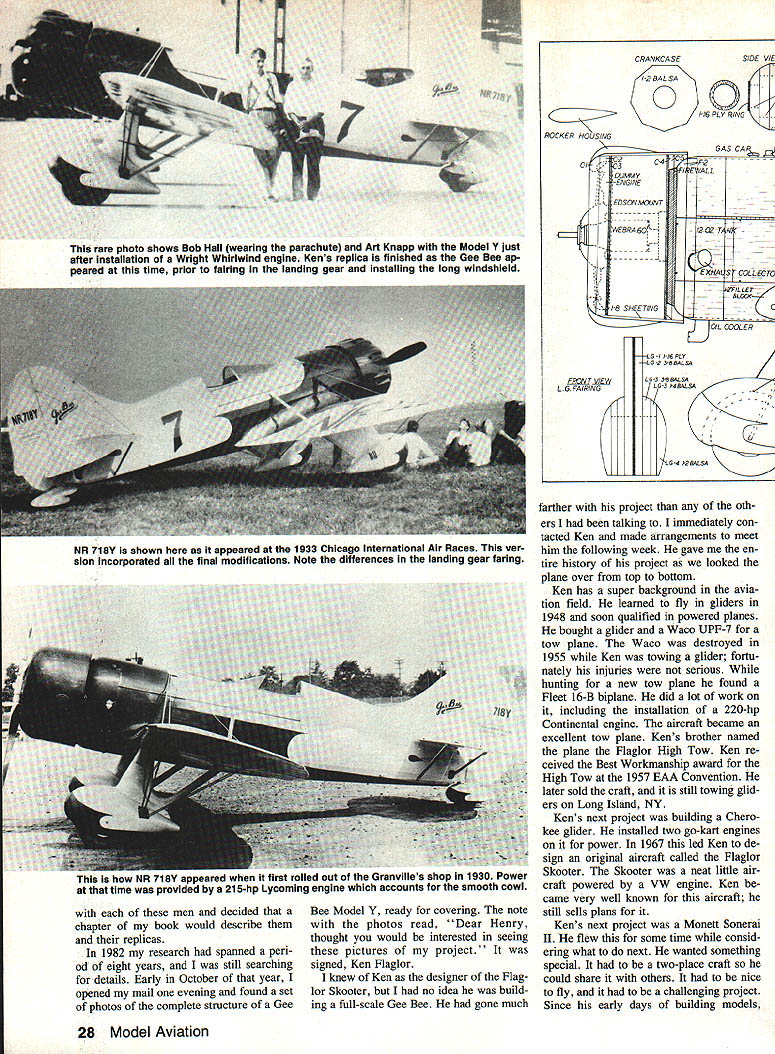
The second Model Y was built for the Cord Automobile Company as a test bed for their new 215-hp radial engine. This Model Y was acquired by Art Knapp in 1933 and modified for the 1933 Chicago International Air Races. A 440-hp Wright Whirlwind was installed for power, the landing gear were faired in, and a long racing windshield was installed over the closed forward cockpit.
The modified Model Y was flown by Florence Klingensmith in the final race of the Chicago event. She crashed into the side of a hill after veering off course. Accounts of the accident told of fabric ripping off a wing, the aircraft breaking up in the air, and other such things. I have spoken to two eyewitnesses, and their story is much different. One of the witnesses was on the field and had a close view while the other (a well-known columnist for a model magazine today) was in the spectator stands.
They agree that Ms. Klingensmith was leading the race, and the plane was really moving. The fabric was bulging up between the ribs on top of the wing as she came around the near pylon. There was a loud pop when the fabric split between the inboard rib and the center section of the wing. This wouldn't throw the aircraft out of control or cause it to crash. After rounding the pylon the plane leveled out, flew off the course, and crashed into a hillside quite some distance away. The pilot was killed. It is possible that she fell victim to fumes in the cockpit, since a closed canopy had been installed before the race.
Bob Hall, who had worked for the Granville Brothers as an engineer, was involved in the modifications done to the Model Y. He had flown it many times. He told me that once during a race he hit a pylon and knocked off 2½ feet from the lower wing. He continued on and landed without any trouble.
The first stock Model Y met its end a few months later. It was being flown near Flushing Meadows after a complete refurbishment. The engine threw a prop blade. The resulting vibration tore the engine out, and the Gee Bee spun into a marsh. It was later destroyed by vandals.
Ken spent all of his spare time on his Gee Bee until it was completed. When I saw his project I was amazed at how much he'd done with the meager information he had to work with. His ability to figure out things about various parts of the aircraft was unbelievable. Some builders are good at welding, others at woodworking, or finishing an airplane; Ken could do it all. He is an amazing craftsman, and his Gee Bee is the most beautiful plane I have ever seen.
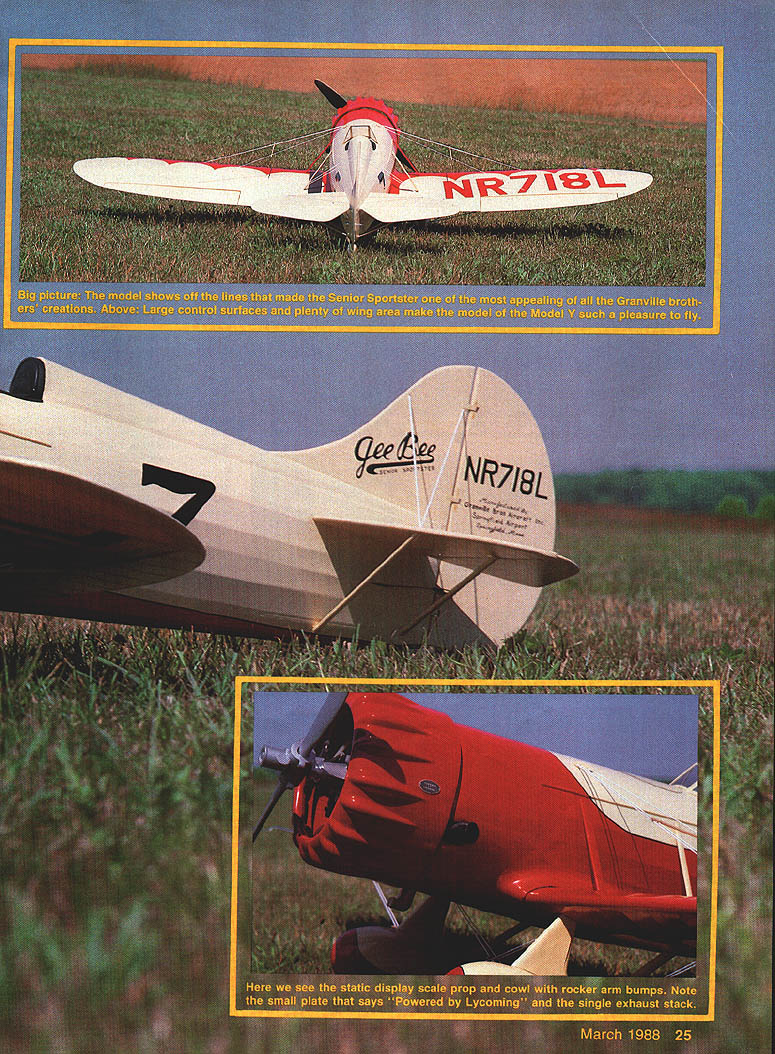
Ken decided to finish his Gee Bee like the second one—as it had been modified for the 1933 Chicago races. He liked the cowl with the rocker-arm bumps, and he liked the original open landing gear fairings. The plane was finished in the original colors, Tucson Cream and Madrid Red. Ken has been questioned as to whether the plane was accurate; the prototype raced with closed landing gear fairings. I have one photo which is a bit fuzzy, but clearly shows the aircraft right after the installation of the Wright engine and before the wheel fairings were closed in. The picture proves that Ken did, indeed, finish his replica accurately.
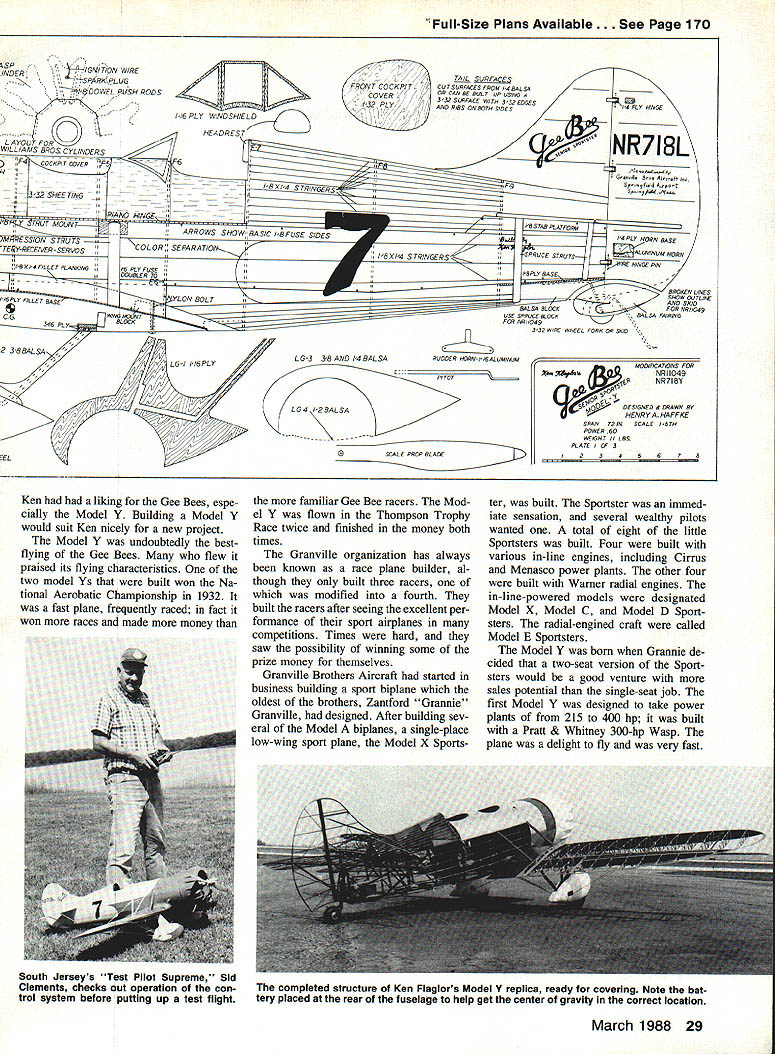
Ken started building his Model Y in January 1977. Work progressed slowly, since he worked on it during the slow months of his business (Ken ran a glass service). He made the first flight on July 4, 1984. It flew beautifully, needing only some brace-wire adjustments to trim it out. The first few landings were plagued with landing-gear dampening trouble. After some experimenting, Ken installed McPherson automotive shocks, and the problems disappeared.
Ken flew off the required number of hours to qualify for cross-country flight. During these flights the plane had the forward windshield removed and the forward cockpit covered over. This was the way the prototype was flown in races; covering the forward cockpit cuts down on drag. After the required time was in, Ken flew the Model Y to Oshkosh. He came home with the Champion Replica Trophy as well as the Northern Illinois Aero Club Best Aircraft Trophy. After Oshkosh, Ken flew to the National AAA Fly-In at Blakesburg, IA. The Model Y received awards for:
- Best Civilian Replica
- Most Rare Monoplane
- Greater NY Chapter Choice
- Best Workmanship by an Owner
Gee Bee Y — Continued
The following year Ken returned to Oshkosh and was again awarded Champion Replica. He left Oshkosh before the meet was over and embarked on the long trip to Westover Air Force Base for the AMA Nats. Since Westover is near Springfield, where the Gee Bees were built, the visit of the Model Y was a historic occasion. Modelers from all over the country were delighted to see Ken's magnificent replica.
I took Ken on a tour of the Springfield area. We visited the museum in Springfield that houses the Gee Bee display. I showed him where Springfield Airport had been; it's the parking lot of a shopping center now. The original hangar is still there, and the spot where the factory had been is marked by a clump of evergreen trees. We drove to the New England Air Museum, where we got a look at an original Gee Bee; the second Model A biplane is housed there. We met the director of the museum and looked at the replica Gee Bee R-1 that they are building from the original factory drawings.
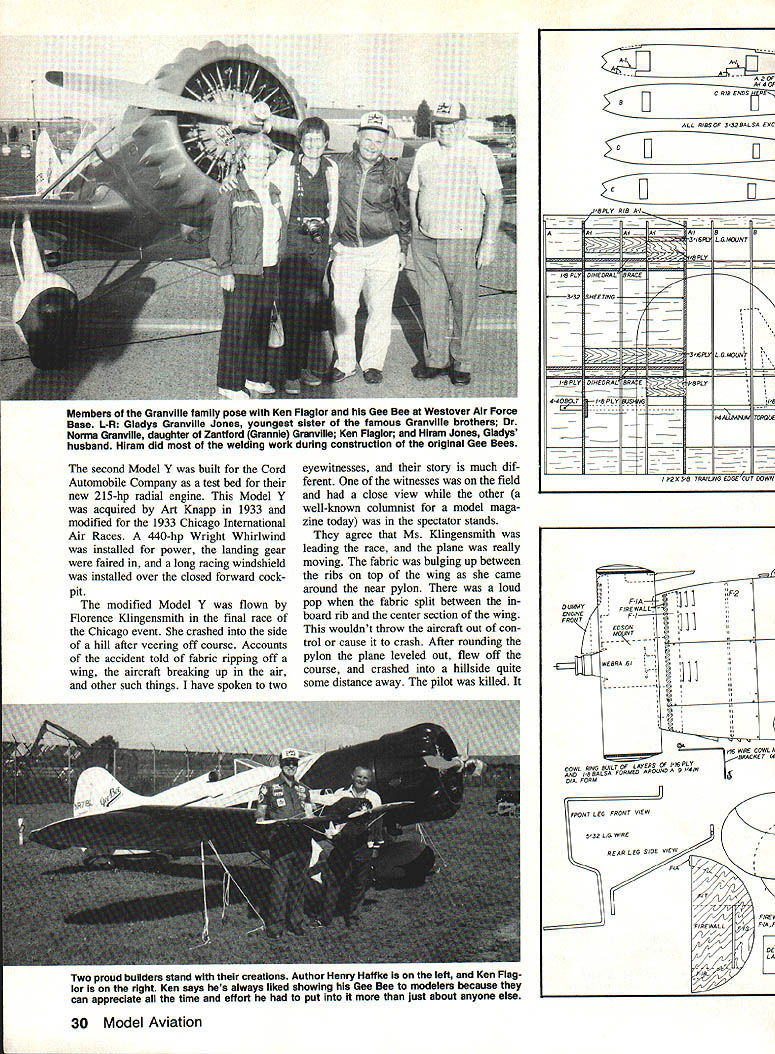
During the next few days at Westover I was able to introduce Ken to several members of the Granville family who came to the Nationals. Ken met Gladys Granville Jones, who was the youngest sister of the five Granville brothers, and her husband, Hiram. Hiram was one of the original factory crew and did most of the welding on the original Model Ys. He also met Norma Granville, the daughter of Zantford Granville, and June Dakin, the daughter of Tom Granville. They were all very pleased to see Ken's beautiful Gee Bee and enjoyed meeting him. I'm sure the plane brought back some old memories for Gladys and her husband.
I will never forget the thrill of seeing Ken lift off from Westover AFB that bright Sunday morning as I stood with Gladys, Hiram, Norma, and their children. It was a beautiful sight to see a Gee Bee over Springfield again. Thank you, Ken, for that wonderful experience.
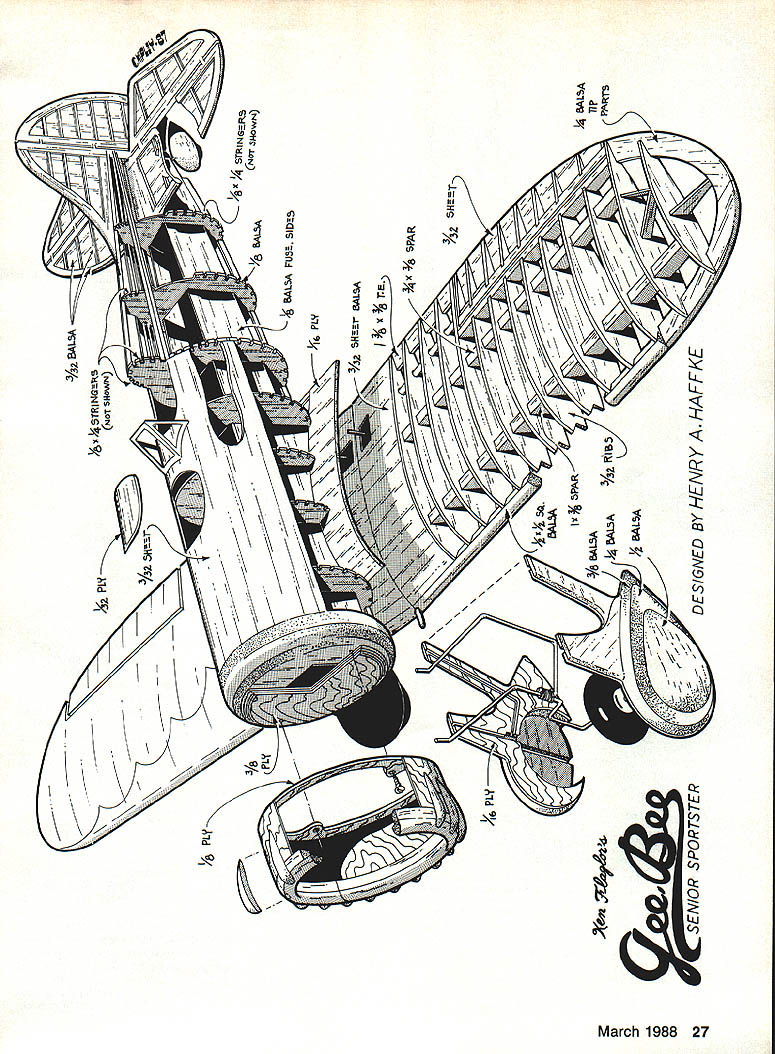
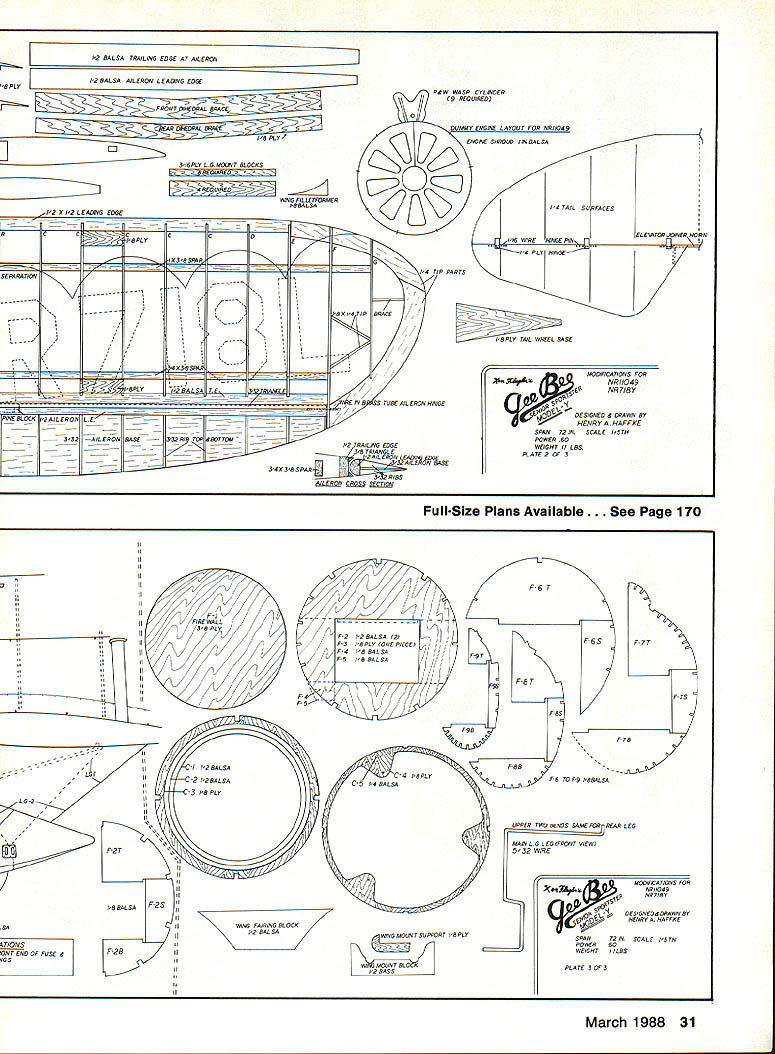
To be continued: Next month, construction details.
Transcribed from original scans by AI. Minor OCR errors may remain.

