
Flightmasters' Second Annual Electric Meet
Text and Photos by Joel Rieman
THERE WAS electricity in the air on the Sunday morning of April 25th and I don't mean lightning. On this morning, the Flightmasters' second annual electric model airplane meet got under way at Mile Square Park in Fountain Valley, CA. The park is literally a mile square which is subdivided into a montage of recreational facilities which include a golf course, picnic area and a modeling site. In years past, these 27,878,400 sq. ft. were operated as an airport until it was shut down due to its urban location. The flying site, which is also infested by RC cars and full-size land sailors, is separated with free-flight, RC and the land sailors each taking one of the 2,000-ft. legs of the equilateral triangle that make up the runways (2,000 ft. being a relatively short strip to put her down on for the modern day full-scale airplane driver) of this abandoned airfield.
Flightmasters, formerly North American Rockwell Flightmasters, prior to the sponsor becoming Rockwell International, is one of the largest scale model organizations in the world and is recognized internationally for its trend setting; at least its trend following. Its membership boasts some of the finest modelers in the country whose names would be familiar to most everyone involved with model aviation. Though Flightmasters is basically a scale modeling club, there were a couple nonscale categories in this meet to help bring electric flying along.
Weather was not a deterrent factor for this meet fortunately, but the status of the weather was questionable in the early hours, not knowing whether or not it would put a damper on the meet. For on this fine and scornful morning, the cloud ceiling was a lofty 1,500 ft. overcast, which is not
Electric Meet/Rieman
(continued from page 55)
to mislead the modeler as some of the early birds found out when their models were nearly sucked up into the cloud base. The tables did turn in our favor with the sky clearing up midway through the meet leaving the usual hazy sunshine. The virgin rays of energy wasted no time setting off some mighty potent lift which seemed to stick around for the remainder of the day.
The idea of using electric motors to power model aircraft has actually been around for quite some time. The concept has been applied with reasonable success, but not until recently has this source of power been used so abundantly. The initial stimulus came when Mattel's Super Star made its debut on the toy market, offering a relatively light electric power source adaptable, with a little butchering, to free-flight models. This recent interest in electric has prompted the development of some very fine motors which are presently being made available to the hobbyist.
The majority of models flown in the categories; Scale, Free-Flight, RC and U-Control, used either the VL Products system or the Astro Flight system, both of which are beautifully engineered powerplants that, by proof of this meet's results, have excellent power and surprisingly long motor runs.
The turnout of models was predominantly Scale and Free-Flight, but participation in all of these categories is likely to increase, being that electric is a rather current trend. (Thanks for the pun Bill Stroman.)
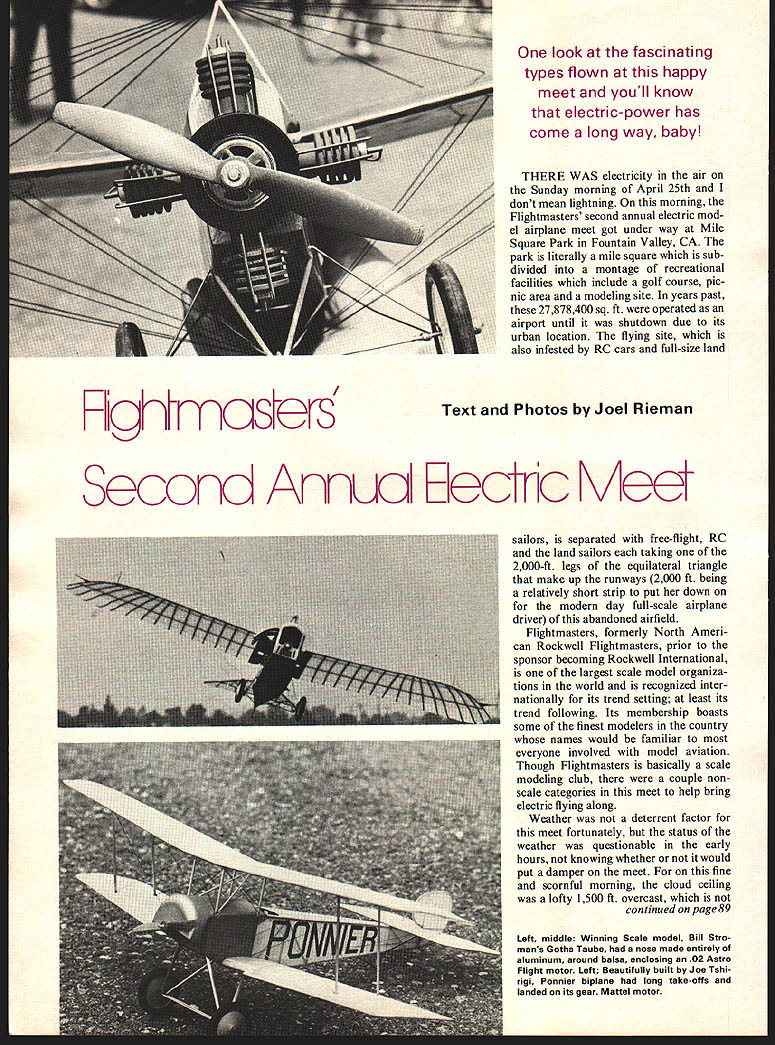
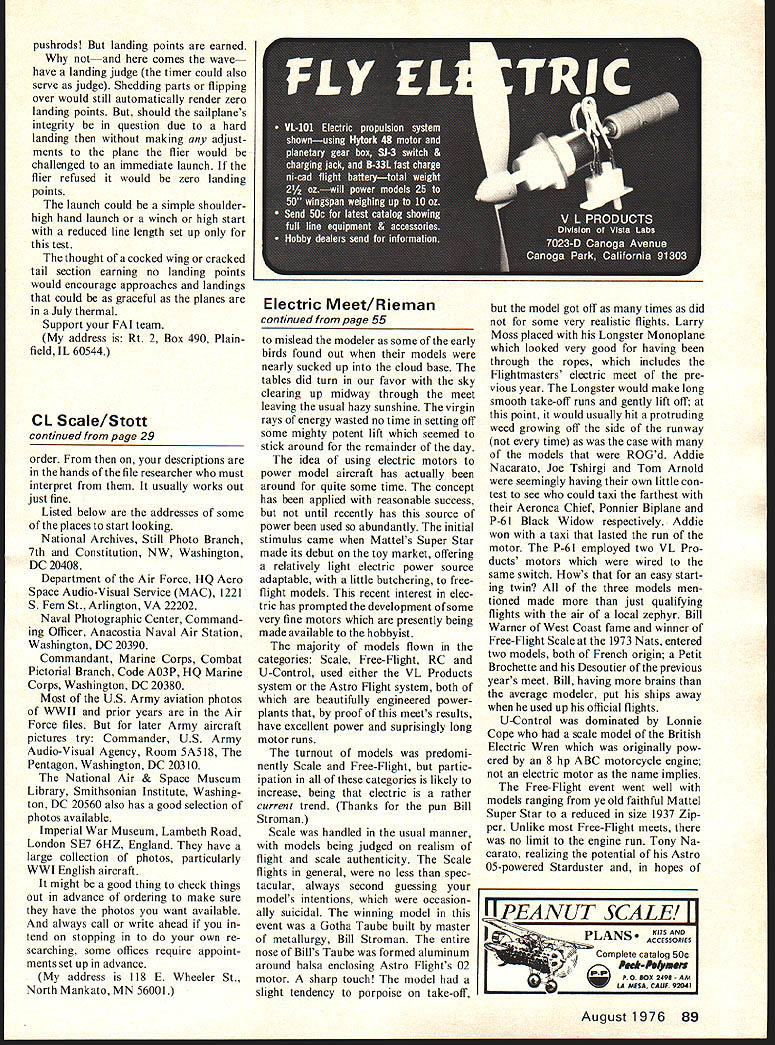
Scale was handled in the usual manner, with models being judged on realism of flight and scale authenticity. The Scale flights in general, were no less than spectacular, always second-guessing your model's intentions, which were occasionally suicidal. The winning model in this event was a Gotha Taube built by master metallurgist, Bill Stroman. The entire nose of Bill's Taube was formed aluminum around balsa enclosing Astro Flight's 02 motor. A sharp touch! The model had a slight tendency to porpoise on take-off, but the model got off as many times as did not for some very realistic flights. Larry Moss placed with his Longster Monoplane which looked very good for having been through the ropes, which includes the Flightmasters' electric meet of the previous year. The Longster would make long smooth take-off runs and gently lift off; at this point, it would usually hit a protruding weed growing off the side of the runway (not every time) as was the case with many of the models that were ROG'd.
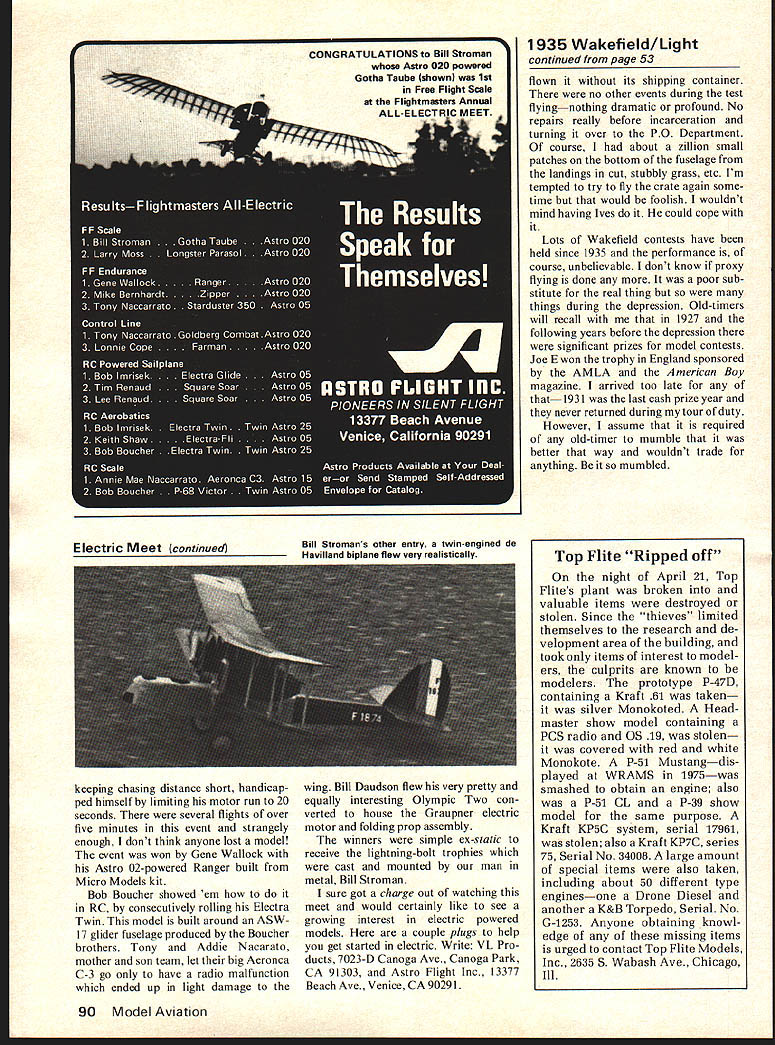
Addie Nacarato, Joe Tshirgi and Tom Arnold were seemingly having their own little contest to see who could taxi the farthest with their Aeronca Chief, Ponnier Biplane and P-61 Black Widow respectively. Addie won with a taxi that lasted the run of the motor. The P-61 employed two VL Products motors which were wired to the same switch. How's that for an easy start? All of the three models mentioned made more than just qualifying flights with the air of a local zephyr. Bill Warner of West Coast fame and winner of Free-Flight Scale at the 1973 Nats, entered two models, both of French origin; a Petit Brochet and his Dossin of the previous year's meet. Bill, having more brains than the average modeler, put his ships away when he used up his official flights.
U-Control was dominated by Lonnie Cope who had a scale model of the British Electric Raven which was originally powered by an 8 hp ABC motorcycle engine; not an electric motor as the name implies.
The Free-Flight event went well with the smaller models ranging from reduced Super Star to a reduced in size 1937 Zip. Unlike most Free-Flight meets, there was no limit to the engine run. Tony Nacarato, realizing the potential of his Astro 05-powered Starduster and, in hopes of
Flightmasters' Second Annual Electric Meet
Keeping chasing distance short, handicapped himself by limiting his motor run to 20 seconds. There were several flights of over five minutes in this event and strangely enough, I don't think anyone lost a model! The event was won by Gene Wallock with his Astro 02-powered Ranger built from Micro Models kit.
Bob Boucher showed 'em how to do it in R.C. by consecutively rolling his Electra Twin. This model is built around an ASW-17 glider fuselage produced by the Boucher brothers. Tony and Addie Nacarato, mother and son team, let their big Aeronca C-3 go only to have a radio malfunction which ended up in light damage to the wing. Bill Davidson flew his very pretty and equally interesting Olympic Two converted to house the Graupner electric motor and folding prop assembly.
The winners were simply ecstatic to receive the lightning‑bolt trophies which were cast and mounted by our man in metal, Bill Stroman.
I sure got a charge out of watching this meet and would certainly like to see a growing interest in electric powered models. Here are a couple plugs to help you get started in electric. Write: VL Products, 7023‑D Canoga Ave., Canoga Park, CA 91303, and Astro Flight Inc., 13377 Beach Ave., Venice, CA 90291.
Transcribed from original scans by AI. Minor OCR errors may remain.

