

The Flinns at Sleeping Bear Dunes
A family vacation culminating in attainment of Level V of the League of Silent Flight is the subject of this charming adventure story — and it was a squeaker. As recalled by Mary Margaret Flinn.
Background
An eight-hour slope flight was the last task needed by my husband, Pat, to achieve League of Silent Flight (LSF) Level V. He had gotten into the LSF Soaring Accomplishments Program at my urging in 1976. The tasks are graduated in difficulty from Level I through V, so they are never beyond the skills a flier has at the time. As each performance level is accomplished, a voucher is sent into the Chicago office; by return mail the pilot receives another that challenges his skills to progress to a higher level. Pat had been working on the Level V tasks for almost two years. He was finding them not quite impossible, but very, very challenging.
Trip to Sleeping Bear Dunes
We planned a family trip from our home in Dearborn, MI to what was reported to be the best slope-soaring site in the Midwest: Sleeping Bear Dunes Lakeshore National Park, on the northwest corner of Michigan's Lower Peninsula. The stage, we hoped, was set for success.
The drive across the state was enjoyable. We stopped and spent a couple of days relaxing with my college roommate's parents, the Durkees, in Fremont. From there we wandered up the lakeshore, making lots of stops. Pat kept looking for high cliffs suitable for slope soaring. As we neared the dune area, we stopped at the Platte River KOA for a weather report from the two modeling couples camping there — Ken and Ruth Bates, Ken and Barb Shaw. Wednesday was supposed to be good, so Plan A was to give it a try the next morning (Wednesday, August 6) at 10 a.m. Our motel was right at the entrance to the Pierce Stocking Scenic Drive, the access road up to the dune observation area near where we would be flying from. We found Karen and Don Patterson at the same motel, eating supper, and cleared Plan A with them — all systems were go.
The Dunes and Maggie
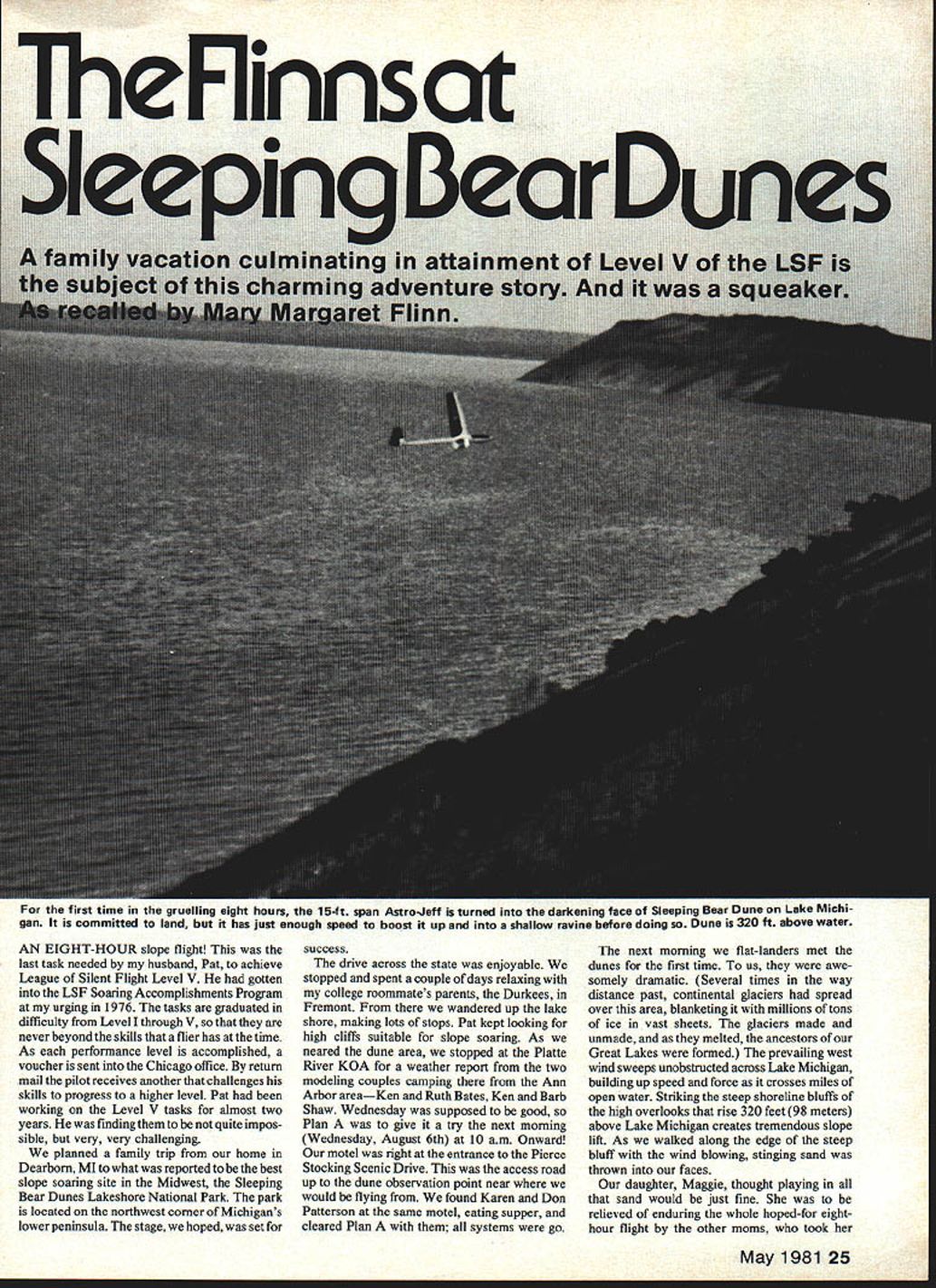
The next morning we flat-landers met the dunes for the first time. To us they were awesomely dramatic. Several times in the distant past continental glaciers had spread over this area, blanketing it with millions of tons of ice. As the glaciers melted, the ancestors of our Great Lakes were formed. The prevailing west wind sweeps unobstructed across Lake Michigan, building up speed and force as it crosses miles of open water. Striking the steep shoreline bluffs of the high overlooks — which rise 320 feet (98 meters) above Lake Michigan — creates tremendous slope lift. As we walked along the edge of the steep bluff with the wind blowing, stinging sand was thrown into our faces.
Our daughter Maggie thought playing in all that sand would be just fine. She was to be relieved of enduring the hoped-for eight-hour flight by the other moms, who took her swimming about noon. Maggie really loves the other three youngsters — Brian Bates, age three; Kristie Shaw, age two; Amanda Jean Patterson, age two. Being eight years old, Maggie relished playing big sister.
At one point a trail marker stated, “Two miles to Lake Michigan, three-hour round trip hiking time.” It was hard to believe. Some other adventurers continued a bit farther and kept calling back that the progress seemed like the lake should be just over the next ridge. It wasn't. Three hours would have had us hiking after dark, so reluctantly we retraced our steps down the dune, determined to try again another day.
Other activities
The modelers and families also got an intimate look at the countryside:
- We rented canoes and drifted down the Platte River. Pat and I paddled at the ends; Maggie and our old English sheepdog Misty (almost the same size as Maggie) sat in the middle. We slipped along the smooth current past wooded stretches and undeveloped riverbanks; it felt like another land. In a two-hour span we reached Lake Michigan and swam in the narrow mouth of the cool, swift-flowing stream.
- Farther upstream we visited the Platte River Fish Hatchery and saw the Coho salmon that stock the lake and rivers.
- Another afternoon we visited the nearby Interlochen Music Camp, enjoyed a dress rehearsal of a student symphony concert, and watched talented young people from all over the world.
Packing and preparation
We had most of what was needed for an all-day slope session:
- Food and water
- Bug repellent
- Suntan lotion
- First-aid kit
- Chairs
- Rain gear
- Cameras
One item someone neglected was the wind. The wind did well blowing grains of sand around and could support RC sailplane flights; but during one afternoon it barely averaged a half hour of usable lift.
The attempted flights
Ken Shaw had completed a four-hour flight the previous Sunday, so we were sure eight hours could be done easily some day. Pat was less enthused after returning to the motel one night when the weather forecast for the remainder of the week promised rain. There was no consoling Pat.
It had stormed Thursday night, and shifting sand had blocked the access road to the dune. The Park Ranger informed us the drive would not open until about 1 p.m. — a big problem. A 1 p.m. start, plus at least a half hour of preparation time, plus an eight-hour slope flight would equal darkness. So we waited at the head of a long line of cars hoping for earlier entry. John and Trixi Vanderploeg from Muskegon arrived and joined the waiting party. Finally, at 12:30 p.m., the ranger opened the gate. I was driving, and at Pat's urging I believe we set a new dune-climb record for the lowest E.T. in the station wagon class.
Pat assembled his 15-ft wingspan version of Jerry Mrlik's Astro-Jeff design — the same plane that was an award winner at Toledo and was used by the Greater Detroit Team to win the 1980 Great Race V. Nothing special was done to the three-channel Kraft equipment. The 1.4 Ah NiCads in the transmitter had been cycled, and four C-size alkaline energizers were soldered together for the airborne battery pack.
The wind was light and coming at an angle out of the southwest. Forecasts predicted a shift to the west and increase to 15–20 mph. Consequently, a compromise of one pound of ballast was added, bringing the weight up to eight pounds and the wing loading to about 12 oz per sq ft.
At 12:55 p.m. on Friday, August 8, Pat tossed his plane off the edge out over the lake. Initially lift was barely enough to keep it up. After a tense 45 minutes, during which the wind had been building, the wind suddenly shifted more to the west and strengthened to the predicted 15–20 mph. Pat's plane climbed on the lift, and at 1:50 p.m. he began his eight-hour slope flight.
Because we had such a late start, a more comfortable height was sought as the slope began to work in the rising, shifting wind. As the forecast had only been marginal, I had a minimum supply of rations, assuming we would be down soon.
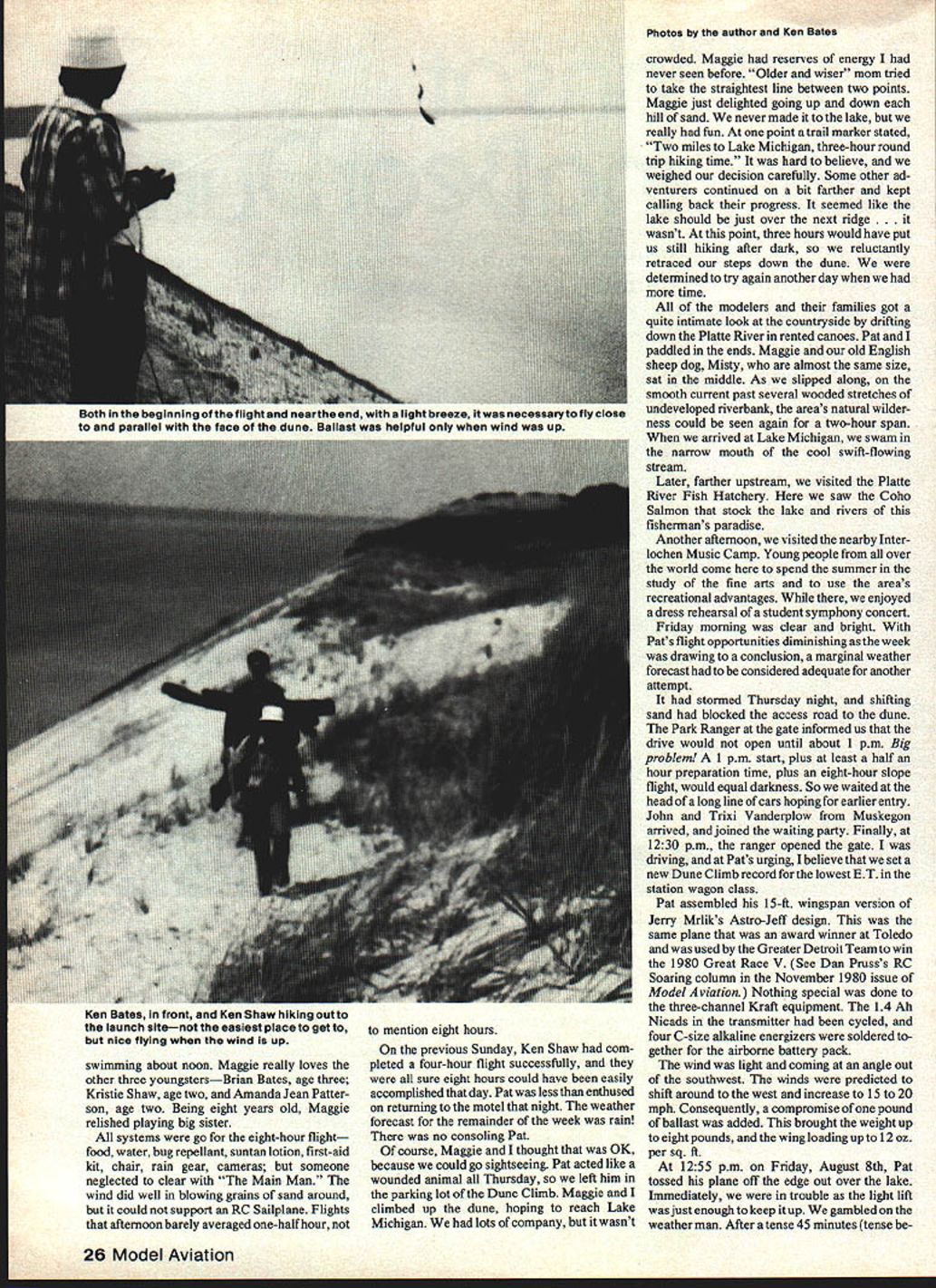
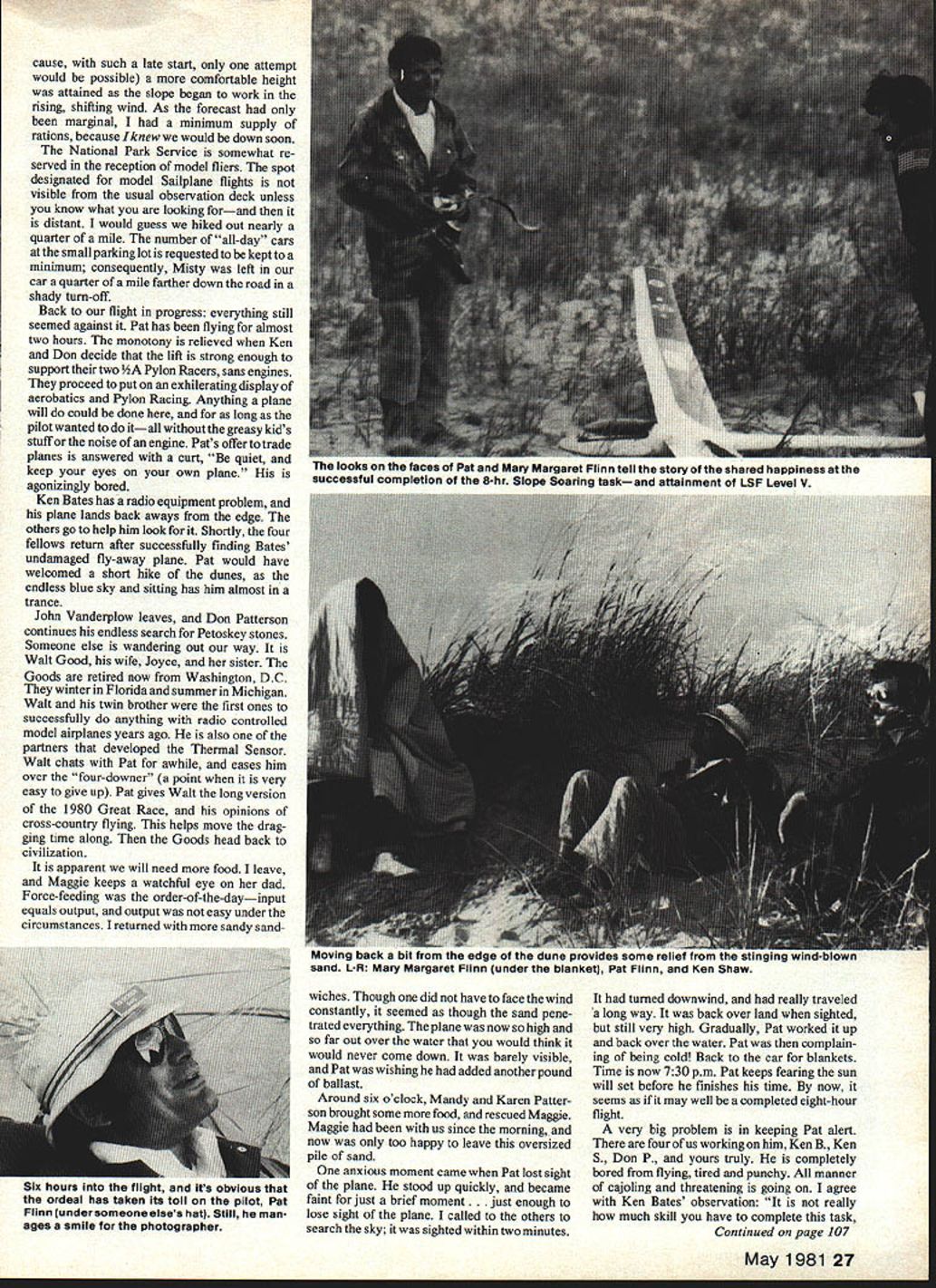
The National Park Service is somewhat reserved toward model fliers. The spot designated for model sailplane flights is not visible from the usual observation deck unless you know what you are looking for — and then it is distant. We hiked nearly a quarter mile out. The number of “all-day” cars at the small parking lot is requested to be kept to a minimum; consequently Misty was left in our car a quarter mile farther down the road in a shady turn-off.
During the flight
After almost two hours the monotony of long-duration slope flying was relieved when Ken and Don decided the lift was strong enough to support their two 1/2A pylon racers (sans engines). They put on an exhilarating display of aerobatics and pylon racing. Anything a plane will do could be done here, and for as long as the pilot wanted — all without the greasy kid's stuff or engine noise. Pat, flying his long-duration job, was agonizingly bored.
Ken Bates had a radio equipment problem and his plane landed back away from the edge. The others hiked to help search and soon returned with Bates' undamaged fly-away. Pat would have welcomed a short hike of the dunes; the endless blue sky and long sitting had him almost in a trance.
John and Trixi Vanderploeg left at one point, and Don Patterson continued his endless search for Petoskey stones. Walt and Joyce Good and Joyce's sister wandered over. Walt Good, retired from Washington, D.C., winters in Florida and summers in Michigan. Walt and his twin brother were among the first to successfully do something with radio-controlled model airplanes years ago; Walt was also one of the partners who developed the Thermal Sensor. Walt chatted with Pat for a while and eased him over the “four-downer” — that low point when it is very easy to give up. Pat gave Walt the long version of the 1980 Great Race and his opinions of cross-country flying; it helped move the dragging time along.
We realized we would need more food. I left to get more sandwiches, and Maggie kept a watchful eye on her dad. The sand penetrated everything. The plane was now so high and so far out over the water that you would think it would never come down; it was barely visible, and Pat was wishing he had added another pound of ballast.
Around six o'clock, Mandy and Karen Patterson brought more food and rescued Maggie, who had been with us since morning and was only too happy to leave the oversize pile of sand.
One anxious moment came when Pat lost sight of the plane. He stood up quickly and became faint for a brief moment — just enough to lose sight of the plane. We all searched the sky; it was sighted within two minutes. It had turned downwind and had traveled a long way, but was back over land and still very high. Gradually, Pat worked it up and back over the water. He then complained of being cold; back to the car for blankets. Time was now 7:30 p.m. Pat kept fearing the sun would set before he finished his time. By then it seemed the eight-hour flight might well be completed.
Keeping Pat alert became a big problem. Four of us worked on him — Ken Bates, Ken Shaw, Don Patterson, and myself. He was completely bored, tired, and punchy. As Ken Bates observed, “It is not really how much skill you have to complete this task, but how badly you want it. It is a test of desire.”
The final hour and landing
As the sun started to set the wind velocity dropped, and with it the lift. Gradually the plane descended. I called encouragement: “Come on, Flinn, you keep telling me how sailplane pilots can get it up higher and keep it up longer. I don't know what you do to keep it up, but you better do it.” His frustrated reply: “I'm doing it, I'm doing it!” — but nothing he could do would regain the lost altitude.
Time was critical. At 8:30 p.m. the plane continued to lose altitude. Anything short of 8:55 p.m. would mean the whole day had been just practice. Cajoling gave way to desperate prayer. At 8:50 p.m. the plane was at launch height (probably about 400 feet) above our heads.
The rules required the plane to land within 200 meters of the launching point to qualify. The ground crew calculated that if he could just hang on and risk a landing on the face of the dune, short of the water, it would be satisfactory. The rate of descent barely lessened; the plane descended to eye level, flying parallel to and hugging the dune face, almost touchable as it floated by at just above stall speed on the last wisps of lift. How he wished he could take out the ballast. We were so close.
At 8:55 p.m. the plane was below the top of the dune — the required time had been completed, but what about the plane? Pat flew it into a small ravine, then brought it back up over the edge to within the required closeness for a valid finish — at 8:58 p.m.
Wild cheering went up from the ground crew and from the observation deck. The Goods and the Vanderploegs had returned to watch the finish and had informed sightseers of what was happening. We had a real gallery up there watching.
It was still daylight over the lake, but in the dune's shadow it was dark. We were happy but completely drained. That last hour was a real strain. The hike back seemed like miles. Had it not been successful, I'm not sure we could have made it.
Aftermath
Saturday was a new day, but a thermal soaring contest in nearby Traverse City started early. Pat was on Cloud 9. He did everything right without even trying that day. He was a Level V, and he punctuated it by taking first place with a 110-point margin.
Traverse City is famous for its Cherry Festival and crops of both sweet and sour cherries. That Saturday night the six couples and four youngsters had dinner together and celebrated the week's triumphs with fresh cherry pie. It was a delicious end to a week we will all long remember in the sands of Michigan's Sleeping Bear Dunes.
Transcribed from original scans by AI. Minor OCR errors may remain.

