
Florida Express
By Stuart L. Richmond
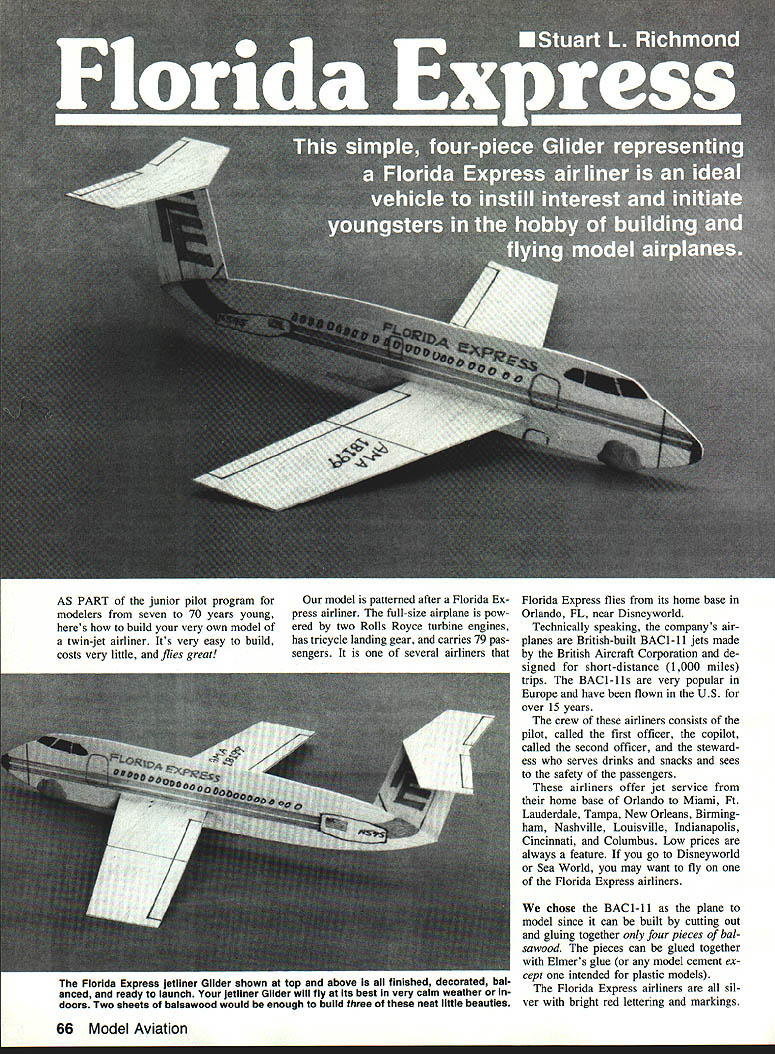
This simple, four-piece glider representing a Florida Express airliner is an ideal vehicle to instill interest and initiate youngsters in the hobby of building and flying model airplanes.
As part of a junior pilot program for modelers from seven to 70 years young, here’s how to build your very own model of a twin-jet airliner. It’s very easy to build, costs very little, and flies great!
The model is patterned after a Florida Express airliner. The full-size airplane is powered by two Rolls-Royce turbine engines, has tricycle landing gear, and carries 79 passengers. It is one of several airliners that Florida Express flies from its home base in Orlando, FL, near Disneyworld.
Technically speaking, the company’s airplanes are British-built BAC 1-11 jets made by the British Aircraft Corporation and designed for short-distance (about 1,000 miles) trips. The BAC 1-11s are very popular in Europe and have been flown in the U.S. for over 15 years.
The crew of these airliners consists of the pilot (called the first officer), the copilot (called the second officer), and the stewardess, who serves drinks and snacks and sees to the safety of the passengers.
These airliners offer jet service from Orlando to Miami, Ft. Lauderdale, Tampa, New Orleans, Birmingham, Nashville, Louisville, Indianapolis, Cincinnati, and Columbus. Low prices are always a feature. If you go to Disneyworld or Sea World, you may want to fly on one of the Florida Express airliners.
We chose the BAC 1-11 as the plane to model since it can be built by cutting out and gluing together only four pieces of balsa wood. The pieces can be glued together with Elmer’s glue (or any model cement except one intended for plastic models). The Florida Express airliners are all silver with bright red lettering and markings.
Materials and Patterns
- 1 sheet 1/32" balsa, 3" wide × 36" long (for wings, stabilizer, rudder)
- 1 sheet 1/16" balsa, 2" wide × 36" long (for fuselage)
- Elmer’s glue or similar (not plastic model cement)
- Sharp modeling knife
- Flat work surface
- Small bit of modeling clay or gum (for nose weight)
- Red and black felt-tip pens (for markings and windows)
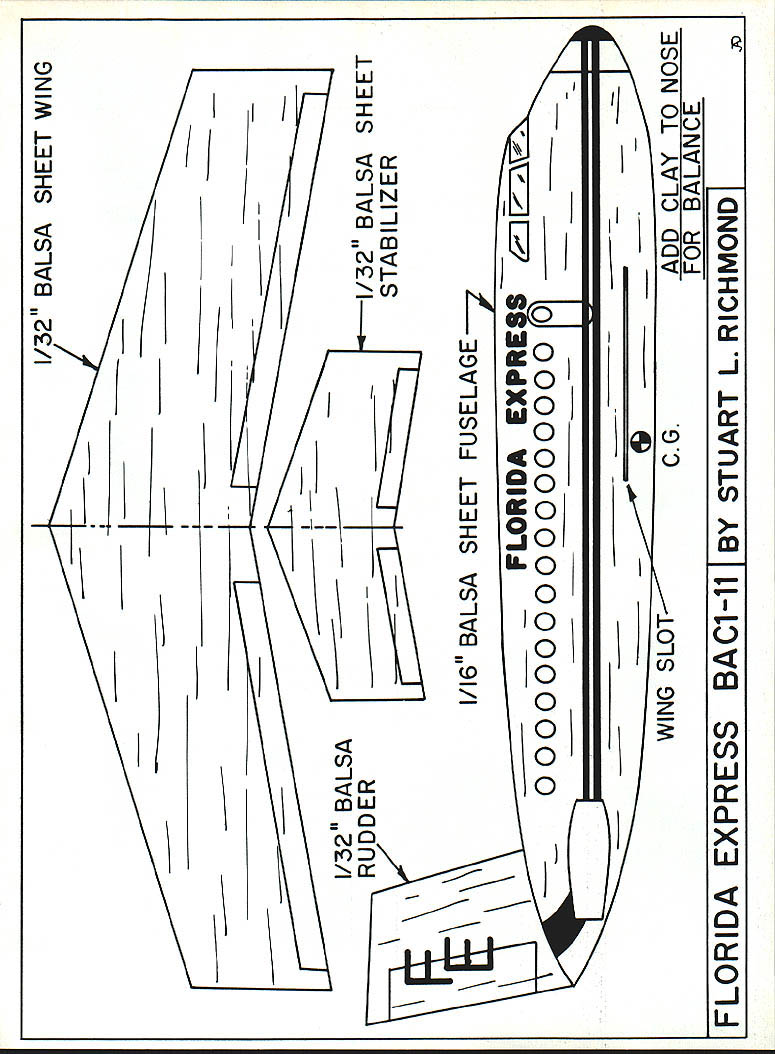
- Paper patterns for the four pieces (wing, stabilizer, rudder, fuselage)
Two sheets (one of each size above) will be enough to build three jetliner models. Be sure to choose the flattest sheets you can find; they don’t need to be the lightest but must lie flat on the table.
Parts (patterns)
- Wing (from 1/32" sheet)
- Stabilizer (from 1/32" sheet)
- Rudder (from 1/32" sheet)
- Fuselage (from 1/16" sheet)
Construction
Cutting and Preparation
- Neatly cut out the paper patterns for the four pieces.
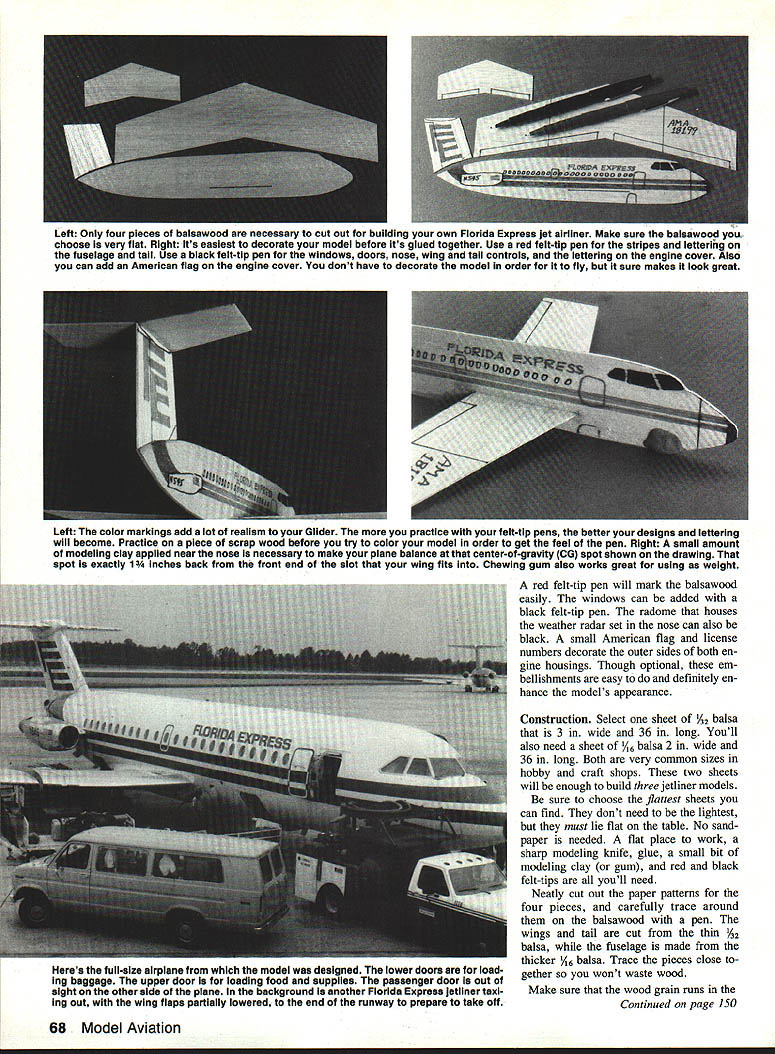
- Carefully trace around the patterns on the balsa with a pen. Trace pieces close together to avoid wasting wood. Make sure the wood grain runs lengthwise.
- Cut the wings and tail from the thin 1/32" balsa; make the fuselage from the thicker 1/16" balsa.
- No sandpaper is needed. Be accurate and precise—especially the slot in the fuselage for the wing and the top and bottom cuts of the rudder. If the wing slot is not accurate, the model won’t fly correctly.
Decoration
- If you wish to decorate the parts, do so before you glue them together.
- A red felt-tip pen will mark the balsa wood easily. Windows and the radome (weather radar area in the nose) can be added with a black felt-tip pen.
- A small American flag and license numbers can be added to the outer sides of both engine housings. These embellishments are optional but enhance the model’s appearance.
Assembly
- Glue the parts together as shown in the photos (or following the paper pattern alignment). Use Elmer’s or similar glue. Allow glue to dry thoroughly before handling.
Balance and Center of Gravity (CG)
- Add weight for correct fore-aft balance by placing a small amount of modeling clay (or chewing gum) on the model’s nose under the cockpit.
- The center-of-gravity (CG) is located exactly 1 1/4 inches back from the front of the wing slot in the fuselage. It is very important that the CG be accurate for the plane to fly well.
- You may also add a little clay to either wing tip to correct any tendency to turn.
Flying
Florida Express prides itself on smooth, gentle rides for passengers. This model jet flies just as smoothly.
- Practice launching the model in a gentle downward path with enough forward speed to fly. Keep your wrist stiff so the model gets a straight flight with no twists.
- To get it gliding well you may have to move, add, or remove a bit of nose clay. You may also have to add a little clay to either wing tip to make it fly straight.
- This model flies best when conditions are calm or with light winds at most.
- When you have it sailing smoothly, look for a high place from which to glide it, such as a steep hill or raised porch, then practice throwing it harder and see what fun you can have.
Remember, you should have enough wood left over for two more airliners.
Transcribed from original scans by AI. Minor OCR errors may remain.

