
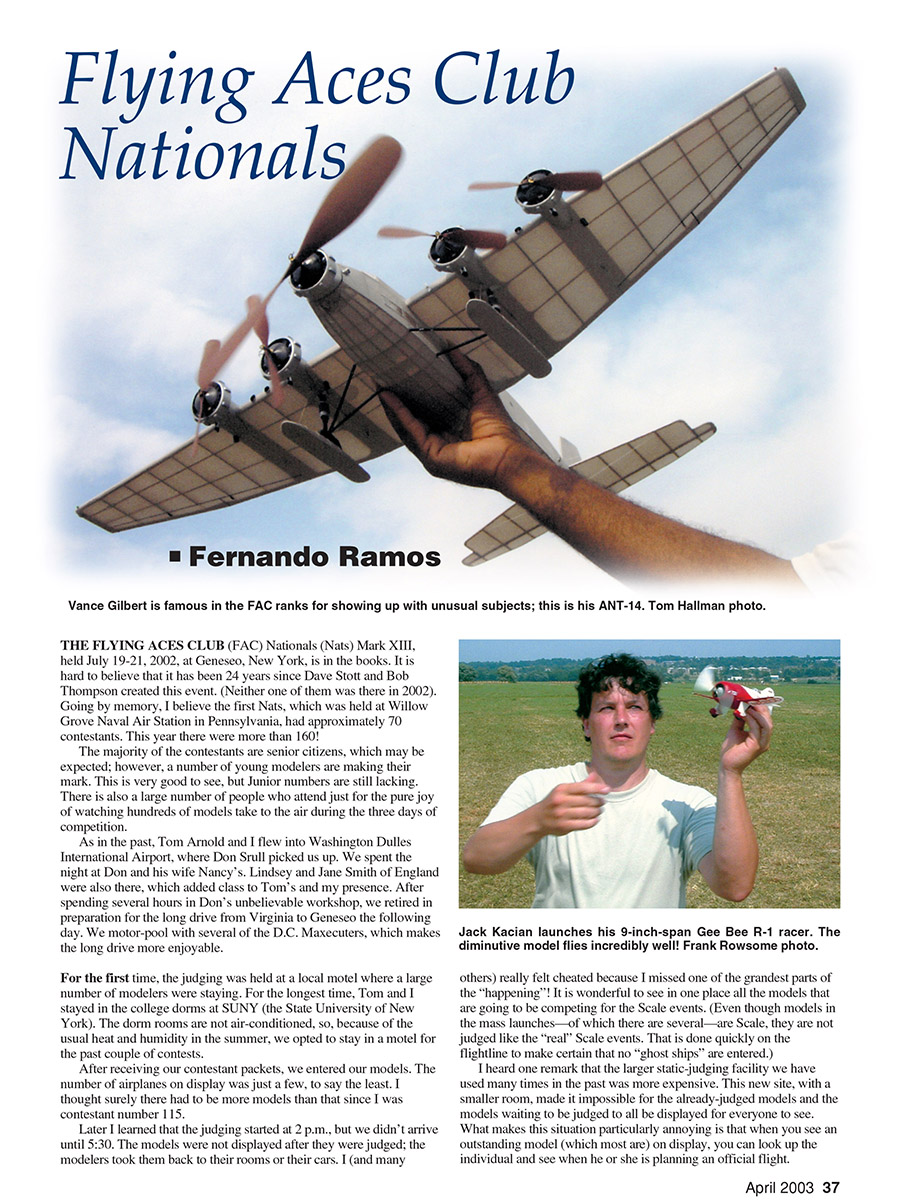
Flying Aces Club Nationals
Fernando Ramos
Overview
The Flying Aces Club (FAC) Nationals (Nats) Mark XIII, held July 19–21, 2002, at Geneseo, New York, is in the books. It is hard to believe that it has been 24 years since Dave Stott and Bob Thompson created this event (neither was there in 2002). Going by memory, I believe the first Nats, held at Willow Grove Naval Air Station in Pennsylvania, had approximately 70 contestants. This year there were more than 160!
The majority of contestants are senior citizens, which may be expected; however, a number of young modelers are making their mark. This is very good to see, but Junior numbers are still lacking. There is also a large number of people who attend just for the pure joy of watching hundreds of models take to the air during the three days of competition.
Arrival and Lodging
As in the past, Tom Arnold and I flew into Washington Dulles International Airport, where Don Srull picked us up. We spent the night at Don and his wife Nancy’s. Lindsey and Jane Smith of England were also there, which added class to Tom’s and my presence. After spending several hours in Don’s unbelievable workshop, we retired in preparation for the long drive from Virginia to Geneseo the following day. We motor-pooled with several of the D.C. Maxecuters, which makes the long drive more enjoyable.
For the first time, judging was held at a local motel where a large number of modelers were staying. For the longest time Tom and I stayed in the college dorms at SUNY (the State University of New York). The dorm rooms are not air-conditioned, so because of the usual heat and humidity in the summer, we opted to stay in a motel for the past couple of contests.
Judging and Model Display
After receiving our contestant packets, we entered our models. The number of airplanes on display was disappointingly small; I thought surely there had to be more since I was contestant number 115. Later I learned that judging started at 2 p.m., but we didn’t arrive until 5:30. The models were not displayed after they were judged; the modelers took them back to their rooms or their cars. Many of us felt cheated because we missed one of the grandest parts of the event — seeing all the Scale models arrayed together. (Even though models in the mass launches—of which there are several—are scale, they are not judged like the “real” Scale events. That quick check is done on the flightline to prevent “ghost ships” from being entered.)
I heard one remark that the larger static-judging facility we have used in the past was more expensive. This new site, with a smaller room, made it impossible for already-judged models and models waiting to be judged to all be displayed for everyone to see. What makes this particularly annoying is that when you see an outstanding model on display you can look up the individual and see when he or she is planning an official flight.
That said, I still saw many outstanding models and flights. Plus, it is always great to see many old friends and make new acquaintances.
Weather and Events
The weather wasn’t too bad for the most part — it never rained. The early mornings were best, with virtually no wind. The wind would come up later in the day, and those retrieving for the mass-launch events had to hustle great distances.
There are so many mass-launch events that it is hard to keep up, but they remain popular. All who participate in these events are dynamite rubber fliers; you have to be excellent to keep placing and reach the final round. However, that isn’t the only requirement; age and physical stamina are important if one is planning to become Grand Champion. You have to be in great shape to retrieve round after round!
Jumbo and Giant Scale events are judged at the field. Unfortunately, because of their size they cannot be displayed with all of the other models. Periodically you can look up and see one of these majestic masterpieces cruising along oh so realistically. There is no doubt that bigger is better!
Just imagine three days of this event — there is nothing like it on the planet. I had the opportunity to meet many new people and visit with old friends, and that alone is worth the trip.
Vendors and New Kits
Many cottage industries displayed an array of goodies for sale. Highlights include:
- Easy Built Models — I met the new owner, Dave Niedzielski. He’s enthusiastic and will do well with the business.
- Dave Delsi — had his tent up selling his line of World War I rubber models.
- Golden Age Reproductions — on hand with their offerings.
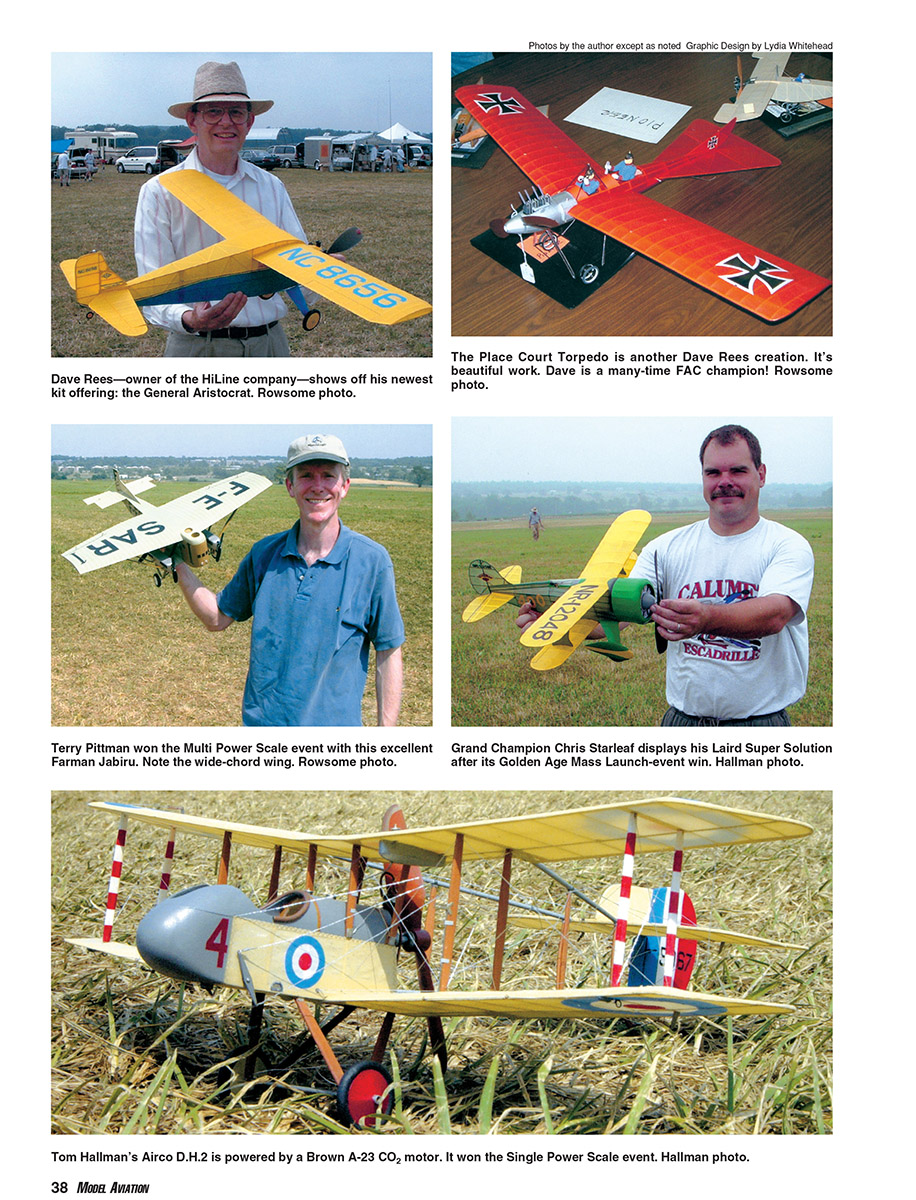
- Dave Rees — who had a large line of paraphernalia for the rubber and electric flier, is branching into the kit business. His first kit is the General Aristocrat. He built one from his kit to make sure all is okay and brought it to compete in Jumbo Scale. It flew out of sight — a beautiful kit and a terrific flyer.
- GizmoGeezer (Orv Odom) and Marcy Green — busy selling their products. They have added a winder with an interesting torque meter that functions like a revolving bar graph.
- Dennis Norman — author of “Color Copier Techniques” (Model Aviation, June 2002) had for sale his recent article about how to make lozenge patterns and other details on tissue with the computer. He brought the Spad featured in his article, a Fokker D.VII, and a Me 109.
I purchased the Fokker packet and was thoroughly impressed. You get two booklets — one on construction of the aircraft and one on how to build and cover it — plus the set of drawings for building the model. The real kicker is that all of the covering for the model is printed on Japanese tissue using the correct lozenge pattern and color, including fuselage and tail, with the crosses detailed as required. Also included is a colored three-view, from which all of the printing was taken. All precut sheets were in a foam-board packet so nothing would get wrinkled or destroyed.
For anyone interested in acquiring any of the three rubber-powered model packets, Dennis’s telephone number is (216) 631-7774.
Awards and Winners
After the flying ended on Sunday, a brief rest was needed before attending the banquet in the evening. Many trophies were awarded to the winners of the various events.
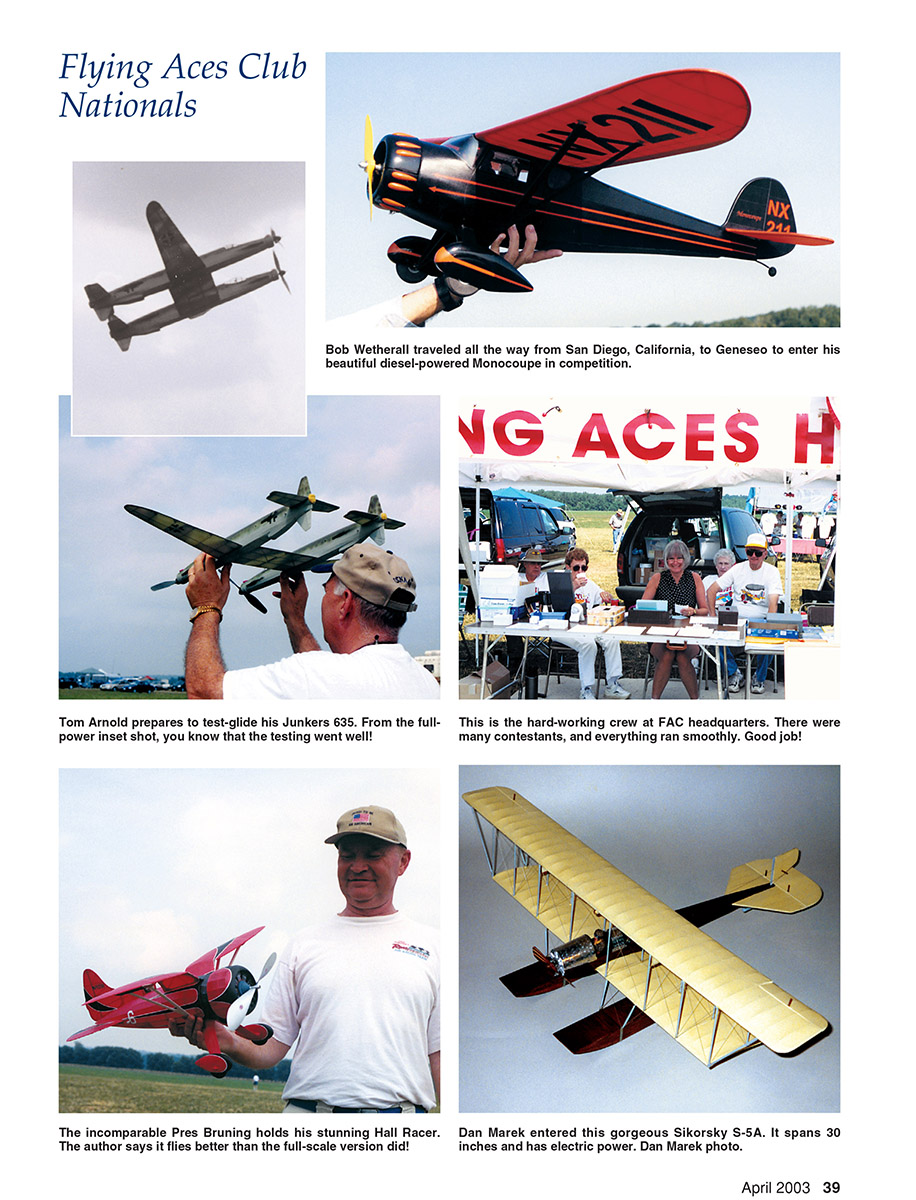
Chris Starleaf won Grand Champion again (he was the 2000 winner) and deservedly so. He brought 19 airplanes! This gives you an idea of what it takes to be at the top in addition to the energy of 10 teenagers. The old stalwarts are still winning and placing, but the energy required to fly as many events as necessary keeps them from being the top dog.
If Chris brought 19 models, I assume the average number of models each modeler brings is 10; that makes at least 1,600 models! Where but at the FAC Nats will you ever see this?
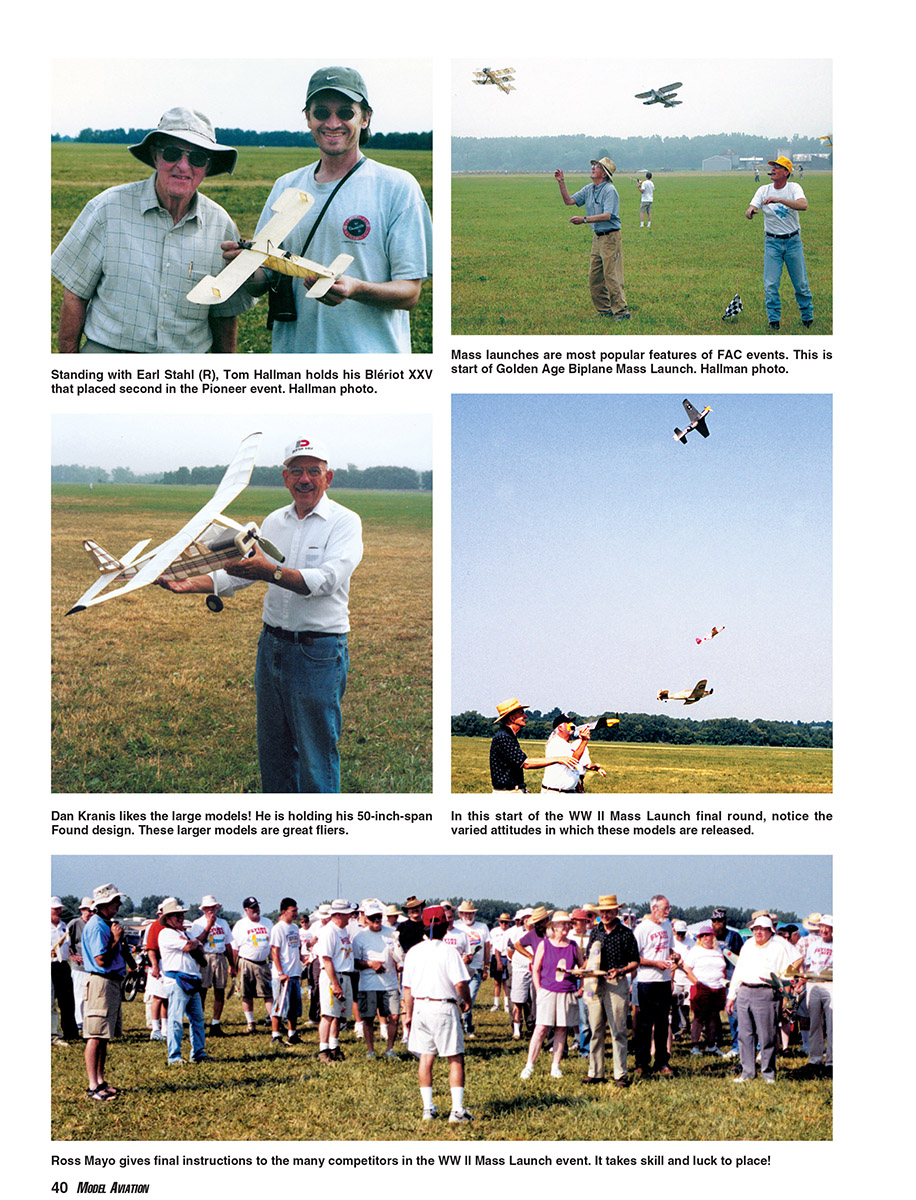
The FAC Nats wouldn’t be what it is without the presence of Earl Stahl, who is respected throughout the world. He is heavily involved with Free Flight Rubber Scale and designed many great planes when he was 15. I got the chance to visit with him — he’s a gentleman’s gentleman!
Thanks and Contact
Thanks to Tom Hallman, Bob Clemens, and Frank Rowsome for their fantastic photos and for being where I couldn’t be.
Fernando Ramos 19361 Mesa Dr. Villa Park, CA 92861 framos@att.net
Transcribed from original scans by AI. Minor OCR errors may remain.

