
Flying Aces Nationals '92
By Bill Warner
Overview
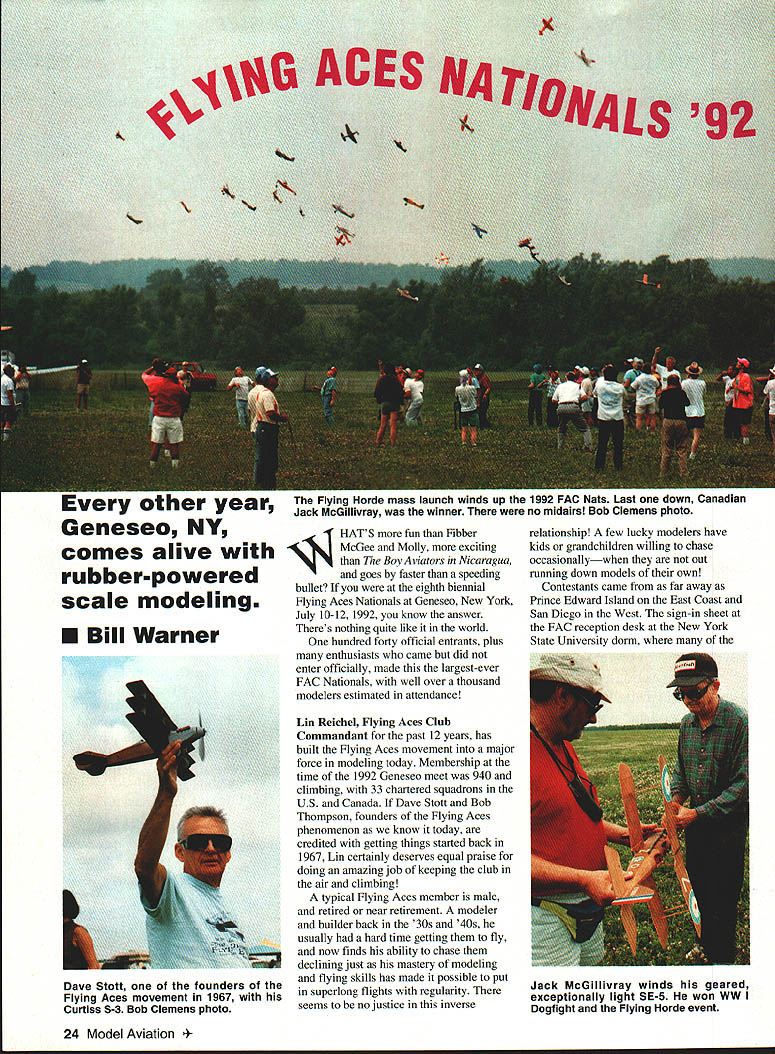
Every other year Geneseo, NY, comes alive with rubber-powered scale modeling. If you were at the eighth biennial Flying Aces Nationals at Geneseo, New York, July 10–12, 1992, you know there's nothing quite like it. One hundred forty official entrants, plus many enthusiasts who came but did not enter officially, made this the largest-ever FAC Nationals, with well over a thousand modelers estimated in attendance.
Lin Reichel, Flying Aces Club Commandant for the past 12 years, has built the Flying Aces movement into a major force in modeling today. Membership at the time of the 1992 Geneseo meet was 940 and climbing, with 33 chartered squadrons in the U.S. and Canada. If Dave Stott and Bob Thompson, founders of the Flying Aces phenomenon, are credited with getting things started back in 1967, Lin certainly deserves equal praise for doing an amazing job of keeping the club in the air and climbing.
The People
A typical Flying Aces member is male, retired or near retirement—someone who modeled and built back in the '30s and '40s, often with mixed success getting models to fly. Now, with mastery of modeling technique and longer flights possible, the ability to chase models has declined for many. A few lucky modelers have kids or grandchildren willing to chase occasionally, when they are not out running down models of their own.
Contestants came from as far away as Prince Edward Island on the East Coast and San Diego in the West. The sign-in sheet at the FAC reception desk at the New York State University dorm, where many fliers stayed, looked like Who's Who in modeling. Informal show-and-tell and hangar flying went on far into the night; fatigue from long drives was forgotten in the euphoria of seeing old friends and new models.
The Field and the Spirit
Friday morning, early birds on the grassy grounds of the National Warplane Museum began launching before breakfast. The line of cars extended for almost half a mile down the approach road, each vehicle stuffed with interesting and finely crafted models. Flights under a minute were rare, even on test—these guys are the best.
As in a three-ring circus, it was impossible to see more than a small part of the action at one time. You'd start down the flight line intending to saunter over to see the museum's B-17 or Catalina and hours later discover you had only progressed a few hundred feet—stopping to chat, snap pictures, admire a technique, gawk at a great flight, or race out to view a mass launch event. The day went by in an instant.
Diversity and good fellowship marked the event. Differences of race, religion, age, or politics were forgotten on the flying field. No thought was given to defeating a fellow contestant—only to doing one's best and helping others do the same. Not once did the author hear complaints about the way the contest was run or about other contestants. Newcomers were often surprised to find that heroes they had read about were glad to lend a hand.
Construction, Materials, and Powerplants
In addition to mastering traditional gumband-and-tissue construction, many builder-fliers have moved into modern materials and techniques: laminated balsa bulkheads, sculpted tips, modern adhesives, and acrylic flat and semigloss enamels are widely used. MonoKote-type covering is conspicuously absent.
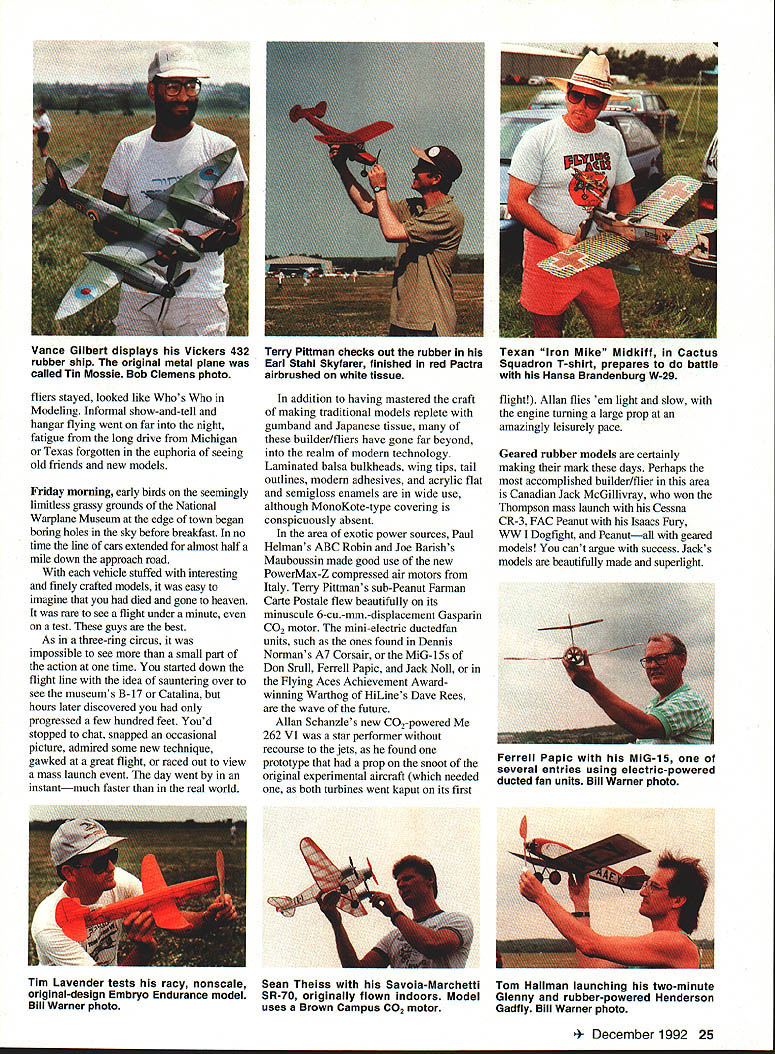
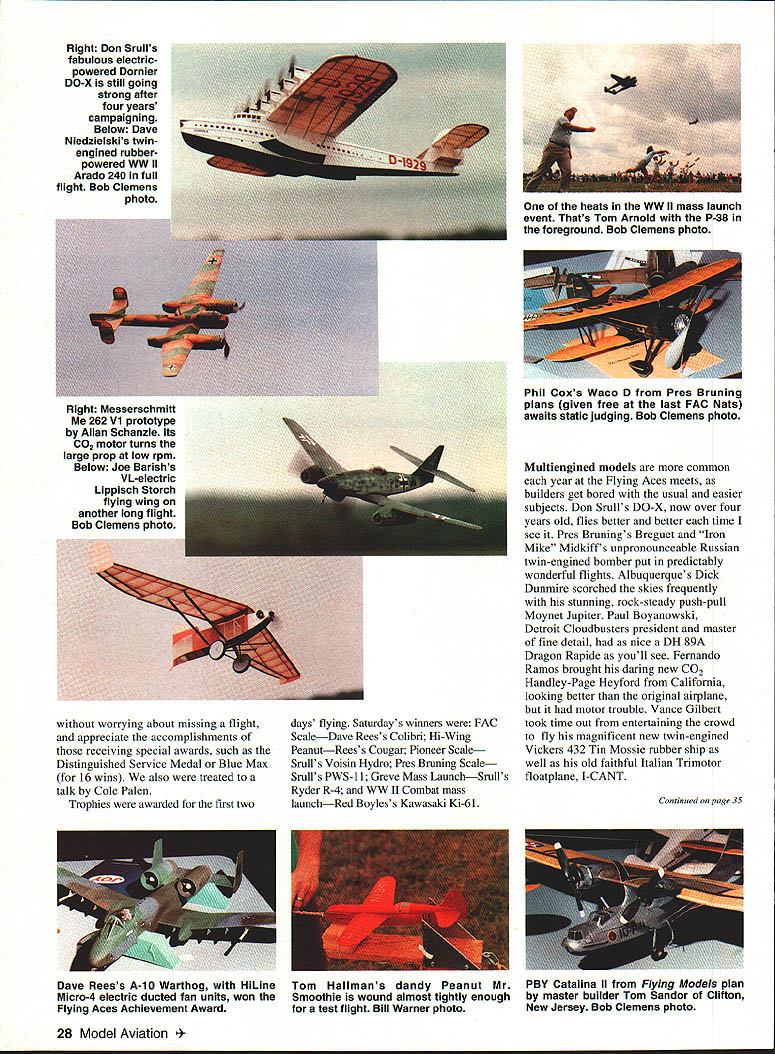
Exotic power sources were prominent. Paul Helman's ABC Robin and Joe Barish's Mauboussin used the new PowerMax-Z compressed-air motors from Italy. Terry Pittman's sub-Peanut Farman Carte Postale flew beautifully on a minuscule 6-cu.-mm. Gasparin CO2 motor. Mini-electric ducted-fan units appeared in models such as Dennis Norman's A7 Corsair, the MiG-15s of Don Srull, Ferrell Papic, and Jack Noll, and the Flying Aces Achievement Award–winning Warthog of HiLine's Dave Rees.
Allan Schanzle's new CO2-powered Me 262 V1 was a star performer without recourse to jets—he found a prototype of the full-size experimental aircraft that had a prop on the nose and modeled accordingly, flying them light and slow with a large, leisurely-turning prop.
Geared rubber models are making their mark. Canadian Jack McGillivray won the Thompson mass launch with his Cessna CR-3 and took titles in FAC Peanut with his Isaacs Fury, WW I Dogfight, and Peanut—many of them geared models. Jack's models are beautifully made and superlight.
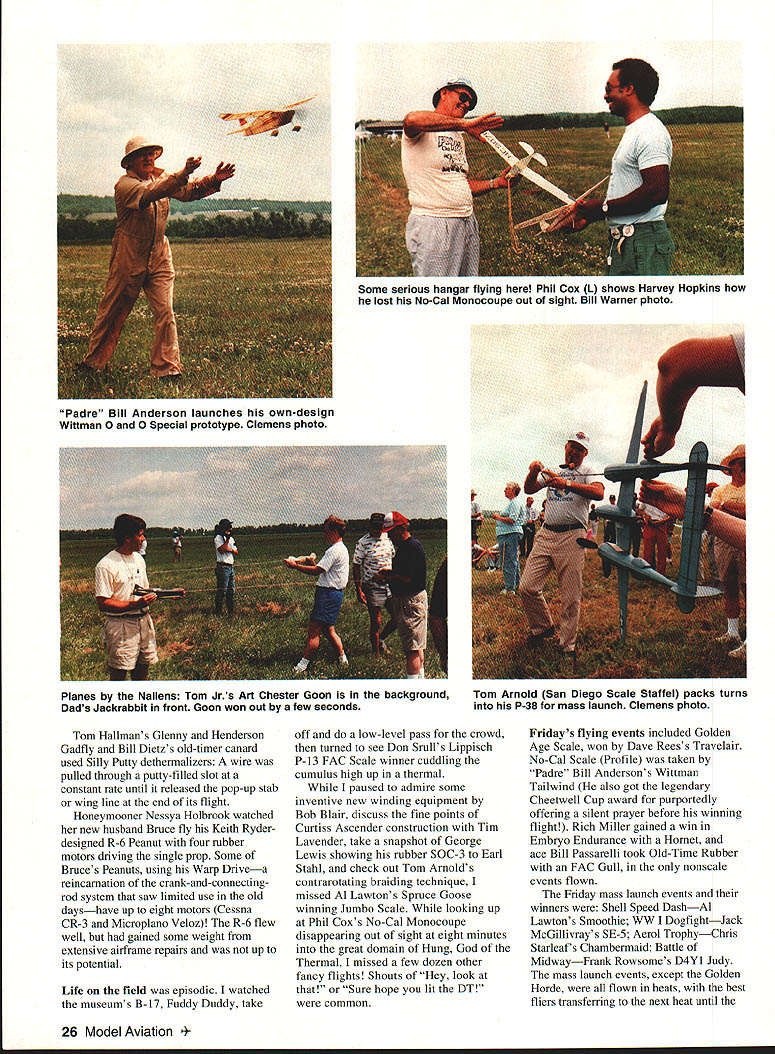
Tom Hallman's Glenny and Henderson Gadfly and Bill Dietz's old-timer canard used Silly Putty dethermalizers: a wire pulled through a putty-filled slot released a pop-up stabilizer or wingtip at the end of flight.
Honeymooner Nancy Holbrook watched her new husband Bruce fly his Keith Ryder–designed R-6 Peanut with four rubber motors driving a single prop. Some of Bruce's Peanuts, using his Warp Drive (a crank-and-connecting-rod system), have used up to eight motors on other models. The R-6 flew well but had gained weight from extensive repairs and was not up to potential.
Friday Highlights and Events
Friday's flying events included Golden Age Scale, won by Dave Rees's Travel Air. No-Cal Scale (profile) was taken by "Padre" Bill Anderson's Wittman Tailwind—he also received the legendary Cheetah Cup award for purportedly offering a silent prayer before his winning flight. Rich Miller won Embryo Endurance with a Hornet, and ace Bill Passarelli took Old-Time Rubber with an FAC Gull—the only nonscale events flown.
Friday mass-launch events and winners:
- Shell Speed Dash — Al Lawton's Smoothie
- WW I Dogfight — Jack McGillivray's SE-5
- Aero Trophy — Chris Starlead's Chambermaid
- Battle of Midway — Frank Rowsome Jr.'s Dauntless
- Dime Scale — Judy
The mass-launch events, except the Golden Horde, were flown in heats, with the best fliers transferring to the next heat until the finals. The finals often featured suspense-filled, plane-on-plane duels. Some flights were so far that reports from observers stationed well downwind were the only way to know who was down first.
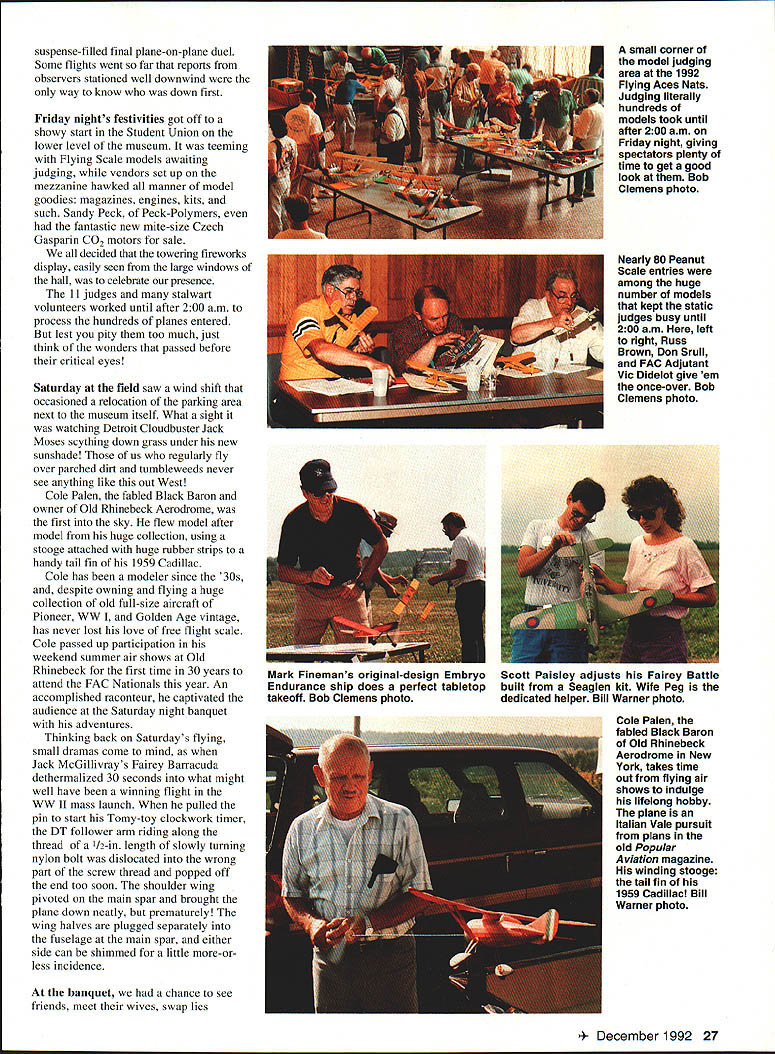
Friday night's festivities in the Student Union and museum mezzanine included Flying Scale models awaiting judging and vendors hawking magazines, engines, kits, and other goodies. Sandy Peck of Peck-Polymers had mite-size Czech Gasparin CO2 motors for sale. A towering fireworks display, visible from the hall's large windows, seemed to celebrate the meet.
The 11 judges and many volunteers worked until after 2:00 a.m. to process the hundreds of planes entered.
Saturday Highlights and Events
Saturday saw a wind shift that required relocating the parking area next to the museum. Cole Palen, the fabled Black Baron and owner of Old Rhinebeck Aerodrome, was the first into the sky. He flew many models from his huge collection, using a stooge attached with rubber strips to the tail fin of his 1959 Cadillac. Cole, a modeler since the '30s and an accomplished raconteur, passed up participation in his summer air shows at Old Rhinebeck for the first time in 30 years to attend the FAC Nationals and captivated the audience at the banquet with his adventures.
Small dramas included Jack McGillivray's Fairey Barracuda dethermalizing 30 seconds into what might have been a winning WW II mass-launch flight. A Tomy clockwork timer's DT follower arm dislocated in the screw thread and popped off too soon, bringing the plane down neatly but prematurely.
Saturday winners included:
- FAC Scale — Dave Rees's Colibri
- Hi-Wing Peanut — Dave Rees's Cougar
- Pioneer Scale — Don Srull's Voisin Hydro
- Pres Bruning Scale — Don Srull's PWS-11
- Greve Mass Launch — Don Srull's Ryder R-4
- WWII Combat mass launch — Red Boyles's Kawasaki Ki-61
Multiengined models were more common each year. Don Srull's DO-X, now over four years old, flies better each time it's seen. Pres Bruning's Breguet and "Iron Mike" Midkiff's Russian twin-engined bomber put in wonderful flights. Dick Dummire scorched the skies with a rock-steady push-pull Moynet Jupiter. Paul Boyanowski had a fine DH 89A Dragon Rapide. Fernando Ramos brought a CO2-powered Handley-Page Heyford that looked superb but had motor trouble. Vance Gilbert flew a new twin-engined Vickers 432 and an Italian Trimotor floatplane, I-CANT.
Two modelers, Red Boyles of Arizona and Dave Rees of North Carolina, were tied in the WW I Dogfight. Vince, the event director, gave each a stack of balsa and a hunk of clay and 20 minutes to return with a completed WW I biplane glider; best two out of three flights won. Red squeaked by when Dave's ship shed its top wing on the final flight.
Tony Peters's all-foam rubber-powered Dornier 212 pusher flying boat, though not eligible for FAC events, was a superb flying ship. Electric-powered foamies included Don Ross's HiLine twin electric B-70 and Paul Clark's Watts-Up Boeing 747.
Organizers and Volunteers
At the control table, Juanita Reichel—the Mother Superior of the Flying Aces movement—Shirley Keunz, and Gina Boyanowski handled the hundreds of official flights—nearly 2,000 in all—with little chance to relax. Daily Contest Directors Ed Novak, Dave Livesay, and Vic Didelot were often seen conferring with Lin Reichel, who had just enjoyed an hour's jaunt in a museum Taylor Cub—his first flight ever in a full-size aircraft.
The atmosphere was always friendly, with different models each day and the joy of meeting new and interesting people. The modelers formed a band of brothers and sisters who belong, by choice, to an extended family united by their shared interest.
The Finale — The Flying Horde
One unforgettable feature was the closing event, the Flying Horde. At 4:00 p.m., under ominous skies, fliers assembled with their sturdiest models, expecting collisions in the crowded airspace. When the shout to launch came, a flurry of models rushed skyward, their massed, whirring propellers darkening the sky. Crash crews awaited falling bits of balsa, tissue, and rubber—but amazingly, not one midair occurred.
The locustlike swarm drifted off, rising gently to meet the first raindrops signaling the end of the meet—a fitting end to three days of magic. Trophies were awarded as the last wet straggler trudged in with a soggy-but-proud model. The Flying Aces Nationals Mark VIII went into the record books. Each contestant went home with a free plan of John Low's PT-19, a treasury of fond memories, and a list of models to build.
The tales of the models and exploits will grow in retelling until they assume the proportions of myth by the time the birdmen return to the field of honor in another two years. (Seventy-eight showed up at Geneseo in 1991, the off year, to participate in a non-Nationals!)
Join the Flying Aces
If you'd like to become part of the Flying Aces family, keep up with FAC activity, and get the newsletter complete with build-it-tonight plans, send $9 to Lin Reichel, FAC GHQ, 3301 Cindy Lane, Erie, PA 16506.
Build! Fly! Win! Eff! Ay! Ceeeee!
Postscript
The Swamp Squadron, 1503 Clairdale Lane, Lakeland, FL 33801, is putting together a videotape of the 1992 FAC Nationals and has tapes from previous years. Send an SASE for an order blank with current prices (about $20).
Transcribed from original scans by AI. Minor OCR errors may remain.

