
Flying Aces Nats
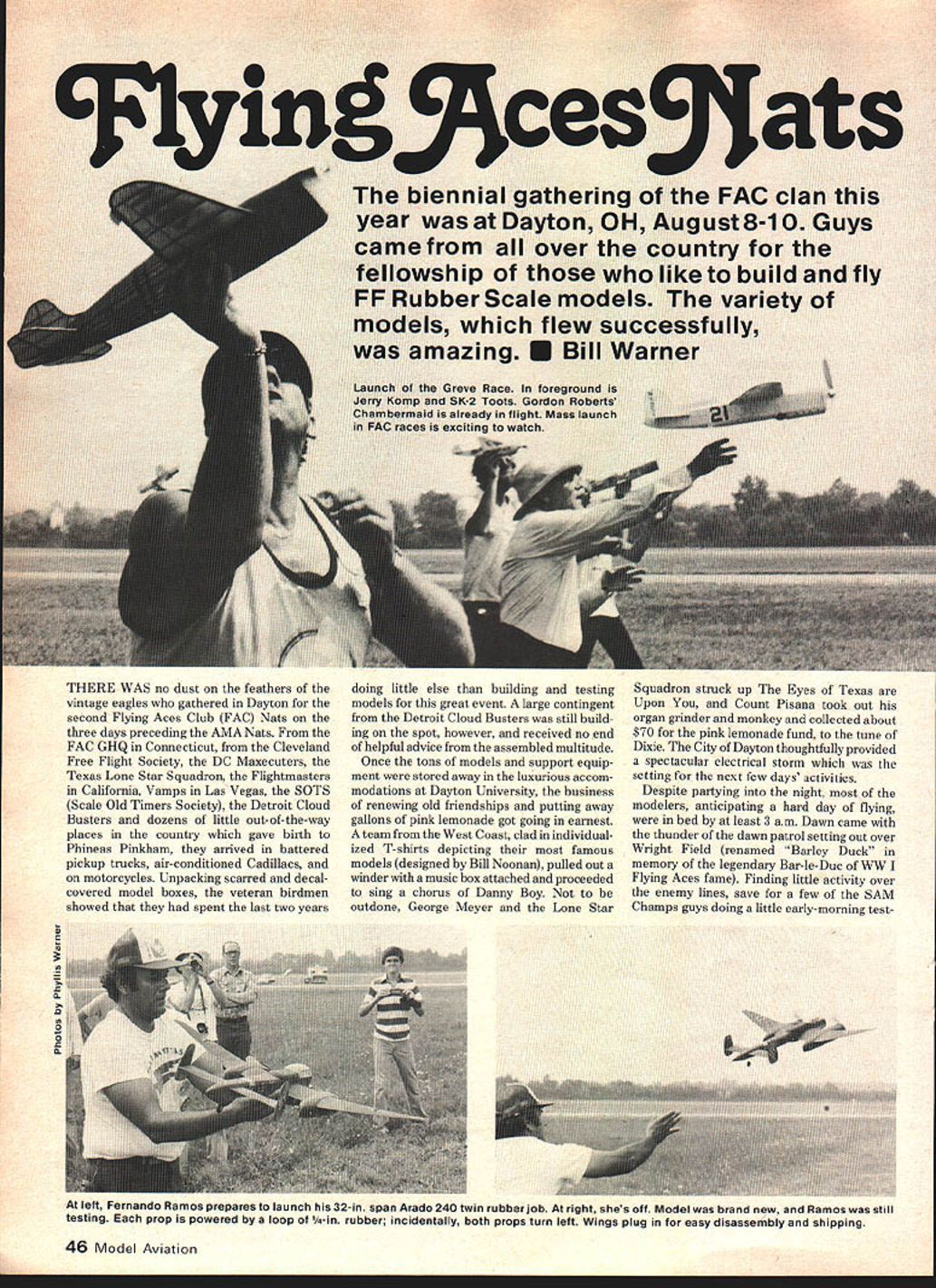
The biennial gathering of the FAC clan this year was at Dayton, OH, August 8–10. Guys came from all over the country for the fellowship of those who like to build and fly free-flight rubber scale models. The variety of models that flew successfully was amazing. — Bill Warner
Overview
There was no dust on the feathers of the vintage eagles who gathered in Dayton for the second Flying Aces Club (FAC) Nats on the three days preceding the AMA Nats. From FAC GHQ in Connecticut, from the Cleveland Free Flight Society, the DC Maxecuters, the Texas Lone Star Squadron, the Flightmasters in California, the VAMPS in Las Vegas, the SOTS (Scale Old Timers Society), the Detroit Cloud Busters and dozens of out-of-the-way places that gave birth to Phineas Pinkham, they arrived in battered pickup trucks, air-conditioned Cadillacs, and on motorcycles. Unpacking scarred and decal-covered model boxes, the veteran birdmen showed they had spent the last two years building and testing models for this great event. A large contingent from the Detroit Cloud Busters was still building on the spot and received no end of helpful advice from the assembled multitude.
Once the tons of models and support equipment were stored in the comfortable accommodations at Dayton University, the business of renewing old friendships and putting away gallons of pink lemonade got going in earnest. A West Coast team, clad in individualized T-shirts depicting their most famous models (designed by Bill Noonan), pulled out a winder with a music box and sang Danny Boy. George Meyer and the Lone Star Squadron struck up The Eyes of Texas Are Upon You, and Count Pisana produced his organ grinder and monkey and collected about $70 for the pink lemonade fund to the tune of Dixie. The City of Dayton generously provided a spectacular electrical storm that set the mood for the next few days.
Despite partying into the night, most modelers—anticipating hard flying days—were in bed by about 3 a.m. Dawn came with the thunder of the dawn patrol setting out over Wright Field (renamed "Barley Duck" in memory of the legendary Bar-le-Duc of WW I Flying Aces fame). Finding little activity over the enemy lines except a few of the SAM Champs test-flying, the patrol returned loaded with unused ammunition.
Atmosphere and Fellowship
Despite a few pink-lemonade hangovers, spirits were high and the stalwart, clear-eyed aviators got down to the day's gum-band twisting. Dick Nutting, writing the daily Nats News bulletin, referred to FACers as "the emerging clowns of modeling"—but clowns, as a class, are not without skill. FACers model in a way that treats the hobby as a way of life. Many do other work simply to keep body and soul together so they can have the wherewithal to make models. Serious things and having fun can be the same thing. An FAC motto: "If you ain't having fun playing with toy airplanes, why not take up collecting string."
FACers represent an amazing number of engineers, doctors, lawyers, university professors, inventors, writers, artists, and other professionals. None were boring or insufferable. The clowning and flying of models is part of the fun. Sincere applause, shouts of encouragement, and cheers for the achievements of others were constant throughout the meet. It is incomprehensible to imagine anyone cheating or taking advantage here; if you've been to contests where modelers complain about judging or other contestants, you'd be impressed with the absence of such behavior at the FAC Nats. FACers take modeling and each other seriously—not competition.
Back at Barley Duck the mornings grew hotter and humidity hovered near 99%. Tissue applied in the deserts of the West sagged and warps appeared, giving strange new trim characteristics to fragile models. Still, planes kept soaring with an elegance seldom seen in modeling. Imagine over 100 of the top modelers in the country—averaging about 30 years' experience apiece, about a dozen planes per car—trying their best to impress a group that is not easily impressed. The thrill of making the rounds again and again, marveling at ingenuity and craftsmanship, left many attendees spent with admiration.
Flying and Competition
The meeting is, nominally, a Nats—a contest—but Flying Aces take competition with a grain of salt. Competition is a means, not an end. Having fun is the end; getting upset about beating others for a trophy is not FAC. A contest placing is the least important reason for getting together; a pat on the back from a respected fellow modeler is a solid gold trophy.
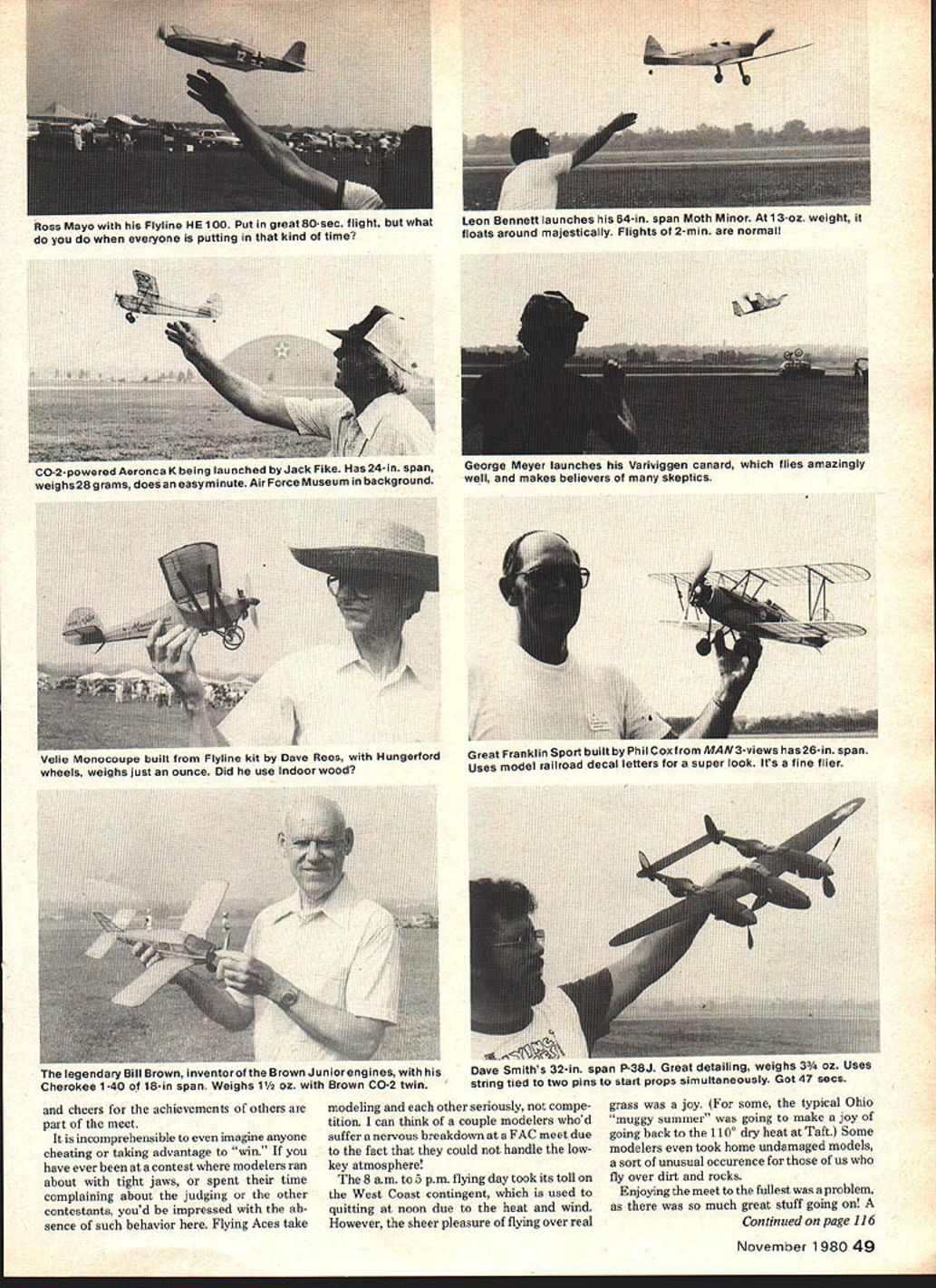
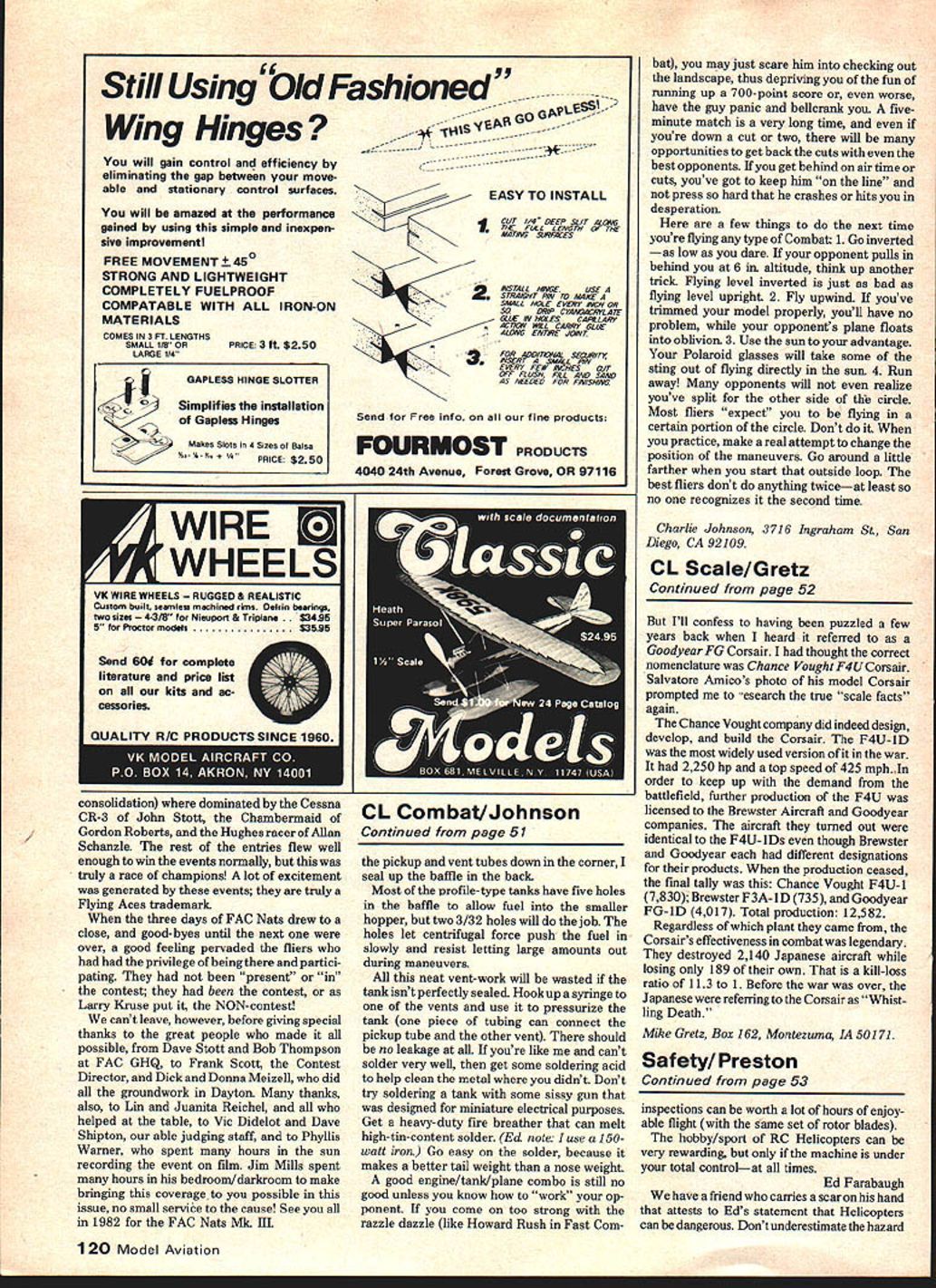
Flying was informal: you flew when ready, observed what you could in between flights, and hoped not to embarrass yourself in front of such a great bunch. The 8 a.m. to 5 p.m. flying day tested the West Coast contingent, used to quitting at noon in heat and wind, but the sheer pleasure of flying over real grass was a joy—some even went home with undamaged models, a rarity for those who fly over dirt and rocks.
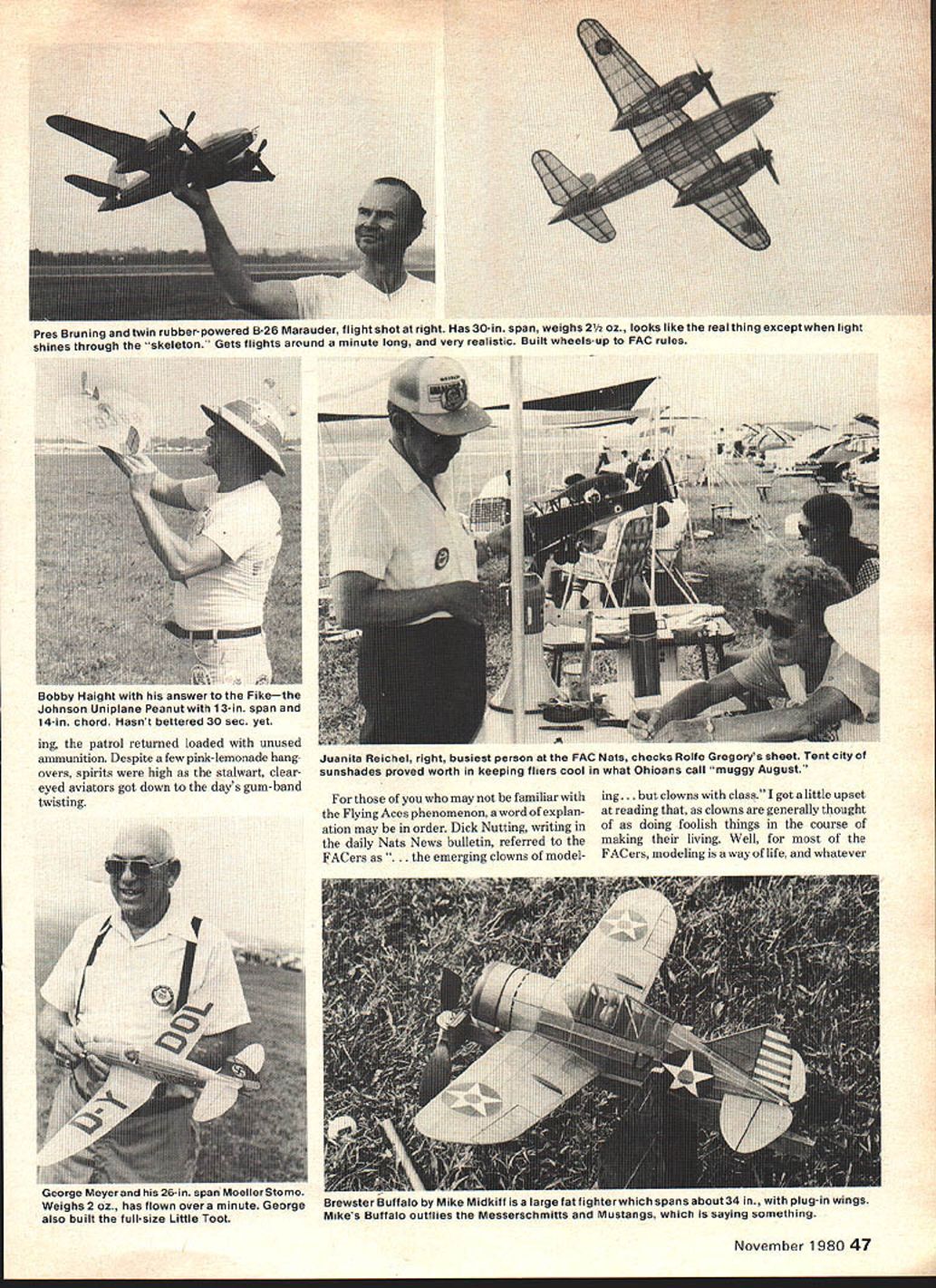
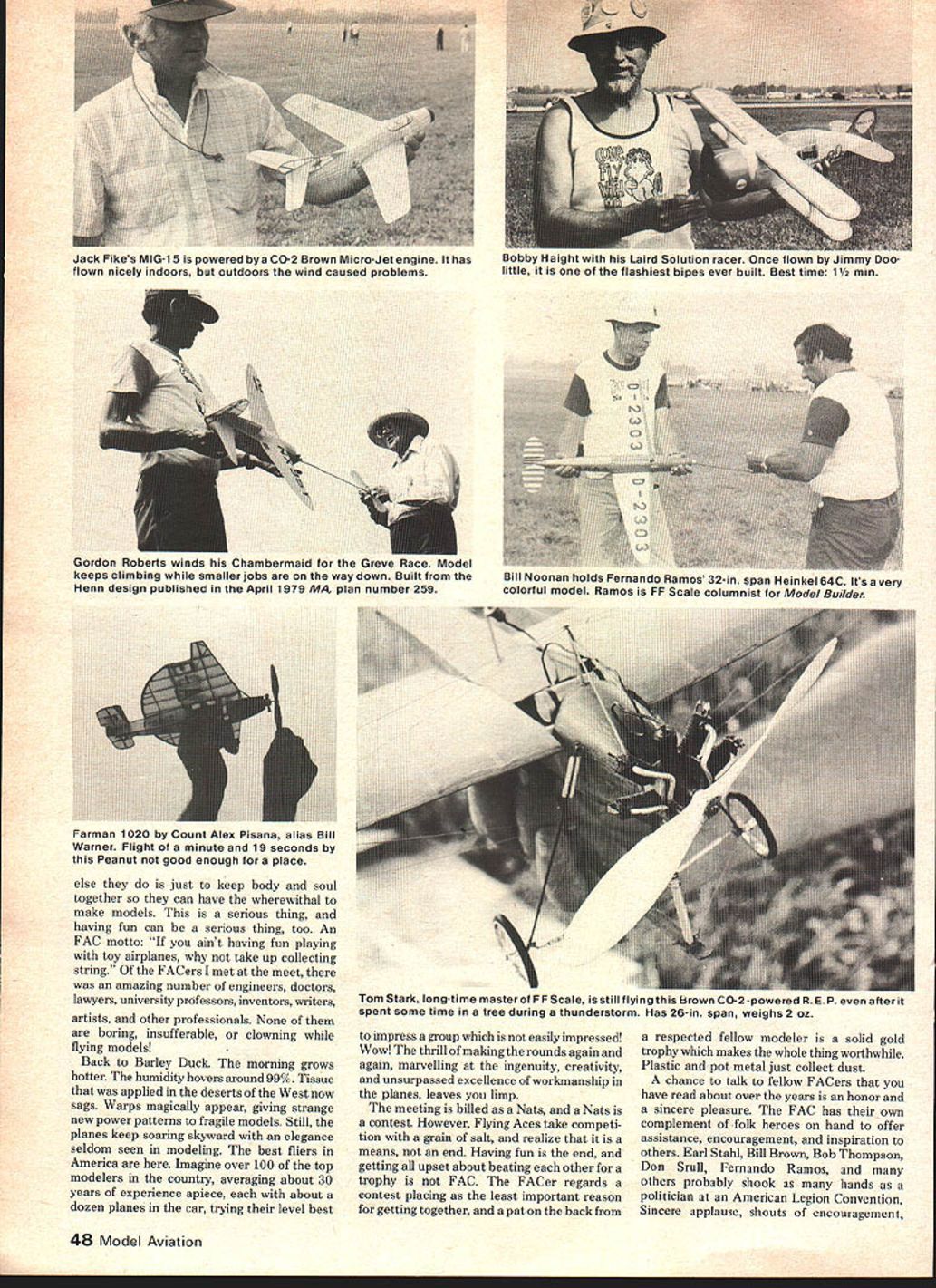
Official flying sheets were passed out by Juanita Reichel. Groans greeted Jim Miller’s announcement that his Currie Wot weighed only 6 grams. Haight produced a peanut model with about 200 square inches called a Johnson Uniplane (13-in span by 14-in chord). Mike Midkiff and his wife hoisted the world's largest Brewster Buffalo rubber job out of the car—it flew like it was helium-filled. Leon Bennett's DH Moth Minor floated on two-minute flights on 60-in wings, making many jealous.
One highlight was the WW I and WW II combat mass-launch events: the first three planes down were dropped and heats continued until one victor remained. Half a dozen biplanes aloft for about a minute was a sight to behold. Don Strull's DH 6 seemed never to come down. In WW II combat, Mike Midkiff's Wildcat repeatedly led others out to the tree line on the horizon. Who says radials can't compete with in-lines?
Event Highlights
- Notable club presence: FAC GHQ (CT), Cleveland Free Flight Society, DC Maxecuters, Lone Star Squadron (TX), Flightmasters (CA), VAMPS (Las Vegas), SOTS, Detroit Cloud Busters.
- Prominent personalities and folk heroes on hand included:
- Earl Stahl
- Bill Brown
- Bob Thompson
- Don Strull
- Fernando Ramos
- Lin and Juanita Reichel
- Dave Stott
- Bill Noonan
- Dick Nutting
- Count Pisana
- Memorable aircraft and flights seen:
- Pres Bruning’s B-26 Marauder—one of the most realistic planes present
- Bob Thompson’s Japanese biplane (weathered by grasshoppers)
- Les Clemens’ red Comet Swift (briefly run over and retrieved)
- Bobby Haight’s orange Peanut Gulfhawk
- Leon Bennett’s DH Moth Minor on long flights
- Bob Seidentopf’s Stinson Trimotor—looks like a museum piece
- Phil Cox’s SuperScale Franklin Sport with railroad-decal lettering
- Chuck Schoeholer’s Beech Staggerwing
- George Meyer’s inverted gull-wing Japanese "Grace"
- Fernando Ramos’ twin Arado 240 rubber job (test flights)
- Mark Fineman’s Nikitin-Chechevitch biplane with a retractable lower wing
- Race events:
- Thompson race (radials), Greve race (in-lines), and the Aerol Trophy (consolidation) were dominated by:
- John Stott’s Cessna CR-3
- Gordon Roberts’ Chambermaid
- Allan Schanzle’s Hughes racer
Saturday night's banquet at Dayton U. featured Robert Hull, a knowledgeable speaker on the golden age of air racing; his stories about Roscoe Turner were a highlight.
Awards and Organization
Awards were made for winners in the first two days of flying, along with special awards to Lin Reichel and Don Strull for outstanding contributions to the FAC cause. Awards mainly consisted of color reproductions of old Flying Aces covers mounted on attractive bases.
The announcement that Dave Stott was giving up Flying Aces leadership brought a tear to many eyes. Lin Reichel will take over the reins; a more capable successor would be hard to imagine. Lin assured everyone of an even bigger and better FAC Nats in 1982.
When the three days drew to a close, attendees felt they had not merely been present at a contest—they had been the contest, or as Larry Kruse put it, the NON-contest.
Thanks and Next Nats
Special thanks to everyone who made the meet possible:
- Dave Stott and Bob Thompson at FAC GHQ
- Frank Scott, Contest Director
- Dick and Donna Meizell, who did much groundwork in Dayton
- Lin and Juanita Reichel and all who helped at the table
- Vic Didlot and Dave Shipton, the judging staff
- Phyllis Warner, who spent many hours photographing the event
- Jim Mills, who worked many hours in his darkroom to bring coverage to the community
See you all in 1982 for FAC Nats Mk. III.
Transcribed from original scans by AI. Minor OCR errors may remain.

