
Flying Aces Nats
Bill Warner
Introduction
The biennial gathering of the fun (and kind of zany) group of FF Scale fliers took place on July 14–15 this year in Utica, MI—attracting guys and gals from all over the U.S. and Canada. Too bad if you weren't there. The next best thing is this report, which captures much of the flavor.
Four years ago I had the privilege of bringing you an account of the Flying Aces Club Nats held in Dayton. It was fun. This year's FAC bash was even better. If you couldn't be there, be my guest as part of the Southern California contingent consisting of Fernando Ramos and myself from the Flightmasters, and Bill Noonan from the San Diego Scale Staffel.
Leaving Los Angeles and Noonan's Shop
Leaving the smog-laden environs of Los Angeles is always a pleasure. A couple of hours in Fernando's hangar behind his country estate on the way to Noonan's is sheer delight. Models, mostly scale, hang everywhere. The centerpiece is the full-size fuselage for Fernando's latest project, another Marquardt Charger biplane. It is all welded up and almost ready to cover. He tells of bringing his son's 4H group into the hangar and of their indifference to it all. We lament the younger generation. When we were kids, a similar experience would have kept us dreaming for months! Maybe that's why most of us in the Flying Aces Club are graying a bit about the temples.
On to San Diego, Noonan's, and departure the next day from Lindbergh Field (remember where they built the Ryan Spirit of St. Louis?). Bill Noonan is talent and style personified. No sooner had we settled down to rest in his living room than Hell's Angels (the Howard Hughes WW I flying movie, not the two-wheeled variety) appeared on the telly. What a way to start our pilgrimage to the past! We fell in love with the old planes and Jean Harlow all over again.
After the flick, we went out to Bill's atelier to gawk at his magnificent creations. You open the door to the shop and have the uncomfortable feeling that you have just done something wrong. A quick glance behind the door confirms your fears. There you see what is left of an ancient model, once a biplane, flattened against the wall! Horrors! When the initial shock wears off, you notice that the parts are too artistically arranged to have been the result of an accident. What Bill did was put a plywood sheet over the Berg biplane in his driveway and then run over it a few times to reduce the model to 2D for a collage. Har! Har!
Bill proceeded to show us his latest goodies, like the machine for printing the German lozenge camouflage pattern for his Halberstadt. It involves making separation artwork and then having four polyester plates made at a rubber-stamp establishment. The tissue is then affixed to a sliding pattern which moves side-to-side in a frame into which the printing plates are inserted. Bill uses Spa-Mark dye applied to the plastic printing plates directly. Surprisingly, it does print on the tissue! Clever. The only drawback is that the plates cost $10 each. I tape-recorded helpful hints, book titles, and booksellers' addresses—whatever I might be able to use or share from this historic visit. All too soon it was time to hit the hay. Bill had been packed for days.
Travel and Arrival
Morning of the day we'd been waiting for. Model boxes, suitcases, camera bags, field boxes loaded. Where do the people fit? Somehow, we squeezed in. At the airport, Fernando and Bill got docked $10 each for their oversize model boxes. I sneaked mine aboard in a brown paper bag. My trick was to hold my Earl Stahl Waco SRE cabin in plain sight as a diversion. Actually, the only people who even noticed it were the pilot, copilot, and a small boy who asked me if I got it in the zoo's gift shop.
Arrival in Denver. Changed from a 727 to a 767. Sat on the ground for an hour in a long line of jets waiting to be airborne. That's what I like about free flight... no waiting for an open frequency! On to Detroit. Amazing, the model boxes were coming out on the baggage carousel at the very moment we arrived. That's one for the books. Hot. Air-conditioned rental car was heaven. We drove through a part of Detroit generally left off visitors' tours on the way to the hotel in Warren. Arrival, unpacking. Nothing broken! We put the models together for an hour and then set out to find other FACers.
Hurst Bowers and his charming companion were poolside. We chatted for a long time. He's presently putting the AMA Museum on order. Just the man for the job! Off to dinner. The three-hour time difference was catching up with us; we were late to the hospitality suite. Seemed like mid-afternoon to us!
Hospitality Suite and Hotel Display
Ralph Kuenz, the world-famous Von Rottenxson, was outlining what the host club (the Detroit Cloudbusters) and the FAC Detroit Geschwader (the strictly FAC nuts within the Cloudbusters) had in store. On exhibit were:
- The huge National Champion Trophy (why not just give it to Don Srull right then and save carrying it out to the field?).
- The superb Earl Stahl Trophy for the best model at the meet exemplifying the spirit of the Stahl type of design—containing as part of the trophy an actual compass and divider Earl used in drawing those famous plans.
- The standard plaques for winners with beautiful etched plates featuring the winners' names.
There was a pageant of models on display in the hotel ballroom. I was introduced to people, had my ears chewed off, and generally enjoyed it.
The Field: Utica Ford Test Track
The next morning we drove to the field. The weather was perfect—blue sky, slight breeze. Flying was set for the next day at the Ford test track in Utica, a banked 2½-mile speedway with an immense infield covered with soft, green, and slightly uneven grass.
Many old friends from previous AMA and FAC Nats were there, and the "pink lemonade" provided by the hosts flowed freely as the stories came fast and furious. Good news via Joe Fitzgibbon, Mr. Golden Age Reproductions himself, cheered us all: they have found that balsa is not as great an insulator for those cryogenic supertankers as previously thought; consequently, billions of board feet will be saved from this horrible fate! Von Loopusall showed me all the great work that has gone into the participant and official buttons, and he noted that the entire club worked on coloring them. Ah, such togetherness. We broke up after midnight. Who's sleepy?
When the alarm went off at what for us was 3 a.m., we found out the answer to that one! At breakfast we joined the gang over orange juice. Swapping stories kept the FAC table the center of attention in the coffee shop. What the heck, it's only once every two years. Time to go. Again, the joy of packing models. Again, we all inhaled and slammed the car doors. Made it! Off to Utica.
Taking the south turn at high speed up on the bank, Noonan dropped into the straightaway at 140 mph! Not really—we resisted temptation, as the Ford folks might frown on it (seeing that we had a rented Plymouth). No use causing any antagonism.
What a flying site! You could actually hit the ground (and we did occasionally) without breaking anything! The only trees in the area were outside the track; they served to stir up the air, creating what the locals call the "snow fence effect," a rolling downdraft that a model has to get through to obtain any duration when the wind is blowing. Open the door, and let's get into the sky!
The Contest and the Crowd
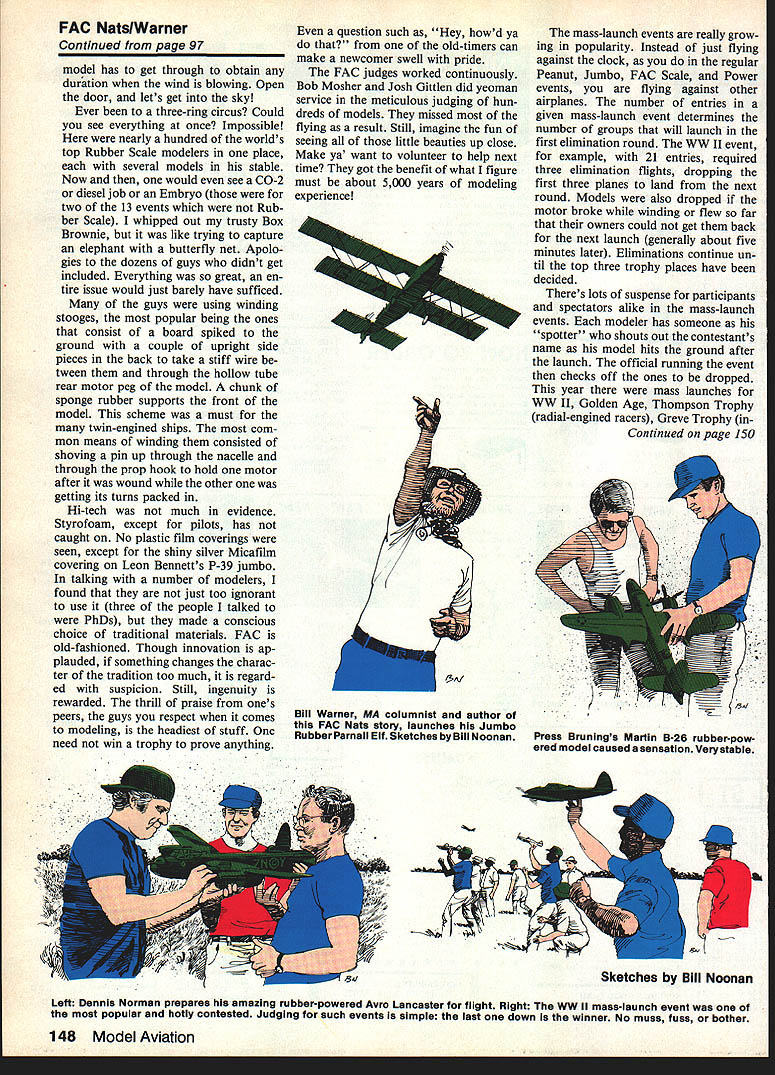
Ever been to a three-ring circus? Could you see everything at once? Impossible! Here were nearly a hundred of the world's top rubber scale modelers in one place, each with several models in his stable. Now and then, one would even see a CO-2 or diesel job or an Embryo (those were for two of the 13 events which were not Rubber Scale). I whipped out my trusty Box Brownie, but it was like trying to capture an elephant with a butterfly net. Apologies to the dozens of guys who didn't get included. Everything was so great, an entire issue would just barely have sufficed.
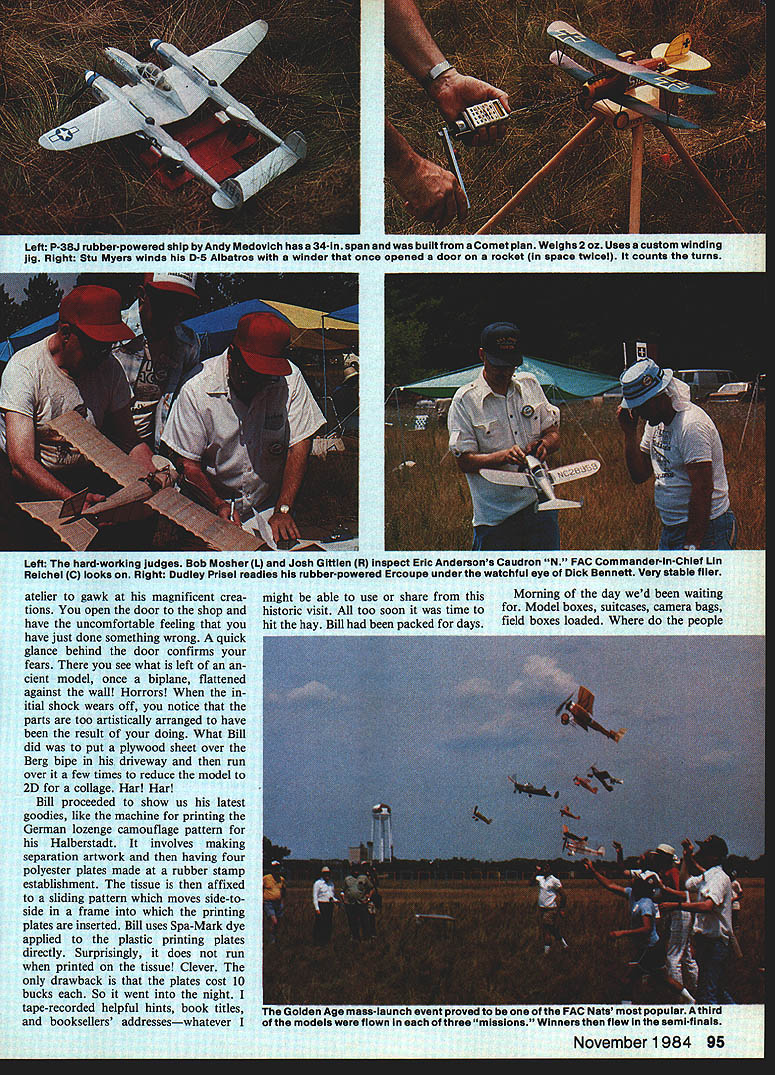
Many of the guys were using winding stooges, the most popular being the ones that consist of a board spiked to the ground with a couple of upright side pieces in the back to take a stiff wire between them and through the hollow-tube rear motor peg of the model. A chunk of sponge rubber supports the front of the model. This scheme was a must for the many twin-engined ships. The most common means of winding them consisted of shoving a pin up through the nacelle and through the prop hook to hold one motor after it was wound while the other one was getting its turns packed in.
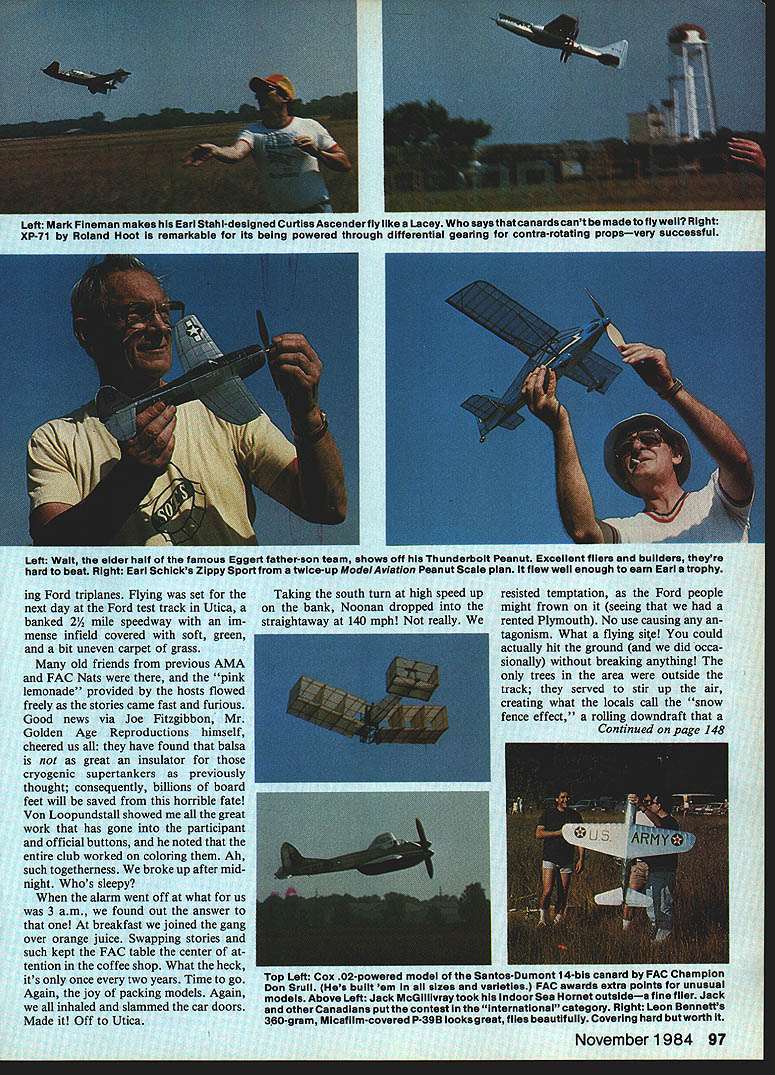
Hi-tech was not much in evidence. Styrofoam, except for pilots, has not caught on. No plastic film coverings were seen, except for the shiny silver Micafilm covering on Leon Bennett's P-39 Jumbo. In talking with a number of modelers, I found that they are not just too ignorant to use it (three of the people I talked to were PhDs), but they made a conscious choice of traditional materials. FAC is old-fashioned. Though innovation is applauded, if something changes the character of the tradition too much, it is regarded with suspicion. Still, ingenuity is rewarded. The thrill of praise from one's peers, the guys you respect when it comes to modeling, is the headiest of stuff. One need not win a trophy to prove anything. Even a question such as, "Hey, how'd ya do that?" from one of the old-timers can make a newcomer swell with pride.
The FAC judges worked continuously. Bob Mosher and Josh Gittlen did yeoman service in the meticulous judging of hundreds of models. They missed most of the flying as a result. Still, imagine the fun of seeing all of those little beauties up close. Make ya want to volunteer to help next time? They got the benefit of what I figure must be about 5,000 years of modeling experience!
Mass-Launch Events
The mass-launch events are really growing in popularity. Instead of just flying against the clock, as you do in the regular Peanut, Jumbo, FAC Scale, and Power events, you are flying against other airplanes. The number of entries in a given mass-launch event determines the number of groups that will launch in the first elimination round. The WWII event, for example, with 21 entries, required three elimination flights, dropping the first three planes to land from the next round. Models were also dropped if the motor broke while winding or flew so far that their owners could not get them back for the next launch (generally about five minutes later). Eliminations continue until the top three trophy places have been decided.
There's lots of suspense for participants and spectators alike in the mass-launch events. Each modeler has someone as his "spotter" who shouts out the contestant's name as his model hits the ground after the launch. The official running the event then checks off the ones to be dropped. This year there were mass launches for:
- WWII
- Golden Age
- Thompson Trophy (radial-engined racers)
- Greve Trophy (inline racers)
- WWI multiplanes (divided into two groups: Peanut and Over-13 in.)
Construction and Techniques
Some of the things that make FAC models fly so well reflect Bill Stout's (Ford Trimotor) admonition: "Simplicate and add lightness." Models with round fuselage cross sections are almost all made from laminating thin balsa strips around undersized cardboard bulkhead forms instead of cutting them out of sheet. Sometimes a "can" or master bulkhead of sheet balsa with a hole for the motor is incorporated to limit "slapping" from super-long rubber motors. Most of the guys build very light and use motors three to four times the hook-to-hook length—for those long prop runs! It is the rare model that will not break a minute.
At 5 p.m. the festivities broke up, and we headed for the pool. There, Don Srull and I came up with a new event to be flown underwater with rubber-powered and glider sub-planes. Maybe next time. Our banquet was from seven until midnight, featuring exciting speakers, dynamic sing-alongs, breathtaking films, and—no scantily-clad dancing girls, though it was great fun nonetheless. Off to bed at 1 a.m.
Highlights and Winners
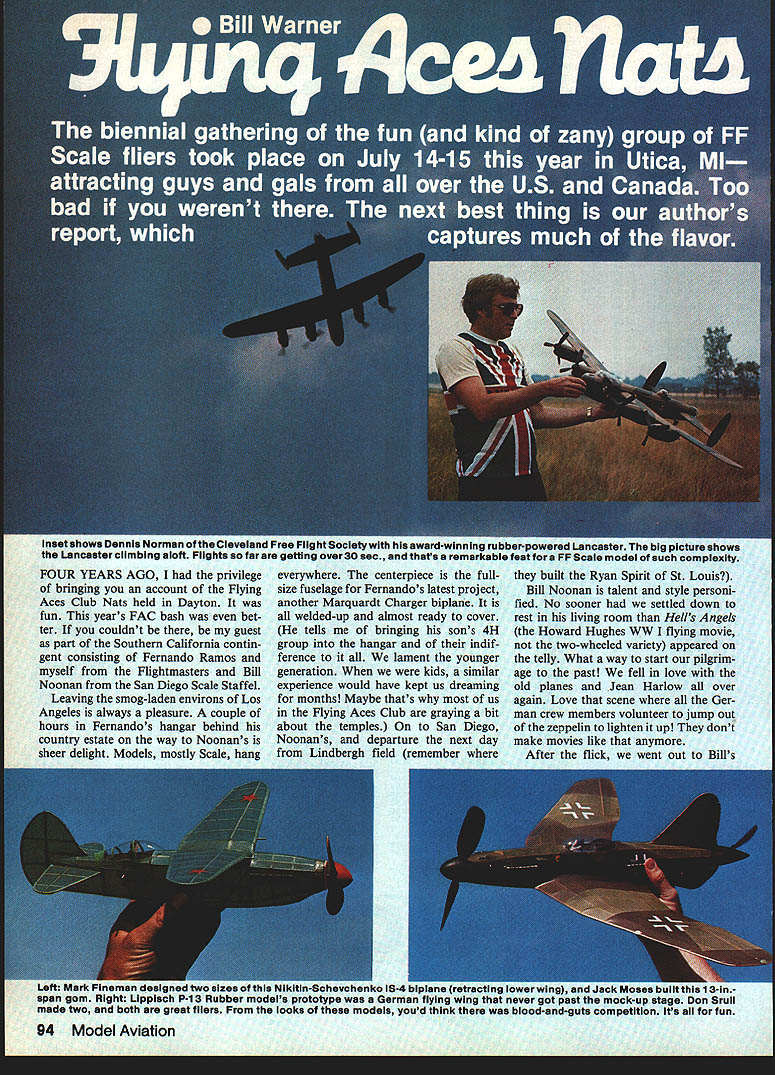
Sunday. The great meet soared on as if we'd never taken a break. Some memorable sights included Don Srull's fabulous models flying about: his Cox .02-powered Santos-Dumont 14-bis, his Voisin peanut-size canard hydroplane, and the two sizes of Lippisch P-13 flying wings after prototypes built for Messerschmitt. They all fly great. Flying in a contest with Srull, a modeler's modeler, is like being in a beauty contest with Catherine Deneuve when one looks like Phyllis Diller.
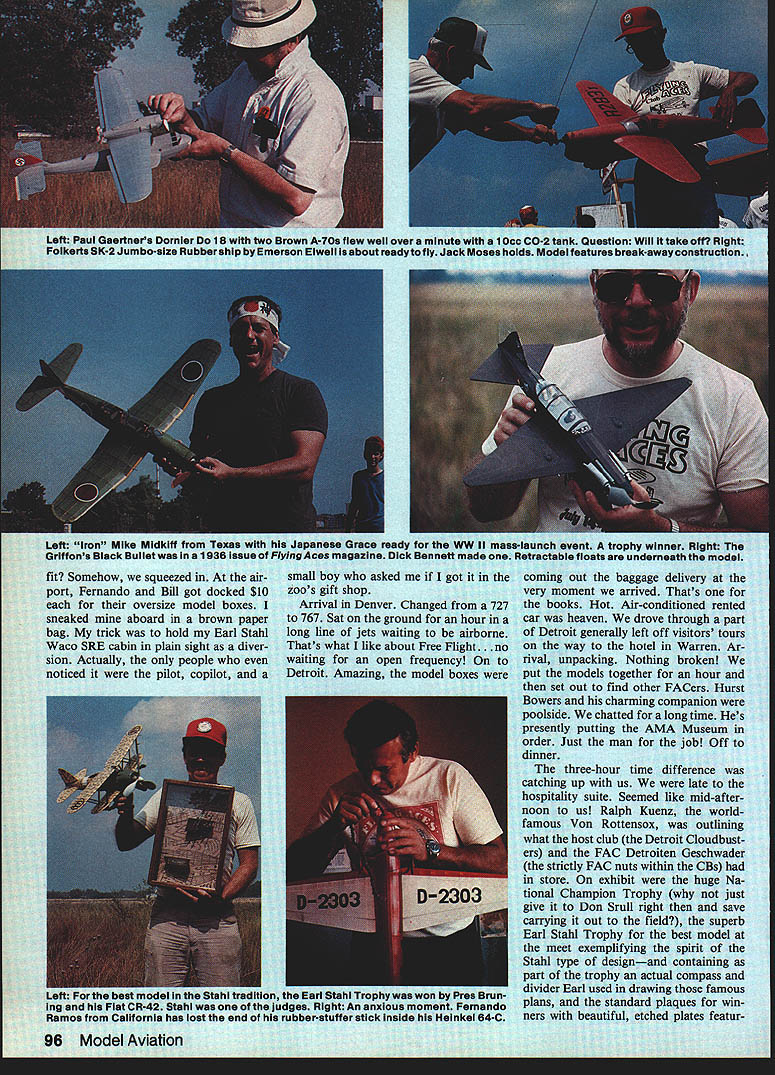
Paul Gaertner's twin CO-2 Dornier flying boat put in a flight well over a minute. Paul was all grins when we congratulated him. Srull's flying wing went through the trees, taking off a wing—knowing him, he'll have it repaired in 10 minutes flat. He took five. Leon Bennett's P-39 was rock-steady in the air. Check Del Balunek's Laird bipe; some sweetie pie, that. And look at Elwell's Folkerts—what a climb, and... oh, oh, that gust's on top of him... crash! No damage—just came apart. Must have been luck, no? Check that construction: made to come apart. Even a loop-brace of aluminum wire through the fuselage at the trailing edge to limit motor slap and also absorb shocks from hard landings.
Gordon Roberts cleaned 'em out again with that same model—against guys like Midkiff, Rees, and Bruning. I got so busy trying to see and photograph it all that my own model and box were left on the field and forgotten (until we got back to the motel). One unknown FACer brought them in and left, Lone Ranger–like, and didn't even leave his name. Thanks!
Near the end of the last day, the much-awaited Lancaster made its appearance on the field. Dennis Norman, one of the few modelers who has ever thermalled out and lost a twin rubber-powered Tigercat, scored the coup of the meet with his 9-oz. Lancaster featuring full interior, crew, 32 separate vacuformed parts, and a sprayed enamel finish. The model put in a few elegant flights, the best of which was 30 seconds. He took home the FAC Achievement Award Trophy. What class! The credit was deserved not only by Dennis, but also by his crew consisting of his lovely wife Linda, son Chris, and ground crew Del Balunek and Todd Allen. You'll be hearing more of this great model.
Pres Bruning took home the coveted Earl Stahl Trophy (Earl himself was one of the judges) with his gorgeous Fiat CR-42. Pres also made available free Northrop Gamma plans through the good graces of Golden Age Reproductions. The entire meet was like this: sharing ranged from Pres's models to the incredible screened T-shirts Noonan donated to the California bunch, to those brilliant hints, tips, ideas, and general camaraderie which made this more than what we commonly refer to as a "contest."
Acknowledgments
For helping to not only make this meet possible, but for their contribution in keeping the spirit of FAC alive, we all thank:
- Ralph Kuenz
- Lin and Janita Reichel
- Fred Wunsche
- Fred Gregg
- Jack Moses
- Bob Mosher
- Josh Gittlen
- Vic Diderot
- Andy and Mrs. Mac Isaac
- Pres Bruning
- George Lewis (my old spotting buddy)
Sunday night's dinner with old friends and the long bull session in the room until the wee hours, the "so-long" breakfast—these are as much a part of the experience as the thermal flight or the trophy presentation. We're planning for the FAC Nats Mk. V in two years. How about you?
Postscript
This advice for all FACers who always have about one day's work left to do on their model when contest day rolls around: "Next time, start one day earlier." —Allan Schanzle, GHB Maxecuters.
FACer Henry Komp, who took third place in the Greve Trophy mass-launch event, got home with his award and then discovered that he had goofed in making a small repair between heats, something not allowed in the FAC rules. Henry promptly mailed his trophy back with an apology! If that isn't in the spirit of what the Flying Aces Club is all about, I don't know what is.
Membership and Newsletters
If you'd like to join the Flying Aces Club, three of the greatest newsletters going are available from two sources:
- GHB Squadron and Flying Aces Club News — operated by Lin Reichel, 3001 Cindy Lane, Erie, PA 16506; membership $9 per year.
- GHB Maxecuters / Max-Fax — Allan Schanzle, 20008 Spur Hill Dr., Gaithersburg, MD 20879; membership $8.
- Crosswinds and Cleveland Free Flight Society membership — Michael C. Zand, 7055 Seven Hills Blvd., Seven Hills, OH 44131; membership about $10 (at last check).
These are just a few of the FAC affiliates which can make your modeling life more enjoyable.
Transcribed from original scans by AI. Minor OCR errors may remain.

