
FLYING ACES NATS
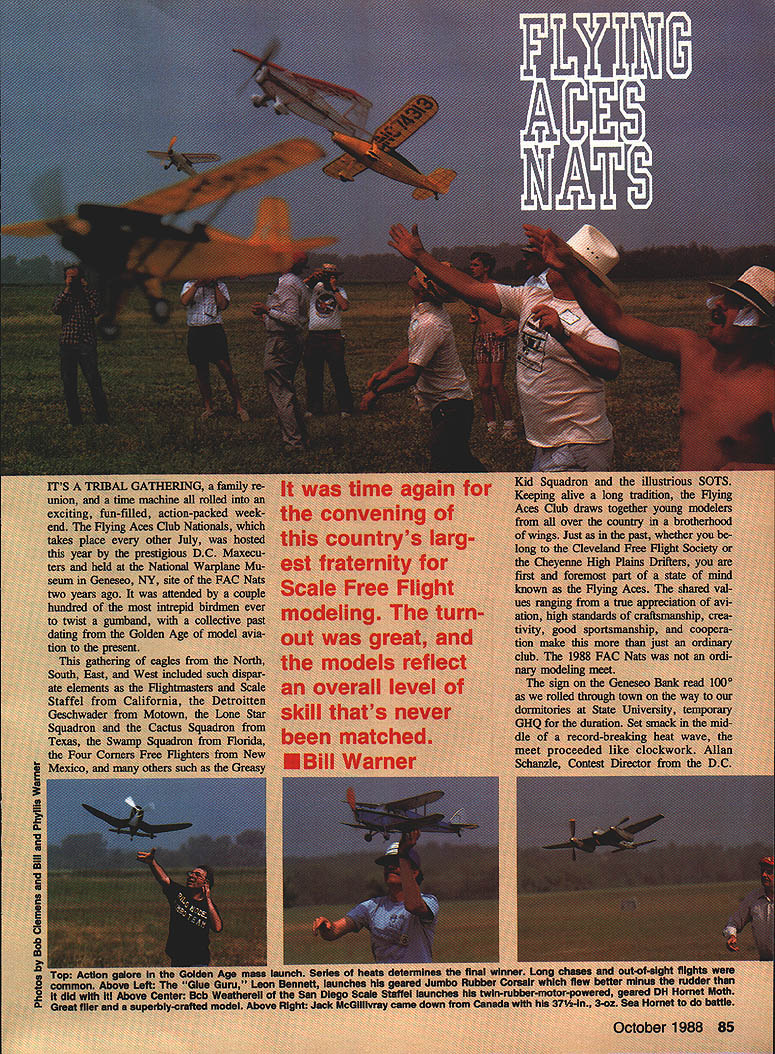
It's a tribal gathering, a family reunion, and a time machine all rolled into an exciting, fun-filled, action-packed weekend. The Flying Aces Club Nationals, held every other July, was hosted this year by the D.C. Maxecuters and held at the National Warplane Museum in Geneseo, NY, site of the FAC Nats two years earlier. It was attended by a couple hundred of the most intrepid birdmen ever to twist a gumband, with a collective past dating from the Golden Age of model aviation to the present.
Participants and Clubs
This gathering of eagles from the North, South, East, and West included such disparate elements as:
- Flightmasters and Scale Staffel (California)
- Detroiter Geschwader (Motown)
- Lone Star Squadron and Cactus Squadron (Texas)
- Swamp Squadron (Florida)
- Four Corners Free Fighters (New Mexico)
- Greasy Kid Squadron
- SOTS
…and many others.
Keeping alive a long tradition, the Flying Aces Club draws together young modelers from all over the country in a brotherhood of wings. Whether you belong to the Cleveland Free Flight Society or the Cheyenne High Plains Drifters, you are first and foremost part of a state of mind known as the Flying Aces. The shared values—appreciation of aviation, high standards of craftsmanship, creativity, good sportsmanship, and cooperation—make this more than just an ordinary club. The 1988 FAC Nats was not an ordinary modeling meet.
Organization and Atmosphere
The sign on the Geneseo bank read 100° as we rolled through town on the way to our dormitories at the State University, temporary GHQ for the duration. Set smack in the middle of a record-breaking heat wave, the meet proceeded like clockwork. Allan Schanzle, Contest Director from the D.C. Maxecuters, kept the show moving and the events ran on schedule. The first 15 entries won Henry Struck Trophies; door prizes went to lucky contestants and post-banquet parties went until after midnight. Everyone was up at the crack of dawn so as not to miss a minute of Sunday's fun.
An astrophysicist in his spare time had brought organizational talents to bear on the problems of running a Scale meet of unparalleled stature. He did it so well that no complaints disturbed the fantastic ambience of the get-together. Sure, it was hot. Of course, dealing with groups which controlled the field and the dining hall posed problems. But the total experience was so well planned that everyone got right into the spirit of the weekend instantly, and sorely regretted leaving when it was over.
Imagine a three-ring circus as seen from the vantage point of one of the performers. You're out there trying to do your thing, partly for your own satisfaction, but largely to share with fellow modelers. You also try to take in as much of what the other guys are doing as you can. Nearly 300 models were presented for the judged events. For every judged model, two or three models for mass-launch events and sport flying were stashed away in rooms, cars, or trailers. Reunions with old friends made the long trek to Geneseo worth whatever the time, expense, and trauma of travel. New friendships were started, new rivalries rekindled, and the fraternity flourished.
Highlights of the Flying
Still, certain scenes riveted everyone's attention. Shared pauses occurred when vintage planes from the museum landed and took off from the grass strip in the middle of the field; the magnificent radial roar and the return of the B-17 to the air show during the barbecue Sunday night was certainly a moment not to be ignored. Whenever Don Srull flew his electric Do‑X, all 12 props churning up the air, flying stopped and jaws dropped.
Dennis Norman's four-engined Lancaster never took to the air, but eyes were trained upon it. Dave Rees drew crowds testing a Northrop flying wing despite launching difficulties. Another flying wing, Vance Gilbert's, flew very well indeed; one airplane even turned around to chase him. Vance's immortal cry—"Hey, don't hit me! I'm the one who made you!"—drew shouts of approval from all parts of the field.
Joe Barish's flight of over three minutes in a VL-powered Fairchild 91 seaplane and Srull's long Voisin canard flights were among the standout performances. Dave Rees' Northrop tests and many other memorable flights made great flights the rule rather than the exception.
Around the perimeter were sideshows ranging from an Easy Built Models van selling arcane transmissions (six motors driving one propeller) to Stu Meyers' space-age electronic torque meter. Close enough, you could hear the lovely song of Bob Weatherell's Earl Stahl–trophy–winning D.H. Dragon, a twin-engined biplane with synchronized CO2 motors—beautiful.
Judging and Scale Events
Friday night was spent in the huge judging area with models spread wall-to-wall on tables. "Go-fers"—modelers chosen for their light touch—shuttled models back and forth from the exhibit room to the room next door, where the most respected panel of Scale judges ever assembled under one roof scrutinized and awarded points to these magnificent flying machines.
Power Scale ships were inspected and dissected by Dave Stott and Bob Thompson. Founders of the resurrected Flying Aces Club, Dave and Bob have a hundred-odd years of modeling experience between them. Don Snull and Dave Rees, both former National Champions, went over the GHQ Peanut Scale models. Dan Driscoll and Von Rettenoss (Ralph Kuenz) put their vast expertise to work on the FAC Scale models, while Pres Bruning and the "Blue Fox" (Russ Brown) evaluated the Jumbo Scale models. No detail escaped them, and their judgments were well reasoned and unquestioned.
Many of the Scale events involve adding your flight time points to your judging (realism, craftsmanship) points to get your ranking. To compete in the mass-launch events held in the afternoon, modelers had to qualify both by accumulating a certain minimum number of Scale points and by making a flight of adequate duration.
Mass Launch Events and the Greve
Modelers launched on signal in heats of about six at a time, with the first model returning to earth being eliminated and the rest going on to the final heats. Modelers had 10 minutes to retrieve their planes, which made it tough in the heat and wind of late afternoon. By 5 p.m., the really good fliers were worn out if they had entered all three mass-launch events each day. On Saturday the WW I Peanut Combat, Greve Trophy (24-in. span racers), in-line engine race from the great National Air Race days, and WW II fighters (24-in. span) were flown.
Some of the most dramatic moments occurred during mass launches. On several occasions the plane that was much higher than the rest suddenly dived out of the sky—capricious air currents and thermals could scorch a sure win. George Meyers and Gordon Roberts learned more than they wanted to about downers.
One of the most interesting mass-launch events was the Greve. Don Srull's Keith Ryder racer, completed just before the meet, was nearly eliminated as it threatened to come in due to a left-wing-low attitude under torque, only beginning to climb late in the heat. Thinking it was over after the second heat, Don gave his model to his retrieval helper, young Adrian Moulton from Canada. When he discovered the win was on for a final head-to-head heat with Gordon Roberts and his Chambermaid, Don had to borrow the model back. Off they went, higher and higher toward a stack of cumulonimbus over the university campus.
"The last one to go out of sight will be the winner," barked CD Allan Schanzle over the bullhorn as the two specks in the sky got smaller and smaller, not 50 yards apart. Suddenly, Roberts' Chambermaid dropped a wing and dived earthward for no apparent reason, leaving the ozone to the Keith Ryder. Don had won, and the thermal gods kept the model aloft; on Sunday Don was seen teaching Adrian to fly the HE 100 offered as a replacement.
Banquet and Awards
When flying ended Saturday and everyone headed for the showers to prepare for the night's banquet, it had cooled off to a mere 94°. Preceded by a cocktail hour, the banquet honored FACers who had achieved a certain number of victories in local contests and had earned the coveted Blue Max. Distinguished Service Medals were awarded to several deserving individuals, foremost among whom was the great Earl Stahl, who was also awarded an honorary rank of colonel in the FAC. Earl noted that it was the 50th anniversary of Scale events at the AMA Nats, and that the first, with 15 entries, had been won by Henry Struck. Trophies were given out for the day's events, and nearly 50 donated door prizes went to lucky contestants. Post-banquet parties went on until after midnight, but everyone was up at the crack of dawn so as not to miss a minute of Sunday's fun.
Sideshows, Seminars, and Anecdotes
- Jim Moseley's T-shirt proclaimed, "My ex-wife hates model airplanes."
- Mac McClenkin spent much time conducting informal seminars on jet power using CO2; his Bell X‑1 setup was a fine illustration.
- Tom Arnold came all the way from California, only to have a full-size PT‑23 taxi over a model winder.
- Fliers showed off laser-cut walnut trophies. Otto Kuhnis' fine artwork and FAC silver belt buckles were sent to Pat Daily in the Philippines.
- Others flashed their participant badges featuring the famous Pinhawk mug, all 200 of which were colored in by the meet's art director, Bill Ceres.
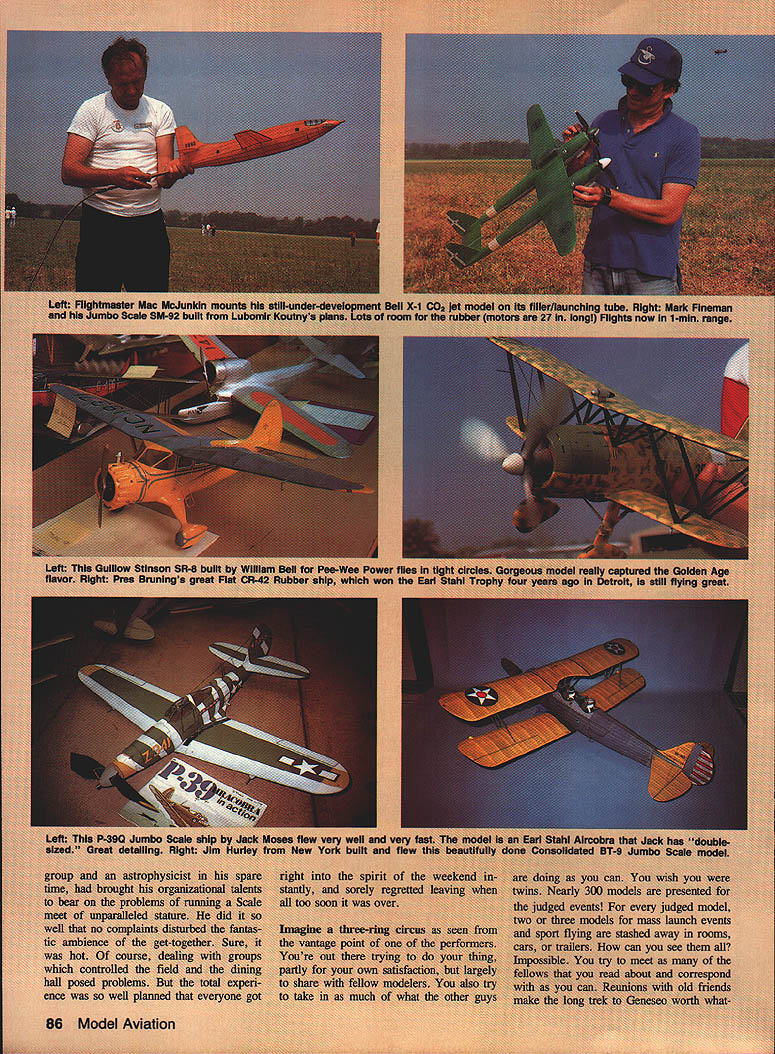
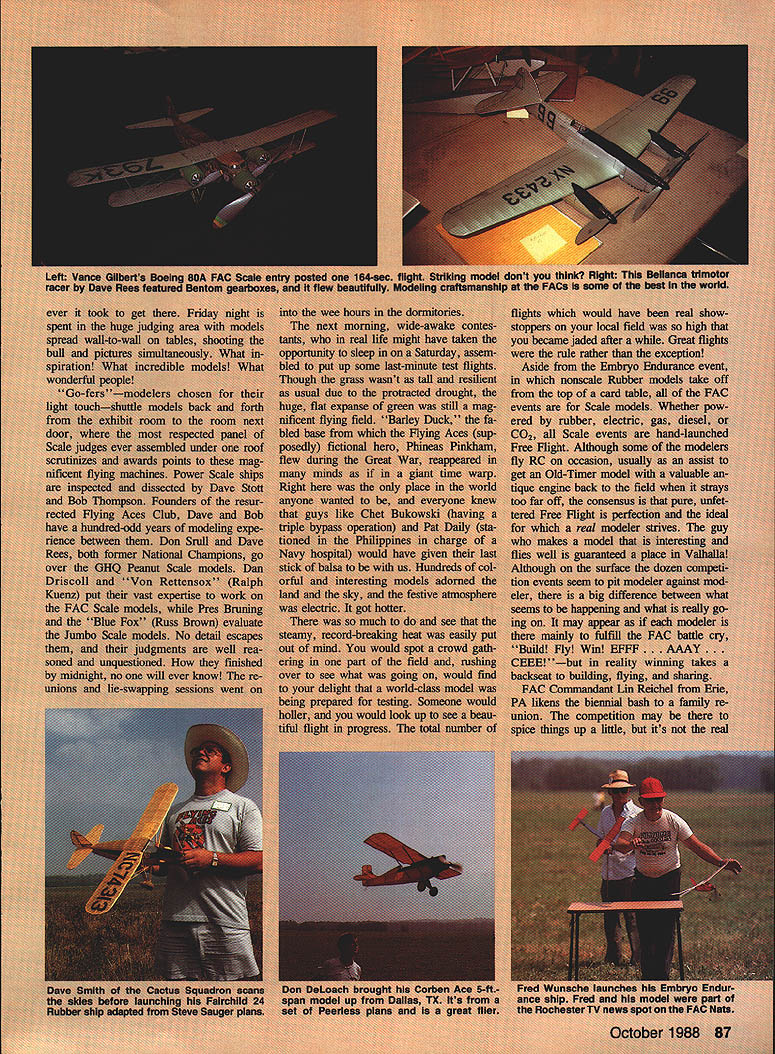
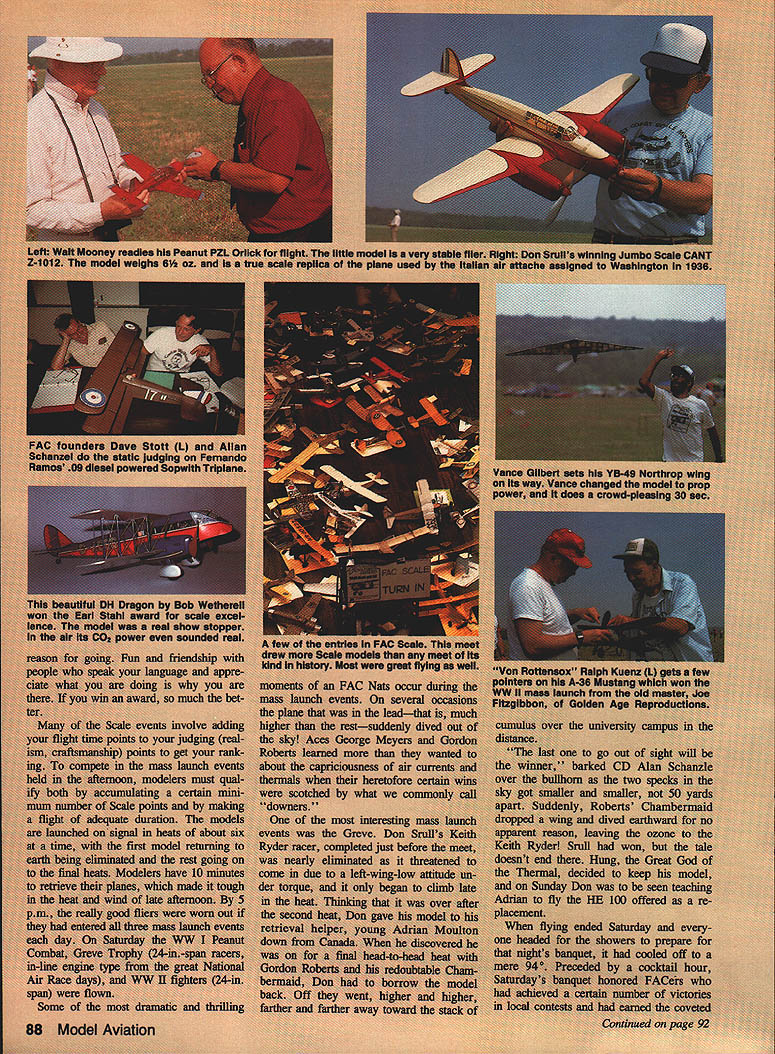
- A jumbo Taylorcraft floatplane dropped a float from 50 ft. and kept flying. Walt Eggert's 24-in.-span SE 5 and Jack McGillivray's 37½-in.-span Sea Hornet were so light they could practically be flown indoors.
- Leon Bennett pulled the entire rudder off his geared Corsair and the flight improved.
- Debates ranged from marking accuracy (whether an early airplane with no markings should get zero or full points) to the coming wave of multiple‑engine models thanks to increased availability of electric motors.
Modelers helped one another: a fellow who'd left his rubber-band winder hundreds of miles away was rescued by his neighbor. Two guys reminisced about seeing the Hindenburg and Graf Zeppelin. Junior modeler Scott Kogut grinned from ear to ear after chasing the results of his first year of model-building—a French Potter Peanut. Joyous whoops and heartfelt encouragements were commonplace.
Combat Engines and Outlaw FAI
Part of a Combat flier's genetic makeup is the desire to fly by any rules other than the ones in force. Current FAA rules mandated the 4mm venturi restrictor and 10%-nitro fuel. So now there is Outlaw FAI Combat with no venturi or fuel restrictions. Unfortunately, the Nelson .15 remains dominant in both categories, so entrants using Nelsons must use the 4mm restrictor and low-nitro fuel. A Fox .15 with open venturi and 50% nitro fuel is a close match for the Nelson, as are other engines like the Cox Conquest and Super Tiger.
Duke Fox offers his Combat Special Mark VI for $80 directly from the factory (phone orders: 501/646-1666). The engine as supplied is good enough to win most contests if properly broken in and tended with care. Run it on the bench, install it in a plane with a rigid mount, use good glowheads, a remote needle assembly, and good 40%-nitro fuel as recommended. If, after a couple of bench runs, you can't make the engine run at full revs for an entire bladderful of fuel at a constant setting, you're not ready to put it in a plane—because it will do the same thing in the air.
Final Impressions
I could fill a hundred pages with the warmth present in the air over the field. Despite disappointments or discomfort, the assembled participants shared an unforgettable experience and a reaffirmation of their beloved hobby. The next reunion is in two years. Why not join the family?
Thanks and Acknowledgements
A heartfelt salute to all who gave of themselves to make the 1988 FAC successful. Special thanks to:
- The Mazzucato organizers
- Lin and Juanita Reichel
- Tom Schmitt
- Bob Clemens
- Marie Rees
- Connie McSulski
- Marian Mann
- Kathy Thomas
- Peg Paisley
- Shirley Kuenz
- Rich Hensel
- Pat Jupiter
- Gerry and Helen Paisley
- Otto Kuhnis
- Claude Powell
- Paul Spreiregen
- Western NY Free Flight Society
- Geneseo National Warplane Museum
- Peck-Polymers
- Golden Age Reproductions
- Sea Glen Models
- Blue Swallow Models
- Flyline Models
- Flying Scale, Inc.
- All the unsung volunteer timers, go-fers, and helpers
- And an especially enthusiastic thanks to all the superb contestants who so willingly shared of themselves to keep Free Flight Scale alive, well, and growing.
Transcribed from original scans by AI. Minor OCR errors may remain.

