
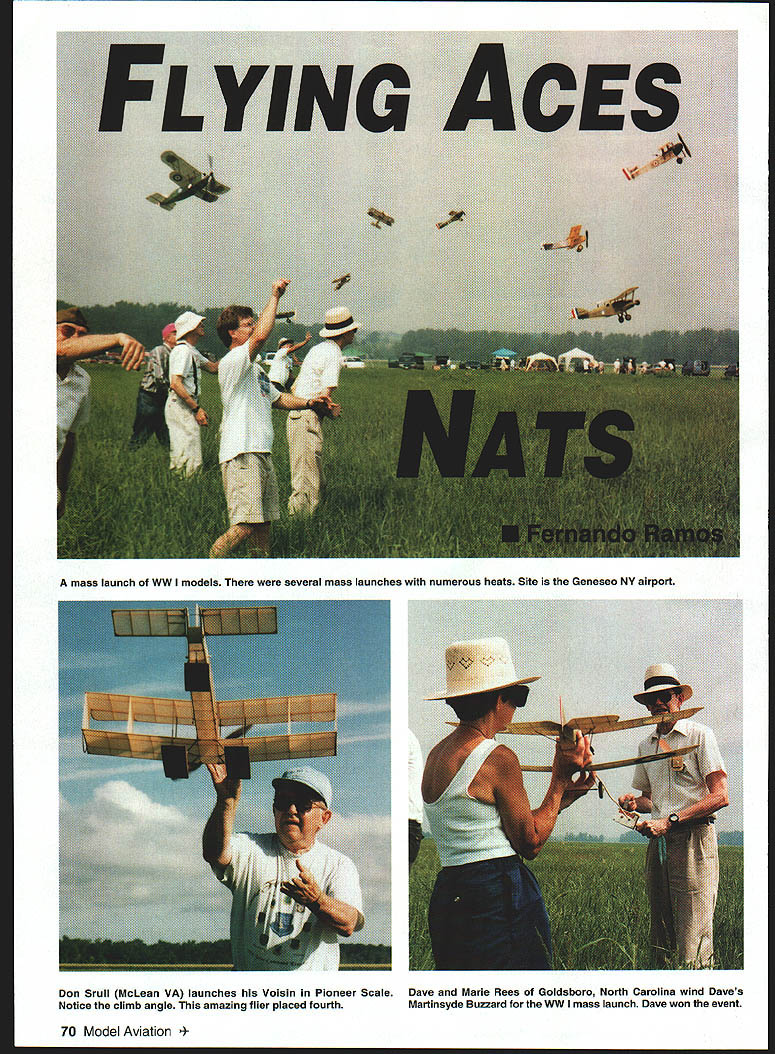
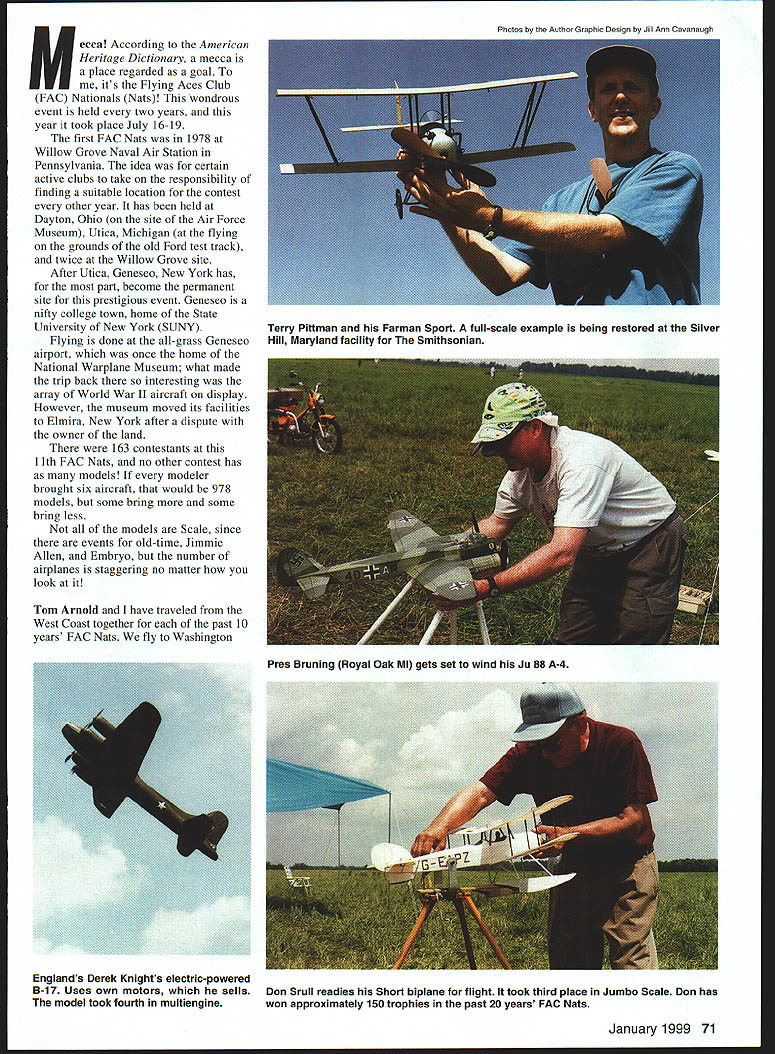
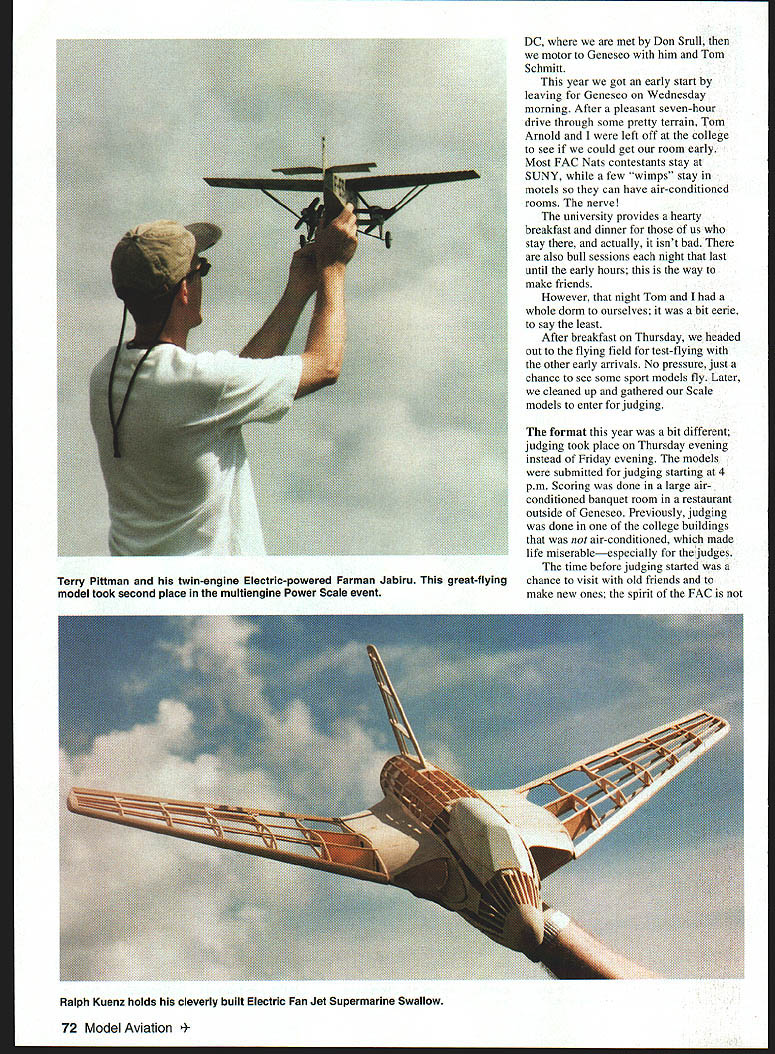
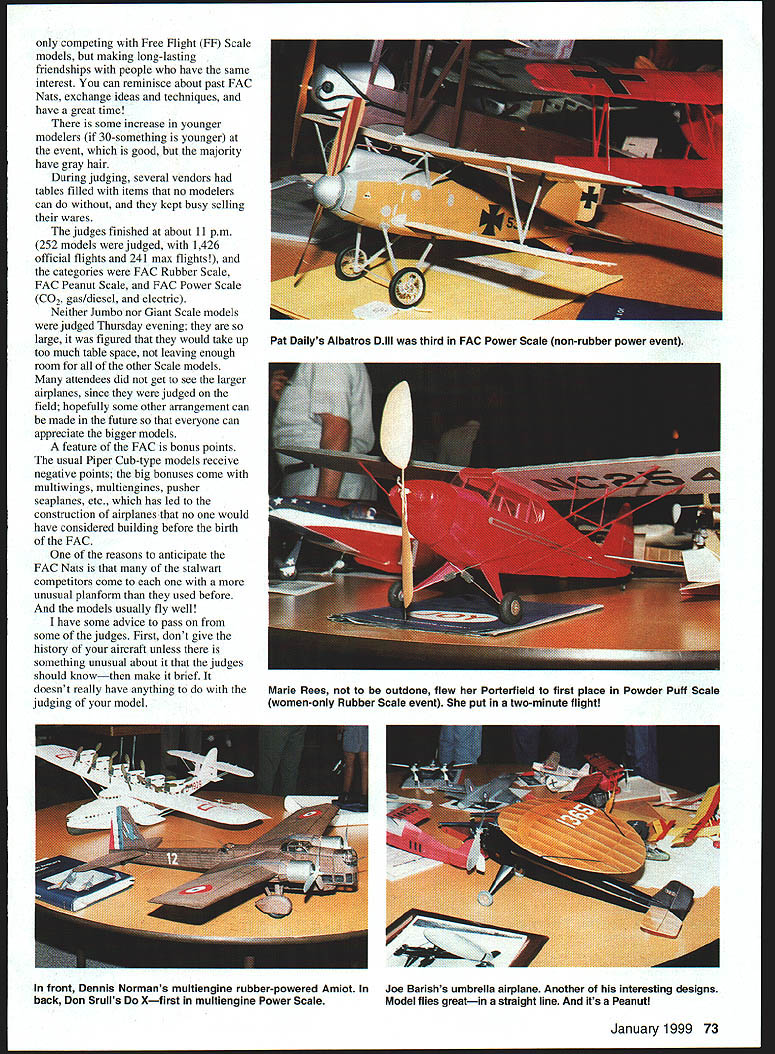
Flying Aces NATS
Fernando Ramos
Mecca for Modelers
Mecca! According to the American Heritage Dictionary, a mecca is a place regarded as a goal. To me, it's the Flying Aces Club (FAC) Nationals (Nats). This wondrous event is held every two years; this year it took place July 16–19.
History
The first FAC Nats was in 1978 at Willow Grove Naval Air Station in Pennsylvania. The idea was for certain active clubs to take responsibility for finding a suitable location for the contest every other year. It has been held at Dayton, Ohio (on the site of the Air Force Museum), Utica, Michigan (at the flying grounds of the old Ford test track), and twice at the Willow Grove site.
After Utica, Geneseo, New York, has, for the most part, become the permanent site for this prestigious event. Geneseo is a nifty college town, home of the State University of New York (SUNY).
Geneseo and Facilities
Flying is done at the all-grass Geneseo airport, which was once the home of the National Warplane Museum. What made the trip back there so interesting was the array of World War II aircraft on display. The museum later moved its facilities to Elmira, New York, after a dispute with the owner of the land.
Attendance and Events
There were 163 contestants at this 11th FAC Nats, and no other contest has as many models. If every modeler brought six aircraft, that would be 978 models; some bring more and some less.
Not all of the models are Scale—there are events for old-time, Jimmie Allen, and Embryo—but the number of airplanes is staggering no matter how you look at it.
Travel and Accommodations
Tom Arnold and I have traveled from the West Coast together for each of the past 10 FAC Nats. We fly to Washington, D.C., where we are met by Don Srull, then we motor to Geneseo with him and Tom Schmitt.
This year we got an early start, leaving for Geneseo on Wednesday morning. After a pleasant seven-hour drive through some pretty terrain, Tom Arnold and I were left off at the college to see if we could get our room early. Most FAC Nats contestants stay at SUNY, while a few "wimps" stay in motels so they can have air-conditioned rooms.
The university provides a hearty breakfast and dinner for those of us who stay there, and actually it isn't bad. There are also bull sessions each night that last until the early hours; this is the way to make friends. That night Tom and I had a whole dorm to ourselves; it was a bit eerie, to say the least.
After breakfast on Thursday we headed out to the flying field for test-flying with the other early arrivals. No pressure—just a chance to see some sport models fly. Later, we cleaned up and gathered our Scale models to enter for judging.
Judging
The format this year was different: judging took place on Thursday evening instead of Friday. Models were submitted for judging starting at 4 p.m. Scoring was done in a large air-conditioned banquet room in a restaurant outside Geneseo. Previously, judging was done in a college building that was not air-conditioned, which made life miserable—especially for the judges.
The time before judging started was a chance to visit with old friends and make new ones. The spirit of the FAC is not only competing with free-flight Scale models but making long-lasting friendships with people who have the same interest. You can reminisce about past FAC Nats, exchange ideas and techniques, and have a great time.
During judging, several vendors had tables filled with items no modeler can do without, and they kept busy selling their wares.
The judges finished at about 11 p.m. (252 models were judged, with 1,426 official flights and 241 max flights!). The categories were:
- FAC Rubber Scale
- FAC Peanut Scale
- FAC Power Scale (CO2, gas/diesel, and electric)
Neither Jumbo nor Giant Scale models were judged Thursday evening; they are so large that they would take up too much table space, not leaving enough room for the other Scale models. Many attendees did not get to see the larger airplanes since they were judged on the field; hopefully some other arrangement can be made in the future so everyone can appreciate the bigger models.
A feature of the FAC is bonus points. The usual Piper Cub–type models receive negative points; big bonuses come with multiwings, multiengines, pusher seaplanes, etc., which has led to the construction of airplanes no one would have considered building before the birth of the FAC.
One reason to anticipate the FAC Nats is that many stalwart competitors come with more unusual platforms than they used before. And the models usually fly well!
Advice from the Judges
- Don't give the history of your aircraft unless there is something unusual the judges should know—then make it brief. It doesn't really have anything to do with judging your model.
- If you expend great effort placing many details on your model, make a list of them and attach it to your three-view.
- For color-and-markings, submit a color photograph or painting of the aircraft you modeled—not someone else's. You would be surprised how many contestants do not submit a color photo.
- Keep your documentation in the order the model will be judged. Anything you can do to make the judges' job easier will not go unnoticed.
Flying Events
After a caloric breakfast Friday morning everyone headed to the flying field. The weather was terrific; there was enough cloud cover to keep it from getting too hot. A good portion of the field had not been mowed, and the grass was at least a foot tall—like mother's arms for errant models.
Several mass-launch events were flown with many heats—a favorite for the spectators. Some mass-launch events have a 15% rubber rule: a model is weighed and, regardless of its weight, you are given 15% of that weight in rubber.
Why the rule? The models fly so well and so far that they create long chases for contestants, who have to be back in time for the next heat. That creates a problem for some of the old-timers—especially when you factor in heat and humidity.
The 15% rule has made fewer low-distance flights possible, and I didn't find anyone who liked it; contestants are forced to build an indoor-type model, or nearly a ghost model (one that is sparse in detail). In actuality, when the weight of the rubber is added to the model's weight, it works out to about 13%.
Press and Radio Control Crossover
Editors from two other model magazines were at the event; it's the first time I had seen either attend. It was fun seeing them go from one end of the field to the other to get photos. This contest is unlike the usual radio-control (RC) Scale contest where models are, for the most part, parked in front of the spectators and flying is done in front of the judges.
One magazine is trying to change its RC-only image and, in part, get back to its free-flight roots. A few RCers are even building rubber models to put some fun back into their modeling, and some of them are finding out what it takes to really trim a model—no servos here!
People and Community
It is difficult to name an individual who stands out among the talent gathered at an event. Names such as:
- Don Srull
- Dave Rees
- Stott
- Nallen
- Bruning
- Hallman
- Clemens
- Kuenz
- Starleaf
- Barish
were present. They are showing the way for the modelers behind them, demonstrating what it takes to be competitive—not only in how they build their creations, but in what they do to make them fly well.
One person who does stand out is Earl Stahl. He doesn't compete, but he shows up to enjoy the sights and sounds of this huge event. He mingles among the contestants and takes photos of their handiwork. I have had the pleasure of knowing Earl for the past 20 years, and I am better for it. What a legacy he will leave to the modeling fraternity!
Banquet and Awards
The banquet was Sunday evening at the restaurant where the judging was done. It was also a departure from previous times; normally the banquet is held Saturday evening.
After a good meal there was a guest speaker, then the trophies were awarded. Dave Rees is the Ace of Aces; he has won more than 400 trophies at this event during the past 20 years, which is amazing! (I believe Don Srull is second with around 150.) Dave's wife Marie helps him.
Final Thoughts and Thanks
I am thankful for having the opportunity to attend every FAC Nats since 1978. During that time I have made wonderful, enduring friendships on which you cannot put a price tag. I can repeatedly tell you how outstanding this event is, but you have to experience it for yourself to get the full flavor. Plan to attend in the year 2000!
Many thanks to Lin and Juanita Reichel, commander in chief—and to all of Lin's helpers, who make the FAC Nats what it is.
Fernando Ramos 19361 Mesa Dr. Villa Park, CA 92667
Transcribed from original scans by AI. Minor OCR errors may remain.

