
Flying For Fun
909 N. Maize Rd., Townhouse 734, Wichita, KS 67212
Doc has felt for some time that being limited to writing about RC Old-Timers has been too restrictive. He and the publisher agreed that a general-interest column, in the same vein as Bill Winter's old "Just for the Fun of It," would interest a wide swath of readers. Doc's new column will appear every other month. He's waiting for your cards, letters, and photos—especially color photos!
Breaking Open
During my 13 years as your "RC Old-Timers" columnist I've often been frustrated by fascinating photos and other interesting material that I couldn't use simply because it didn't fit the limited format of that column. Also, to be absolutely frank, I've had a lifelong fascination with all things that fly—not just Old-Timers. So I've long wished for the chance to write a column that covers the whole modeling spectrum, from those incredible rainbow-streaked indoor micromodels to the jumbo RCs with their awesome size and realism.
What's more, in the past few years I've lost interest in things competitive. Instead I find immense enjoyment in totally relaxed, highly social activities like fun-flys and fly-ins. Take a look at the July 1990 Sanctioned Events Calendar in the "Competition News" section of this magazine. Count the noncompetitive events and then the contests. You'll find that well over half the list comprises gatherings that promise fun, not trophies. In my area hardly a weekend goes by without some type of IMAA or local fun fly. Social events are truly sweeping the modeling world.
Lots of you are gravitating toward this fly-for-fun attitude and need a forum in a national publication. Publisher Ross McMullen has wisely chosen to add such coverage to Model Aviation. This column is that addition.
Add is the operative word here. Rather than abandoning those wonderful Antiques, the column is simply expanding into contemporary times. If it's about modeling, I'm interested. If you think a model airplane is neat, I'll think it's neat. Just send some photos and a simple letter that I can share with all the readers of Model Aviation.
In high school journalism class I learned that any properly written article should address who, what, where, when and how. Basic stuff, but a good guideline for any decently written communication.
Who?
I'm a 58-year-old practicing dentist (a long way from retirement), blessed with a remarkably patient wife of 36 years, three grown children and two delightful granddaughters. I'm also still that six-year-old boy who was given a couple of hang-up rubber-powered models by a kid who was moving out of town.
You know the kind of models I mean: incredibly delicate structures, covered in some sort of gossamer material that smelled of bananas. They were beautiful—vastly more appealing than any toy I'd ever had. Nothing quite like them could be bought, and it obviously took skill and craftsmanship to make them.
And so began a lifetime obsession. Untold hours of enjoyment, not to mention countless lessons in patience, perseverance, craftsmanship, logic, deduction, self-reliance, self-image, and handling success and failure, were mine by way of building and flying models. When you get right down to it, model airplanes shaped our whole lives, didn't they?
What?
Old, new, mundane, outlandish, ugly, beautiful, success or failure—every model aircraft I've ever built has been fun. I'm interested in the whole modeling spectrum, not just Old-Timers. If you're interested and think your model airplane is neat, send some photos and a simple letter so we can share them with readers.
When?
What claims a columnist's time is not so much writing the column as answering the letters it generates. That's why MA publisher Ross McMullen and I have opted for a rather lengthy column every other month, allowing time for answering letters one month and writing the column the next. Ross says we'll try that format for a while, then reevaluate it based on reader response. Of course, the whole shebang is predicated on my mailbag filling up. Unless you readers keep a steady flow of material coming I won't have a second column to write.
Where?
Right here, in the pages of what is recognized as the finest general-interest model publication in the world. When Potomac Aviation Publishing folded about a decade and a half ago, the AMA decided to publish its own journal. Under the capable leadership first of Bill Winter, then of Carl Wheeler and now of Ross McMullen, Model Aviation has evolved into the highly regarded magazine it is today.
How?
Ross McMullen has decided to make "Flying for Fun" the first of the new Features to feature color photography whenever possible. If the prose matches the photography, so much the better.
Naturally, old black-and-white prints of historical value are always welcome. But if you're going to take a photo to send me, why not make it color? Nearly everyone has a 35mm camera, and with today's excellent film and quality processing most of you probably find it easier to get good color prints to send than to send Polaroid photos; the color will reproduce, but the quality is poor. Slides require an extra step to reproduce but are acceptable.
So get out your camera. Send me pictures of your models. Send me pictures of anyone else's models. Just make sure they're fun models!
Three small requests:
- Please don't attempt to call me. My home phone is unlisted, as I simply don't have time to get involved in 45-minute conversations on matters that can be covered in 10 minutes of letter writing.
- Please don't call me at work. I refuse to interrupt a patient's treatment to take hobby calls. Business and pleasure don't mix, and I need to make a living just as you do.
- If you write requesting a response, be sure to include a large self-addressed envelope. I don't respond to letters if the writer hasn't extended that courtesy.
Please don't be put off by these simple requests. I make every effort to respond to all letters as promptly as possible, and I greatly enjoy doing so.
Little Douglas Hardware
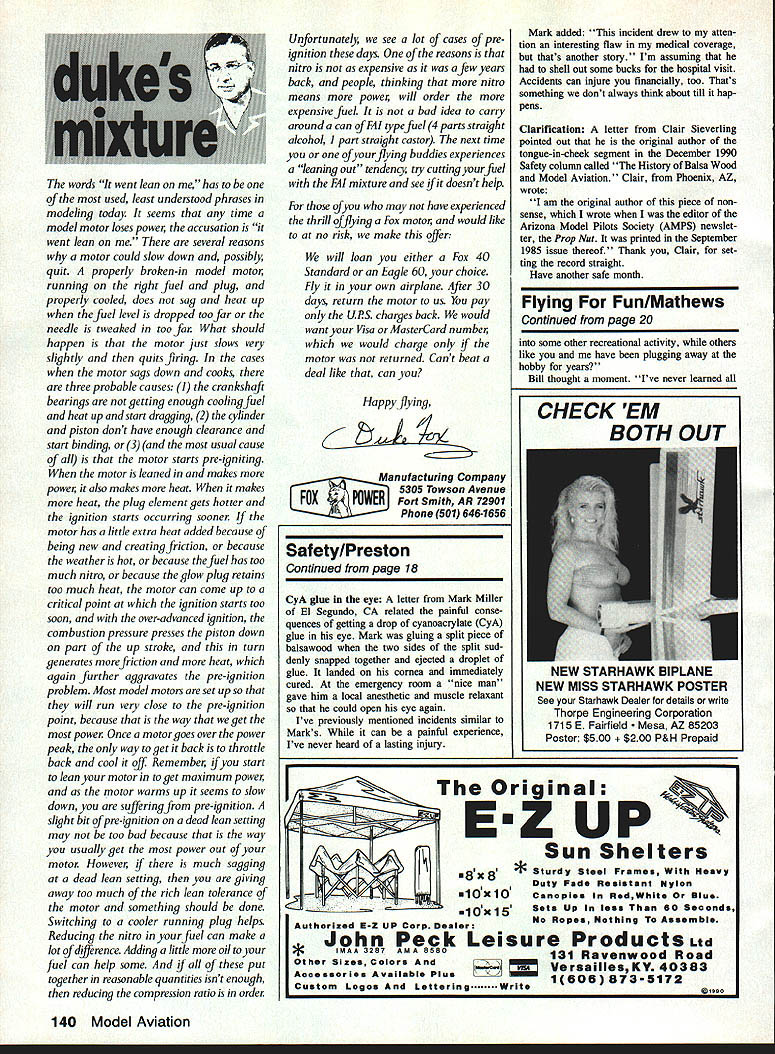
Regular readers of the "RC Old-Timers" column will recognize the little Electric 1934/35 Douglas Hardware Special featured in the June 1989 column. The history of that design—it's believed to have been the first gas model built—and the effort that went into restoring the original for the AMA museum make for fun reading. The column is well worth looking up.
Earl Brightbill of Roswell, GA used the three-views from that column to recreate the original 7-ft. model in a 42-in. size. He's added a scrap balsa Brown Jr. dummy engine atop the Peck Silver Streak electric motor—an inspiration I find both charming and more in tune with a re-creation than the ultrastreamlined poses we usually see on the Old-Timer Electrics.
Earl uses rudder, elevator and speed control with a BEC for control of his diminutive 20-oz. electric. A 500-mAh battery pack drives both the 50-watt Silver Streak and the radio. The Rev-Up 6 x 3 prop appears to be the best match on this particular model.
Old-Timers in all their variety seem to make excellent electric conversions. When you consider that the vintage birds were designed for engines that didn't produce a whole lot of power for their weight, that their structures were light, and that they were created to rotate around a coil, condenser and dry cell battery pack, it isn't surprising that they fly reasonably well with electric systems. After all, an electric motor doesn't have a much higher power-to-weight ratio than, say, an old Brown engine.
Half-A RCSD
Radio-Controlled Scale Drive (RCSD) seems to be slowly catching on as a fun thing to do. Several disparate concepts appear to be emerging. The Society of Antique Modelers hopes to have the activity as an extension of their desire to recreate a moment in history. Other groups are cultivating RCSD as a way of enjoying the challenge of Free Flight Scale without the flying site and retrieval hassles.
To explain that a bit further: the SAM types would like to limit model selection to prewar designs originating before 1942. Others prefer to limit choices to full-scale prototypes built prior to a given cutoff date. Still others have no interest in competing but simply want to build what they flew, or yearned to fly, back when all those incredible choices were new and fresh.
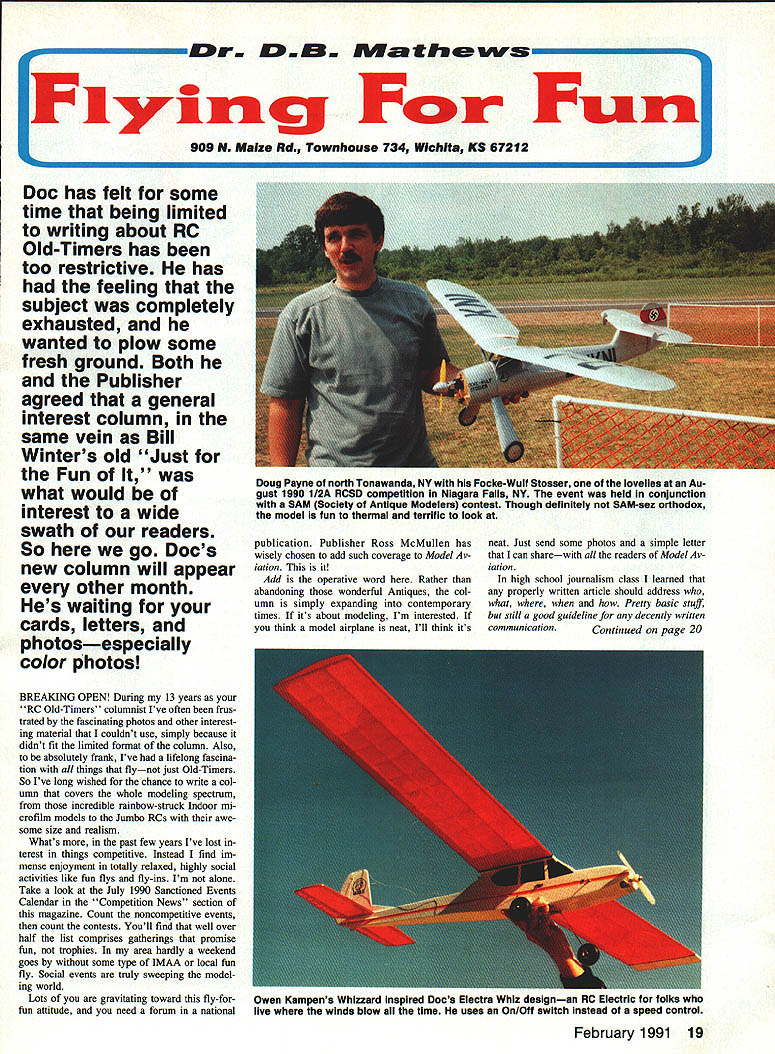
The two examples shown this month were entered in a 1/2A RCSD event held in conjunction with a SAM contest in Niagara Falls, NY in August 1990. Though neither design meets the old specifications found in the SAM preamble, both are attractive and fun to fly.
Jack Brown of SAM 48, who sent the photos of Doug Payne's Focke-Wulf Stosser taken at that event, commented that Doug developed his model from three-views he had located at a library. That's commendable—and the finished product certainly is lovely.
Should you be interested in a similar project, let me call your attention to Aeromodeller plan FSP/617 of a Stosser in 42-inch size. This is a robust Free Fighter that could be easily modified to a weight more appropriate for an .049 engine or enlarged to accept some other power plant. The Aeromodeller drawings, along with three-views of the Stosser and a whole slew of other interesting possibilities, are part of the MAP Plans Catalog.
Electric-powered Glider Experiment
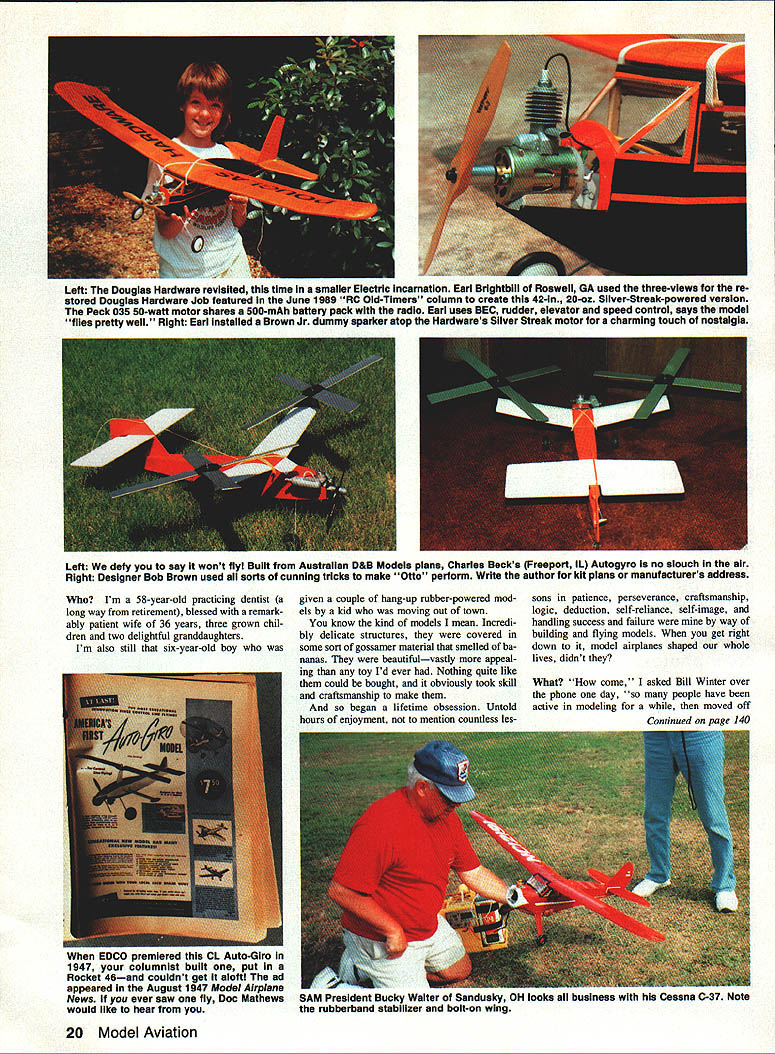
Electric-powered gliders seem reasonably satisfactory in our winds, so I decided to try a thin glider section on a sleek cabin model. I'm a longtime admirer of Owen Kampen's Whizzard, kitted by Ace R/C—it's an exceptionally attractive and easy-to-build airplane—so I borrowed its appearance for this little hybrid electric. The wing section is a Selig S.4061 straight out of Ace's Sky Hawk Glider.
Holding the airframe weight to a minimum took a huge effort. With tons of technical help from Dick Gibbs, I ended up with a wing area of 550 sq. in. and a 10-oz. wing loading.
I've used three different can motors for power: a Davey Systems Hyper Thrust, a Goldberg Turbo 550, and the $7.50 Mabuchi from Ace. All three, according to Gibbs, rate at about 10,000 rpm, and all needed at least a seven-cell, 1,200-mAh battery pack for even marginal performance.
Originally I tried a speed-control prototype (whose manufacturer shall remain anonymous). When it caused repeated meltdowns, I changed to a simple Bantam midget servo running an on/off switch made from an Ace R/C 60X31 onboard glow ignition setup. It's simple and effective. (It's also, unfortunately, no way to set up a BEC.) An 8 x 4 Top Flite prop seemed the best match for the can motors.
The wing and stab are covered with Litespan from Idealair Models (P.O. Box 44853, Detroit, MI 48224). Litespan is a heat-shrink material that looks for all the world like a well-doped silk surface, which is what most modelers take it for until they're told otherwise.
And how did my experiment fly? Sluggishly, until I retrofitted it with an Astro Cobalt .05. That brought it to life—and drove up the cost along with the climb rate.
This project is still many miles from the end of the trail and a long way from publication (if I ever publish it). But it's probably superior to most of the sport designs that are available today. The model will climb to adequate height three times per charge and it thermals in moderate to strong lift. Plus, it's kind'a fun.
Otto the Gyro
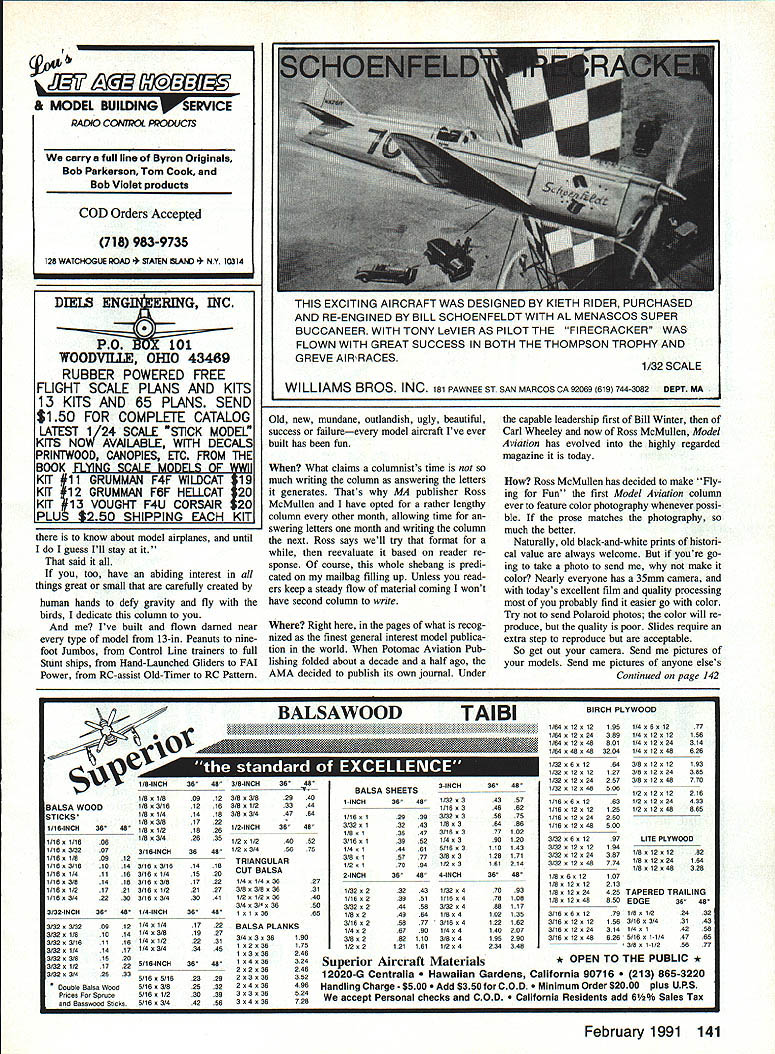
Here's a good example of the sort of thing I'd like to spotlight in this column. By odd coincidence this project is the work of Charles Beck (Freeport, IL), whose brother Ralph of Beloit, WI was responsible for the restoration of the Douglas Hardware Special mentioned earlier. The Beck brothers certainly know how to have fun with model airplanes.
Last winter Charles scratch-built an interesting autogyro from a plans set sent to him by a fellow Old-Timer aficionado in Australia. Charles was skeptical. Kitted by D&B Models in Australia, on paper the design looks, shall we say, a little eccentric. But his Aussie friend assured him that he'd seen the model fly and considered it worth building.
The D&B Models Autogyro has a 38-in. fuselage and a 28-in. wing and rotor support. Rotor diameters are 22 in. each. The rotors are made from eight sheets of 1/8 x 2-in. balsa and covered with Black Baron film. They are rigged to a hardened rocker block using 5/32 in. of overlap to form the pitch, with the second set overlapped in reverse order to create counter-rotation. No balancing of the rotors was necessary; they turn on 1/8-in. music-wire shafts via a pair of nylon nose-gear bearings epoxied into the hubs.
The flat-bottomed section of the wing provides some lift, but not nearly enough to sustain hovering flight. The stab and fin are of 3/16-in. sheet with six degrees of positive incidence (front up) built in. The engine, on the other hand, is set with 10° of downthrust.
Tilting the rotors inward provides some dihedral effect. The shafts are inclined rearward, which puts the blades at a positive angle to the wind flow and gets them moving.
So does it fly? Glad you asked. Charles reports that the critter not only flies but loops and knife-edges (sort of)—and even, so help me, rolls. The plans indicate that the rotors will stop at the top of a roll, but Charles' rotors spin so fast he can't tell if they do or don't. Since the kit manufacturer recommends a .15- to .20-cu.-in. engine, the O.S. .25 FSR he used put him well over the expected peak of the power curve.
Charles can slowly flare in his plane for a conventional landing, or he can land it by hovering. For the latter, he slowly adjusts the throttle while feeding in more and more up elevator; as the power is reduced the model will slowly settle onto its wheels.
Power off? Charles says he simply noses down to keep the rotors turning, then dead-sticks just as he would for a powered flare landing.
In a subsequent letter Charles told of a stunning episode with his autogyro. Having run out of fuel while still a distance from the runway, he'd made a forced landing in a cornfield. The stalks were eight feet high, and they broke one blade off each of the rotors. Charles repaired the blades with CyA, then flew several more times—with perfectly normal performance. Imagine his astonishment to discover, after his last flight, that both blades were gone! The missing blades, by the way, were never found.
I reconstructed Charles' kit plans in rather rough form—but with enough detail to serve a seasoned scratch-builder. Should you want to take on this project, I'll be glad to either provide the manufacturer's address or consult with you about scratch-building one.
Control Line Autogyro
Being desperately short of photos of Free Flight and Control Line subjects, I've started this first column heavily toward RC. I'm hoping for contributions from the FF and CL communities to keep some balance.
Way back in 1947 the Engineering and Development Co. (EDCO) of Del Mar, CA kitted a CL autogyro. I built one, powered it with a Rocket .46, and couldn't get it to fly at all—the creature wouldn't even move fast enough to achieve lift-off. A couple of guys my age say they've either had some success personally or observed others who have. Have any of you ever seen one fly? I'd like to hear from you.
In the meantime, go build a model—and then enjoy it!
Transcribed from original scans by AI. Minor OCR errors may remain.

