

Dr. D. B. Mathews 909 N. Maize Rd., Townhouse 734, Wichita, KS 67212
Flying For Fun
MEMORIES Some of my fondest modeling recollections are of the Nats held in the 1950s and ’60s. Best of all are those memories of the huge Navy hangars where we all congregated to build, repair and store our models and gear, show and tell, lie a little, visit a lot and just plain have a darn good time.
There was sometimes more to see and do inside the hangar than out on the flight line, and often the activities went on most of the night. The whole scene had a feeling of its own with dozens of innovative designs and new products to study and critique.
Wonderful visions flash before me of:
- Ted Eckentrapp hand-launching his 12‑in. monster out the open hangar door and into the night.
- Dave Platt rebuilding a crashed ME‑109 — including the airbrushing.
- Someone flying a tiny CO2 single‑channel ship.
- Kids flying Delta Darts at 2 a.m.
- A Morton M‑5 being run.
- Flags and banners hanging over tables where groups had homesteaded.
- A modeler asleep on the floor under a table full of his models.
There were sounds of laughter, congratulatory shouts and quiet condolences, greetings to old friends, introductions to new acquaintances — a persistent hum of activity. There was the smell of glue and dope, exotic fuels and concession‑stand hot dogs.
Most of us were guests of the U.S. Navy. We slept in the barracks, swam in the base pool, ate in the enlisted mess and vicariously were “in the Navy now.” Many of us shared rides to the Nats and depended on our feet and tractor‑drawn flatbeds to get from one area to another. It was easy to congregate in the hangar. Today, most of us can afford air‑conditioned motels or motor homes, restaurant food and a more elaborate lifestyle than the one I remember from those old Nats.
A special memory
I cherish an encounter with a smallish man with thick glasses and a serious “up East” accent. I saw him at the 1948 Nats in Olathe, Kansas. Dressed in a coat and tie, one afternoon he set up a display case in the hangar. In it were engines — not just your common garden‑variety sparkers, but incredibly tiny little things. Remember, in 1948 the smallest of the small was .09 cu. in.
An astonished flood of excitement swept through the hangar as news of the tiny engines spread. They absolutely stunned everyone who saw them. The largest of the small were perhaps .05 cu. in., and from there they ran to a thing so diminutive he had it soldered onto his tie bar! Incredible — running engines one‑tenth the size of anything any of us had ever seen.
That man was Ray Arden, designer of the smallest production engines of the pre‑WWII era: the Atom. He introduced the Arden .09 and .19 after the war. There was something else about Ray Arden; he was responsible for the most revolutionary piece of model technology of all time — the glow plug.
A 15‑year‑old in the crowd (me) asked, “Mr. Arden, do you have any plans to market engines this small?” He answered, “I doubt if a market for them would ever exist.” Whew — was he wrong. Ask LeRoy Cox!
As a footnote, one of my dental‑school classmates was from Danbury, Connecticut. He told me that Pete Denninger was the neighborhood kid who kept coming into Ray Arden’s shop. Arden’s inventive genius was not limited to model aircraft engines; he had file cabinets full of patents for automobile and household‑appliance products. Ray Arden may well have been the Thomas Edison of modeling.
The 1/2A revolution
Apparently, at the very moment Ray Arden was questioning whether a market for small engines existed, others were preparing to market them.
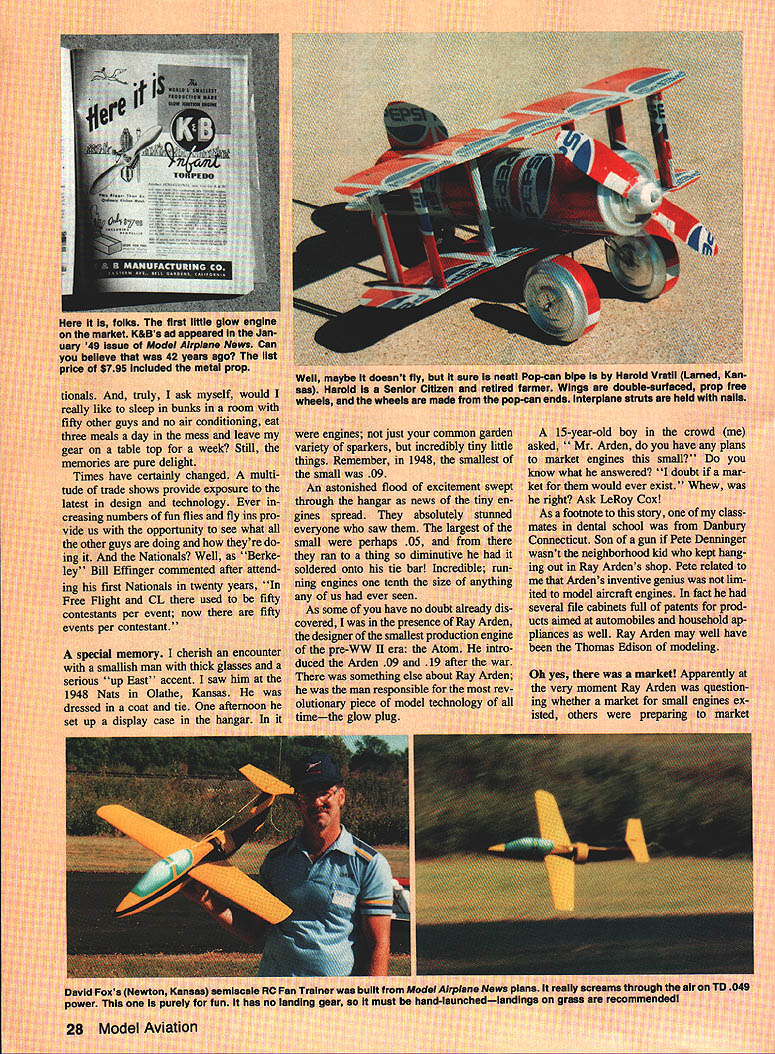
Lud Kading and John Broadbeck (originators of K&B) were already producing pre‑delivery units of their Infant. The .020‑cu. in. Infant was first advertised in January 1949, only four months after I saw Arden’s in the hangar, and this little power plant set off the 1/2A revolution that changed power modeling forever.
Within months Mel Anderson introduced the .035‑cu. in. Spitzy and Bill Attwood his .049‑cu. in. Wasp. Within the year, many manufacturers had similar small engines on the market, magazines were full of 1/2A designs and a long list of Free Flight and CL kits became available. As they say, “the rest is history.”
K&B’s Infant was first out of the gate, and very few suitable designs were available. Hoping to promote the engine, Kading designed a bunch of all‑balsa models for publication in the model press. These were sport Free Flight designs — hardware, or even lines, weren’t yet available for such minute CL power.
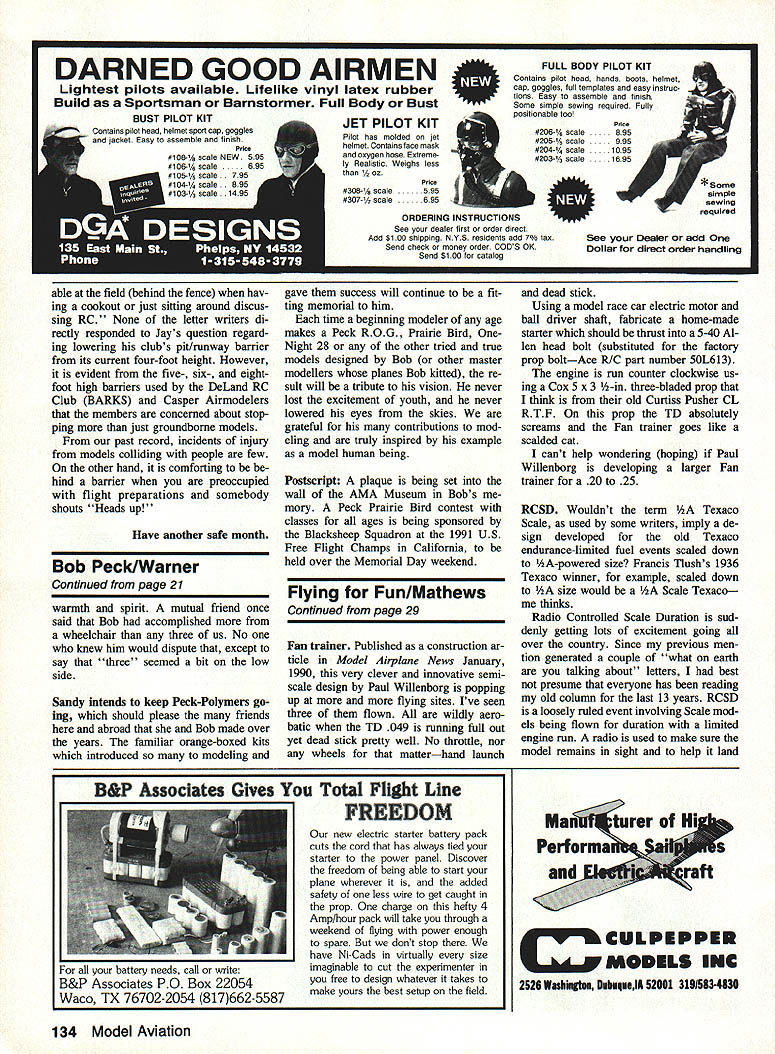
Among the Kading designs is the Baby Biwinger from Air Trails, April 1952. Of course we all approached these tiny engines as novelties, but we quickly learned they were a rich source of great amounts of inexpensive fun.
I personally recall my Infant as a cantankerous little beast. Since there were no commercially available props small enough, the Infant was supplied with a metal prop bent out of a stamping. I quickly learned to carve my own out of a chunk of pine. The Baby Biwinger drawings even included a prop blank drawing.
Getting fuel with sufficient nitro content for the Infant was another difficulty. As I recall, the model would run on Q.R. No. 3 fuel, but poorly. I finally solved the problem by spiking mine with nitro‑propane bought from the local druggist. Try that today! After a springtime of fiddling with the Infant, I stuck it on the front of a self‑designed stick ROG Free Flight sort of thing and had a barrel of fun flying it from the local golf course. Try that today as well!
Even smaller
Dan Walton found Kading’s old article and full‑size drawings in his magazine collection and built the Biwinger for his new Cox .010. The modern .010 now in production produces more power than the twice‑sized original Infant.
Dan’s Biwinger flies in a tight left‑hand climb and steep left‑hand descent — note that I did not say “glide.” These well‑controlled climb and rapid‑descent Free Flight models were quite popular in the 1950s since they could be flown safely from athletic fields and vacant lots with little fear of flyaways. Classic examples are Joe Wagner’s Veco Dakota and the Midwest Sniffer.
With the .010 Cox back in production, many of the dozens of old .020 designs could provide hours of inexpensive fun for the kids (grandpa and grandkids). If you build one, send me some pictures.
Fan trainer
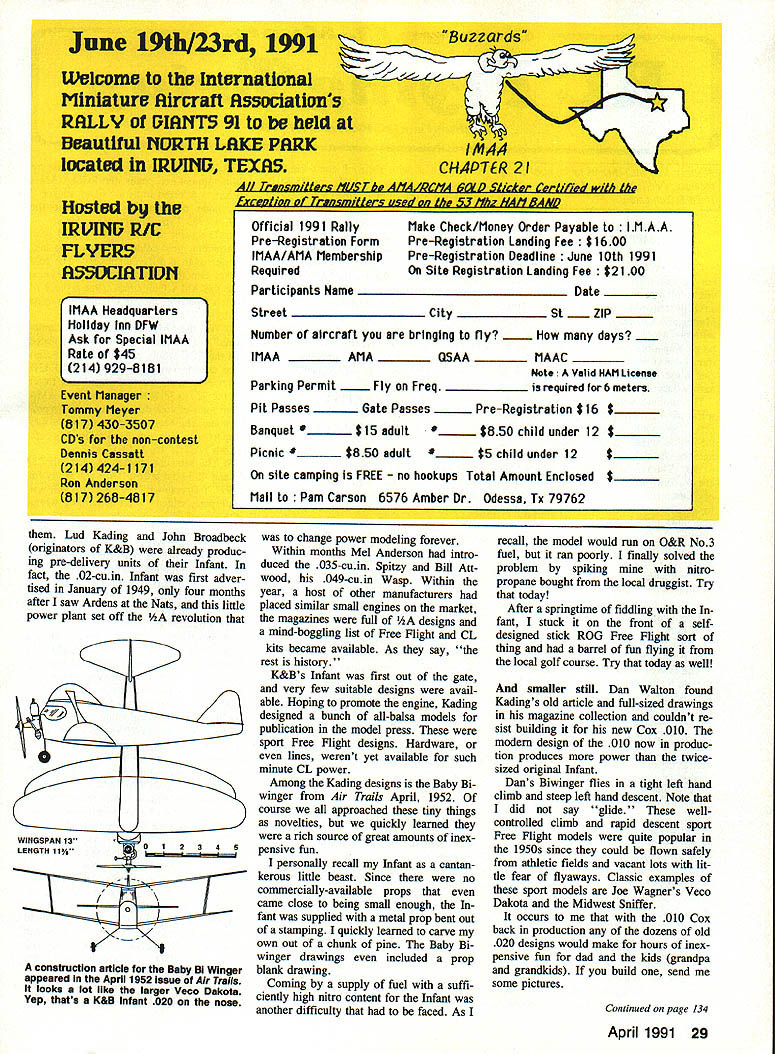
Published as a construction article in Model Airplane News (January 1990), this clever and innovative semi‑scale design by Paul Willenborg is popping up at more and more flying sites. I’ve seen three of them flown. All are wildly aerobatic when the TD .049 is running full out, yet dead‑stick pretty well. No throttle, nor any wheels for that matter — hand launch and dead stick.
Using a model race‑car electric motor and ball driver shaft, fabricate a home‑made starter which should be thrust into a 5‑40 Allen‑head bolt (substituted for the factory prop bolt — Ace R/C part number 50L613).
The engine is run with a Cox 5 x 3‑1/2‑in. three‑bladed prop (I believe from their old Curtis Pusher CL R.T.F.). The TD absolutely screams and the Fan trainer goes like a scalded cat.
I can’t help wondering (and hoping) if Paul Willenborg is developing a larger Fan trainer for a .20 to .25 engine.
RCSD (Radio Controlled Scale Duration)
Wouldn’t the term “1/4A Texaco Scale,” as used by some writers, imply a power‑sign developed for the old Texaco endurance‑limited fuel events scaled down to 1/4A size? Francis Flush’s 1936 Texaco winner, for example, scaled down to 1/4A size would be a 1/4A Scale Texaco — me thinks.
Radio Controlled Scale Duration (RCSD) is suddenly getting lots of excitement across the country. Since my previous mention generated a couple of “what on earth are you talking about” letters, let me clarify. RCSD is the loosely ruled event involving scale models flown for duration with a limited engine run. A radio is used to keep the model in sight and to help it land.
While more of these scale models are being built and flown for pure noncompetitive fun, several clubs are also running competitions for them. Most are using the S.A.M. 1/2A Texaco rules (which makes the terminology even more confusing). Those rules are basically: Cox Black Widow engines, full fuel tank, 15‑minute max, two official flights, and the model must look like an appropriate full‑size prototype.
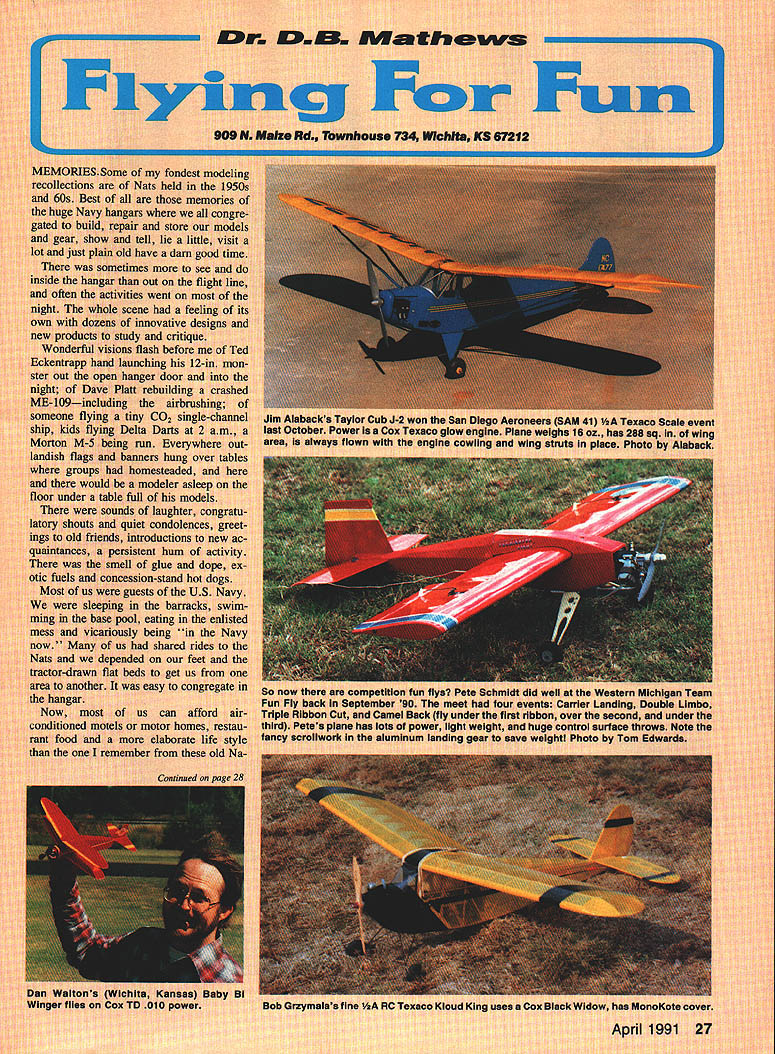
Jim Alaback, from San Diego, won the Aeroneers event in October 1990. His Taylor J‑2 maxed one flight and had nine minutes on the other. Interestingly, the regular 1/4A Texaco winner’s time was less. Alaback’s model is based on a converted .050 Comet rubber‑powered kit by Bill Schmidt. I saw Bill’s cub fly — it was beautiful and flew well, but it displayed pitch sensitivity and had to be flown constantly.
The reason is not the kit manufacturers (Comet, Megow, Peerless, etc.). Rubber‑power kits were designed more as scale projects than as true fliers. It has been almost universally accepted among Free Flight Scalers for many years that the scale horizontal stab of most prototypes is just too small for model use.
Notice the designs of Stahl, Struck, Mooney, Winter, Linberg and others. All have at least 20% additional volume in the stab, and sometimes the vertical fin requires slight enlargement. We mention this as a precaution when developing a true RCSD project from one of the old kit drawings.
Bill Winter’s Kadet Sr.
Here are some tidbits from Bill Winter’s letter that accompanied the photo he sent me:
- He built a second Sig Kadet over the 1989–90 winter just to keep busy.
- He converted the design to a tail‑dragger with higher performance and improved aerobatics.
- The old steer‑by‑rudder dihedral was reduced to 2½ degrees.
- Generous barn‑door ailerons were added with independent servos for use as flaperons.
- Power was upped to a K&B 65 Sportster.
- The prop is a 12 x 5 wood.
These changes produced a lively performer suited to aerobatics and improved handling.
Closing note: many of us still cherish the memories of those Navy hangar Nats. If you’re inspired to revive any of the old small‑engine designs or build a Biwinger for a modern .010, I’d love to see photos.
Transcribed from original scans by AI. Minor OCR errors may remain.

