
Flying for Fun
FOR SOME OF US, one big source of fun in this model airplane hobby comes from problem-solving. We experience a certain rush of accomplishment when a persistent problem is conquered.
Sometimes the problem is in our own model, but often that rush comes when someone else's problem is resolved. There seems to be a direct proportion between the duration and persistence of the problem and the amount of joy felt in its conquest.
Apparently it is bad form for a columnist ever to admit he has mundane problems, for fear of losing credibility or something. But I've fought annoying carburetion problems with a pair of big-bore Italian engines for two flying seasons.
Sensing my frustration, many flying buddies tried to adjust, reposition, and modify this fool carburetor to obtain a consistent idle that would predictably transition in midrange. Often the input of others will solve the most recalcitrant problems and can be of invaluable assistance—but not in this one.
I have other power plants of this size that run beautifully with minimal "fiddle factor"—but not these two. Set to idle, either they would flame out when the throttle was advanced, or if set to prevent that they would die when the throttle was retarded. Incredibly frustrating!
Jokingly, some of my associates have accused me of landing that Big Bingo deadstick more than power-on. They may be closer to the truth. It has landed dead-stick in trees, tall grass, wheat fields, and darn near everywhere within a half-mile radius of wherever I have flown. This apparent ineptitude has even been on display at IMAA fly-ins. There's nothing like dispelling myths of expertise before a large group of one's peers. Is that what the term humiliation means? Certainly, it is a humbling experience.
I fervently hope that all these problems are peculiar to me, and that none of you has any firsthand experience with a two-flying-season frustration of any kind.
Carburetion problems solved
Early in May I finally gave up and decided to buy a chain-saw engine. Jim Van Loo heard me and advised sending my engines to Bill Carpenter (CH Ignition) to have Walbro carbs and spark ignitions installed. I did, and I wish I'd done so long before.
The improvements are dramatic:
- Engines start by hand on the first or second flip.
- They idle so slowly the prop looks like a floor fan.
- The only way to shut them off is to turn off the ignition module.
- Throttle transition is smooth and predictable; I can idle back for final approach with confidence the engine will accelerate when needed — I can even touch-and-go.
- Simple hi-test gasoline (Klotz 100, available from speed shops through Sig) is less expensive and leaves far less exhaust residue than glow fuel.
- The gross weight of the ignition module and its battery pack is less than 12 ounces versus about 18 ounces for glow for the same flight length.
- By comparison, a chain-saw engine that will give equivalent prop rpm numbers weighs nearly three pounds.
Big Bingo flew for the first time in two years. I felt giddy and a bit silly with the rush of joy. Interestingly, the mood of elation was also displayed by the guys at the field, either because the model finally flew up to its capabilities or because they knew they wouldn't have to run and hide next time I flew it. What is flying for fun about, again?
Corrections and Whiz 40
Two errors in recent columns require correction. I credited the Anderson Kingfisher in the June issue to Bill Stranahan; I still don't know the identity of the builder. Will someone please speak up? I also grievously credited the wrong organization with the introduction of the FCC chairman to RC flying.
Whiz 40 — neat idea. AMAs are just passing folks from Ace R/C who have been offering stick time to spectators using Micro Pro radios and buddy boxes. Whiz 40s have been used at several AMA outdoor events with the same concept. Cox folks and plastic control-line people around the country have reported a tremendous response — adults and youngsters trying RC flying for the first time. The popularity of the idea is best demonstrated by hour-long lines of people waiting to fly; it is tremendous promotion for the hobby. Any time we can demonstrate to the general public that the hobby/sport requires considerable skill and knowledge, it helps dim the perception that it is only for the older crowd.
Of Monocoupes and Men (and Women)
We ran the photo of Gary Voss's Monocoupe 90A to inform those who have written looking for a copy of John Underwood's Of Monocoupes and Men, which has been out of print for several years. Good news: the book is back in print and should be available through the aviation magazine dealers who advertise in Model Aviation.
I've long had a special spot for this work: its large collection of interesting photos and a text loaded with historical material make for repeated enjoyable reading. Can't say that about every book, but Dave Thornburg's Do You Speak Model Airplane? is another delight — a perfect Christmas gift for airplane nuts.
The pictured 90A has a rather unusual Waters cowl developed for round engines. It is more closed than usual, with cutouts for single cylinders. The Waters cowl was not used much by Monocoupes, but it makes an obvious "instant recognition" signature on the Luscombe Phantom. This is understandable since Donald Luscombe was one of the founders of Mono Aircraft before leaving to found his own company in 1934.
A new photo-illustrated text, Visions of Luscombe, is now available.
To tie a few facts together: the Monocoupe 90A X11735 (royal blue with cream trim) pictured has doors enlarged 50% to better accommodate the ladies and their tight skirts. Look at the fashions of 1934 to understand this. John Underwood's marvelous work is chock-full of details like that.
Help — Ford Flying Flivver
Please excuse me for using this column to try to locate something for personal use, but I have an overwhelming desire to develop a Ford Flying Flivver for a four-stroke twin. I'm not referring to the rather ugly Flivver prototype with the three-cylinder Anzani, but the much more attractive second version with the license-built Bristol Cherub two-cylinder horizontally opposed power plant.
This version is illustrated in Lightplane by Underwood and Collange. I've spent years trying to chase down three-views of this aircraft. It may be that after the prototype crashed into Miami Bay, killing its pilot, Henry Ford ordered all drawings destroyed. However, on the chance that three-views might exist: does anyone have any information I could borrow?
Speaking of Henry Ford: as you know, the Ford Flivver automobile was also affectionately known as the Tin Lizzie. Our feature model this month uses a play on that term to become the Twin Lizzie.
Twin Lizzie
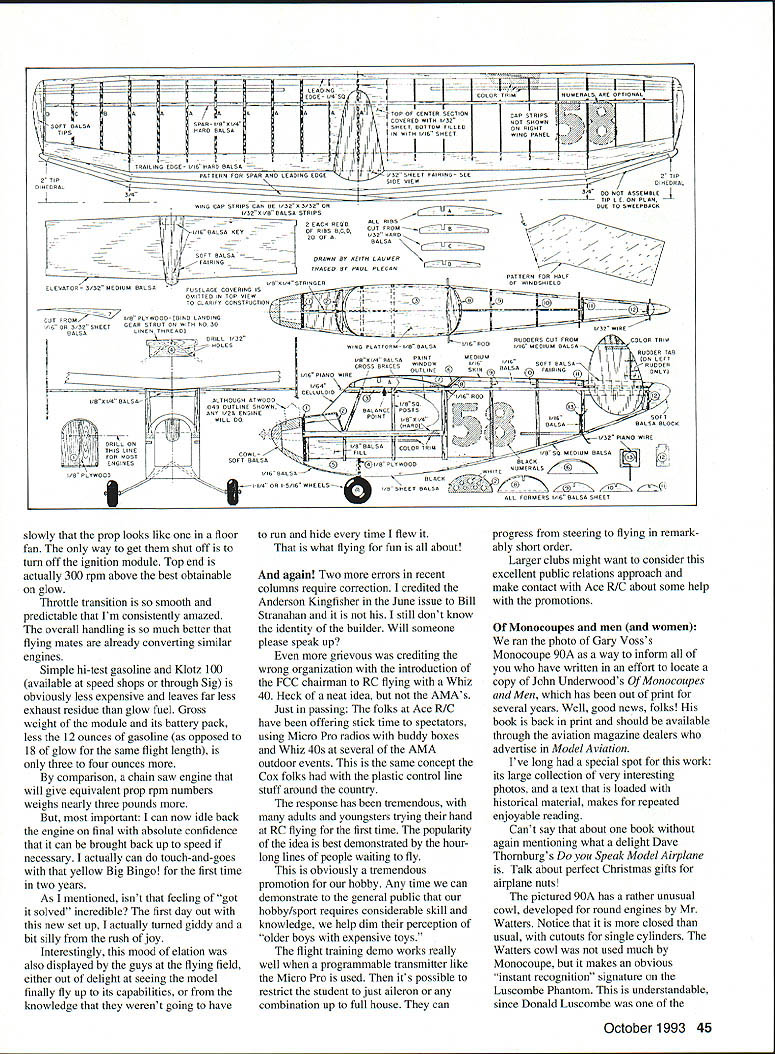
Keith Laumer published several clever and attractive sport free-flight designs; this one is a prime example. I thought his opening words in the construction article (Model Airplane News, April 1959) captured the spirit of limited-duration, small-field free flight, so I'll quote:
"It's a perfect day for flying; the runway is smooth and the air is calm. Engine humming, Twin Lizzie starts her takeoff run; the tail skid clears the ground, and with a tentative bounce, she's airborne, climbing steadily in a wide turn that brings her back directly overhead with 50 feet of altitude. The sun glints off her side as she swings past to make another circle, climbing to 100 feet before the engine cuts.
In the glide, the ship drifts back toward the runway, rocking slightly in an occasional gust, to float in for a perfect landing, ready to go again."
Anyone who has built and flown these little free-flight designs — Dakota, Sniffer, or Rascal — knows the feeling and what great fun it is.
Some data from the original construction article:
- Power shown on the plans: Atwood Wasp (photos show a McCoy .049 diesel).
- Span: 31 inches.
- Chord: 4-3/4 inches.
- Finish: AeroGloss dope.
- Flight path: left under power and right in the glide.
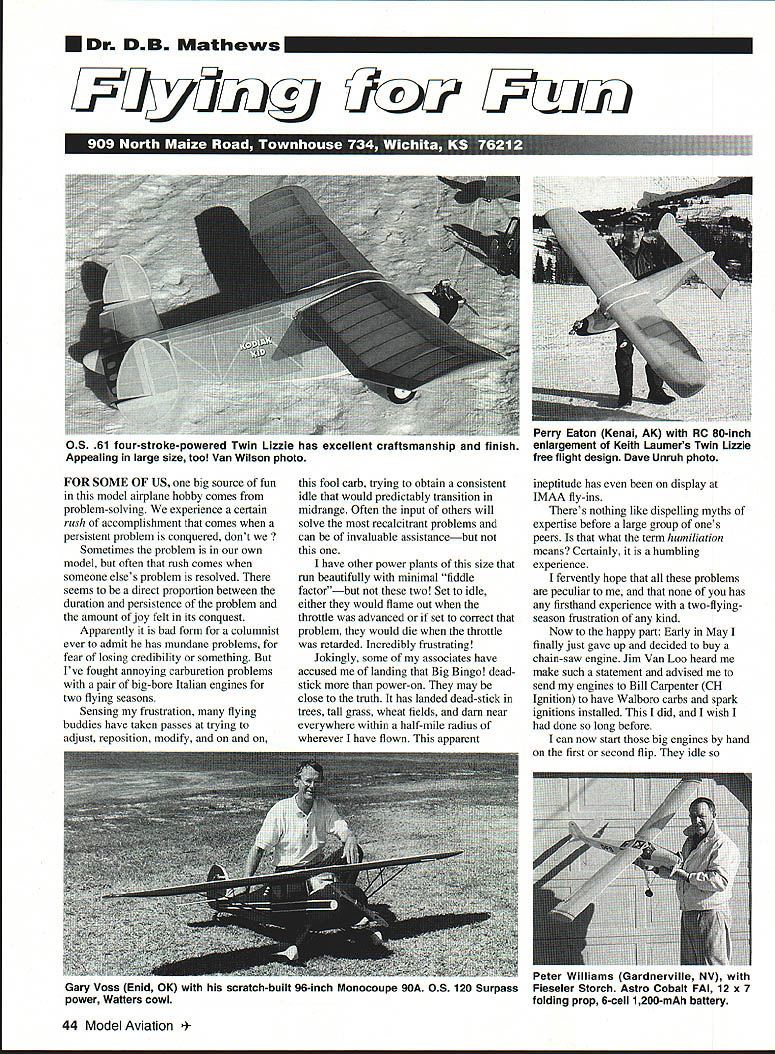
A slightly enlarged version by Perry Eaton of Kenai, Alaska spans 90 inches and is powered with an O.S. .61 four-stroke. The addition of radio control assures that every flight will be like the one Keith Laumer described.
Additionally, Paul Denson designed and published a double-sized version of the Laumer design called Twin Lizzie O.M.T. in MAN, April 1978. This version is for three channels of RC and a .20-cubic-inch power plant.
Full-size plans for either version are likely available from Model Airplane News. Certainly looks like flying fun to me.
Transcribed from original scans by AI. Minor OCR errors may remain.

