
Flying for Fun
Dr. D.B. Mathews 909 North Maize Road, Townhouse 734, Wichita, KS 67212
This is being written in mid-September—the peak season for fun-flys, fly-ins, rallies, or whatever you want to call them. The events I've attended so far have experienced record-breaking attendance.
There were nearly 100 fliers for the Labor Day 49th Jumbo in Kansas City, Missouri; 75 at the Wichita IMAA event; a local fun-fly with nearly 50; and I read of 267 pilots at the Joe Nail Memorial, held in Greenville, South Carolina.
It is evident that the popularity of non-competition events is increasing. I also have noticed that attendance at competitive events in my area continues to dwindle.
Obviously, more and more pilots and spectators are being attracted to these social events, where the only winners are the folks with the biggest smiles, where camaraderie is more important than trophies, and winning friends is much more satisfying than defeating them.
In the June 1993 column I mentioned the potential fun of flying electric RC models from small bodies of water in residential areas. That column brought about some neat photos and a letter from Jon Svendsen of Anchorage, Alaska. Here is a thumbnail description of our contemporary world: a 747 captain for Japan Airlines, Jon is from Norway and is living in Anchorage, Alaska; his letter was written on a layover in São Paulo, Brazil.
Jon Svendsen's letter
Jon's letter is so full of useful nuts-and-bolts material on electric flying in general, and off-water in particular, that I'm going to quote it extensively:
"You are right: electric float planes not only fly, they can fly very well indeed and easily ROW (rise off water). Moreover, the technology to accomplish this has been around for over a decade. You don't need foreign components, with their badly translated instructions, nor large doses of highly technical information. The best products of electric float flying are made by established American manufacturers.
"Because I have known for several years how well this can work, it is a big puzzle as to why it is not catching on more quickly. Obviously, it has to do with bad experiences with bad equipment and a built-in prejudice as a result.
"Mitch Poling's two articles in the 1985 June and July issues of Model Aviation and the section on float planes in his book got my interest, and I ordered plans for his Aquasport (RCM #907). Shortly after, I flew it at Denver's Cherry Creek reservoir with great success. The only inconvenience was traveling a considerable distance in order to fly.
"When my new employer insisted I move to Anchorage, the first requirement when house-hunting was a location on a lake. I wanted to just step out of the living room and fly, not only because I'm lazy, but one wants to fly when conditions and the mood are right.
"Sometimes less than an hour of free time is available and using the time to travel to a flying site wastes it.
"Unfortunately, I found bigger lakes have bigger homes with bigger price tags, but I finally found a condo on a little duck pond. I had never tried flying from such a small and crowded site.
"In June 1993, my third Aquasport was ready and had been tested on a larger, unpopulated lake. I knew I had a good one and soon took it to the duck pond with total success! It maneuvers easily within the narrow confines of this small lake, negotiating all obstacles with a handy margin. No radio problems have been experienced, either.
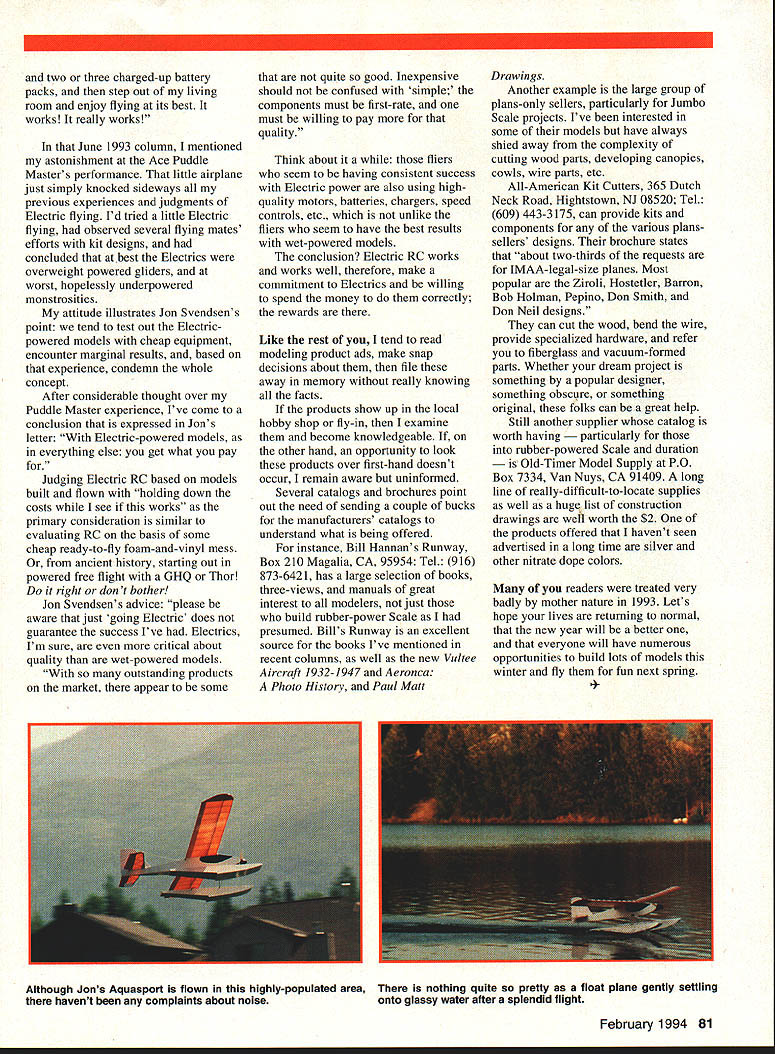
"This, of course, is only one side of it; the ecology is the other. So far, no complaints about noise (there really isn't any), but I have seen lots of smiles, curiosity, and repeated comments on how quiet my Aquasport is (and how it certainly couldn't bother anyone).
"Of course, Alaskans may have a more open mind than most, but they would probably take a shotgun to it if they didn't like it!
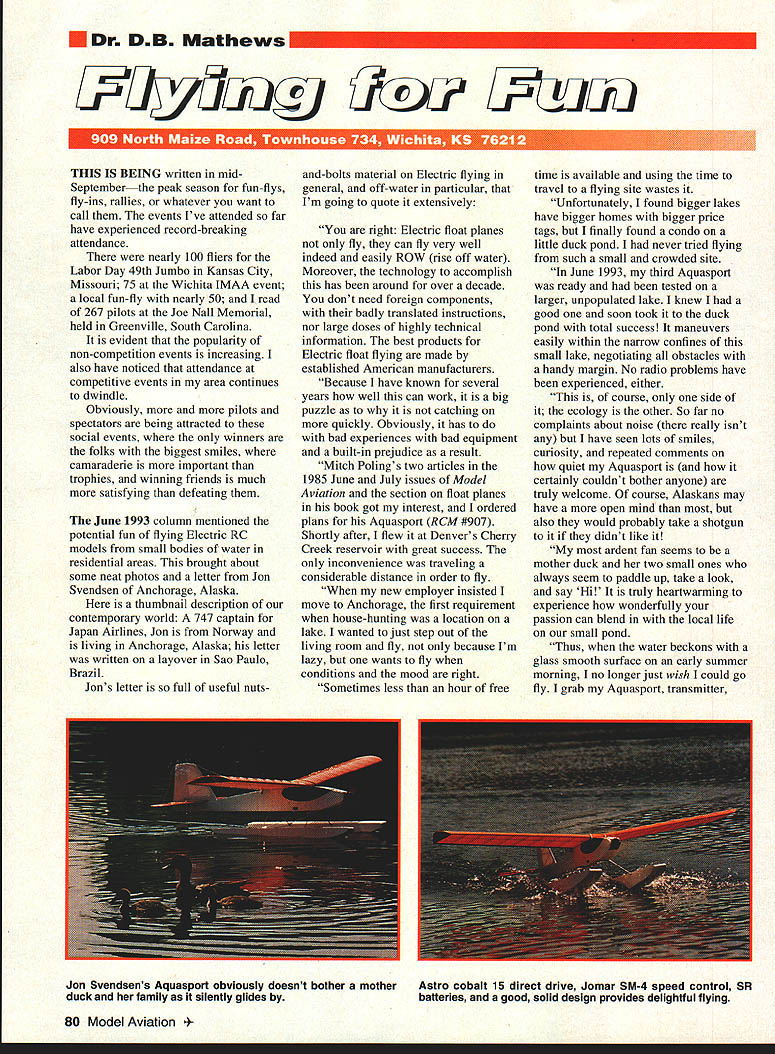
"My most ardent fan seems to be a mother duck and her two small ones, who always seem to paddle up, take a look, and say 'Hi!' It is truly heartwarming to experience how wonderfully your passion can blend in with the local life on our small pond.
"Thus, when the water beckons with a glass-smooth surface on an early summer morning, I no longer just wish I could go fly. I grab my Aquasport, transmitter, and two or three charged-up battery packs, and then step out of my living room and enjoy flying at its best. It works! It really works!"
Electric RC: quality matters
In that June 1993 column, I mentioned my astonishment at the Ace Puddle Master's performance. That little airplane simply knocked sideways all my previous experiences and judgments of electric flying. I'd tried a little electric flying, had observed several flying mates' efforts with kit designs, and had concluded that at best the electrics were overweight powered gliders, and at worst, hopelessly underpowered monstrosities.
My attitude illustrates Jon Svendsen's point: we tend to test out electric-powered models with cheap equipment, encounter marginal results, and, based on that experience, condemn the whole concept.
After considerable thought over my Puddle Master experience, I've come to a conclusion that is expressed in Jon's letter: "With electric-powered models, as in everything else: you get what you pay for."
Judging electric RC based on models built and flown with "holding down the costs while I see if this works" as the primary consideration is similar to evaluating RC on the basis of some cheap ready-to-fly foam-and-vinyl mess. Or, from ancient history, starting out in powered free flight with a GHO or Thor! Do it right or don't bother!
Jon Svendsen's advice: "Please be aware that just 'going electric' does not guarantee the success I've had. Electrics, I'm sure, are even more critical about quality than are wet-powered models.
"With so many outstanding products on the market, there appear to be some that are not quite so good. Inexpensive should not be confused with 'simple'; the components must be first-rate, and one must be willing to pay more for that quality."
Think about it a while: those fliers who seem to be having consistent success with electric power are also using high-quality motors, batteries, chargers, speed controls, etc., which is not unlike the fliers who seem to have the best results with wet-powered models.
The conclusion? Electric RC works and works well; therefore, make a commitment to electrics and be willing to spend the money to do them correctly; the rewards are there.
Like the rest of you, I tend to read modeling product ads, make snap decisions about them, then file these away in memory without really knowing all the facts.
If the products show up in the local hobby shop or fly-in, then I examine them and become knowledgeable. If, on the other hand, an opportunity to look these products over first-hand doesn't occur, I remain aware but uninformed.
Several catalogs and brochures point out the need of sending a couple of bucks for the manufacturers' catalogs to understand what is being offered.
Drawings and suppliers
For instance, Bill Hannan's Runway, Box 210, Magalia, CA 95954; Tel.: (916) 873-6421, has a large selection of books, three-views, and manuals of great interest to all modelers, not just those who build rubber-powered scale as I had presumed. Bill's Runway is an excellent source for the books I've mentioned in recent columns, as well as the new Vultee Aircraft 1932–1947 and Aeroneca: A Photo History, and Paul Matt drawings.
Another example is the large group of plans-only sellers, particularly for jumbo-scale projects. I've been interested in some of their models but have always shied away from the complexity of cutting wood parts, developing canopies, cowlings, wire parts, etc.
All-American Kit Cutters, 365 Dutch Neck Road, Hightstown, NJ 08520; Tel.: (609) 443-3175, can provide kits and components for any of the various plans-sellers' designs. Their brochure states that about two-thirds of the requests are for IMAA-legal size planes. Most popular are the Ziroli, Hostetler, Barron, Bob Holman, Pepino, Don Smith, and Don Neil designs.
They can cut the wood, bend the wire, provide specialized hardware, and refer you to fiberglass and vacuum-formed parts. Whether your dream project is something by a popular designer, something obscure, or something original, these folks can be a great help.
Still another supplier whose catalog is worth having—particularly for those into rubber-powered scale and duration—is Old-Timer Model Supply, P.O. Box 7334, Van Nuys, CA 91409. A long line of really difficult-to-locate supplies as well as a huge list of construction drawings are listed within the $2 catalog. One product offered that I haven't seen advertised in a long time is silver and other nitrate dope colors.
Many of you readers were treated very badly by mother nature in 1993. Let's hope your lives are returning to normal, that the new year will be a better one, and that everyone will have numerous opportunities to build lots of models this winter and fly them for fun next spring.
Transcribed from original scans by AI. Minor OCR errors may remain.

