
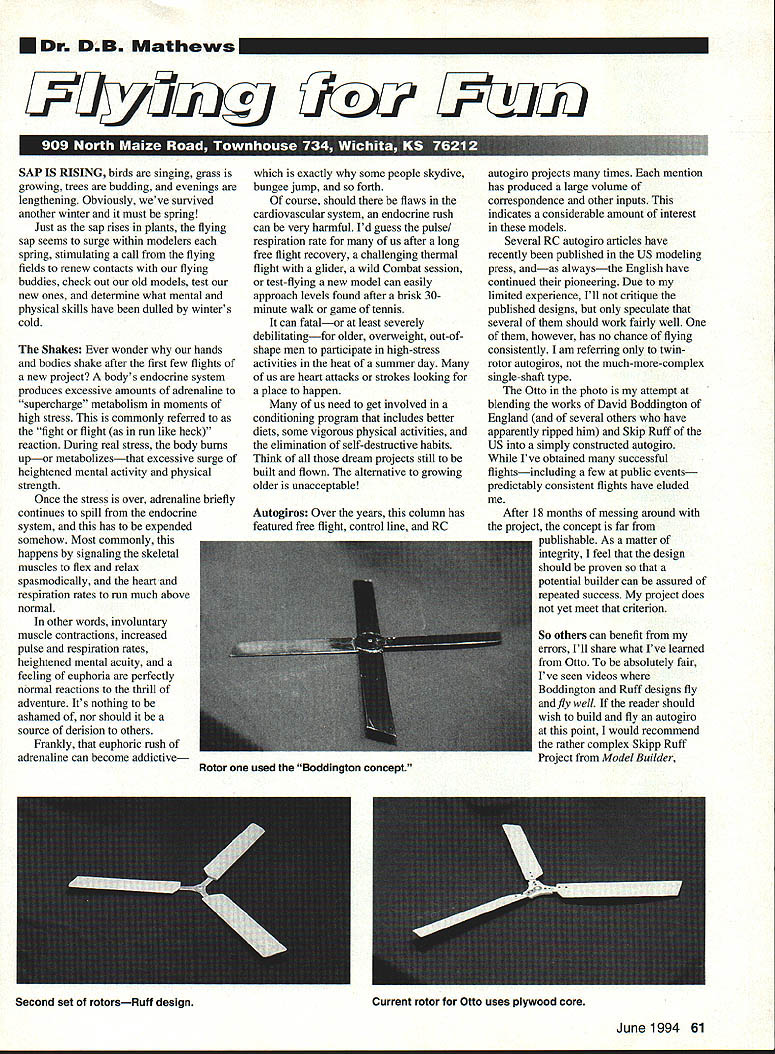
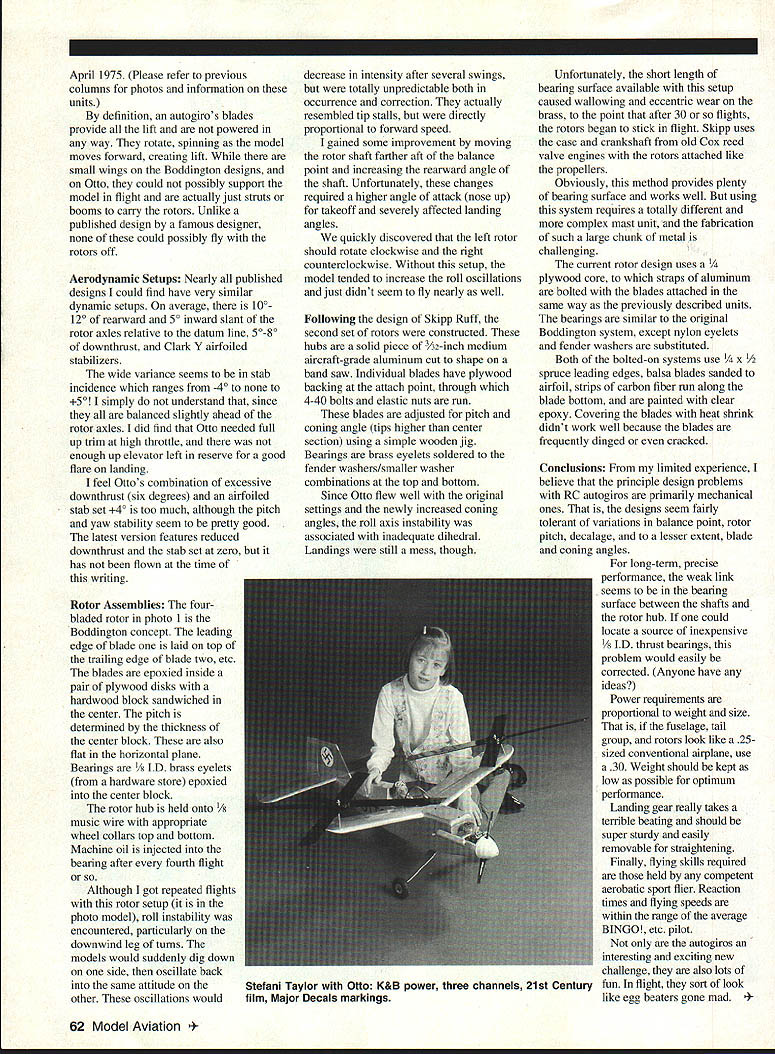
Flying for Fun
Dr. D.B. Mathews 909 North Maize Road, Townhouse 734, Wichita, KS 76212
Spring and the Call to Fly
Sap is rising, birds are singing, grass is growing, trees are budding, and evenings are lengthening. Obviously, we've survived another winter and it must be spring!
Just as the sap rises in plants, the flying sap seems to surge within modelers each spring, stimulating a call from the flying fields to renew contacts with our flying buddies, check out old models, test our new ones, and determine what mental and physical skills have been dulled by winter's cold.
The Shakes
Ever wonder why our hands and bodies shake after the first few flights of a new project? A body's endocrine system produces excessive amounts of adrenaline, the "supercharge" metabolism in moments of high stress. This is commonly referred to as the "fight or flight (as in run like heck) reaction." During real stress, the body burns up—or metabolizes—that excessive surge of heightened mental activity and physical strength.
Once the stress is over, adrenaline briefly continues to spill from the endocrine system, and this has to be expended somehow. Most commonly, this happens by signaling the skeletal muscles to flex and relax spasmodically, and the heart and respiration rates to run much above normal.
In other words, involuntary muscle contractions, increased pulse and respiration rates, heightened mental acuity, and a feeling of euphoria are perfectly normal reactions to the thrill of adventure. It's nothing to be ashamed of, nor should it be a source of derision to others.
Frankly, that euphoric rush of adrenaline can become addictive—which is exactly why some people skydive, bungee jump, and so forth.
Of course, should there be flaws in the cardiovascular system, an endocrine rush can be very harmful. I'd guess the pulse/respiration rate for many of us after a long free-flight recovery, a challenging thermal flight with a glider, a wild Combat session, or test-flying a new model can easily approach levels found after a brisk 30-minute walk or game of tennis.
It can be fatal—or at least severely debilitating—for older, overweight, out-of-shape men to participate in high-stress activities in the heat of a summer day. Many of us are heart-attackers or stroke victims waiting for a place to happen.
Many of us need to get involved in a conditioning program that includes better diets, some vigorous physical activities, and the elimination of self-destructive habits. Think of all those dream projects still to be built and flown. The alternative to growing older is unacceptable!
Autogiros
Over the years, this column has featured free flight, control line, and RC autogiro projects many times. Each mention has produced a large volume of correspondence and other inputs. This indicates a considerable amount of interest in these models.
Several RC autogiro articles have recently been published in the U.S. modeling press and—as always—the English have continued their pioneering. Due to my limited experience, I'll not critique the published designs, but only speculate that several of them should work fairly well. However, I have no chance of flying consistently; I am referring to twin-rotor autogiros, not the much-more-complex single-shaft type.
The Otto in the photo is my attempt at blending the works of David Boddington of England (and of several others who have apparently ripped him) and Skip Ruff of the U.S. into a simply constructed autogiro. While I've obtained many successful flights—including a few at public events—predictably consistent flights have eluded me.
After 18 months of messing around with the project, the concept is far from publishable. As a matter of integrity, I feel that the design should be proven so that a potential builder can be assured of repeated success. My project does not yet meet that criterion.
So others can benefit from my errors, I'll share what I've learned from Otto. To be absolutely fair, I've seen videos where Boddington and Ruff designs fly and fly well. If the reader should wish to build and fly an autogiro at this point, I would recommend the rather complex Skip Ruff project from Model Builder.
April 1975. (Please refer to previous columns for photos and information on these units.)
By definition, an autogiro's blades provide all the lift and are not powered in any way. They rotate, spinning as the model moves forward, creating lift. While there are small wings on the Boddington designs, and on Otto, they could not possibly support the model in flight and are actually just struts or booms to carry the rotors. Unlike a published design by a famous designer, none of these could possibly fly with the rotors off.
Aerodynamic Setups
Nearly all published designs I could find have very similar dynamic setups. On average:
- 10°–12° of rearward tilt of the rotor axles relative to the datum line
- 5° inward slant of the rotor axles
- 5°–8° of downthrust
- Clark Y airfoiled stabilizers
The wide variance seems to be in stab incidence, which ranges from −4° to none to +5°. I simply do not understand that, since they all are balanced slightly ahead of the rotor axles. I did find that Otto needed full up trim at high throttle, and there was not enough up elevator left in reserve for a good flare on landing.
I feel Otto's combination of excessive downthrust (six degrees) and an airfoiled stab set at +4° is too much, although the pitch and yaw stability seem to be pretty good. The latest version features reduced downthrust and the stab set at zero, but it had not been flown at the time of this writing.
Rotor Assemblies
The four-bladed rotor in photo 1 is the Boddington concept. The leading edge of blade one is laid on top of the trailing edge of blade two, etc. The blades are epoxied inside a pair of plywood disks with a hardwood block sandwiched in the center. The pitch is determined by the thickness of the center block. These are also flat in the horizontal plane. Bearings are 1/8" I.D. brass eyelets (from a hardware store) epoxied into the center block.
The rotor hub is held onto 1/8" music wire with appropriate wheel collars top and bottom. Machine oil is injected into the bearing after every fourth flight or so.
Although I got repeated flights with this rotor setup (it is in the photo model), roll instability was encountered, particularly on the downwind leg of turns. The models would suddenly dig down on one side, then oscillate back into the same attitude on the other. These oscillations would decrease in intensity after several swings, but were totally unpredictable both in occurrence and correction. They actually resembled tip stalls, but were directly proportional to forward speed.
I gained some improvement by moving the rotor shaft farther aft of the balance point and increasing the rearward angle of the shaft. Unfortunately, these changes required a higher angle of attack (nose up) for takeoff and severely affected landing angles.
We quickly discovered that the left rotor should rotate clockwise and the right counterclockwise. Without this setup, the model tended to increase the roll oscillations and just didn't seem to fly nearly as well.
Following the design of Skip Ruff, the second set of rotors were constructed. These hubs are a solid piece of 3/32-inch medium aircraft-grade aluminum cut to shape on a bandsaw. Individual blades have plywood backing at the attach point, through which 4-40 bolts and elastic stop nuts are run.
These blades are adjusted for pitch and coning angle (tips higher than center section) using a simple wooden jig. Bearings are brass eyelets soldered to fender washer/smaller washer combinations at the top and bottom.
Since Otto flew well with the original settings and the newly increased coning angles, the roll-axis instability was associated with inadequate dihedral. Landings were still a mess, though.
Unfortunately, the short length of bearing surface available with this setup caused wallowing and eccentric wear on the brass, to the point that after 30 or so flights, the rotors began to stick in flight. Skip uses the case and crankshaft from old Cox reed-valve engines with the rotors attached like the propellers. Obviously, this method provides plenty of bearing surface and works well. But using this system requires a totally different and more complex mast unit, and the fabrication of such a large chunk of metal is challenging.
The current rotor design uses a 1/4" plywood core, to which straps of aluminum are bolted with the blades attached in the same way as the previously described units. The bearings are similar to the original Boddington system, except nylon eyelets and fender washers are substituted.
Both of the bolted-on systems use:
- 1/4" x 1/2" spruce leading edges
- balsa blades sanded to an airfoil
- strips of carbon fiber run along the blade bottom
- blades painted with clear epoxy
Covering the blades with heat-shrink didn't work well because the blades are frequently dinged or even cracked.
Conclusions
From my limited experience, I believe that the principal design problems with RC autogiros are primarily mechanical ones. That is, the designs seem fairly tolerant of variations in balance point, rotor pitch, decalage, and to a lesser extent, blade and coning angles.
For long-term, precise performance, the weak link seems to be in the bearing surface between the shafts and the rotor hub. If one could locate a source of inexpensive 1/8" I.D. thrust bearings, this problem would easily be corrected. (Anyone have any ideas?)
Power requirements are proportional to weight and size. That is, if the fuselage, tail group, and rotors look like a .25-sized conventional airplane, use a .30. Weight should be kept as low as possible for optimum performance.
Landing gear really takes a terrible beating and should be super sturdy and easily removable for straightening.
Finally, flying skills required are those held by any competent aerobatic sport flier. Reaction times and flying speeds are within the range of the average BINGO!, etc. pilot.
Not only are the autogiros an interesting and exciting new challenge, they are also lots of fun. In flight, they sort of look like egg beaters gone mad.
Transcribed from original scans by AI. Minor OCR errors may remain.

