
Flying for Fun
909 North Maize Road, Townhouse 734, Wichita, KS 76212
What's in a name?
George Myers' April column discussed AMA's evolution from a primarily scientific study group of the 1930s to a sport fliers group of the 1990s. His well-thought-out treatise traces AMA's change in emphasis and perceived mission.
Reading his column made me ponder the difference between an academy and an association. My old dictionary defines an association as "an associated body of persons formed for a common objective; a society." Academy is defined as "a school for instruction in special subjects: an association of men eminent in literature, science, and art."
It would appear that an academy is a type of association; however, it differs from associations in that its primary focus is the acquisition and distribution of knowledge. Agree?
Association vs. academy
To go a bit further with this: a physician can be a member of the American Medical Association. If he is specialized, however, the group responsible for disseminating knowledge and testing its members for that specialization is an academy—like the American Academy of Surgeons (AAS).
Members who have met educational and testing requirements of the academy and have been accepted for membership are called Fellows. These academies exist throughout technical fields, ranging from engineers to clinical psychologists.
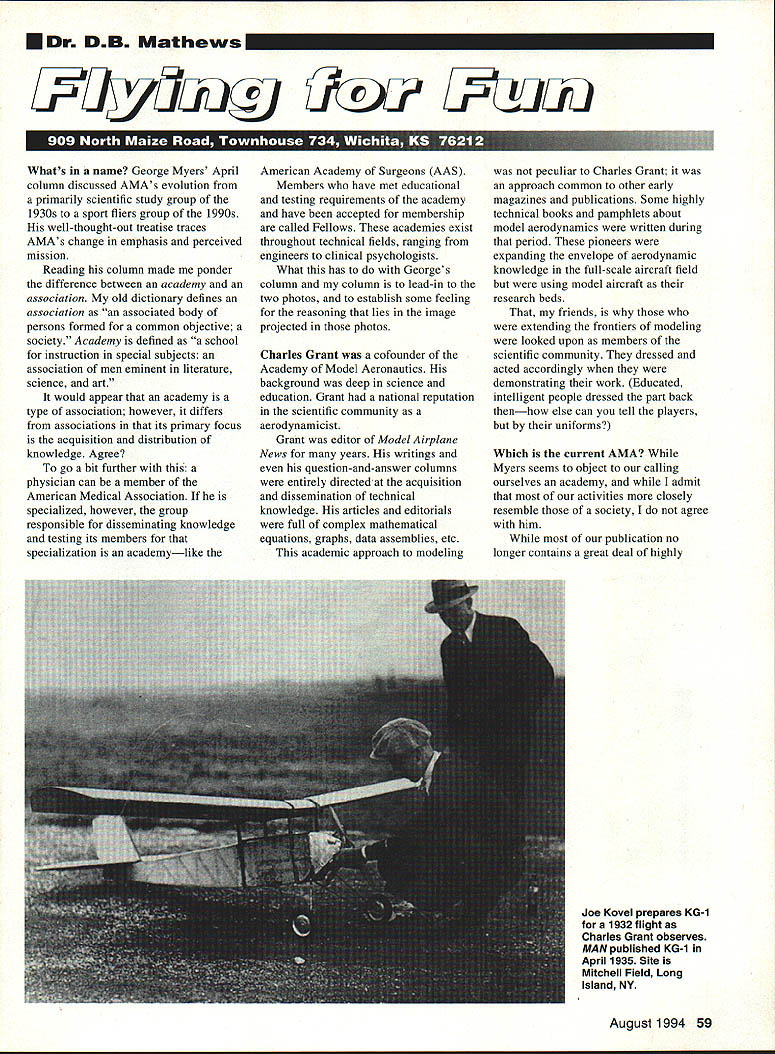
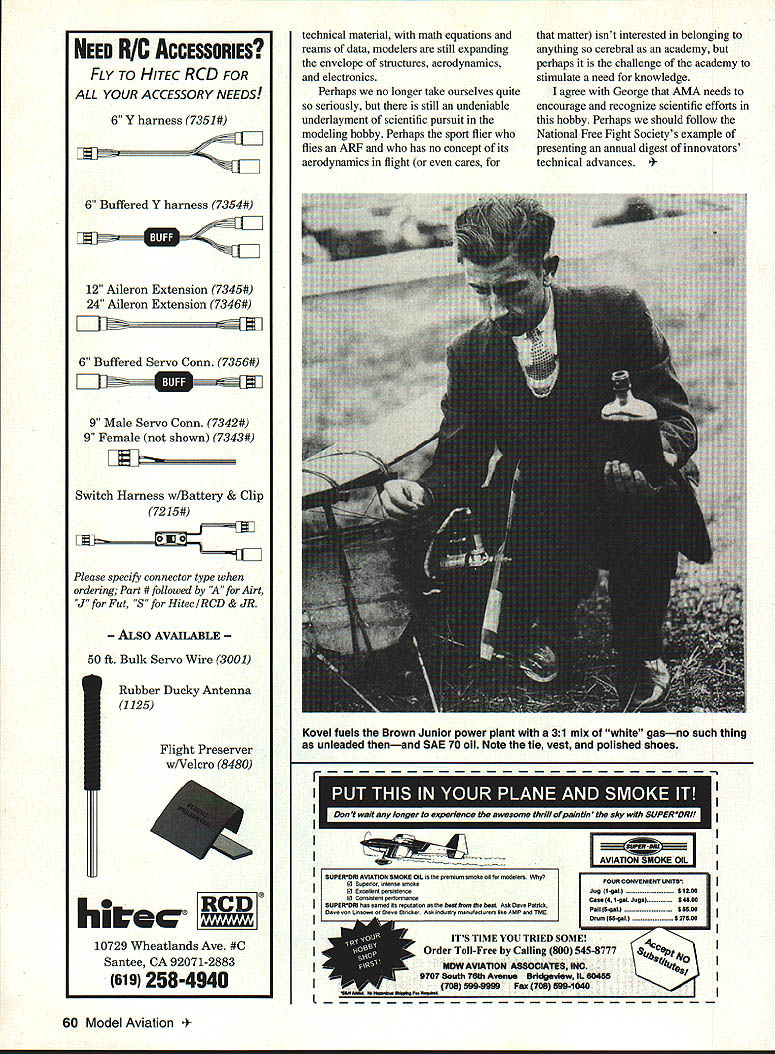
What this has to do with George's column and my column is to lead in to the two photos, and to establish some feeling for the reasoning that lies in the image projected in those photos.
Charles Grant and the Academy of Model Aeronautics
Charles Grant was a cofounder of the Academy of Model Aeronautics. His background was deep in science and education. Grant had a national reputation in the scientific community as an aerodynamicist.
Grant was editor of Model Airplane News for many years. His writings and even his question-and-answer columns were entirely directed at the acquisition and dissemination of technical knowledge. His articles and editorials were full of complex mathematical equations, graphs, data assemblies, and the like.
This academic approach to modeling was not peculiar to Charles Grant; it was an approach common to other early magazines and publications. Some highly technical books and pamphlets about model aerodynamics were written during that period. These pioneers were expanding the envelope of aerodynamic knowledge in the full-scale aircraft field but were using model aircraft as their research beds.
That, my friends, is why those who were extending the frontiers of modeling were looked upon as members of the scientific community. They dressed and acted accordingly when they were demonstrating their work. Educated, intelligent people dressed the part back then—how else can you tell the players but by their uniforms?
Which is the current AMA?
While Myers seems to object to our calling ourselves an academy, and while I admit that most of our activities more closely resemble those of a society, I do not agree with him.
While most of our publication no longer contains a great deal of highly technical material with math equations and reams of data, modelers are still expanding the envelope of structures, aerodynamics, and electronics.
Perhaps we no longer take ourselves quite so seriously, but there is still an undeniable underlayment of scientific pursuit in the modeling hobby. Perhaps the sport flier who flies an ARF and who has no concept of its aerodynamics in flight (or even cares, for that matter) isn't interested in belonging to anything so cerebral as an academy, but perhaps it is the challenge of the academy to stimulate a need for knowledge.
I agree with George that AMA needs to encourage and recognize scientific efforts in this hobby. Perhaps we should follow the National Free Flight Society's example of presenting an annual digest of innovators' technical advances.
Transcribed from original scans by AI. Minor OCR errors may remain.

