
Dr. D.B. Mathews 909 North Maize Road, Townhouse 734, Wichita, KS 67212
Flying for Fun
Some of my life's greatest moments have been spent watching free flight models lock into thermals and climb as if they were being moved by the hand of God to become mere specks in the sky. Some of my happiest days were spent flying free flight with my sons at events all over the U.S. Unfortunately, as my sons grew up, retrieving free flight models became increasingly arduous. The mile markers got farther and farther apart.
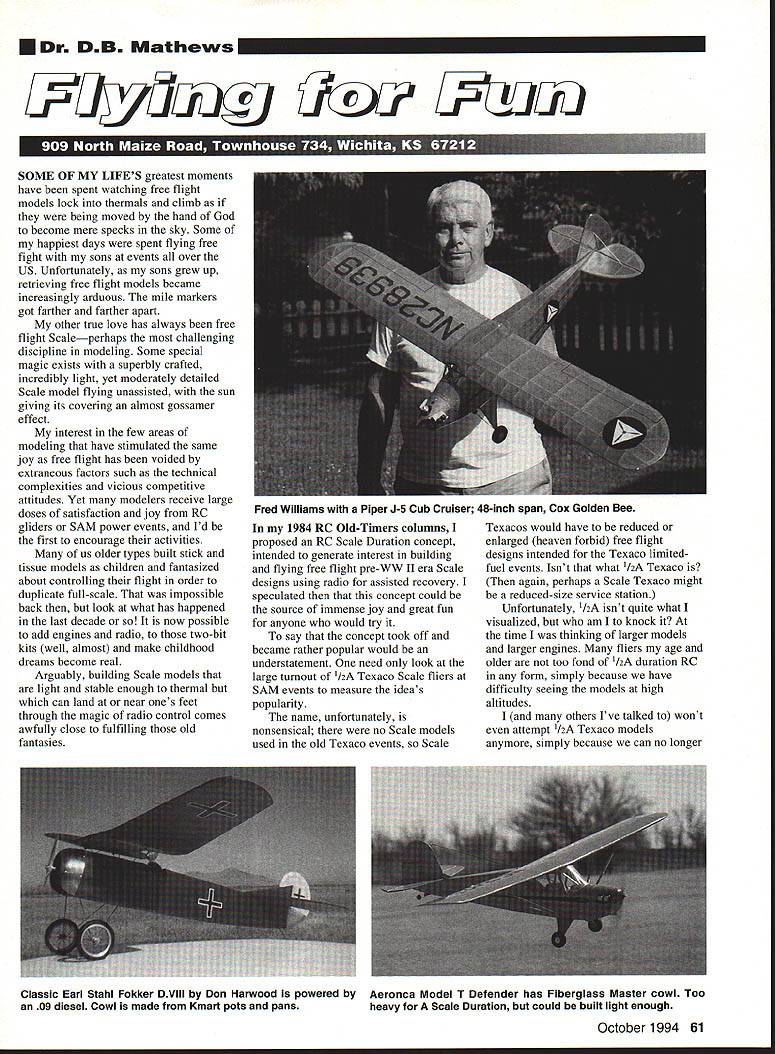
My other true love has always been free flight Scale—perhaps the most challenging discipline in modeling. Some special magic exists with a superbly crafted, incredibly light, yet moderately detailed Scale model flying unassisted, with the sun giving its covering an almost gossamer effect.
My interest in the few areas of modeling that have stimulated the same joy as free flight has been voided by extraneous factors such as the technical complexities and vicious competitive attitudes. Yet many modelers receive large doses of satisfaction and joy from RC gliders or SAM power events, and I'd be the first to encourage their activities.
Many of us older types built stick-and-tissue models as children and fantasized about controlling their flight in order to duplicate full-scale. That was impossible back then, but look at what has happened in the last decade or so! It is now possible to add engines and radio to those two-bit kits (well, almost) and make childhood dreams come real.
Arguably, building Scale models that are light and stable enough to thermal but which can land at or near one's feet through the magic of radio control comes awfully close to fulfilling those old fantasies.
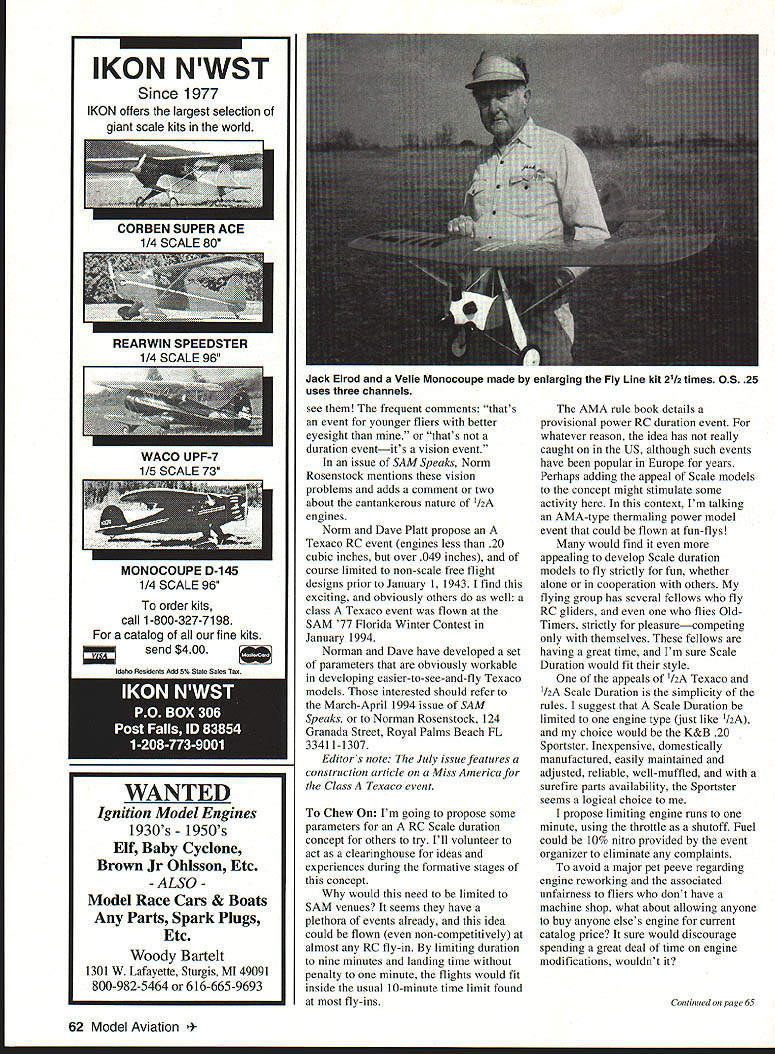
In my 1984 RC Old-Timers columns, I proposed an RC Scale Duration concept, intended to generate interest in building and flying free flight pre–WW II era Scale designs using radio for assisted recovery. I speculated then that this concept could be the source of immense joy and great fun for anyone who would try it.
To say that the concept took off and became rather popular would be an understatement. One need only look at the large turnout of 1/2A Texaco fliers at SAM events to measure the idea's popularity.
The name, unfortunately, is nonsensical; there were no Scale models used in the old Texaco events, so Scale Texacos would have to be reduced or enlarged (heaven forbid) free flight designs intended for the Texaco limited-fuel events. Isn't that what 1/2A Texaco is? (Then again, perhaps a Scale Texaco might be a reduced-size service station.)
1/2A isn't quite what I visualized, but who am I to knock it? At the time I was thinking of larger models and larger engines. Many fliers my age and older are not too fond of 1/2A duration RC form simply because we have difficulty seeing the models at high altitudes. Many others I've talked to won't even attempt 1/2A Texaco models anymore, simply because we can no longer see them. The frequent comments: "That's an event for younger fliers with better eyesight than mine," or "That's not a duration event—it's a vision event."
In an issue of SAM Speaks, Norm Rosenstock mentions these vision problems and adds a comment or two about the cantankerous nature of 1/2A engines.
Norm and Dave Platt propose an A Texaco RC event (engines less than .20 cubic inches, but over .049 cubic inches), and of course limited to non-scale free flight designs prior to January 1, 1943. I find this exciting, and obviously others do as well: a Class A Texaco event was flown at the SAM '77 Florida Winter Contest in January 1994.
Norman and Dave have developed a set of parameters that are obviously workable in developing easier-to-see-and-fly Texaco models. Those interested should refer to the March–April 1994 issue of SAM Speaks, or contact Norman Rosenstock, 124 Granada Street, Royal Palm Beach, FL 33411-1307.
Editor's note
The July issue features a construction article on a Miss America for the Class A Texaco event.
To Chew On
I'm going to propose some parameters for an A RC Scale duration concept for others to try. I'll volunteer to act as a clearinghouse for ideas and experiences during the formative stages of this concept.
Why would this need to be limited to SAM venues? They have a plethora of events already, and this idea could be flown (even non-competitively) at almost any RC fly-in. By limiting duration to nine minutes and landing time within one minute, the flights would fit inside the usual 10-minute time limit found at most fly-ins.
The AMA rule book details a provisional power RC duration event. For whatever reason, the idea has not really caught on in the U.S., although such events have been popular in Europe for years. Perhaps adding the appeal of Scale models to the concept might stimulate some activity here. In this context, I'm talking about an AMA-type thermaling power model event that could be flown at fun-flys.
Many would find it even more appealing to develop Scale duration models to fly strictly for fun, whether alone or in cooperation with others. My flying group has several fellows who fly RC gliders, and even one who flies Old-Timers, strictly for pleasure—competing only with themselves. These fellows are having a great time, and I'm sure Scale Duration would fit their style.
One of the appeals of 1/2A Texaco and 1/2A Scale Duration is the simplicity of the rules. I suggest that a Scale Duration be limited to one engine type (just like 1/2A), and my choice would be the K&B .20 Sportster. Inexpensive, domestically manufactured, easily maintained and repaired, reliable, well-muffled, and with superb parts availability, the Sportster seems a logical choice to try.
I propose limiting engine runs to one minute, using the throttle as a shutoff. Fuel could be provided by the host club, perhaps to eliminate any complaints.
To avoid a major pet peeve regarding engine reworking and the associated unfairness to fliers who don't have a machine shop, what about allowing anyone to buy anyone else's engine for current catalog price? It sure would discourage spending a great deal of time on engine modifications, wouldn't it?
While not absolutely essential, the event would be much more fun to watch and fly if single models were required to rise off ground (ROG). Engine runs of 60 seconds would get almost any model up to an altitude where something in the nature of a mild thermal would be needed to keep it airborne another five minutes. In other words, no eight-minute motor runs for 10-minute maxes.
Landings should be within a 100-foot radius of the takeoff and within one minute of the nine-minute maximum. After that, a second-for-second penalty would encourage the flier to get his model down so the next guy could fly. There would be a three-flight total if it were run as a competition.
I'm inclined to think that the only other parameters needed are weight limits. A minimum wing loading of 10 ounces per square foot should be about right. From a practical standpoint, models with a 600–700 square inch area and 41.7 to 48.6 ounces fueled weight should be well within the building skills of almost anyone. One could build light without being forced to resort to micro radio equipment.
Since this would not be a SAM event, no one will give us any static if we cover our models with heat-shrink materials. Construction materials could be totally conventional. For example: Sig's 1/2-scale Cub will fly and thermal rather well with a .20-sized engine, a three-channel radio, and some increased dihedral. I've seen it done.
Model design choices are limitless:
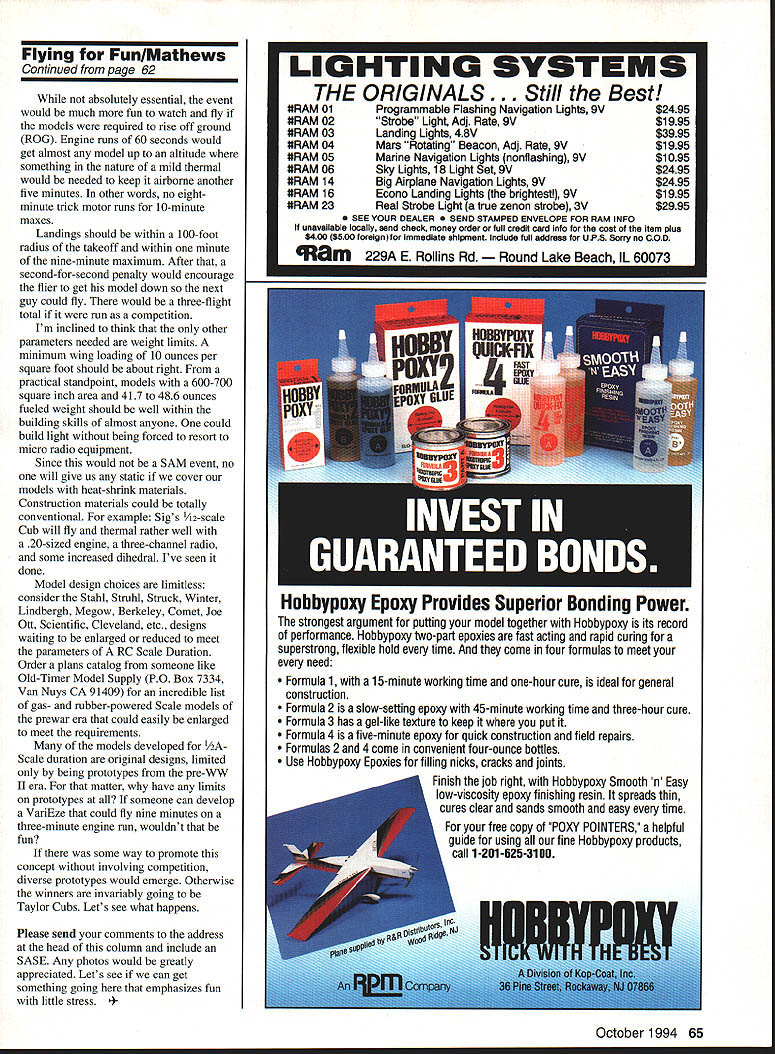
- Consider Stahl, Struhl, Struck, Winter, Lindbergh, Megow, Berkeley, Comet, Joe Ott, Scientific, Cleveland, etc., designs waiting to be enlarged or reduced to meet the parameters of an RC Scale Duration.
- Order a plans catalog from Old-Timer Model Supply (P.O. Box 7334, Van Nuys, CA 91409) for an incredible list of gas- and rubber-powered Scale models of the prewar era that could easily be enlarged to meet the requirements.
Many of the models developed for 1/2A Scale Duration are original designs, limited only by being prototypes from the pre‑WWII era. For that matter, why have any limits on prototypes at all? If someone can develop a VariEze that could fly nine minutes on a three-minute engine run, wouldn't that be fun?
If there was some way to promote this concept without involving competition, diverse prototypes would emerge. Otherwise the winners are invariably going to be Taylor Cubs. Let's see what happens.
Please send your comments to the address at the head of this column and include an SASE. Any photos would be greatly appreciated. Let's see if we can get something going here that emphasizes fun with little stress.
Transcribed from original scans by AI. Minor OCR errors may remain.

