
Dr. D.B. Mathews
Flying for Fun
Planting Seeds
Some seeds sprout very quickly and bloom almost overnight, while others lie dormant for many years until the correct conditions occur, whereupon they burst forth in full bloom.
I hold that not all modeling programs that promote modeling to the public bloom immediately. We can plant the seeds and carefully nurture them, but often we must wait patiently for the program to germinate and finally bloom.
If a modeling promotion project doesn't immediately produce a mass rush to the hobby shop, we should not consider the seeds dead. Rather, they are just dormant and may remain so for many years until suddenly the proper stimulus triggers their maturation.
Surely we see the value in any effort to introduce youngsters to the special excitement of building and flying model aircraft. Many rewards result from modeling:
- learning patience
- developing craftsmanship
- following instructions
- developing a work ethic
- learning to respect and relate to adults
- discovering the joy that comes with learning, effort, and success
Equally important are the hours of recreation, social interaction, and mental and physical stimulation provided to adults.
Junior Projects Don't Work
For at least 50 years, the model airplane press has been bemoaning the fact that there is a lack of modelers under 20. Almost from AMA's inception, it has promoted innumerable projects to interest youngsters.
Many highly organized in-school programs have been developed. Examples of past efforts include:
- In the 1940s, Plymouth Motor Corporation sponsored a multiyear nationwide modeling promotion.
- The Optimist Clubs of America were once very involved in youth modeling and running local contests.
- Newspapers once ran regular modeling columns and held large contests (one even presented a full-size Ercoupe as a grand prize).
- For many years the US Navy sponsored the model airplane Nationals, opening their facilities to feed and house entrants and providing manpower and logistic support.
- Most local model clubs have sponsored and organized promotional activities for kids, ranging from building and flying AMA Cubs (Sig claims 1,575,000 built and flown) to instructional programs at the local YMCA.
Despite these well-designed, well-administered, and well-intended efforts, if one were to ask the organizers if they were successful, the answer would likely be a resounding "No!"
These evaluations are based on the presumption that had the programs been successful, a large percentage of the youngsters who participated would have immediately become preoccupied with modeling—just like those of us who are over 55 did when we were kids.
Since few of the kids became instant "lifers" (as Dave Thornburg calls us), the projects were judged failures. My premise is that the projects did not fail.
Consider this: despite all the gloom and doom that has pervaded the hobby over the years—predicting its immediate demise because so few kids were involved—modeling is larger than at any time since the 1940s. The time frame didn't match the organizers' expectations. The results were not immediate; they were long-term.
A Microsurvey
When I became aware of this issue's emphasis on youth, I started asking fliers at flying fields and in hobby shops: "How did you get started in the hobby?" (Try that some time—it's an education!)
I learned that many of the over-55 crowd were bitten by 25-cent rubber-powered kits as kids, and they never really recovered. For them (and me) modeling has been a lifetime avocation. I surmise that we are the group most concerned by the lack of junior modelers. I'm not sure that concern is justified.
We have felt threatened by the lack of kids in our hobby for nearly a half century—yet there seems to be a constant influx of new modelers. Except for those who are assisted and guided by fathers or friends, there are precious few youngsters.
I think the fields that are fertile enough to bloom previously planted hobby seeds are:
- young adults
- recent empty-nesters
- full-scale pilots who can no longer afford or abide the regulations of private flying
- retirees
- certainly a few kids
Long Germination
The majority of my interviewees report that they started modeling because they were exposed to it years before by neighbors, relatives, an organized introduction, or by watching modelers at a flying site.
They had been aware of the hobby for many years, were attracted to it, wanted to get involved, but the realities of school, athletics, raging hormones, automobiles, lack of financial and skill resources, etc., proved insurmountable when they were kids. Raising and providing for a family, establishing a career, and other demands on their time and money held them back as young adults.
We fliers can relate numerous instances where someone we exposed to modeling many years ago suddenly surprised us by becoming a modeler.
Some examples from my experience:
- I lost track of the boy who mowed our lawn and spent time in our workshop. He grew up, moved away, tracked me down, and called to say he had built one of my designs and would like to get together to fly.
- Three young boys who watched us fly 20 years ago but were not actively involved came to me at fly-ins and actually had to introduce themselves.
- A recent retiree showed up at the flying site with an RC trainer asking for flying instructions; I had sold an O&R .23 to this person in 1947 and hadn't seen him in 40 years.
- Fellows with whom I modeled long ago sat out of modeling for years and are now back.
I'm sure many of you can relate similar experiences, where someone younger or an adult you influenced became an active adult modeler. Perhaps someone who you "talked modeling" to for years has retired and taken up the hobby. Did we waste our time with them? Hardly!
It should be noted that there is a strong need to further nurture these new arrivals by providing encouragement, friendly advice, and by sharing our expertise with them. This nurturing is every bit as important as planting seeds, yet it is often overlooked by clubs and individuals.
Not all programs that introduce modeling bloom quickly. We can only plant the seeds, nurture, and wait. If an introduction activity doesn't immediately result in many new modelers, don't be impatient or disappointed—the seeds you've planted may be slow growers.
Perhaps if organizers of the previously mentioned activities had accepted this premise, and the concept that they were primarily doing something good for the community, they would not have abandoned their support so easily.
Doing Some Good Stuff
About a year ago, I mentioned the potential of clubs becoming involved with Big Brothers/Big Sisters—an organization that exists in most localities and places children with adult volunteers who offer friendship.
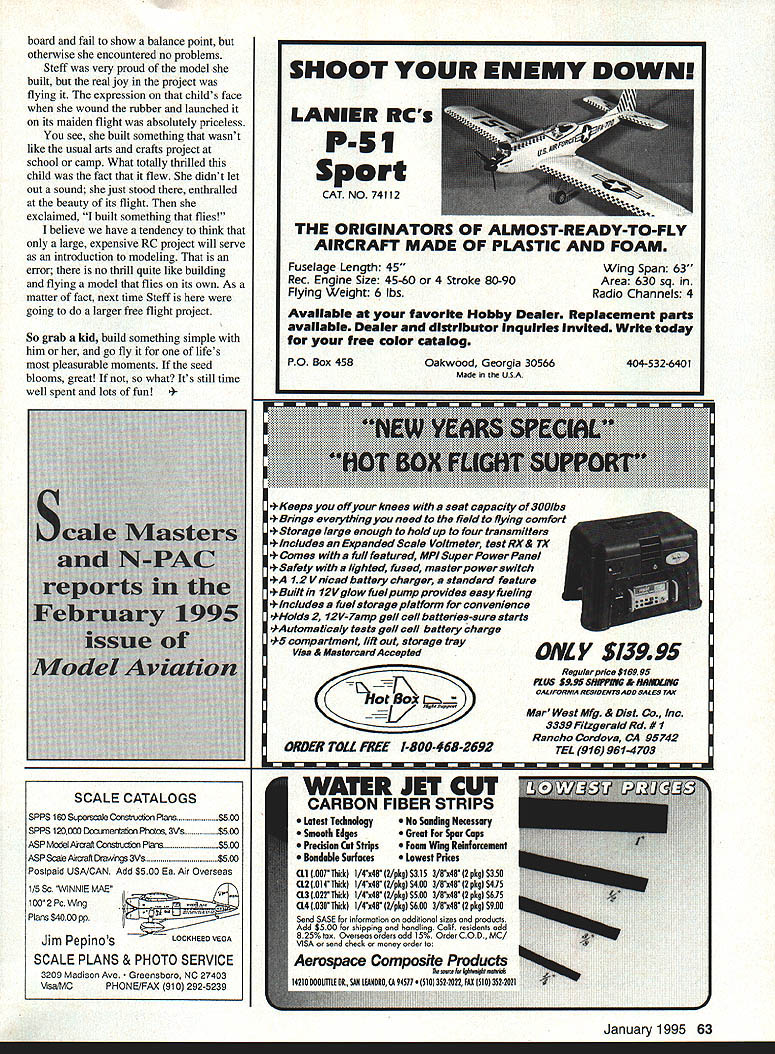
Darwin Hawkins and the Wichita RC club recently organized a Student Pilot Day with the local Big Brothers/Big Sisters chapter. RC trainers with buddy-box transmitters were used to provide basic stick time for the boys and girls. While the event was a learning experience for all, it worked out rather smoothly: each child and Big Brother or Sister flew several times, and the modelers had lots of fun instructing and interacting with the youngsters.
Local hobby shops and individuals donated a Fox engine, a Futaba radio, a Whiz kit, and many field-support items. A 12-year-old youngster who showed the most interest and need was the lucky recipient. Joel's father was killed last year in a farming accident. The boy and his father had been very close, and the healing has been quite hard for him. Fortunately, Joel's Big Brother has helped fill some of the void, and just happens to be a beginner in RC himself.
Joel was very excited and also mentioned that he and his dad had talked about getting into modeling. His mother said this is the first time he has really smiled and laughed in a long time.
Was this a successful activity? It depends on how you evaluate it. It's not likely that a whole bunch of youngsters, Big Brothers, or Big Sisters rushed out and bought model airplane kits. But who is to say what impact this event had on the participants? It may take many years to tell.
If none of those participants ever becomes interested in modeling, the event was still truly worthwhile from a good-citizenship standpoint. The adults involved certainly contributed something to the community and justifiably felt good about themselves.
Typical Grandparent?
A patient told me years ago, "Grandkids are the reward for all the headaches associated with raising their parents." I absolutely agree! While geography prevents daily contact with two of my four grandchildren, the time they are in Kansas means that everything else assumes a very low priority.
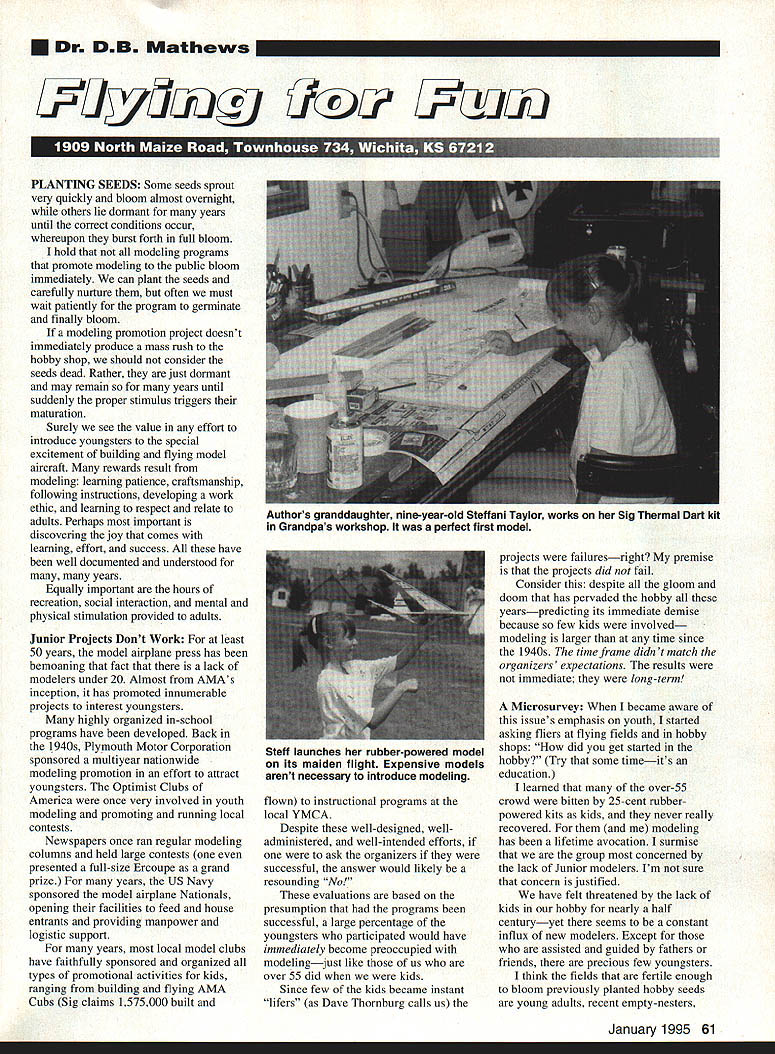
Steffani, the oldest, is probably only average, but to me she is the prettiest, brightest, most lovable nine-year-old in the universe. I try to plan special activities for her when she's here, and we have a grand old time.
Last summer we flew my Whiz on several afternoons, and while her current flying skills involve bashing the sticks around like she's chasing Pac-Man, we had a wonderful time. We took a picnic lunch, laughed, talked, and acted silly—just like everyone else does with grandchildren, I presume.
She wanted to build a model of her own, so I purchased a Sig Thermal Dart kit and supervised her reading of the instructions, cutting and gluing the parts. This is an excellent first project for a child this age. The instructions do not mention placing wax paper between the covering and the building board where it will prevent the model from sticking to the table. If you are building with a child, always keep an eye on the glue and be sure you don't leave them alone with small parts or a bottle of cement. The instructions also fail to show a balance point, but otherwise she encountered no problems.
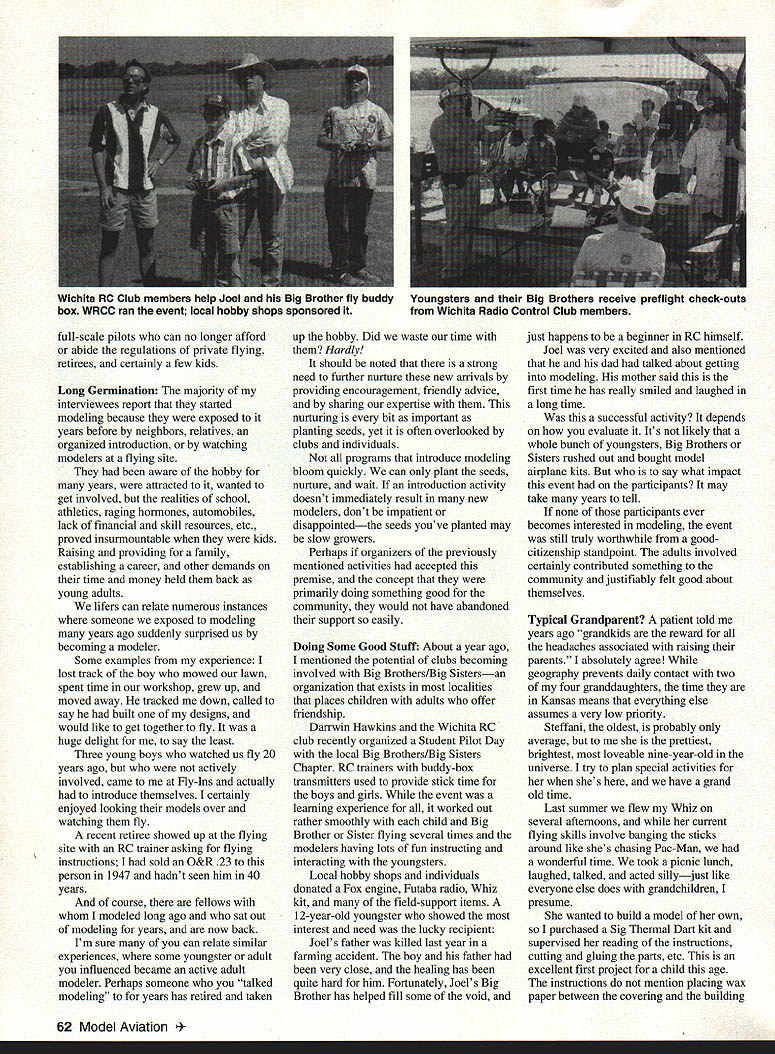
Steff was very proud of the model she built, but the real joy in the project was flying it. The expression on that child's face when she wound the rubber and launched it on its maiden flight was absolutely priceless.
You see, she built something that wasn't like the usual arts-and-crafts project at school or camp. What totally thrilled this child was the fact that it flew. She didn't let out a sound; she just stood there, enthralled at the beauty of its flight. Then she exclaimed, "I built something that flies!"
I believe we have a tendency to think that only a large, expensive RC project will serve as an introduction to modeling. That is an error; there is no thrill quite like building and flying a model that flies on its own. As a matter of fact, next time Steff is here we're going to do a larger free-flight project.
So grab a kid, build something simple with him or her, and go fly it for one of life's most pleasurable moments. If the seed blooms, great! If not, so what? It's still time well spent and lots of fun!
Transcribed from original scans by AI. Minor OCR errors may remain.

