
Flying for Fun
Dr. D.B. Mathews 909 North Maize Road, Townhouse 734, Wichita, KS 67212
ARC Scale Duration
During the nearly twenty years I've been writing for model magazines, nothing has equaled the response to my comments on ARC Scale Duration in the October 1994 column. Many others agree that building and thermaling scale models of this size would be terrific fun.
Input has varied regarding the mechanisms to develop rules, but the response to the concept has been totally favorable.
Several letters indicate a preference for using a fuel-allotment approach, similar to Norm Rosenstock's "A Texaco" proposal in the July 1994 issue of this magazine. Other writers prefer using the power-duration or climb-and-glide rules currently in the AMA rule book. Some express concerns over my suggested use of a standard engine, while still others are uneasy about the ROG requirements.
Frankly, I really don't care how the idea evolves on a competitive basis, and I will delegate the rules development to those who do care. The concept will certainly work as a stimulus to tie SAM (Society of Antique Modelers), soaring, and Sport Scale competitors together. The rules should be developed by those involved—not by those who fly only for their personal challenges and enjoyment.
My limited early experience indicates that ARCSD is sufficiently challenging to stimulate anyone, while rewarding the builder with hours of pure modeling joy.
As my Defender was merrily thermaling away, I commented to one of my flying friends (who loves to thermal Old-Timers) that this fulfilled a childhood dream: a scale model, built like some old 25-cent rubber-powered model, riding a boomer held in suspension by some magical hand—yet it was going to land at my feet. Truly a beautiful sight, and we could see the full thing, unlike a 1/2 A!
I used a modified Clark Y section — that is not a flat-bottom airfoil, folks! Over and over again, this type of section has proven to be taciturn and tolerant of balance points. A moderately thick leading edge, combined with a "thick" high point, provides good low-speed performance without wild instability at high throttle.
The setup is much like that commonly used on most of the simpler Old-Timers. These are the free-flight settings I used:
- Wing at 3° positive incidence with 4° dihedral
- Washout in both wingtips
- 3° downthrust
- 2° right thrust
- Balance at 1/3 mean chord
- Stab at 2°
These are free-flight settings, and they should be. An ARCSD is actually quite capable of flying without any radio inputs—at least in theory.
Aeronca Defender
When writing about the Scale Duration concept back in May (for the October issue) I had not actually built a model to test the parameters. Hate to admit that, but it's true. I based the idea on years of experience with Old-Timers of that size, and I felt pretty sure of my idea, but I really did need to build a model for proof.
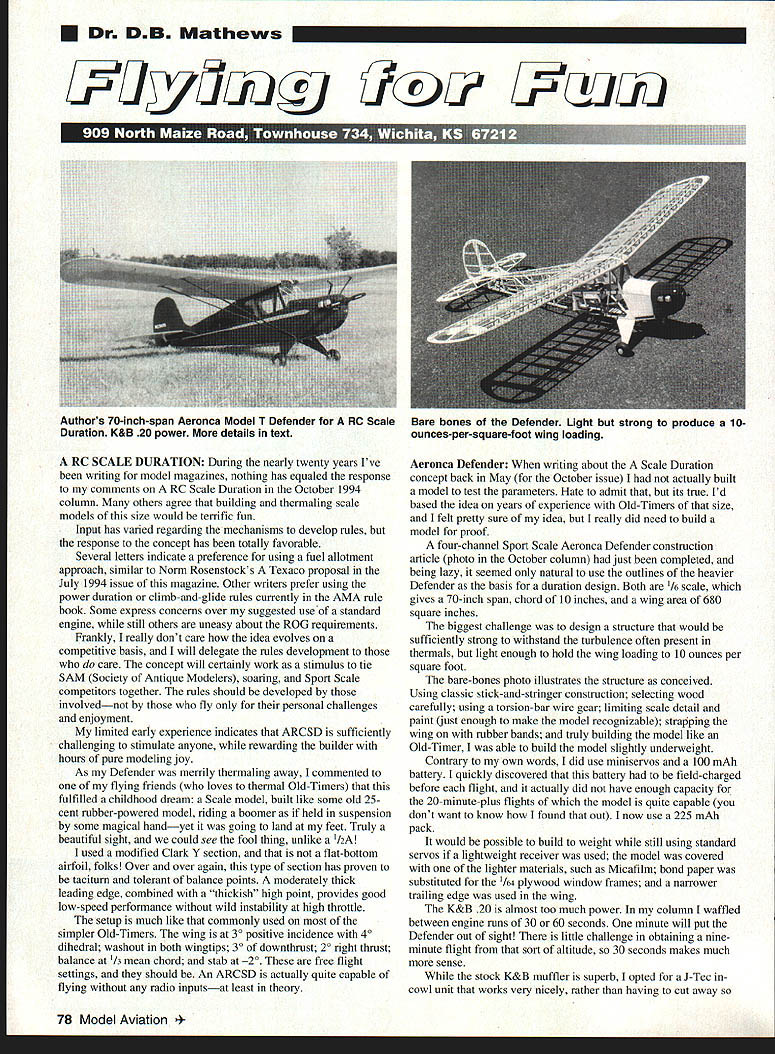
A four-channel Sport Scale Aeronca Defender construction article (photo in the October column) had just been completed, and being lazy, it seemed only natural to use the outlines of the heavier Defender as the basis for a duration design. Both are 1/6 scale, which gives a 70-inch span, chord of 10 inches, and a wing area of 680 square inches.
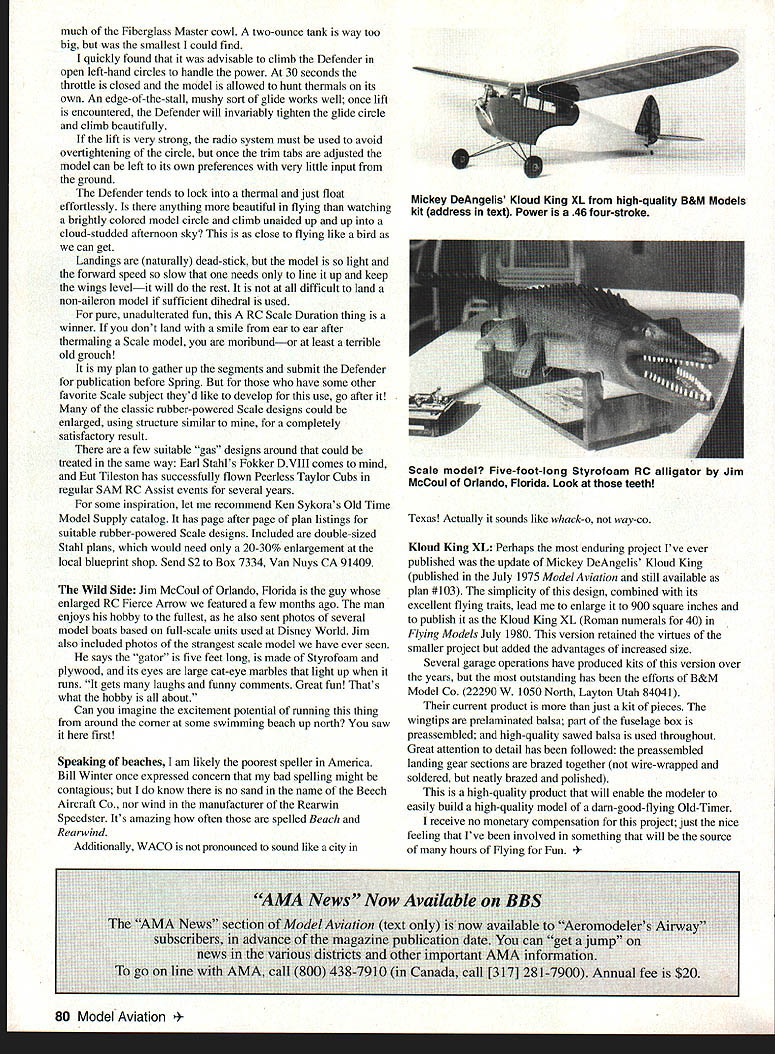
The biggest challenge was to design a structure that would be sufficiently strong to withstand the turbulence often present in thermals, but light enough to hold the wing loading to 10 ounces per square foot.
The bare-bones photo illustrates the structure as conceived. Using classic stick-and-stringer construction; selecting wood carefully; using a torsion-bar wire gear; limiting scale detail and paint (just enough to make the model recognizable); strapping the wing on with rubber bands; and truly building the model like an Old-Timer, I was able to build slightly underweight.
Contrary to my own words, I did use mini servos and a 100 mAh battery. I quickly discovered that this battery had to be field-charged before each flight, and it actually did not have enough capacity for the 20-minute-plus flights of which the model is quite capable (you don't want to know how I found that out). I now use a 225 mAh pack.
It would be possible to build to weight while still using standard servos if a lightweight receiver was used; the model was covered with one of the lighter materials, such as Micafilm; bond paper was substituted for the 1/64 plywood window frames; and a narrower trailing edge was used in the wing.
The K&B .20 is almost too much power. In my column I waffled between engine runs of 30 or 60 seconds. One minute will put the Defender out of sight! There is little challenge in obtaining a nine-minute flight from that sort of altitude, so 30 seconds makes much more sense.
While the stock K&B muffler is superb, I opted for a J-Tec incowl unit that works very nicely, rather than having to cut away so much of the Fiberglass Master cowl. A two-ounce tank is way too big, but was the smallest I could find.
I quickly found that it was advisable to climb the Defender in open left-hand circles to handle the power. At 30 seconds the throttle is closed and the model is allowed to hunt thermals on its own. An edge-of-the-stall, mushy sort of glide works well; once lift is encountered, the Defender will invariably tighten the glide circle and climb beautifully.
If the lift is very strong, the radio system must be used to avoid overtightening of the circle, but once the trim tabs are adjusted the model can be left to its own preferences with very little input from the ground.
The Defender tends to lock into a thermal and just float effortlessly. Is there anything more beautiful in flying than watching a brightly colored model circle and climb unaided up and up into a cloud-studded afternoon sky? This is as close to flying like a bird as we can get.
Landings are naturally dead-stick, but the model is so light and the forward speed so slow that one needs only to line it up and keep the wings level — it will do the rest. It is not at all difficult to land a non-aileron model if sufficient dihedral is used.
For pure, unadulterated fun, this is an RC Scale Duration thing — a winner. If you don't land with a smile from ear to ear after thermaling a scale model, you are moribund—or at least a terrible old grouch!
It is my plan to gather up the segments and submit the Defender for publication before spring. But for those who have some other favorite scale subject they'd like to develop for this use, go after it! Many of the classic rubber-powered scale designs could be enlarged, using structure similar to mine, for a completely satisfactory result.
There are a few suitable "gas" designs around that could be treated in the same way: Earl Stahl's Fokker DVII comes to mind, and Eut Tileston has successfully flown Peerless Taylor Cubs in regular SAM RC Assist events for several years.
For some inspiration, let me recommend Ken Sykora's Old Time Model Supply catalog. It has page after page of plan listings for suitable rubber-powered scale designs. Included are double-sized Stahl plans, which would need only a 20–30% enlargement at the local blueprint shop. Send $2 to Box 7334, Van Nuys, CA 91409.
The Wild Side
Jim McOoul of Orlando, Florida is the guy whose enlarged RC Fierce Arrow we featured a few months ago. The man enjoys his hobby to the fullest, as he also sent photos of several model boats based on full-scale units at Disney World. Jim also included photos of the strangest scale model we have ever seen. He says the "gator" is five feet long, is made of Styrofoam and plywood, and its eyes are large cat-eye marbles that light up when it runs. It gets many laughs and funny comments. Great fun! That's what the hobby is all about.
Can you imagine the excitement potential of running this thing from around the corner at some swimming beach up north? You saw it here first!
Speaking of beaches, I am likely the poorest speller in America. Bill Winter once expressed concern that my bad spelling might be contagious; but I do know there is no sand in the name of the Beech Aircraft Co., nor wind in the manufacturer of the Rearwin Speedster. It's amazing how often those are spelled Beach and Rearwind.
Additionally, WACO is not pronounced to sound like a city in Texas! Actually it sounds like whack-o, not way-co.
Kloud King XL
Perhaps the most enduring project I've ever published was the update of Mickey DeAngelis' Kloud King (published in the July 1975 Model Aviation and still available as plan #103). The simplicity of this design, combined with its excellent flying traits, led me to enlarge it to 90 square inches and to publish it as the Kloud King XL (Roman numerals for 40) in Flying Models, July 1980. This version retained the virtues of the smaller project but added the advantages of increased size.
Several garage operations have produced kits of this version over the years, but the most outstanding has been the efforts of B&M Model Co. (22920 W. 1050 North, Layton, Utah 84041).
Their current product is more than just a kit of pieces. The wings are prelaminated balsa; part of the fuselage box is preassembled; and high-quality cowl balsa is used throughout. Great attention to detail has been followed: the preassembled landing gear sections are brazed together (not wire-wrapped and soldered, but neatly brazed and polished).
This is a high-quality product that will enable the modeler to easily build a high-quality model of a darn-good-flying Old-Timer. I receive no monetary compensation for this project; just the nice feeling that I've been involved in something that will be the source of many hours of flying for fun.
Transcribed from original scans by AI. Minor OCR errors may remain.

