
Dr. D. B. Mathews 909 N. Maize Rd., Townhouse 734, Wichita, KS 67212
Flying For Fun
MORE DARN FUN! I've just returned from one of the most enjoyable weekends I've ever spent. The Ace R/C Float Fly the first weekend in June was blessed with absolutely perfect weather: light winds, moderate temperatures, good cloud cover, and lots and lots of flying.
Traditionally, Ace R/C staff members present some Saturday evening entertainment as part of the buffet. This year they really outdid themselves. Ace has recently leased Higginsville Municipal Airport and moved electronic repair, R&D, and other parts of its operation into an administration building and large hangar. Sort of novel — a model aircraft manufacturer with its own 3,000-ft. paved runway. They decided to take advantage of the big old hangar (it looks like 1942) and put on a WWII USO show. Sid Nelson brought a full-size clipped-wing T‑Craft and put on an aerobatics demonstration that climaxed with an inverted ribbon cut. We pigged out on a delicious buffet.
About sundown the hangar was struck by magic. The Ace Players set up a stage draped with WWII tarps; Ace's bundled balsa supply was used as walls behind the lights. When the lights dropped it was suddenly 1942 and, for many of us, nostalgia hit hard. Imagine impersonations of:
- Kate Smith singing "God Bless America"
- The Andrews Sisters singing "Rum and Coca‑Cola"
- The Marx Brothers and era music
A rush of patriotic fever swept the crowd; the audience stood up, yelled, and waved the little flags placed at each chair. Absolutely the finest amateur-theater presentation I've seen — an emotional experience. Let's hope this becomes a float-fly tradition.
What a great, fun-filled event this is becoming: nearly 175 entries, well over 300 models, a huge crowd of spectators, entries from Montana to Georgia and Long Island to Florida — and, most important, everyone having tons of plain old fun. No judgments, no hassles over rules, no stress — just pure, unadulterated fun. I'm sure you'll have a chance to attend similar events this year.
Staying on Track
One of the systems Ace used to keep things moving smoothly was the track-and-tile flight-control system. Each registered float-fly entrant received a 1 x 4‑in. plywood tile with the pilot's name, frequency, and a colored dot. When ready to fly, you placed the tile in the top of a vertical rack; matching-colored tiles slid down the track until a tile reached the next bottom point. When it reached the bottom, the modeler moved to the flight station, readied gear, and handed a large colored disk used to check out transmitters to the impound manager. If someone was flying on the same frequency, the impound manager held that transmitter until the other model was safely back ashore.
The system allowed Ace to distribute fliers evenly among flight stations; if a station became overloaded, colored dots were simply changed. Flight lines moved smoothly because a glance at tiles in the track told you whose turn it was. I first saw a similar system last Labor Day weekend at the 49th Jumbo Squadron event at Lake Jacomo, Missouri, and was impressed. At a large, heavily flown event like a float fly, the system really shines.
Row-rise operations off the water often slow for safety reasons. Boat crews recovering capsized planes or dead-stick landings can halt takeoffs and landings whenever a manned boat is on the water. Though recoveries were efficient at Higginsville, delays are unavoidable. Considering that, it was remarkable to see 270-plus flights made in eight hours on Saturday — credit much of that to the track-and-tile system. It also avoids complaints like "I didn't hear my name called." Try it — you'll have lots of fun.
Letter Express
Wayne Norris, Xenia, Ohio, writes:
"I've been building and flying models for 23 years. Like so many others, I started with five-cent rubber jobs. Many of these lifted my spirit away from a small Iowa farm. My first gas plane was an Enya .29-powered solid wood control liner. I still think CL is a good place for a novice to learn building skills and how to run an engine. RC has been my staple for the last 16 years. Scratch-building and getting my wife involved are a big part of the fun.
"Model airplanes have always been a big part of my life. I'm sure they helped mold my personality and career choice of becoming a professional pilot."
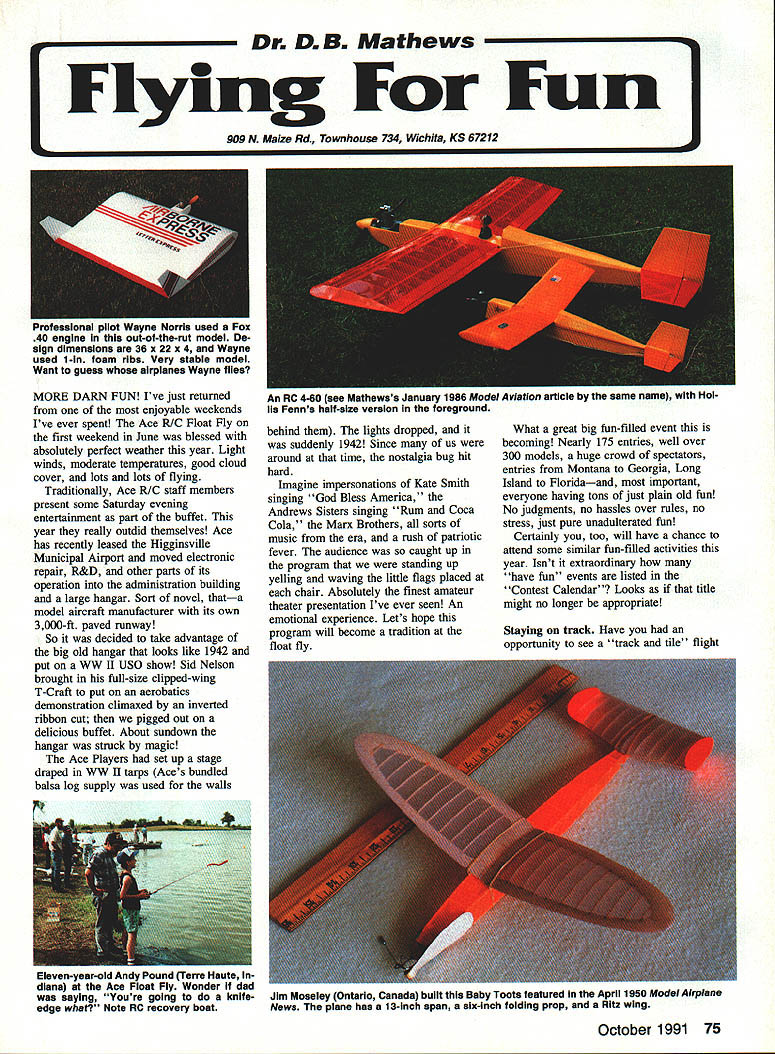
Take a look at Wayne's flying letter in one of the photos and guess what institution he flies for. He says he built it to fly at company picnics.
Trivia: Jeep and Bazooka
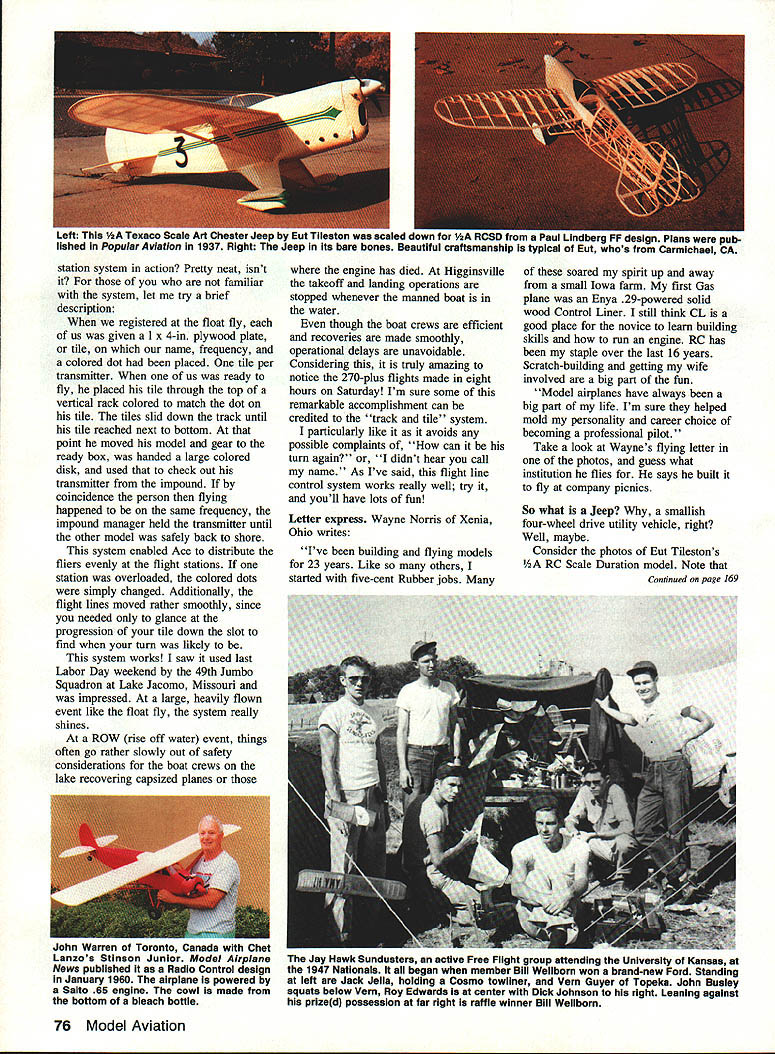
- Jeep: Consider Eut Tileston's 1/2A RC Scale Duration model and the prototype racer flown in 1937. How did Art Chester arrive at the name "Jeep" four years before Willys? Neither Chester nor Willys invented the name. As I recall, "Jeep" was a little, talking animal in the comic strip Alley Oop long before the name was picked up by others.
- Bazooka: The military antitank weapon borrowed its name from a large, ludicrous-looking kazoo-like musical instrument played by country/western comedian Bob Burns.
Frequency Safety and "Bulletproof" Receivers
At the Ace Float Fly, all transmitters were checked on scanners during Friday-night registration. Several relatively new 1991 transmitters were found to be spattering off-frequency.
A receiver may be bulletproof, but that's useless if the flier next to you is using a shotgun. I'm not comfortable flying near anyone who doesn't have a current-year Gold sticker on his transmitter. Are you?
On a related note: have you flown with someone only 10 MHz away? I was uneasy the first time someone fired up an RC 13 next to my RC 12. After thinking, I relaxed — if the other guy bought a Gold transmitter for RC 13, it should be legal. How great it will be not waiting half the morning for your frequency to open up. Thank you, AMA.
Frankly, I'm more comfortable in a 12-13 or 26-27 match than with someone who shows up with a beat-up old imported transmitter and fires up next to me on RC 52 while I'm in the air on RC 54. Think about it.
Magazine Reprints
John Warren asked for help finding a reprint of the original Chet Lanco construction article. Carolyn Gierke now provides such a service. Send her as much information as possible — author, title, magazine, date, and page numbers. Costs vary by length and number of pages. Carolyn also has a large collection of extra copies of old magazines for sale.
Contact:
- Carolyn Gierke
- 1276 Ransom Road, Lancaster, NY 14086
Noise: Decibels and Pitch
Noise (sound) is measured two ways: amplitude (volume, measured in decibels) and pitch (measured in cycles per second). Most noise reduction efforts focus on lowering volume, which is important, but pitch also affects annoyance.
Examples:
- Hit high C and low C on a piano at the same volume; high C is more penetrating.
- A foghorn may produce more decibels, yet a siren sounds more obnoxious.
- A 1/2-A engine's sound is often more irritating than a larger gas burner; prop pitch contributes.
Pragmatically, consider both decibels and pitch when trying to be good neighbors.
Big Bingo! — Wing and Bolt Modifications
Some builders of Big Bingo! (Model Aviation, February 1991) using high-powered "fire-breather" engines (A&M/Sachs, etc.) have reported loss of aileron effectiveness in high-speed runs. It appears the two-part wing can spread at the rear bolts and cause flexing. Suggested fixes:
- Add a 1/8-in. brass strap fastened through the hardwood trailing-edge bolt insert with 8-32 bolts and blind nuts. Mount on the wing bottom and inside the 1/4 x 20 hold-on bolts so only one side need be unbolted when separating the wing. This prevents wing spread.
- Use 3/8-in. I.D. nylon grommets at the rear 4 x 20 bolts. Redrill elongated holes with a 1/8-in. bit and epoxy the grommets in while the wing is attached to the fuselage.
- Replace 1/4 x 20 nylon bolts with hex-head steel bolts; nylon bolts may flex under extreme loads.
- Consider epoxying a 1/4-in. strip of aircraft ply from front to back of the hardwood bolt blocks on both sides of the fuselage and epoxying them to the fuselage wall and blocks.
These mods shouldn't be necessary with moderate power (.120 four-strokers or .90–1.08 two-strokes), but for extreme power and speed they are good practice.
Modeling and Kids — A Father's Gift
Kids are born blank; parenting writes what's on them. Andy Pound and his dad Ron are a perfect example. They've attended Ace float flies for years. Andy loves to fly model airplanes — fearless, quick reflexes, cheerful, courteous, and fun to be around. Ron is firm, corrects Andy, then ruffles his hair. The love between father and son is clear. That's good parenting.
Many of you include families in modeling; those memories are priceless when kids grow up. Consider clubs working with Big Brothers/Big Sisters or similar organizations — a natural fit for sharing modeling with youngsters. I'd be delighted to hear of activities in this area.
A Fly-by-Night Operation (From Jim Moseley)
"The last Sunday in April marked more than six months during which I've been unable to fly Free Flight outdoors due to the Canadian weather.
"Around 11:00 p.m. I wandered out onto the apartment balcony, leaned on the rail, and surveyed the world; suddenly I realized it was unusually mild and dead calm. Not a breath of air stirring! A small thought surfaced, but common sense said, 'Nah, you can't; it's dark.' Such reasoning was soon overwhelmed by longing, and within minutes I'd picked up a small rubber model, looped a gumband, and headed for a factory sports field a half mile away. I haven't been able to gain access to this site before...
"I find that looking to the south the city glow of Toronto brightens the sky enough that a model should be just visible against it if it isn't too far away. A few hundred hand turns confirm this is the case, with a bonus of some stray light from nearby highway lamps reflecting from the undersurface of the wings.
"What followed was a blissful hour of supremely contented flying. Suppose a policeman had come by; how would I have explained what I'm doing? 'Just flying a model airplane in the dark, officer?'
"I was having such a good time I could have stayed all night, but it was getting a bit chilly, so back to the apartment. Got home just after 1 a.m., happy as could be, to a wife who now knows there is nothing left in aeromodelling to surprise her. Now if I could persuade her to go along next time and hold a high-intensity lantern... hah!
"Truly this has to be Flying for Fun. Do you agree, Doc?"
Yes — I do. Do you, readers?
The Way We Were
Although the photo is tattered and blotched, I must share Dick Johnson's memories. Dick and others in the photo were students on the GI Bill at the University of Kansas in 1947. They formed an active Free Flight club in Lawrence called the Jay Hawk Sundusters.
When Bill Wellborn won a new Ford in a raffle at a movie theater, they loaded up models and headed for the AMA (1947) Nationals in Minneapolis. In Dick's words, "We had a fantastic time without winning a thing." They later attended the 1948 and 1949 Nationals at Olathe Naval Air Station (Kansas) and again didn't win, but had a ball flying anyway.
Dick recalls seeing his first Dynajet at Minneapolis, watching Jim Walker fly three Fireballs at once, and observing younger flyers learn from older pros. In 1977 at the SAM Champs in Las Vegas, Jack, Dick, and Roy held an unofficial 30th reunion. Dick has retained AMA 5192 all those years — a testament to his lifelong interest in modeling.
Transcribed from original scans by AI. Minor OCR errors may remain.

