
Flying for Fun
D.B. Mathews 909 N. Maize Rd., Townhouse 734, Wichita KS 67212
Preventive Maintenance
Now that we are deep into the "dark months" (aka winter) and are hard at work on our building projects for the coming flying season, let's not neglect our flying fleet. Above and beyond monthly battery cycling, we need to make sure our models are ready to go the first time a decent day finally comes along.
Checklist
- Tighten each nut and bolt (including the servo mounts) — even the wheel collars.
- Repair any rips or tears in the covering.
- Check propellers for chips and cracks; retighten propeller and spinner.
- Check clevises and horns for wear.
- Check the fuel tank, stopper, and tubing; replace if brittle.
- Check servo arms and servos for looseness.
- Clean everything thoroughly, including transmitters.
Yes, the pin in clevises can fail; yes, the propeller or spinner can work loose without coming off; yes, chipped propellers are dangerous; yes, oil and grime can work their way into glue joints; and yes, servo arms and even servos themselves can work loose. Models are subjected to intense vibration for relatively long periods; anything that can work loose will.
A few hours spent on preventive and interceptive maintenance will be rewarded with another season of good, safe flying from your old reliables.
So I Set Down and Flew
In the early days of television, many variety shows featured composers of popular tunes, and the show would be built around their songs. Invariably, the tunesmith would say, "then I set down and wrote," then he would play his tune on the piano. I always wondered if anyone ever composed music standing up.
With the exception of some glider and Old-Timer fliers, we modelers normally fly standing up. How about our flying buddies who have a difficult time standing because of illness or orthopedic problems? They can sit at a workbench and build up a storm (which is very good therapy for them), but what about flying their projects?
One of my longtime flying buddies had knee-replacement surgery; he scheduled it and his recovery for the winter months, so he could get back to flying in the spring. Others are less fortunate and will never be agile enough to fly standing up again.
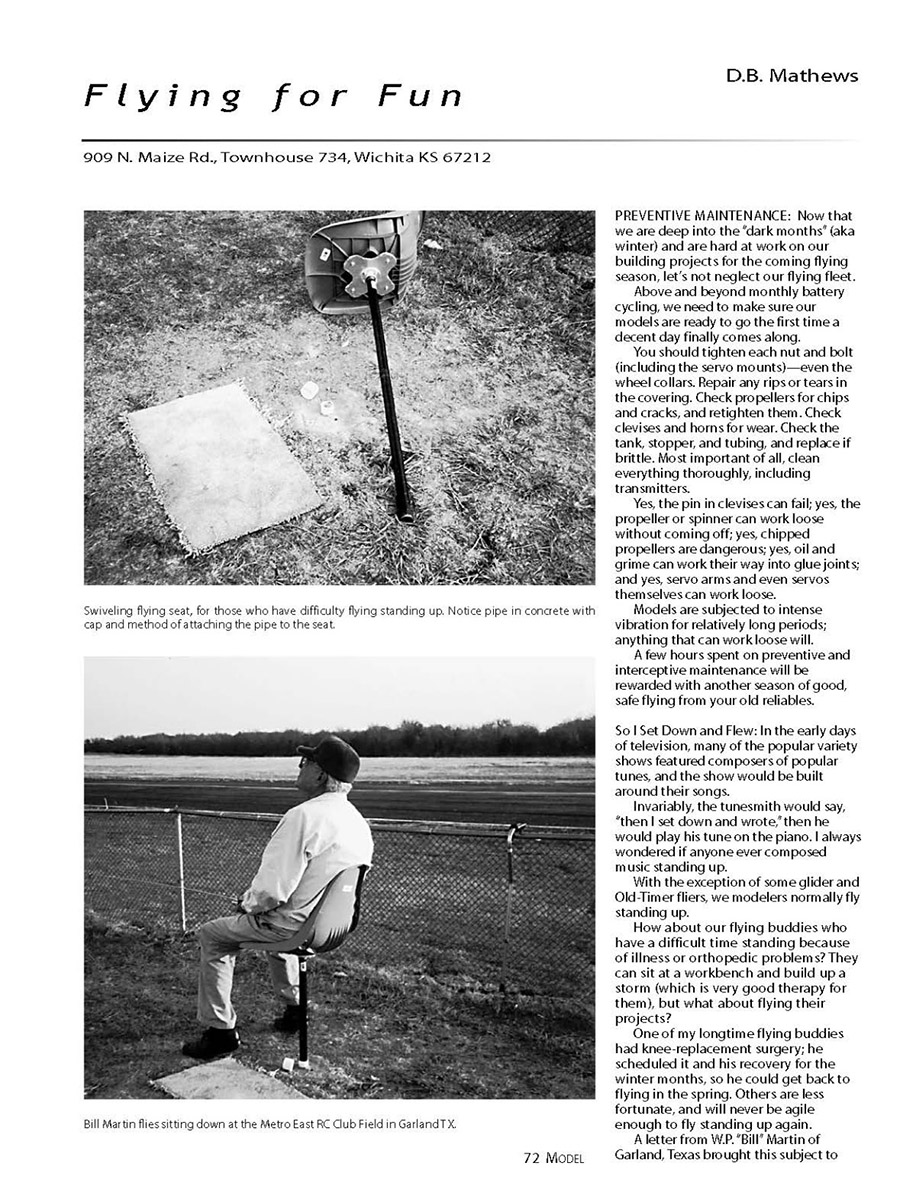
A letter from W.P. "Bill" Martin of Garland, Texas brought this subject to mind, and he provided photos of a splendid solution to the problem.
"After a long illness I thought my flying days were over, because I could no longer stand up to fly. My friends Glen Keppenhan and Neal Higinbotham surprised me with a chair that's placed in the ground and swivels, so I can turn and watch my planes do touch-and-goes.
What a great hobby and true friends!"
Ground Swivel Chair
It looks as though the chair is a molded-pedestal type, mounted with four bolts on a fabricated metal plate. A threaded pipe fitting has been bolted onto the plate, with a length of pipe screwed into it. For a ground mount, they dug a hole and set a section of larger pipe in concrete, into which the chair pipe is set to provide a swivel action. They keep a cap over the opening when it's not in use.
The whole thing is simplicity itself, yet it's a wonderfully thoughtful solution to a vexing problem.
Hold Still!
I made my living using my fingers for more than 40 years. As a result, I've always been extremely careful around spinning propellers. Under no circumstance will I reach around the propeller arc to do anything to a running engine. Some of my flying buddies have found amusement in my moving behind the engine to remove the glow plug, clip, etc., but I've only needed stitches twice in the 60 years I've been modeling!
Recently I saw Gail Schulman, who has been modeling even longer than I have; he taught me caution a long time ago. I noticed he was missing the tip phalanx of a finger.
Gail's accident and my two were caused by spinning propellers hitting our bodies — not from getting our bodies in the way of the props.
I got one bad cut on my leg when a control-line model slipped out of a homemade "stooge"; the other accident happened when a model rolled downhill into my hand as I was getting up to move around to the back; much the same thing happened to Gail.
Perhaps my most frightening and potentially serious experience was in my youth, when I was running an O&R .60 in a Custom Cruiser control-line model to show off to my buddies. I placed the model on an old card table, and one of the other kids hung onto the tail. When the engine started and gave it a mighty roar, the noise frightened the other kid and he let go. Then I had a snarling engine headed for my lap!
Fortunately the propeller snagged my loose-fitting shirt and died, or I probably would not have fathered three wonderful children!
Even though you are propeller safety-conscious, you are still at risk — unless the model is held securely.
Throughout the years, I've seen modelers tie big models to picnic tables, fence posts, and screwdrivers stuck in the ground, in an effort to hold them in place. Of course, there is always the flying buddy who will stand in the oily exhaust for you while he hangs on uncomfortably.
Unfortunately, all these "hold-stills" depend on the availability of ropes or items you can't carry with you to the field. For a long time, I've wanted a system that will safely hold my model when the engine is running, and is always available.
While attending an International Miniature Aircraft Association fly-in in York, ME during the summer of 1999, I spotted such a device and purchased it. I've used it faithfully ever since, and I feel safe moving around in front of a running engine for the first time in all these years. In its own way, this gadget is the most important piece of ground-support equipment I own.
The Hold-Still Device
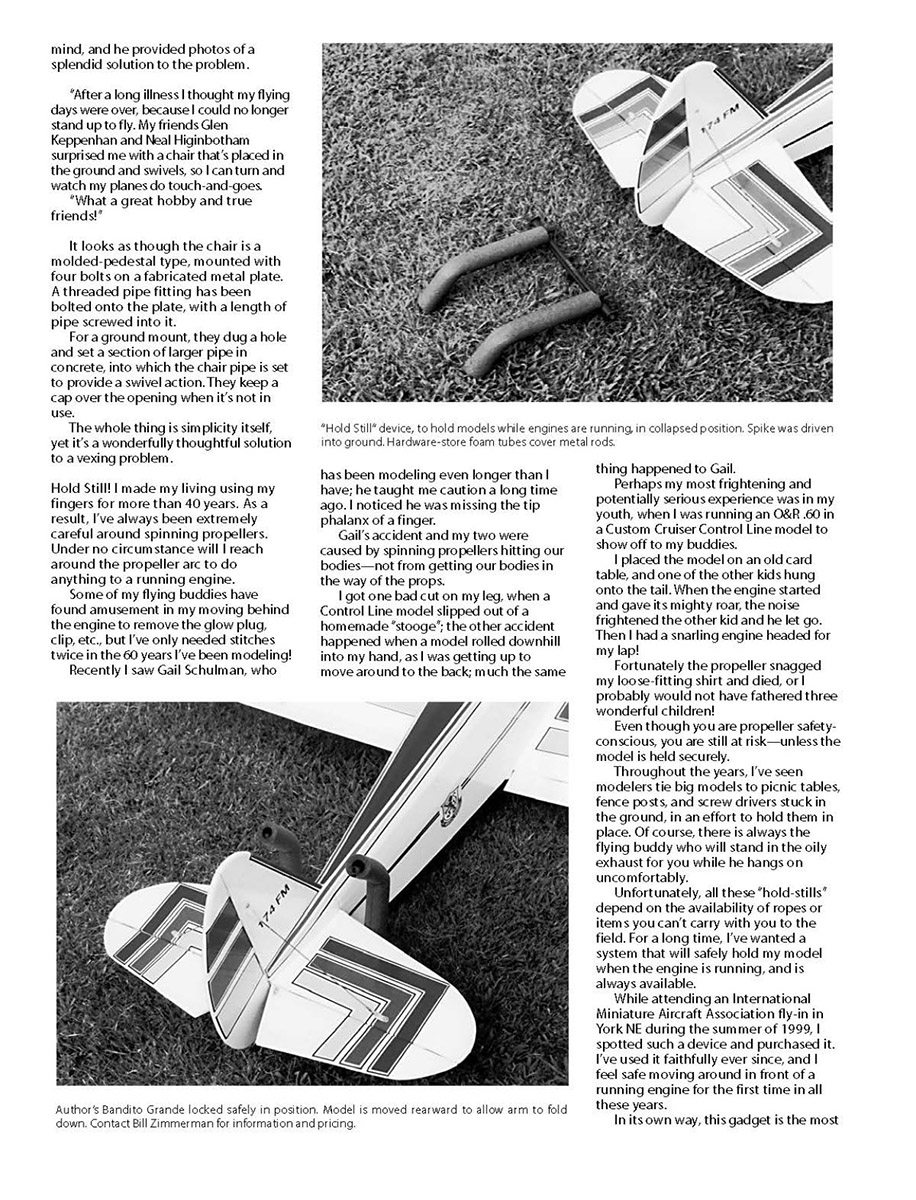
Bill Zimmerman described his need for the same type of holder to his son Kirk. Kirk took some measurements and thought about it. He came up with what amounts to a metal "T" rod, with a pair of hinges and stops welded onto it, which supports a "U." The pointed end of the T-shaped rod is driven approximately nine inches into the ground, positioned so the hinge lets the "U" drop back, but is in full stop to forward pressure.
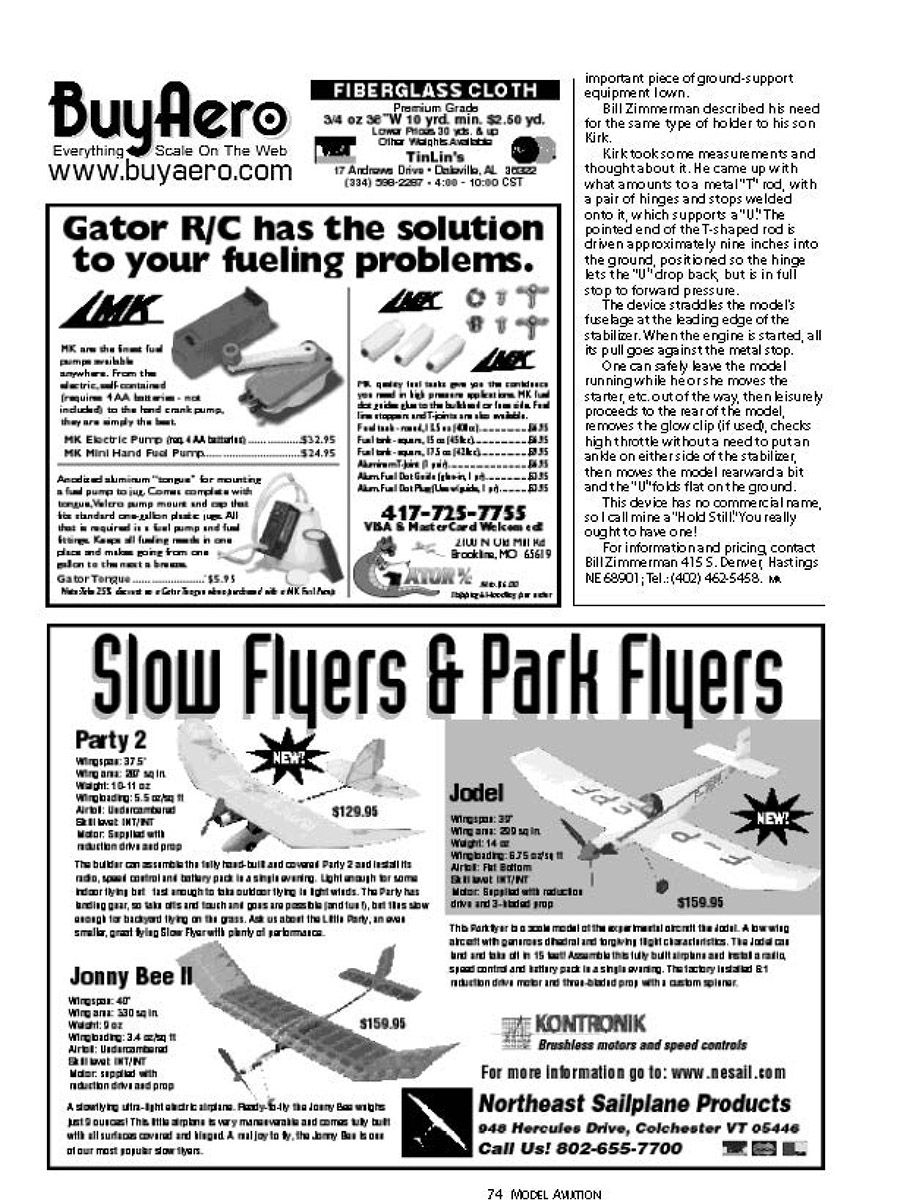
The device straddles the model's fuselage at the leading edge of the stabilizer. When the engine is started, all its pull goes against the metal stop. One can safely leave the model running while he or she moves the starter, etc., out of the way; then leisurely proceed to the rear of the model, remove the glow clip (if used), check high throttle without a need to put an ankle on either side of the stabilizer, then move the model rearward a bit and the "U" folds flat on the ground.
This device has no commercial name, so I call mine a "Hold Still." You really ought to have one!
For information and pricing contact:
- Bill Zimmerman
415 S. Denver, Hastings NE 68901 Tel.: (402) 462-5458
Transcribed from original scans by AI. Minor OCR errors may remain.

