
Flying for Fun
D.B. Mathews
909 N. Maize Rd., Townhouse 734, Wichita, KS 67212
AS PART of the World War II balsa-shortage-theme column of November 2000, I reproduced a magazine ad for Modelcraft kits that substituted "OHONOTE" wood for balsa. I posed the question, "What was it?"
A letter from Dave Hendrex of Los Angeles gives the answer.
"I was fortunate to know and work for Barney Snyder, his wife Peg, and son Jim during summer breaks while in high school over 40 years ago.
"Regarding your question about Barney Snyder's alternative material for balsa, if memory serves me correctly, he said he used hemlock."
Consider This:
There is a true story I've wanted to fit into a column for many years, but I was never sure where or how to use it.
This came from the late Don McGovern, and it involves a major kit manufacturer (of not only airplanes, but boats and cars in all disciplines) who employed Don for many years. I will not use a name, out of respect for the deceased owner, but many of you will figure out who it is.
This firm started out in the mid-1930s as a basement/neighborhood source of balsa and supplies. It grew until it was the largest of the large, with a line of products numbering in the hundreds.
The aircraft kits were designed by a true "who's who" of successful modelers, and the company reached the point where any breakthrough design that did well at an AMA Nationals was a cinch to be kitted by it.
The OPS controls were tightly enforced by traveling inspectors and reports by the public. The objective of keeping a lid on prices and preventing the growth of a black market was successful—mostly because of the civilian population's cooperation and appreciation.
Prices were controlled after WWII ended until the spring of 1946, when the regulation was removed. Consumer prices exploded almost overnight!
A Chevrolet that was $1,200 one day sold for $1,800 the next, then for $2,500 within a few months, and so forth. Supply and demand was allowed to find a new price structure that was not artificially controlled.
Inflation continued to erode the purchasing power of the dollar in later years, primarily because the federal government overspent its income and financed the deficit through public bonds and notes.
This is hardly a column about economics, so let's take a look at inflation's impact on the kit manufacturer to which I'm referring.
The company's owner developed a mind-set that modelers would not pay what seemed to him like ridiculous prices for his kits. In spite of rapidly rising costs of labor and raw materials, he thought, "no one is going to pay $25 for the same kit that was $15 in last year's catalog."
His choices were limited to raising kit prices or lowering quality. He held selling prices down by reducing costs and the quality of wood and hardware in his kits. The poor man could not accept the idea that modelers would pay more for quality. The outstanding designs he had secured the commercial rights to were being kitted with wood so poor it was useless, hardware that was essentially junk, and boxes of very poor quality. In the industry, the firm developed a reputation for not paying its designers royalties, then not even paying its employees salaries. The owner's well-intentioned but misguided choices held kit prices down, but his sales declined and his profit margin was compromised. Those things, combined with a reputation for poor quality, led to the firm's eventual bankruptcy.
Most successful modelers will not buy junk—regardless of how cheap it is!
You may recall those low-quality kits. If you wanted to build one of those outstanding designs (several of which still exist in successor companies' lines) you bought the kit, transferred the patterns to decent balsa and plywood, bent up new wire for the landing gear, etc., and bought new hardware.
No matter how much one paid for the kit, it was actually very expensive.
After some reflection, I see a parallel between this story and many of our experiences with electric flight. I can only speak from my own disappointments with electric-powered models and those of my flying buddies.
Although most model kits marketed in the formative years of this facet of the hobby are well-designed and nicely kitted, they were supplied with cheap "can" motors and low-quality batteries. They flew like lead sleds!
Yet, some modelers enjoy excellent performance and have a lot of fun flying with electric power.
This caused me to analyze the situation, and I came to a conclusion: because of skepticism about this new adventure, we have been unwilling to spend enough on quality electric components to be successful.
Modelers have learned the hard way to spend enough to get the expected results. Most of us will not buy engines, radios, kits, or supplies based strictly on cost. However, we succumb to the appeal of "cheap" when it comes to electric flight.
Although I never thought I'd live to see $1,500 kits, I must admit they are worth the cost. Many modeling products sell for what seem to be high prices, but they do sell. There is a demand and a place in our hobby for quality!
The Difference
Following this line of logic and applying it to electric flight led me to ask myself: what are the successful electric fliers doing that is making the difference?
Are they smarter than the rest of us? If so, how?
If they have a secret, what is it?
Most of the experts get good results with traditional electric designs similar to our "lead sleds." The question becomes, where did we go wrong?
The answer is:
- Cheap batteries
- Cheap chargers
- Cheap speed controls
- Cheap installations
All R/Cers who cycle their flight packs have learned that some packs charge to much higher voltages and hold their charges longer than others. Simply put, some packs are superior to others.
We have also learned that high-quality peak-detection chargers will "pump" up a pack better than the cheap chargers. Less obvious is the current loss across cheap speed controls.
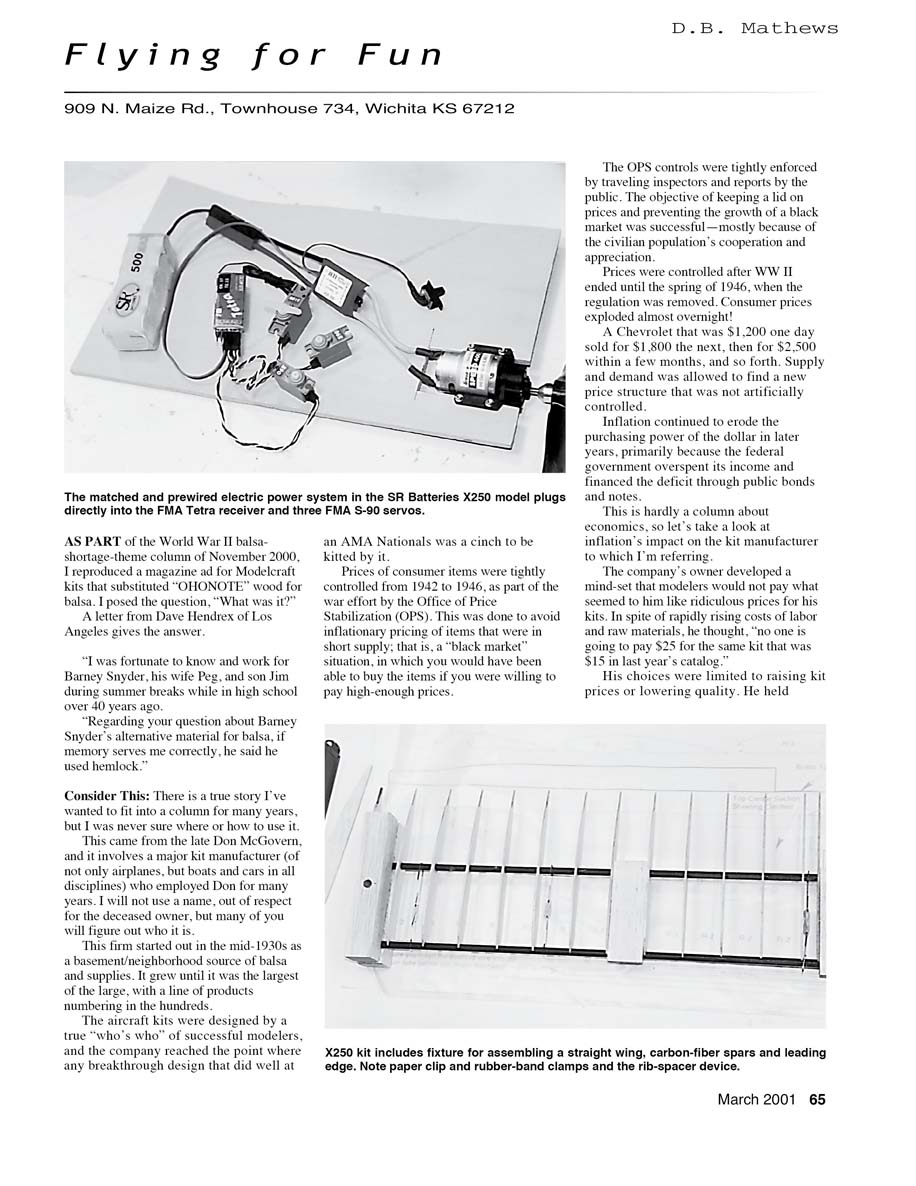
I ordered an SR Batteries X250 kit, a prewired motor/gearbox with a Jeti speed control, and, most importantly, SR-matched 10-cell 575 mAh battery packs. The package oozes quality in every aspect. The model has been completed, and suddenly I'm getting flights that rival those of the experts.
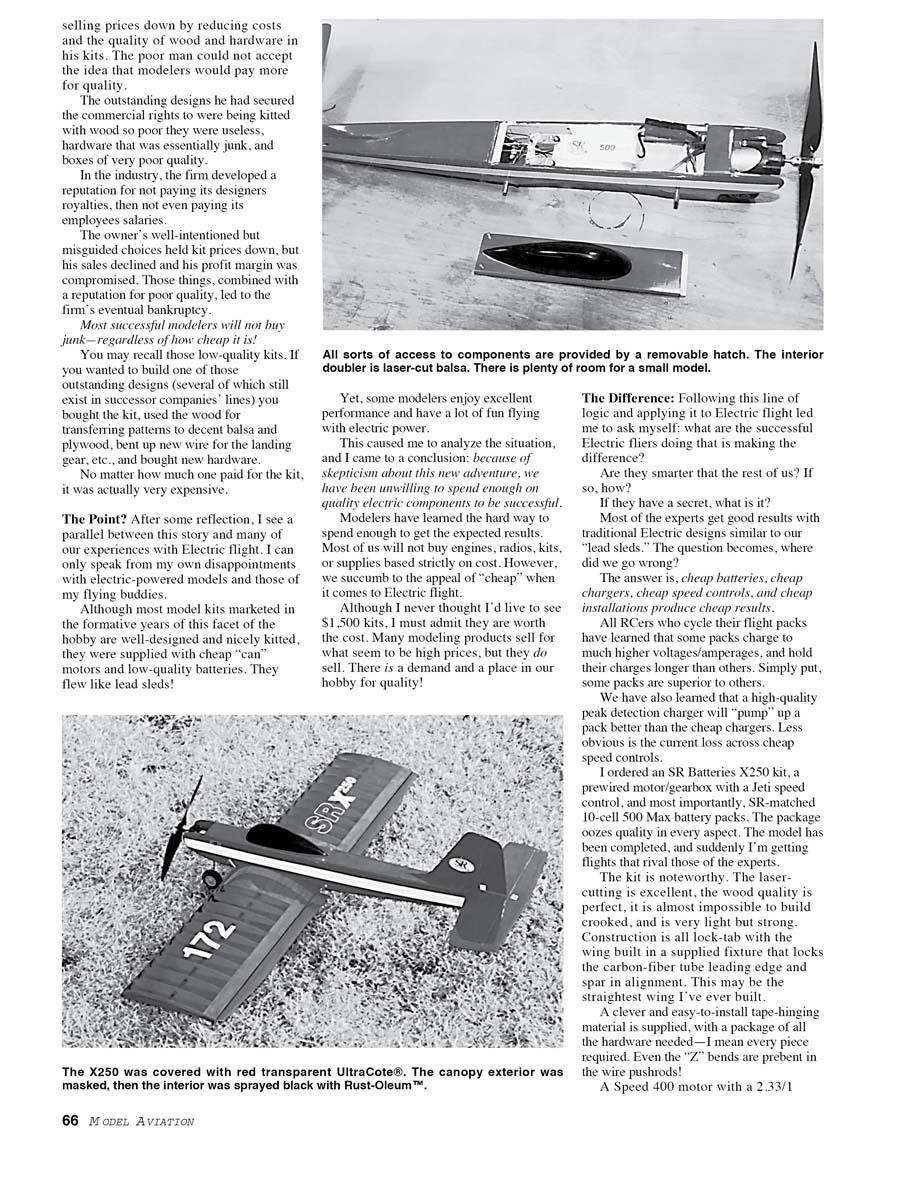
The kit is noteworthy. The laser-cutting is excellent, the wood quality is perfect, it is almost impossible to build crooked, and it is very light but strong. Construction is all lock-tab with the wing built in a supplied fixture that locks the carbon-fiber tube leading edge and spar in alignment. This may be the straightest wing I've ever built.
A clever and easy-to-install tape-hinging material is supplied, with a package of all the hardware needed—I mean every piece required. Even the "Z" bends are pre-bent in the wire pushrods!
A Speed 400 motor with a 2.33:1 gearbox turns a Graupner 9 x 5 slim propeller. A Jeti 350 speed control is used, since it can handle four servos — although I'm using three — and the brake can be disconnected. Ten SR Batteries 575 mAh cells, matched for output, impedance, and discharge curves, are ideal for the X250.
Although the motor, speed control, tiny switch harness, and Sermos battery leads wouldn't be difficult to connect and solder with a pencil-type iron, they are available in a preassembled, matched component package.
I chose FMA S-90 servos, which I have used before and know to be of the highest quality. An FMA Tetra receiver, which had previously performed flawlessly, was used to complete the guidance system.
With these components, my completed SR X250 weighs 22 ounces "fueled." Since seven of those ounces are in the battery pack, this four-channel model weighs 15 ounces empty, for a wing loading of about 13 ounces per square foot.
If one were to use glow or diesel power instead of the electric system, an .049 glow engine would be fine — but terribly noisy, cantankerous, and messy. Electric motors start so easily, and they are very neighborhood-friendly.
The electric-powered sport model's appeals are many, but far from the least is that it opens up flying areas not previously usable. I've been flying my model in five- to 15-knot winds with no problems, in roughly one-third the space needed for wet-powered radio control (R/C) models.
Although the X250 flies a bit too fast for "yard" or "park" flying, it certainly is safe to fly on athletic fields or large school grounds — and without bothering anyone!
I know nothing about the tiny electric-powered models suitable for small places, but I would guess the concept of "you get what you pay for" applies to them as well.
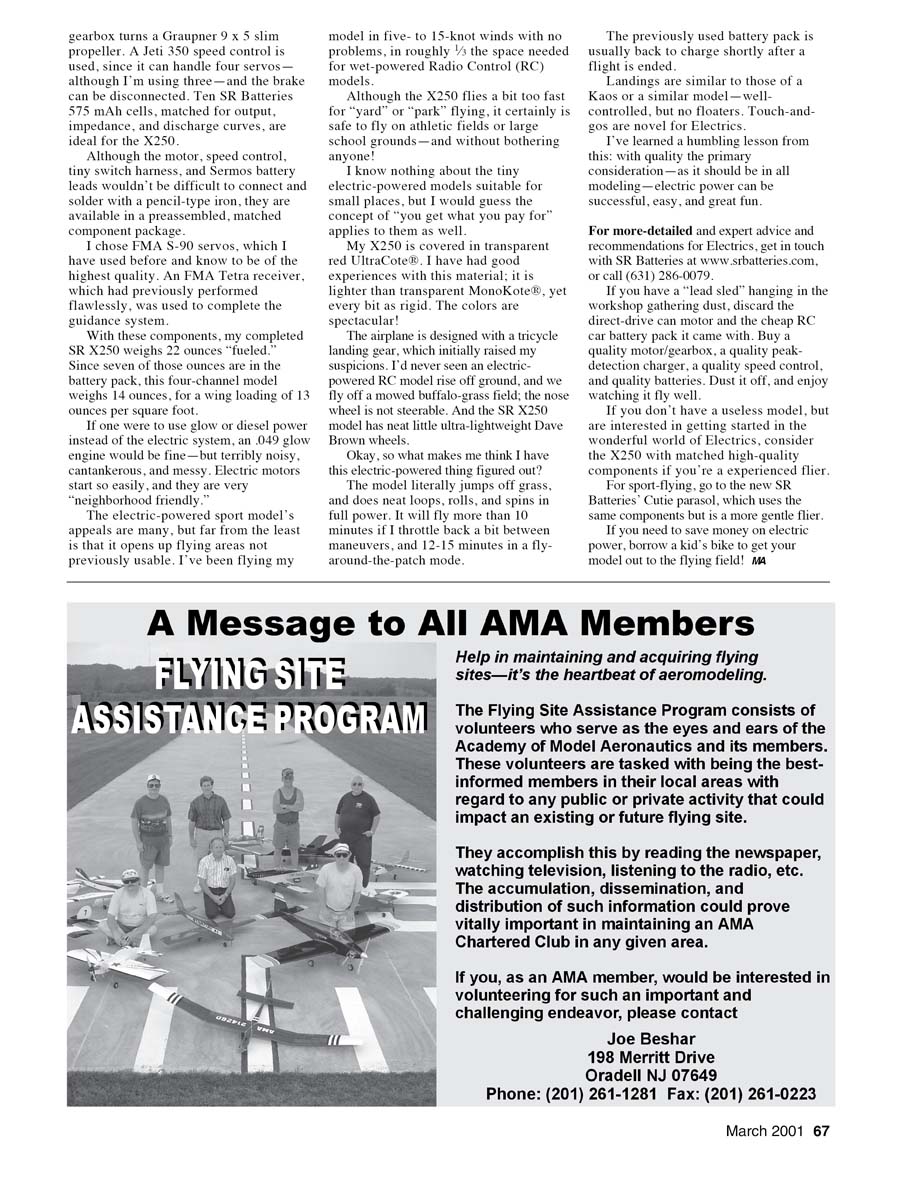
My X250 is covered in transparent red UltraCote®. I have had good experiences with this material; it is lighter than transparent MonoKote®, yet every bit as rigid. The colors are spectacular!
The airplane is designed with a tricycle landing gear, which initially raised my suspicions. I'd never seen an electric-powered R/C model rise off the ground, and we fly off a mowed buffalo-grass field; the nose wheel is not steerable. The SR X250 model has neat little ultra-lightweight Dave Brown wheels.
Okay, so what makes me think I have this electric-powered thing figured out?
The model literally jumps off grass, and does neat loops, rolls, and spins at full power. It will fly more than 10 minutes if I throttle back a bit between maneuvers, and 12–15 minutes in a fly-around-the-patch mode.
The previously used battery pack is usually back to charge shortly after a flight is ended.
Landings are similar to those of a Kaos or a similar model — well-controlled, but no floaters. Touch-and-goes are novel for electrics.
I've learned a humbling lesson from this: with quality the primary consideration — as it should be in all modeling — electric power can be successful, easy, and great fun.
For more-detailed and expert advice and recommendations for electrics, get in touch with SR Batteries at www.srbatteries.com, or call (631) 286-0079.
If you have a "lead sled" hanging in the workshop gathering dust, discard the direct-drive can motor and the cheap R/C car battery pack it came with. Buy a quality motor/gearbox, a quality peak-detection charger, a quality speed control, and quality batteries. Dust it off, and enjoy watching it fly well.
If you don't have a useless model, but are interested in getting started in the wonderful world of electrics, consider the X250 with matched high-quality components if you're an experienced flier.
For sport-flying, try the new SR Batteries Cutie parasail, which uses the same components but is a more gentle flier.
If you need to save money on electric power, borrow a kid's bike to get your model out to the flying field!
MA
Transcribed from original scans by AI. Minor OCR errors may remain.

