
Flying for Fun
D.B. Mathews 909 N. Maize Rd., Townhouse 734, Wichita KS 67212
Banished to the Boonies
In last month's column I expounded at length on the advantages of presenting our modeling activities to the public as a sport rather than a hobby. Fundamental to that presentation are exposure and demonstration—areas in which we have some problems.
Almost without exception we fly our models in remote locations, be they control line (CL), free flight, or radio control (RC). This isolation—to "out in the boondocks" flying sites—is the result of noise complaints by neighbors who have no tolerance for our activities. Could it be that noise complaints are directly tied to our poor image? Would we be better tolerated if modeling was perceived as a sport?
Properly muffled, our engines make no more noise than the boats used to tow skiers, nor do we even come close to the noise levels of motorcycles, street rods, or, for that matter, many car sound systems.
Through the years the public has become more and more intolerant. In the immediate post-World War II era, CL circles were found in almost every park and town, and the models were certainly not muffled. Try to find those circles now. Back then CL flying was considered a good recreational activity for all those retiring soldiers—a sport, if you please.
So whatever the factors, we end up flying our models in locations remote to the public and not well suited to demonstrating the fun and challenges of our sport. In that late-1940s era, large numbers of spectators would drive to and park around those CL circles to speculate, ask questions, and often become involved. That same opportunity to "sell" our sport is still present if people can find us.
The answer? While reading the preceding you likely asked yourself, Doesn't this guy know about electric RC? Oh yes, and that is the point of this writing. We are in another era, which is seeing our sport demonstrated in parks and facilities close to and easily accessible to the public. This could well be the second coming of our sport to the attention of the man on the street.
The 400-size models can be flown safely (and silently) in the confines of soccer fields, baseball diamonds, football fields, etc. Since there is no noise to complain about, we all have liability insurance through our homeowners' policies or AMA, removing those concerns, and we are flying models of such low weight that no major property or personal damages are likely.
Models larger than Speed 400 size are a bit heavy and of higher performance, and they should probably not be flown on the more public facilities. Little is lost since the wide and exciting variety of models suitable for 400 use seems nearly limitless.
My experience with the less-than-nine-ounce park flyers is that those who are fortunate to live in areas with predominantly light winds can fly these little models in limited spaces and benefit us all by demonstration. I've said it before: if the leaves are moving on the trees, it's darn near too windy to fly this little guy outdoors.
However, consider the potential for good public relations when flying the less-than-nine-ounce models in gyms and multipurpose rooms, particularly in the winter months when it's cold outside. RC flying becomes a year-round sport with these little gems.
There are so many of these nine-ounce models around that I see no need to coordinate indoor sites with the free flighters, and I am not too sure how well they mix anyway. Find the person or people in charge of day-leasing such facilities, and demonstrate to them how harmless our little models are. You can probably work something out for one night a week or weekends at a reasonable cost.
Isn't it exciting to consider the bunch of kids and adults who will come running when an electric model is flying across the street or down the block? The dialogue for this little play has changed. It used to be: "Where did you get that?" "I built it from a kit." "Oh." End of conversation.
Now we can answer, "It's available ready to fly at Joe's Hobby Shop," and hear, "Where is that located, and how much is it?"
Like it or not, the concept of building a model airplane seems daunting to the raw novice. Perhaps building will not seem so mysterious with time and experience, and he or she will find the joy of creating—but not initially.
It seems that all the needed pieces are present for us to enter the most exciting time in our modeling history. Let's not blow this chance by frittering it away with many rules or personal agendas; let's all get together, have fun, and share it with the public.
Micro RC
This new and exciting facet of our sport has quite a few aliases, including:
- park flyers
- yard flyers
- street flyers
- slow flyers
- indoor RC
All of those names refer to essentially the same type of model: one that is electric-powered and weighs nine ounces or less.
One of my respected friends in this business expressed to me that "the whole thing is a fad." That was two years ago, and time has proven him incorrect. The astonishing number of these little models reported in almost ready-to-fly form boggles the mind; every new month's magazines introduce at least half a dozen more.
I haven't seen even a fraction of the variety flown, but I'm already painfully sensitive to the wide difference in flying ability between the various models. My first micro RC model was an absolute turkey—so bad that a Web site exists to exchange ideas and modifications to get it to fly. Its attraction? The price. That just never works as a first criterion, does it?
An increasing number of small RC flyers are being flown successfully outdoors on calm mornings and evenings, and of course indoors, and they fly rather well. Common to most of these models is a variously numbered and variously geared GWS motor; its common denominator is a motor that fits into a molded chamber in the gearbox.
Additionally, myriad incredibly small servos and receivers are becoming available from the various manufacturers, as are suitable battery-eliminator circuits (BECs) and speed controls. Although the majority of these little models are powered with six to eight small Ni-Cd cells, more and more are using nickel-metal-hydride (NiMH) and lithium resin cells; the advantage is more power per gram of weight and much longer motor runs. The disadvantage is increased cost.
The answer to a modeler's prayers may be lithium-polymer cells. I spent a week with the importer (FMA Direct) and will write about them next month, but for now consider these numbers: four times the duration at one-fifth the weight of Ni-Cds and approximately that for NiMH cells. And lithium-polymer cells won't explode if they're overcharged, as do some of the other lithium chemistries. The exciting thing is that models can weigh 25–40% less, yet perform the same and not require recharging after every flight.
Cost is deceiving since one does not need two or three packs to stay ahead of the charging times while still flying—one set will do. If you are considering purchasing new flight packs for your electric-powered model, check out lithium-polymer cells.
Bantams
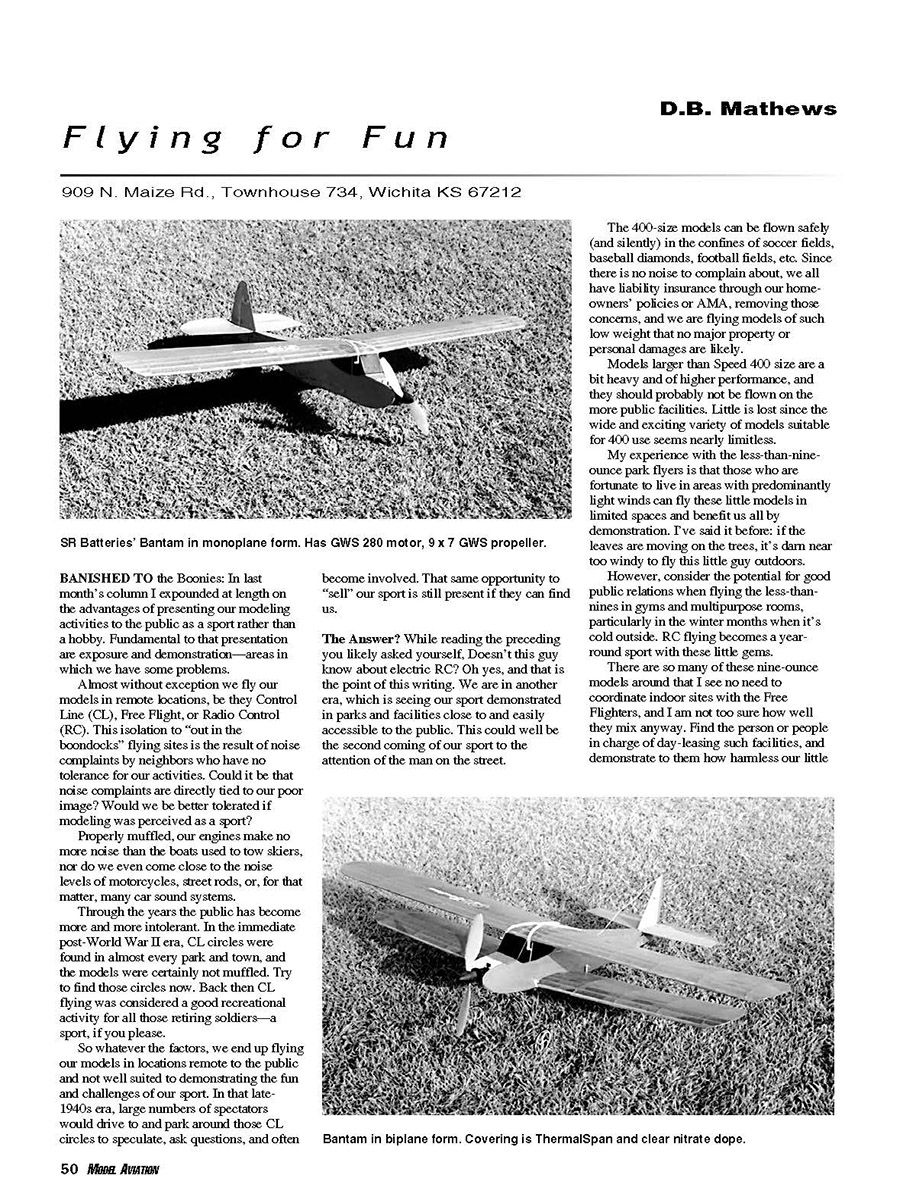
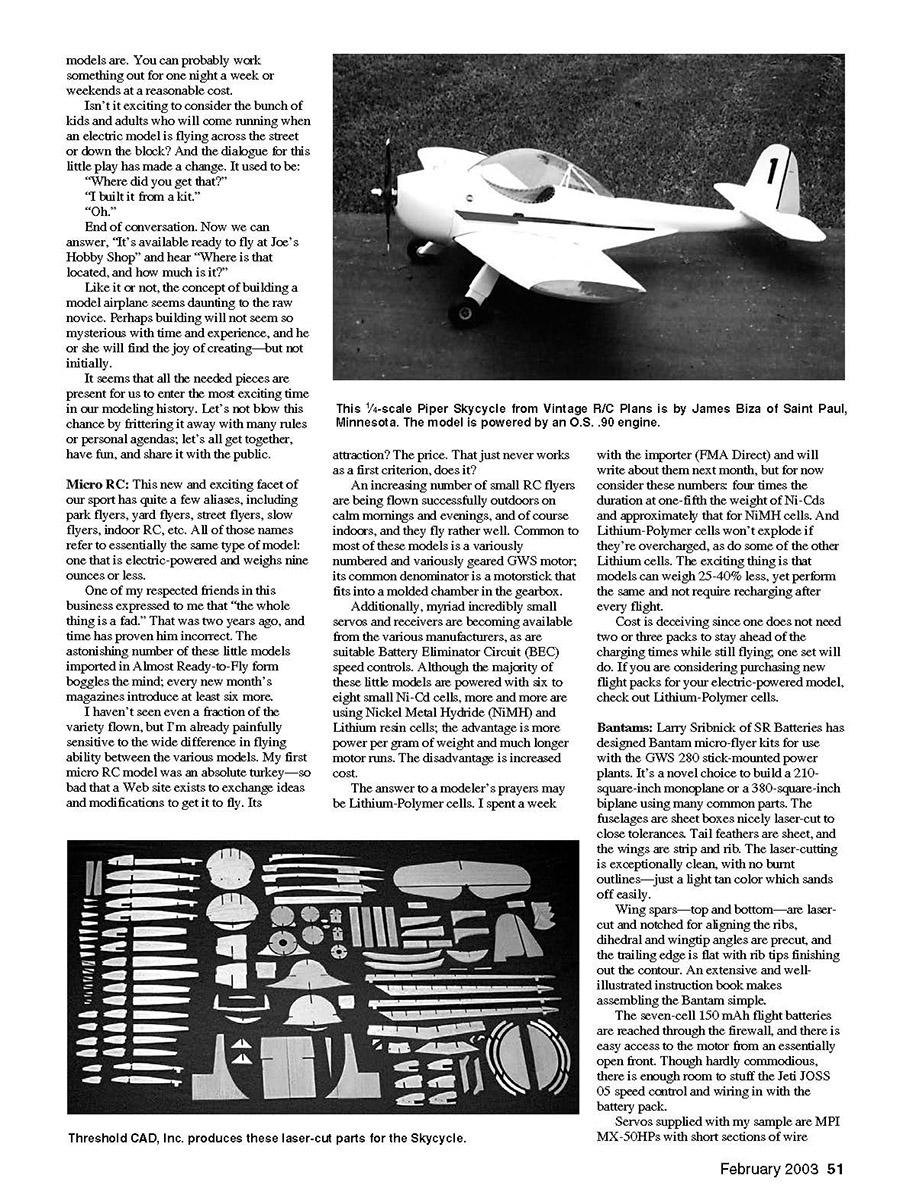
Larry Sribnick of SR Batteries has designed Bantam micro-flyer kits for use with the GWS 280 stick-mounted power plants. It's a novel choice to build a 210-square-inch monoplane or a 380-square-inch biplane using many common parts. The fuselages are sheet boxes nicely laser-cut to close tolerances. Tail feathers are sheet, and the wings are strip-and-rib. The laser-cutting is exceptionally clean, with no burnt outlines—just a light tan color which sands off easily.
Wing spars—top and bottom—are laser-cut and notched for aligning the ribs. Dihedral and wingtip angles are pre-cut, and the trailing edge is flat with its tips finishing out the contour. An extensive and well-illustrated instruction book makes assembling the Bantam simple.
The seven-cell 150 mAh flight batteries are reached through the firewall, and there is easy access to the motor from an essentially open front. Though hardly commodious, there is enough room to stuff the Jeti JOSS 05 speed control and wiring in with the battery pack.
Servos supplied with my sample are MPI MX-50HPs with short sections of wire cyanoacrylate-glued into aluminum tubing used as pushrods. Hinges on the elevator and rudder are a clear, 1-inch-wide, adhesive-backed Mylar applied over the covering. They work very well, and not only hinge the surfaces but seal the gap.
The supplied receiver is an MPI MX-6800 Pico four-channel cube. It's small and light, and I found it to work fine when mine was the only transmitter running, but I encountered glitches in an environment of multiple transmitters. Since the Pico is single-conversion, I chickened out and changed to an FMA S0 dual-conversion receiver of the same weight and size, and that solved the problem. (Single-conversion receivers are fine when flying alone, but be cautious in a multisignal environment.)
Although these models are designed for UltraCote Lite covering, I used ThermalSpan. This material looks almost exactly like the old-faithful Japanese tissue and is approximately the same weight, but it is a heat-shrinkable polymer of remarkable strength. ThermalSpan has no adhesive on it, so it is applied over a precoated surface (I used Sig stick-it). Overlaps must also be coated.
I saved roughly a half ounce per model, but I did encounter a problem: when overheated with an iron or heat gun, this material darkens in color. I suspect that my poor technique is at fault. The factory weights are 8.0 ounces for the monoplane and 9.0 ounces for the biplane. Mine came in at 7.5 and 8.0 ounces, but they look like many leopards. There is no need to learn a new technique; cover them in UltraCote Lite.
Test-flown outdoors in light winds, the monoplane proved to need a slightly more forward balance point than the one shown on the plans. Although it's heavier, larger, and more bouncy in turbulence, the biplane version seems to fly better on the available power.
As you can see, I built a biplane fuselage and used a hatch held with attachment rubber bands to create a monoplane/biplane from the same model. If the Bantam is to be flown strictly indoors, the biplane might be the better choice.
Both versions of the Bantam are fun to build, simple, durable, easy to repair, and fly well. Perhaps most important, they are not cookie-cutter foam. They have personality.
Piper Skycycle Revisited
Several years ago I used this column to attempt to encourage a manufacturer to kit a Piper Skycycle in an 80-inch or larger size utilizing a fiberglass fuselage. A huge number of readers wrote to express their interest in such a project, and although I forwarded all the responses to the prospective kitter, it chose not to dust off the molds and proceed.
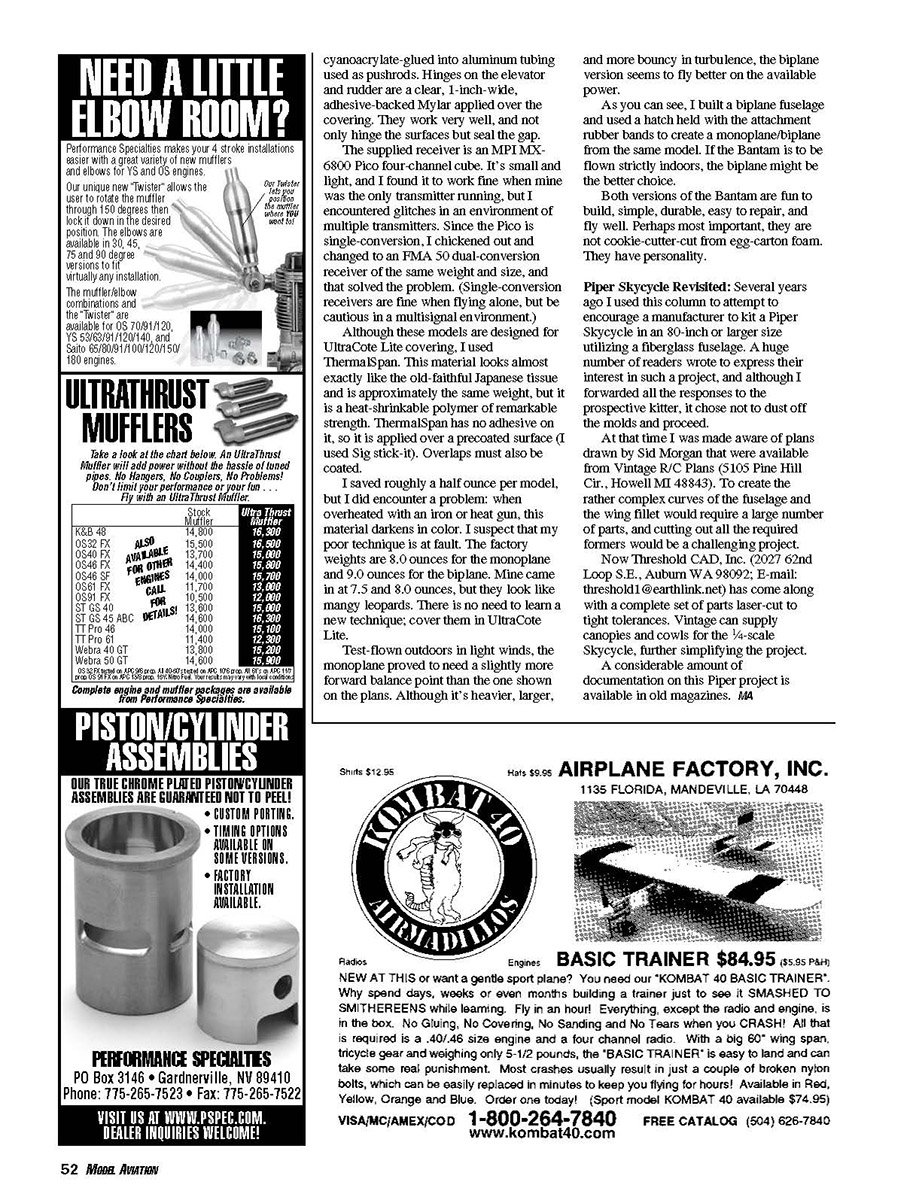
At that time I was made aware of plans drawn by Sid Morgan that were available from Vintage R/C Plans (5105 Pine Hill Cir., Howell MI 48843). Cutting out all the required formers would be a challenging project.
Now Threshold CAD, Inc. (2027 62nd Loop S.E., Auburn WA 98092; E-mail: threshold1@earthlink.net) has come along with a complete set of parts for a laser-cut kit of tight tolerances. Vintage can supply templates and a cowl for the 1/4-scale Skycycle, further simplifying the project.
A considerable amount of documentation on this Piper project is available in old magazines.
Transcribed from original scans by AI. Minor OCR errors may remain.

