
Flying for Fun
D.B. Mathews
909 N. Maize Rd., Townhouse 734, Wichita KS 67212
Contrary to my promise, this month's column will not center on Lithium-Polymer cells. Logistic problems have not allowed me enough time to thoroughly flight-test these units, and you deserve better than a rehash of the factory press releases.
Memories: Learning about the passing of one of my boyhood heroes—J.C. "Madman" Yates—set off some reminiscences of what has remained one of my most indelible model-airplane memories after more than 55 years. I know I've related it in the pages of this column and in the text of the "Super Duper Zilch" construction article I had published in the February 1979 Model Airplane News, but it deserves repetition for longtime readers and telling for you newer ones.
I'll set the scene in the summer of 1948.
Control Line (CL) flying was in the midst of a monstrous surge in activity around the world. New designs, new manufacturers, and new hobby shops were popping up seemingly overnight. Virtually every city and hamlet had one or more CL circle. Nearly every weekend had a modeling event of some sort scheduled within driving distance.
Radio Control (RC) was not even in its infancy, really; only a handful (likely less than a hundred nationwide) of modelers who were also licensed Hams were making successful RC flights. Their equipment was all self-designed, and it was built huge in size and marginal in reliability.
Free Flight (FF), while still popular, was beginning a slow decades-long decline in popularity. Urbanization was removing many usable farm fields and grass-strip airports from availability to FFers.
In contrast, a look at the modeling magazines of the day will reveal literally hundreds of kits, engines, and accessories advertised for the CL fliers. The modeling world was on fire for CL. The kits and supplies available ranged in quality from splendid to pure junk. I know this since I bought my share of the junk.
We were so psycho about inverted flight that someone sold a control handle that was spring-loaded and center-pivoted so that it could be made to flip the up line to the bottom and vice versa. Someone else sold a "tachometer" that used a vibrating strip of metal which slid in and out of a handle. One slid it in and out until the strip started vibrating when placed on a model with the engine running. This was only slightly more accurate than guessing the rpm.
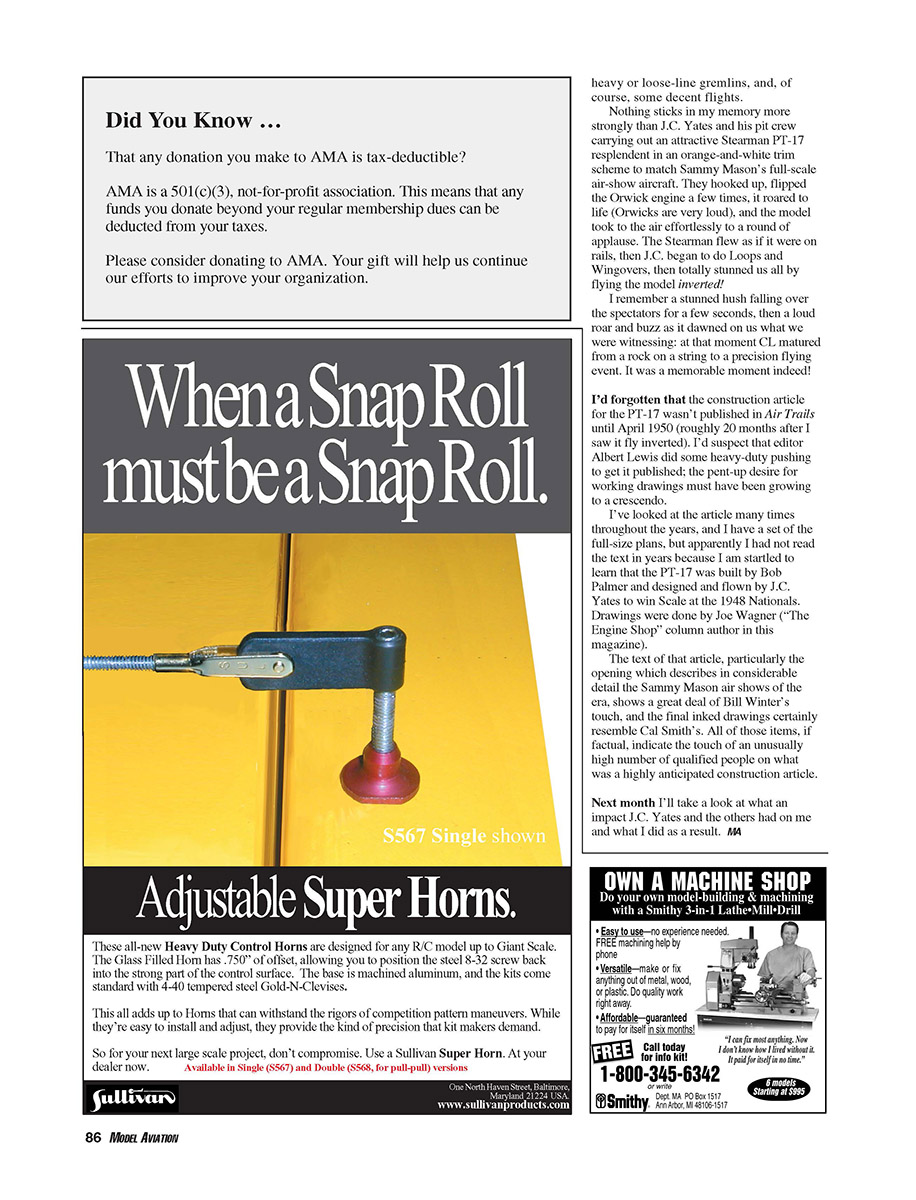
Back in that summer, the "stunts" most fliers were capable of were inside loops and wingovers; only a few had mastered inverted flight. Bill Skipper had been advertising his Akro-bat as "capable of inverted flight," using his special tanks, for less than a year. We were terrified of the concept of lowering our wrists to add down-elevator to the flying model. We had gone through an early learning period in which one never pointed the handle downward. Doing so was contrary to all our acquired instincts.
Most of the models we were flying were not pretty. The Rick's Box Car, Over Easy, deBolt bipes, and a few other stunt-capable models were not designed with appearance as a first consideration.
Ray Arden had just introduced the glow plug, so most models were still flying with coil, points, and batteries, which not only weighed a bunch but physically required extra room. No product has ever again totally and almost instantly revolutionized modeling the way the glow plug did.
Models were covered with silk or silkspan (a grainy paper made from vegetable fiber) finished in nitrate dope. The pretty, shiny models were often the result of 20 or 30 successive coats of dope, hand-rubbed between coats. Few bothered since chances were extremely high that the model was going to meet an ugly end as we tried to learn to fly stunt.
CL stunt models were ugly, overweight, overpowered things that flew at speeds resembling those in contemporary CL combat and were totally lacking in grace or aesthetic appeal. Most of our models had flying characteristics resembling a rock on a string, but we knew no better.
The terms "stunt pattern" and "precision flying" came along several years later; back then it was called "stunt," and it could include a balloon bust, banner towing, touch-and-gos, etc., for points.
Most of us were delighted to be able to do three consecutive inside loops and a couple of wingovers; that is, if we could get the confounded ignition engine to run, avoid kinking our single-strand lines, and keep the lines tight in flight.
For those who didn't have the opportunity to be modelers in those days, don't take my comments as indicative of some horrible disappointments in flying CL back then. We were having a wonderful time; the sheer joy of getting something we had built to fly a successful flight left us with lifelong, pleasant memories. Those were marvelous times for us.
Does it sound as though we lacked good sense in messing with equipment so primitive? The term "primitive" only applies to mechanical devices when they have been superseded by something more advanced. Compared to everyone else's models of the time, we were not at all primitive. Primitive compared to what?
I've often reflected on that primitive/modern judgment when observing full-scale aircraft of the World War I era. Their flimsy "wires everywhere" construction, wrinkled covering, and obvious fragility would lead one to wonder what sort of crazy person would fly such an airplane in a combat setting. If everyone's airplane looked like theirs, how would they know it was primitive?
So we didn't know any better? We were having all sorts of fun and were perhaps in blissful ignorance? Yes, but nonetheless we were virtually addicted to flying model airplanes.
We were happy as larks with what we had until August 1948 when we gravitated to the first Navy-sponsored and -staffed Nationals at Olathe, Kansas, Naval Air Station. Suddenly our models and flying skills became primitive indeed! Bob Palmer, Jim Saftig, Davey Slagle, J.C. Yates, and a few others were flying much larger, lighter models in a much slower and more precise manner than we had ever considered.
We were startled to see how large their models were and how well they held the outside of the circle in spite of flying so slowly, and how round their loops and precise their maneuvers were. We had been made aware of these developments through magazine articles and advertisements, but we didn't comprehend the difference until we saw them fly firsthand.
Perhaps nothing illustrates this shocking change in CL flying better than the evening the CL scale models were flown. We had all done the usual "oooh and aaah" tours of the entrants spread out on the hangar floor as they awaited static judging. There had been the usual spectator judgments, such as "That's beautiful but it will never fly," or the reverse: "It doesn't look too scale or pretty, but I'll bet it will fly."
The scale CL models were flown inside a big Navy hangar with its huge doors opened on the downwind side during the evening hours. I distinctly recall a large crowd gathered around a roped-off area and models being carried into the enclosure and started with considerable difficulty, if at all. Equally etched in my memory were twin-engine models that never got off because of engine failures or undercarriage failures due to their weight. I recall other single-engine subjects crashing from the dreaded tail-heavy or loose-line gremlins, and, of course, some decent flights.
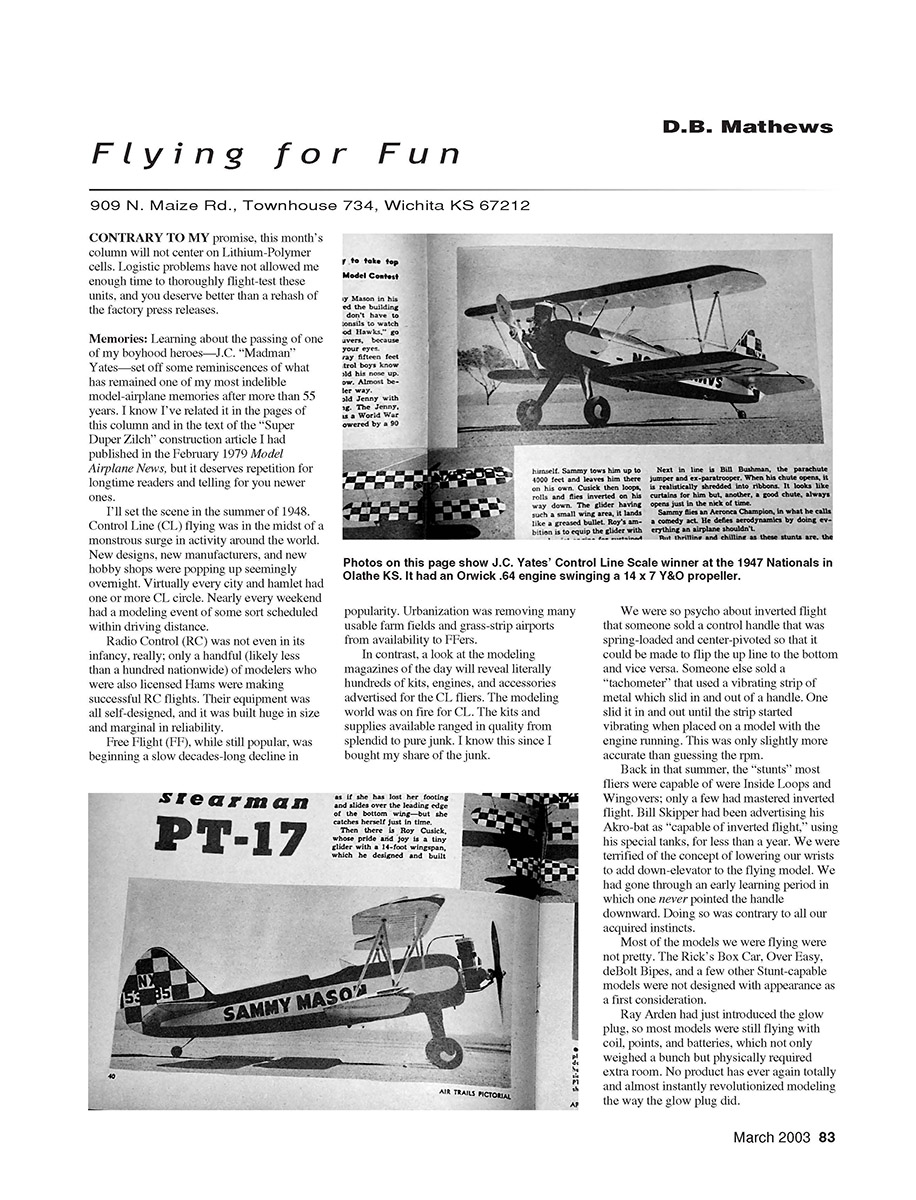
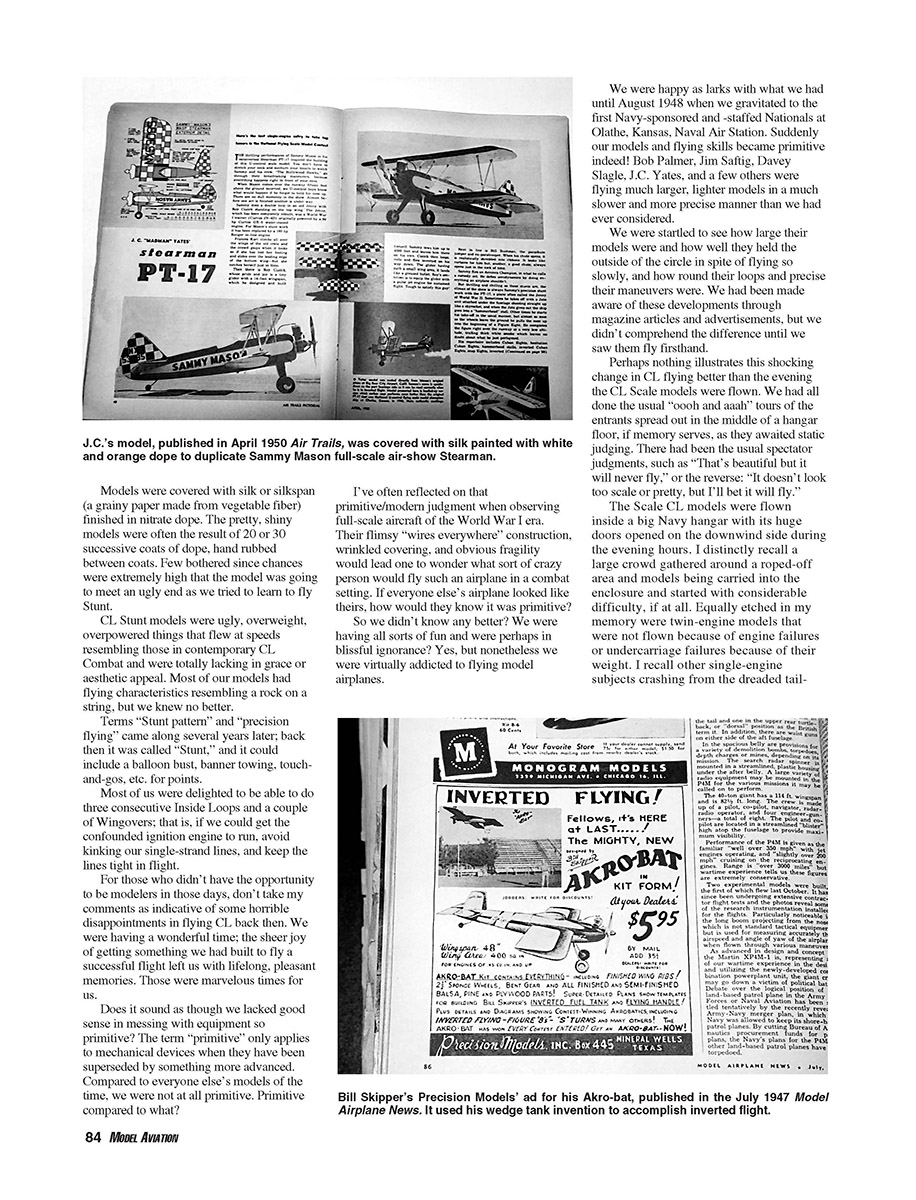
Nothing sticks in my memory more strongly than J.C. Yates and his pit crew carrying out an attractive Stearman PT-17 resplendent in an orange-and-white trim scheme to match Sammy Mason’s full-scale air-show aircraft. They hooked up, flipped the Orwick engine a few times, it roared to life (Orwicks are very loud), and the model took to the air effortlessly to a round of applause. The Stearman flew as if it were on rails, then J.C. began to do loops and wingovers, then totally stunned us all by flying the model inverted!
I remember a stunned hush falling over the spectators for a few seconds, then a loud roar and buzz as it dawned on us what we were witnessing: at that moment CL matured from a rock on a string to a precision flying event. It was a memorable moment indeed!
I'd forgotten that the construction article for the PT-17 wasn't published in Air Trails until April 1950 (roughly 20 months after I saw it fly inverted). I'd suspect the editor Albert Lewis did some heavy-duty pushing to get it published; the pent-up desire for working drawings must have been growing to a crescendo.
I've looked at the article many times throughout the years, and I have a set of the full-size plans, but apparently I had not read the text in years because I am startled to learn that the PT-17 was built by Bob Palmer and designed and flown by J.C. Yates to win Scale at the 1948 Nationals. Drawings were done by Joe Wagner ("The Engine Shop" column author in this magazine).
The text of that article, particularly the opening which describes in considerable detail the Sammy Mason air shows of the era, shows a great deal of Bill Winter’s touch, and the final inked drawings certainly resemble Cal Smith’s. All of those items, if factual, indicate the touch of an unusually high number of qualified people on what was a highly anticipated construction article.
Next month I’ll take a look at what an impact J.C. Yates and the others had on me and what I did as a result.
MA
Transcribed from original scans by AI. Minor OCR errors may remain.

