
Flying for Fun
D.B. Mathews 909 N. Maize Rd., Townhouse 734, Wichita KS 67212
More about the Wright Brothers
In the August column (the text for the January 2004 issue), I described Kitty Hawk / Kill Devil Hill, North Carolina, as poor spots to be during a hurricane. I wasn't being psychic or prophetic — things simply turned out badly in September for those living on Cape Hatteras, as television coverage showed. Hopefully enough damage was repaired by December to accommodate those who planned to travel to the historic site for the centennial-of-flight activities.
Several recent television specials on the History Channel, A&E, and PBS covered the efforts of at least three groups to create flyable replicas of the 1903 Wright Flyer. No drawings of many of the original aircraft's parts exist, and the supposedly original craft hanging in the Smithsonian is actually made from pieces of several later-crashed aircraft. The original was severely damaged and not returned to Dayton, Ohio.
As a consequence, builders have combined accurate measurements of surviving parts with estimates based on photographs. In each instance, creators have avoided the temptation to improve the original's aerodynamic and mechanical shortcomings. As one can readily determine from that famous first-flight photo and subsequent movies of the early Wright aircraft, they are unstable in pitch. However, the Pat Tritle–designed kit from Dare Design and Engineering has enlarged horizontal and vertical tail surfaces, which gives it flight stability.
Speaking of that first-flight photo: the spectator at the lifeguard station who volunteered to take a picture as the Flyer rose off the dolly was assigned the task of squeezing the rubber bulb that opened and closed the camera shutter. After the flight he was unsure whether he had done so when the Flyer left the launch rails. Therefore, the brothers were unsure whether they had a picture of that first flight until they saw it in their darkroom in Dayton several weeks later.
Notice in that picture that Orville and Wilbur had physical contact with the airplane until it lifted off. There is something fitting in that, isn't there?
More goofs
I hope I never top the battleship-identification error, but I seem capable of messing up little things. In case anyone believed for a minute that the Flying Flea shown in the September 2003 column is a canard — don't. Change that to a tandem wing, similar to the configuration Samuel Langley couldn't get to fly. Something must have been haywire with the Flea's aerodynamics since several European governments banned the aircraft from the air in the late 1930s. However, the radio-control (RC) models fly fine.
"The Future Lies Ahead"
That nonsensical phrase was an unsuccessful presidential candidate's campaign slogan in the late 1940s. Where else would the future lie?
Since my recent columns have centered on events more than 100 years old, this month I'll take a look at something contemporary for contrast: an explosion of interest in flying SPAD RC models. SPAD stands for "Simple Plastic Airplane Designs." These 25- and 40-size aircraft are built from Coroplast, a corrugated, cardboard-like plastic. What is way out about these designs is their extreme simplicity — essentially flying planks with rudimentary airfoils and light wing loadings combined with extreme power-to-weight ratios to produce 3-D-type performance.
Besides being inexpensive and easy to assemble, SPAD designs are incredible in flight. They will loop and roll so fast they are a blur, hover, and do all those other 3-D things, yet they are amazingly durable. If you haven't seen these designs fly, you owe it to yourself to seek them out. A useful website is www.spadworld.net.
The SPAD concept's virtues and appeal have recently been adapted to electric-powered park flyers. These little aircraft bring wild aerobatics, low cost, simple construction, and high durability to park-flyer sizes. Here in Wichita, where the concept seems to have originated, the idea is running wild, with roughly a 25% increase in the number of fliers weekly.
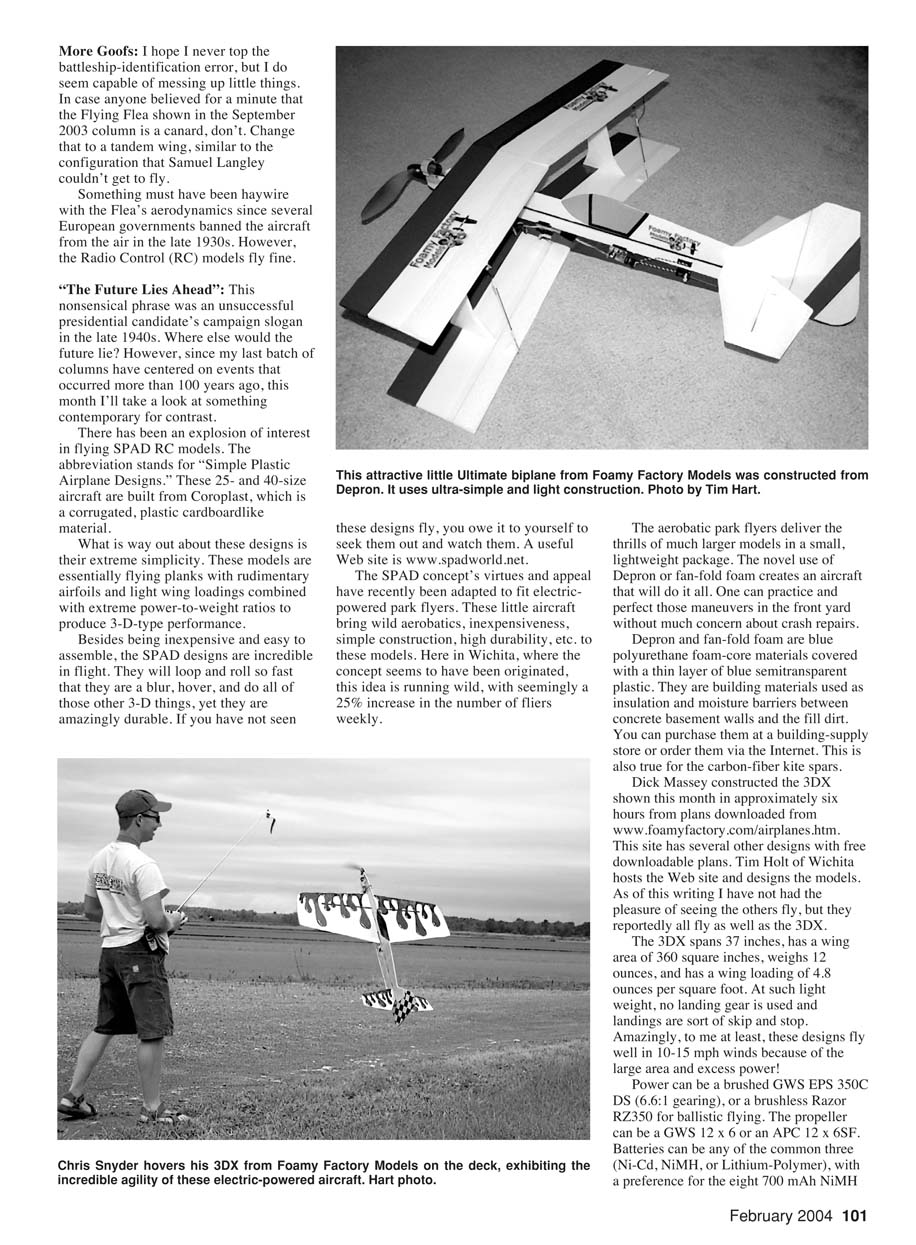
The aerobatic park flyers deliver the thrills of much larger models in a small, lightweight package. The novel use of Depron or fan-fold foam creates aircraft that will do it all. You can practice and perfect maneuvers in the front yard without much concern about crash repairs.
Depron and fan-fold foam are blue polyurethane foam-core materials covered with a thin layer of semitransparent blue plastic. They are building materials used as insulation and moisture barriers between concrete basement walls and the fill dirt. You can purchase them at a building-supply store or order them via the Internet. The same is true for carbon-fiber kite spars.
The 3DX (an example)
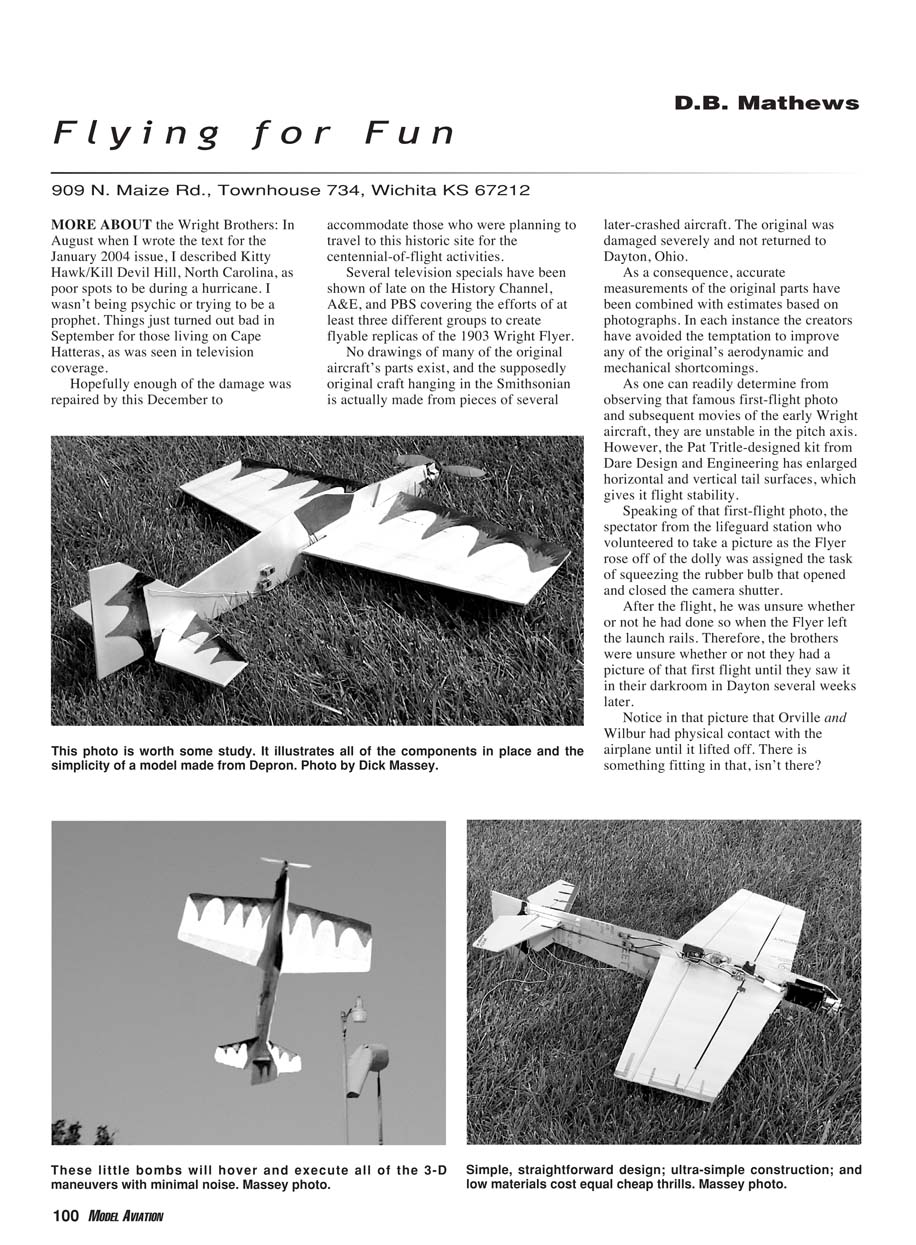
Dick Massey constructed the 3DX shown this month in approximately six hours from plans downloaded from www.foamyfactory.com/airplanes.htm. That site has several other designs with free downloadable plans. Tim Holt of Wichita hosts the site and designs the models. I have not had the pleasure of seeing all the other designs fly, but they reportedly fly as well as the 3DX.
Specifications and typical equipment:
- Span: 37 inches
- Wing area: 360 square inches
- Weight: 12 ounces
- Wing loading: 4.8 ounces per square foot
- Typical power: brushed GWS EPS 350C DS (6.6:1 gearing) or a brushless Razor RZ350 for ballistic flying
- Propeller: GWS 12x6 or APC 12x6SF
- Batteries: any of the common three (Ni-Cd, NiMH, or Lithium-Polymer), with a preference for eight 700 mAh NiMH cells
Construction notes:
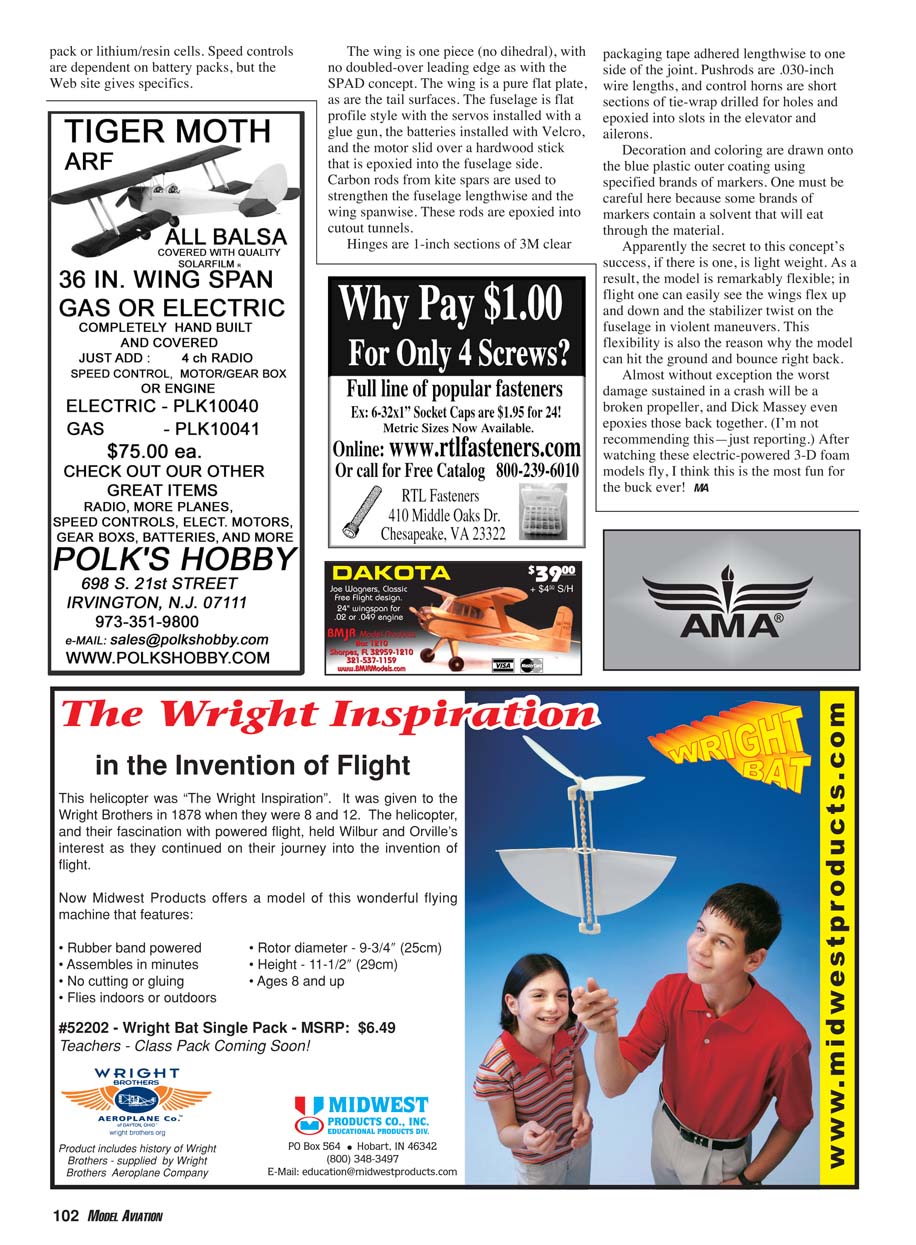
- The wing is one piece with no dihedral and no doubled-over leading edge as used in some SPAD concepts. The wing and tail surfaces are pure flat plates.
- The fuselage is flat-profile style. Servos are installed with a glue gun; batteries are attached with Velcro; the motor is slid over a hardwood stick that is epoxied into the fuselage side.
- Carbon rods from kite spars strengthen the fuselage lengthwise and the wing spanwise; these rods are epoxied into cutout tunnels.
- Hinges are 1-inch sections of 3M clear packaging tape adhered lengthwise to one side of the joint.
- Pushrods are .030-inch wire lengths. Control horns are short sections of tie-wrap drilled for holes and epoxied into slots in the elevator and ailerons.
- Decoration and coloring are drawn onto the blue plastic outer coating using specified brands of markers. Be careful: some marker brands contain solvents that will eat through the material.
The secret to the concept's success, if there is one, is light weight. As a result, the model is remarkably flexible; in flight you can easily see the wings flex up and down and the stabilizer twist on the fuselage during violent maneuvers. This flexibility is also why the model can hit the ground and bounce right back.
Almost without exception, the worst damage sustained in a crash will be a broken propeller; Dick Massey even epoxies those back together (I am not recommending this — just reporting). After watching these electric-powered 3-D foam models fly, I think this is the most fun for the buck ever! MA
Transcribed from original scans by AI. Minor OCR errors may remain.

