
Flying for Fun
D.B. Mathews 909 N. Maize Rd., Townhouse 734, Wichita KS 67212
Fancy Foam Models
I have previewed kits for 3‑D miniature foam electric‑powered fliers by Fancy Foam Models. They are made from precisely CNC‑cut and routed Depron, ready to have the included graphite rods and such glued in, and slots for the servos, etc., are neatly cut. This is good news for those who are unable or unwilling to gather all the nontraditional materials and hardware for these little wonders.
These models are available in levels of completeness ranging from high‑performance packs, including everything but the transmitter, to replacement parts and hardware. Contact www.fancyfoam.com for a catalog and ordering instructions. This is high‑quality stuff!
The following material is excerpted in large part from an interesting web site—www.ctie.monash.edu.au/hargrave/dennyplane_jr.html—which was created and is maintained by Russell Naughton, a staff member of Monash University in Victoria, Australia.
Who is Reginald Denny?
One evening I watched Mr. Blandings Builds His Dream House on the Turner Classic Movies television station. This entertaining 1948 comedy stars Cary Grant and Myrna Loy as the Blandings, and Reginald Denny as their architect.
While I was watching it, it occurred to me that not many modelers associate movie stars with our hobby. Some collectors and some of us older guys recall Dennymite engines and Dennyplane kits, but few fully realize their connection to a successful actor. I thought that could be the basis of a few interesting columns if I could access photos and articles on the subject.
Jack Maxwell wrote a two‑part article about Reginald Denny’s association with Radio Plane—one of the first firms to supply radio‑controlled target drones to the military in the late 1930s—that was published in the July and August 1992 issues of Model Aviation (MA). Jack had served in a Navy unit that maintained and flew those drones during World War II.
That article was supported with numerous photos and data, so it was obvious that the material existed somewhere. I made a quick trip to the Google search engine and turned up the aforementioned Reginald Denny site. It includes several hundred photos from what is obviously the Denny family album and reproductions of material published about Reginald Denny, including a construction article for a Dennyplane Jr. that I wrote which was published in the January 1977 MA. Now that’s flattering!
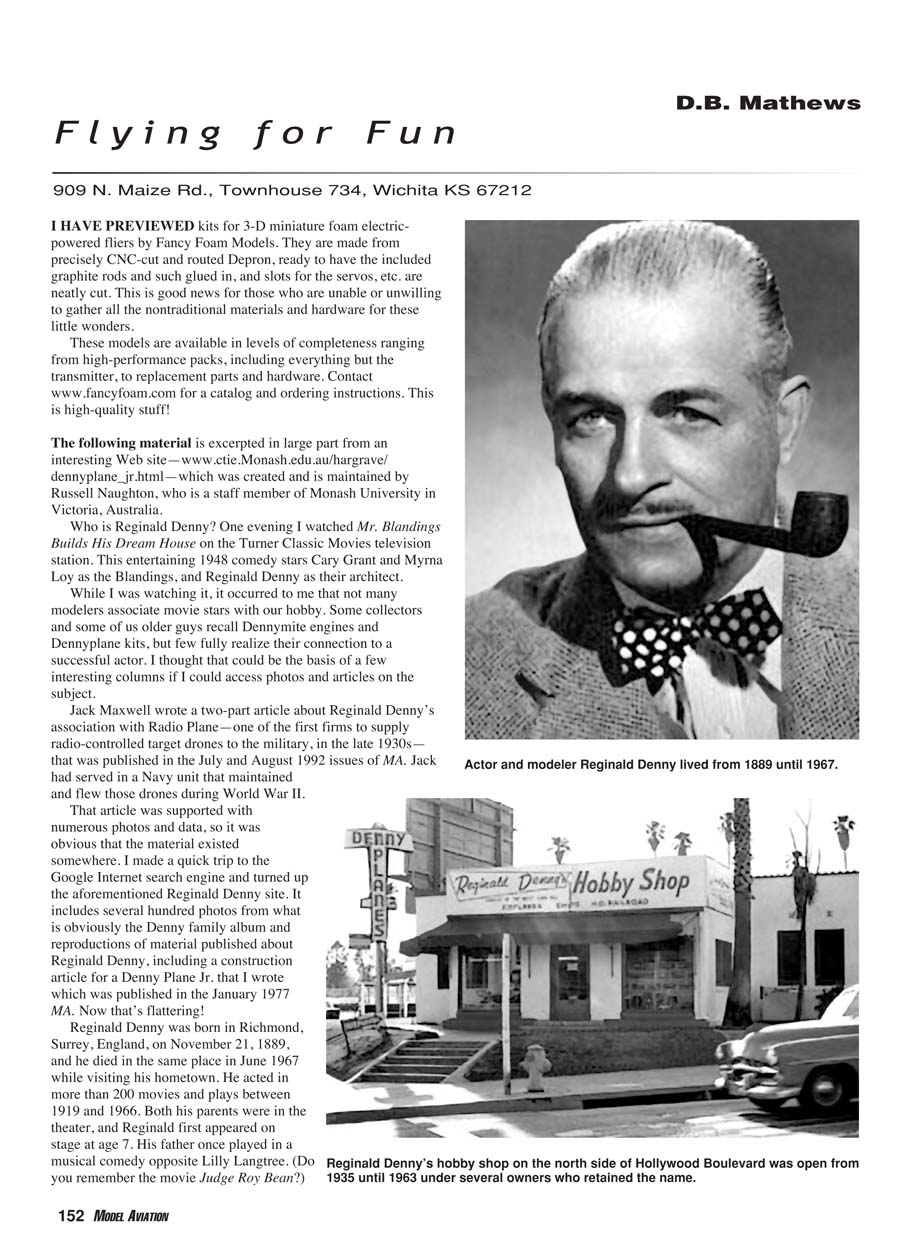
Reginald Denny was born in Richmond, Surrey, England, on November 21, 1889, and he died in the same place in June 1967 while visiting his hometown. He acted in more than 200 movies and plays between 1919 and 1966. Both his parents were in the theater, and Reginald first appeared on stage at age 7. His father once played in a musical comedy opposite Lily Langtry. (Do you remember the movie Judge Roy Bean?)
Reginald quit school at 16 to pursue a full‑time theatrical career. He was successful in numerous roles in English Music Hall. He visited the U.S. with a touring group in 1911 and moved here permanently in 1914. A moderately successful career in silent films followed. When World War I broke out, Reginald enlisted in the Royal Air Force and was sent to Hastings, England, for pilot training. The war ended before he completed his training, so he saw no combat. This service left him with a lifelong interest in flying full‑scale and model aircraft. Returning to Hollywood in 1921, Reginald was frequently cast as the all‑American athletic type since he was in excellent condition. The advent of talking pictures ended this illusion, but his rugged good looks and sophisticated manner made him ideal for character roles—particularly playing sophisticated Englishmen.
The list of Reginald Denny's performances in movies is much too long to print here, but some of his more familiar roles include:
- Commander Schmidlapp in Batman
- Henry Percival in Cat Ballou
- The police chief in Around the World in 80 Days
- Frank Crawley in Rebecca
- Algy Longworth in the Bulldog Drummond series
He created a role in the stage production of My Fair Lady, and his last movie was Assault on a Queen in 1966. During his career he acted in such varied films as Abbott and Costello Meet Dr. Jekyll and Mr. Hyde (1953) and Romeo and Juliet (1936).
Chances are extremely high that you have seen Reginald Denny in a movie. You may not have been able to put a name to the face, and you probably didn't know of his connection to model airplanes.
Reginald Denny, Modeler
Charles Lindbergh's solo crossing of the Atlantic set off a nationwide aviation craze, as has often been documented. Everyone young and old was focused on aviation and aviation events, and this interest and enthusiasm extended to building and flying model airplanes.
Numerous companies jumped into the activities with kits for rubber‑powered models. Any event involving model airplanes generated huge crowds.
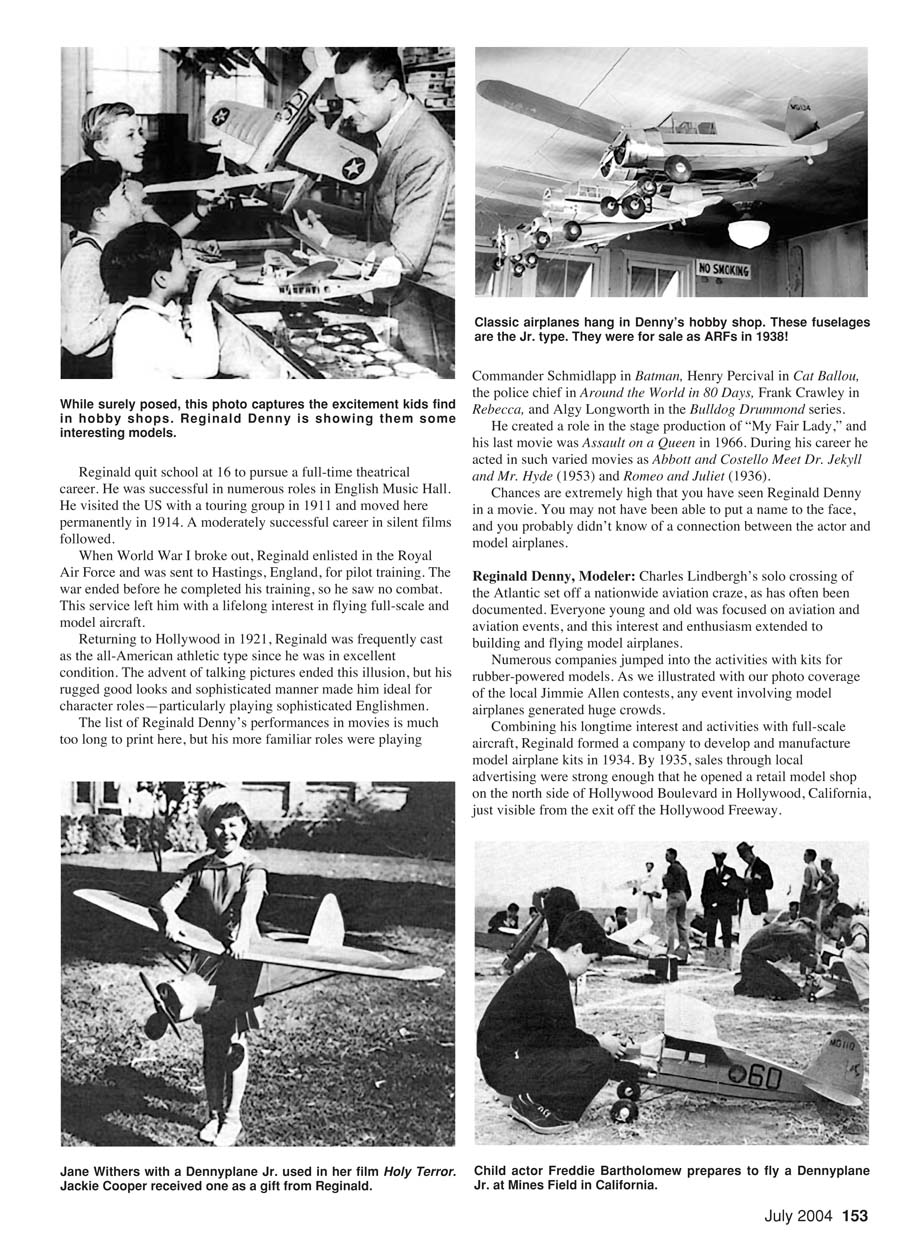
Combining his longtime interest in full‑scale aircraft with hobby activities, Reginald formed a company to develop and manufacture model airplane kits in 1934. By 1935, sales through local advertising were strong enough that he opened a retail model shop on the north side of Hollywood Boulevard in Hollywood, California, just visible from the exit off the Hollywood Freeway.
That location remained open until at least 1963 under the management of Peter Veer. Apparently in 1963 (there is some contention on this date) the shop was sold to Col. Tom’s and combined with a store farther south in West Los Angeles.
As was typical in that era, the shop was a special place for modelers of all ages but was particularly magnetic to the young children in the neighborhood. Numerous modeling friends who are 50 or older often relate what places of total fascination and dreams hobby shops were in their youth. One of my favorite items that illustrates that phenomenon was an article published many years ago centering on kids in hobby shops titled “How Much Are Your 10 Cent Gliders?”
Reginald enjoyed young people and was exceedingly accommodating to them in his shop. Legend has it that no child was denied the joy of building a model airplane from one of his kits just because he or she had no money.
Reginald also developed a wonderful reputation for presenting his kits or completed models to child stars of the day. A photo on the cover of Mechanix Illustrated several years ago showed a young Mickey Rooney launching a Dennyplane. And as you can see from the photos I’ve used, several other child stars had those models.
The Dennyplane and the Dennymite
In 1937, Reginald added a realistic‑looking “gas” design called the Dennyplane to his rubber‑power kit line. This original version was notable because of its all‑sheet‑balsa tail surfaces; aluminum‑tube wingtips; and two‑piece, plug‑in wing.
The Dennyplane also used an experimental engine that was apparently developed and produced by Major Mosely’s Aircraft Industries in Burbank, California—the same company that made and sold Baby Cyclone engines. A modeling‑press advertising campaign, most notably in Model Airplane News, generated worldwide sales.
Later versions of the Dennyplane were designed around the Dennymite engine that Walter Righter developed and manufactured and Reginald sold under license. This power plant, although crude in some ways, started and ran reliably, and it was sturdy—more than could be said about many of its counterparts.
The Dennymite was not produced during World War II, but it was sold again in the late 1940s. The advent of glow plugs and modern fuels brought the curtain down on it because it was not robust enough to stand such use.
A source of confusion for many years is the “Jr.” version of the Dennyplane. This was a design featuring a one‑piece wing, simplified landing gear, and overall simplified construction. It was sold as a lower‑priced kit, eliminating much of the deluxe hardware and liquids of the more expensive Dennyplane.
Both designs could hardly be thought of as “Duration” models, particularly when compared with contemporary East Coast and upper Midwest designs of the era. The popular competition events for free‑flight power in the California area placed emphasis on appearance and realistic flight, presenting appearance points combined with points for realistic takeoff, landing, and flight path. This preference is easily detectable when you look closely at the designs of Joe Weathers, Barney Snider (Model Craft), Danner Bunch, etc.
As a consequence, the Dennyplane series has never been popular with those who fly old‑time designs competitively. However, its undeniable eye appeal made the Dennyplane series quite popular with the free fliers back then who had more interest in aesthetics than duration.
The Dennyplane Jr. and RC Conversion
The Dennyplane Jr. lends itself very well to conversion to three‑ or four‑channel RC; the original hinge lines can be retained, and the round cowl can be selected from the stock of several aftermarket fiberglass suppliers. (Mine used one designed for the old WK Nieuport 17 kit.)
Check the catalog for Fiberglass Specialties, 51200 Milano Dr., Macomb MI 48042; Tel.: (810) 677‑0213. Construction plans and drawings of the Dennyplane Jr. are available from the AMA plans service.
Next Month
There is such a huge volume of material about and photos of Reginald Denny—the modeler—that I want to share, I will continue this theme in the August column.
Model Aviation (MA)
Transcribed from original scans by AI. Minor OCR errors may remain.

