
Flying for Fun
D.B. Mathews
909 N. Maize Rd., Townhouse 734, Wichita KS 67212
IN THE MID-1930s, RC models became the basis for the Army Air Corps' development of aerial targets for antiaircraft gunnery training. Starting in 1935, Radioplane of California developed several variations of movie star and modeler Reginald Denny's original designs.
As I have attempted to illustrate in the last few months, Reginald Denny's pioneering efforts led to the first military contract for radiocontrolled drones being awarded to his Radioplane Company.
At the expense of his movie career and financial well-being, he and his associates spent numerous days and nights perfecting a drone to the point at which it could be demonstrated and subsequently ordered. For his efforts, Reginald Denny is justifiably referred to as the father of Remotely Piloted Vehicles (RPVs).
When I first planned for this series of columns, I was well aware of Reginald Denny's involvement in model airplanes, from his hobby shop to his kits and his distribution of Dennymite engines. His pioneering involvement in RPVs came as a complete surprise to me and probably to many of you readers.
This discovery is directly related to an incredible web site sponsored and maintained by Monash University in Australia, which adds still another strange twist to the story. Check that site at www.ctie.monash.edu.au/hargrave/denny.html.
The Control Systems
The early radio-control equipment that Reginald Denny and his associates used was highly sophisticated for its time but incredibly primitive compared to modern gear. The earliest appears to have been single-channel regenerative (not superheterodyne), utilizing stepping relays or even telephone-dial equipment. In this system, the signal was turned off and on to activate a mechanical device that moved a control surface one step at a time. One push of the control button gave right rudder and a second push gave left, with a pause in between. Movement was full travel and therefore anything but proportional in any way.
RPV systems slowly evolved following the same general development patterns as the radio-control systems we hobbyists used. Space Control introduced the first commercial multichannel proportional equipment in 1958. This and similar gear sold for what was the equivalent of a month's salary for many modelers. Unlike hobbyist gear, however, the military radio equipment was notable for placing an emphasis on reliability and durability at the expense of weight and compactness.
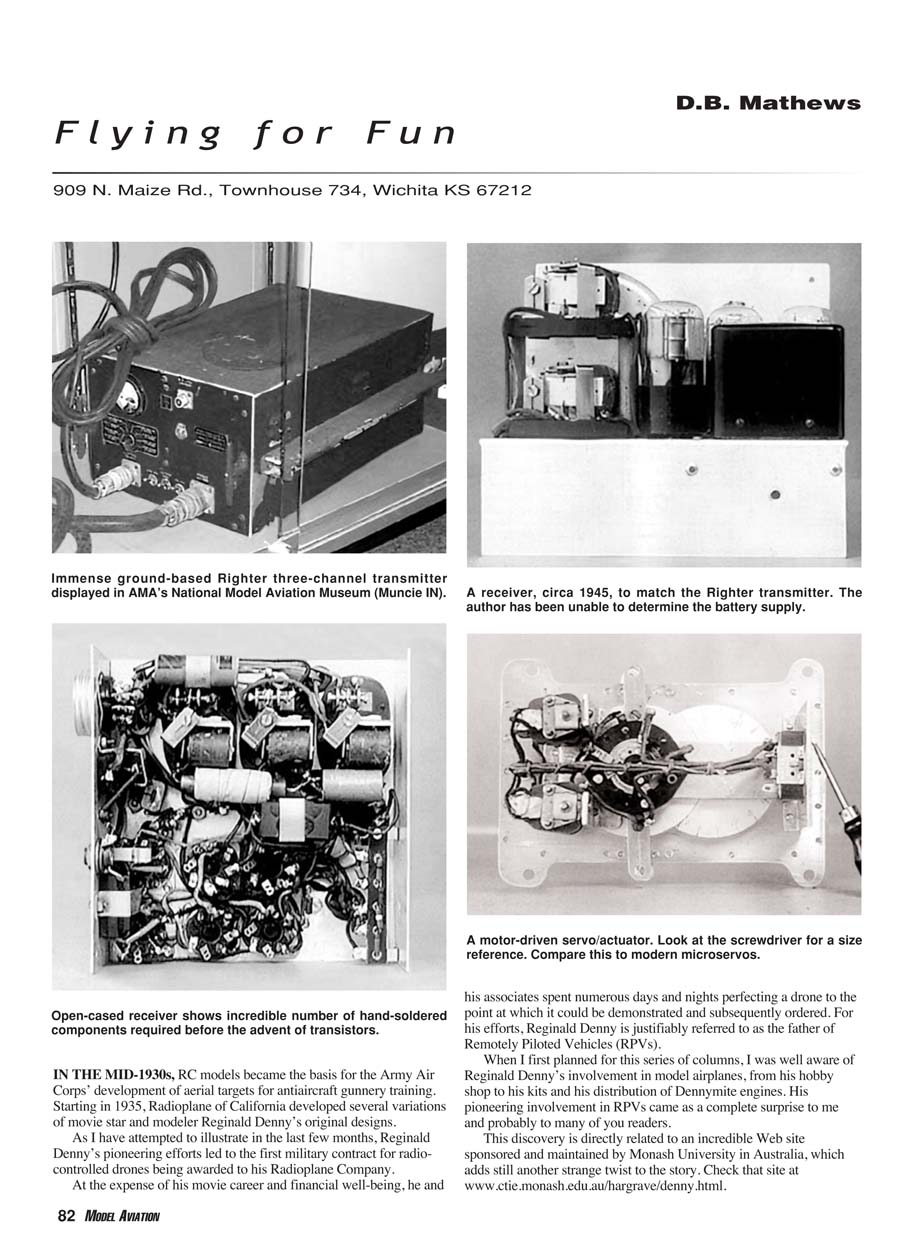
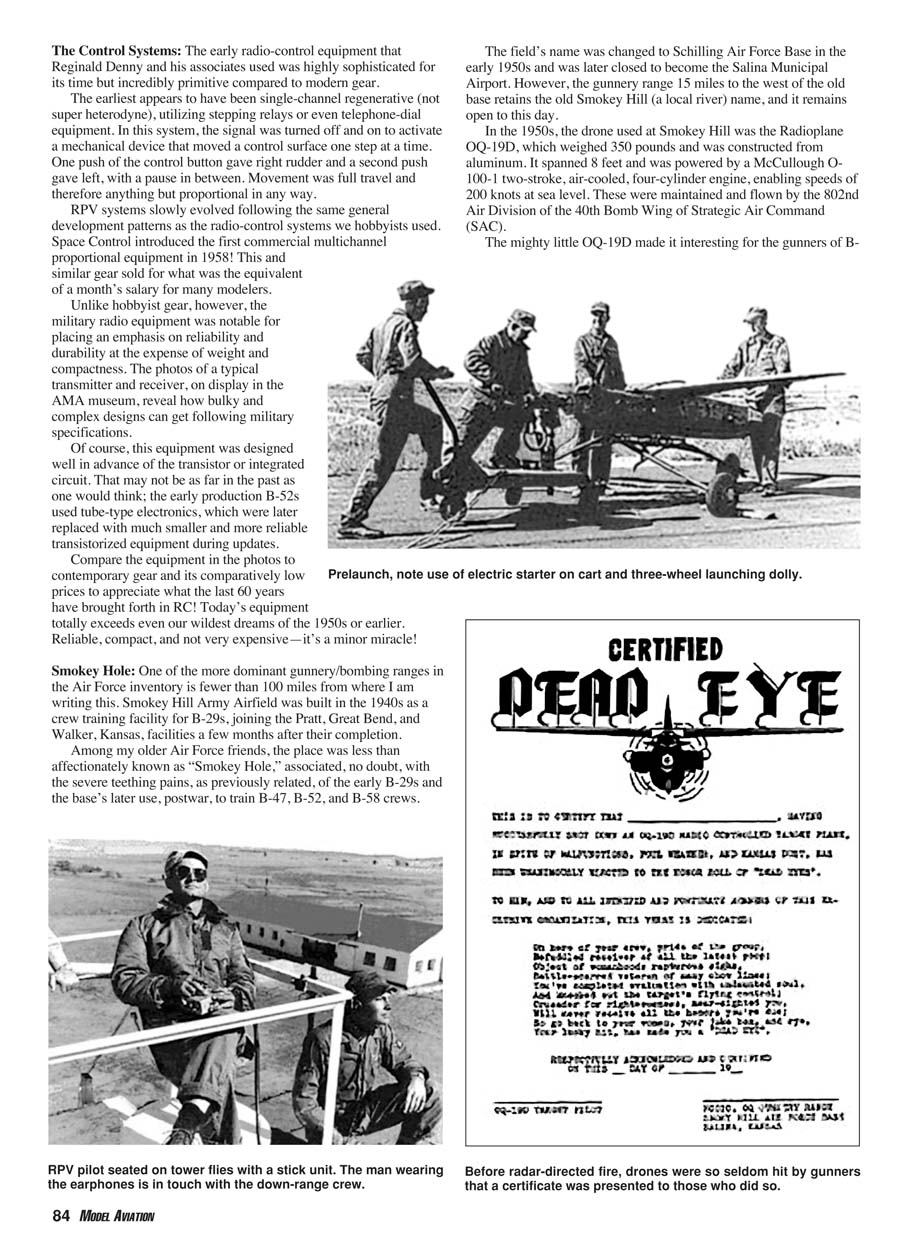
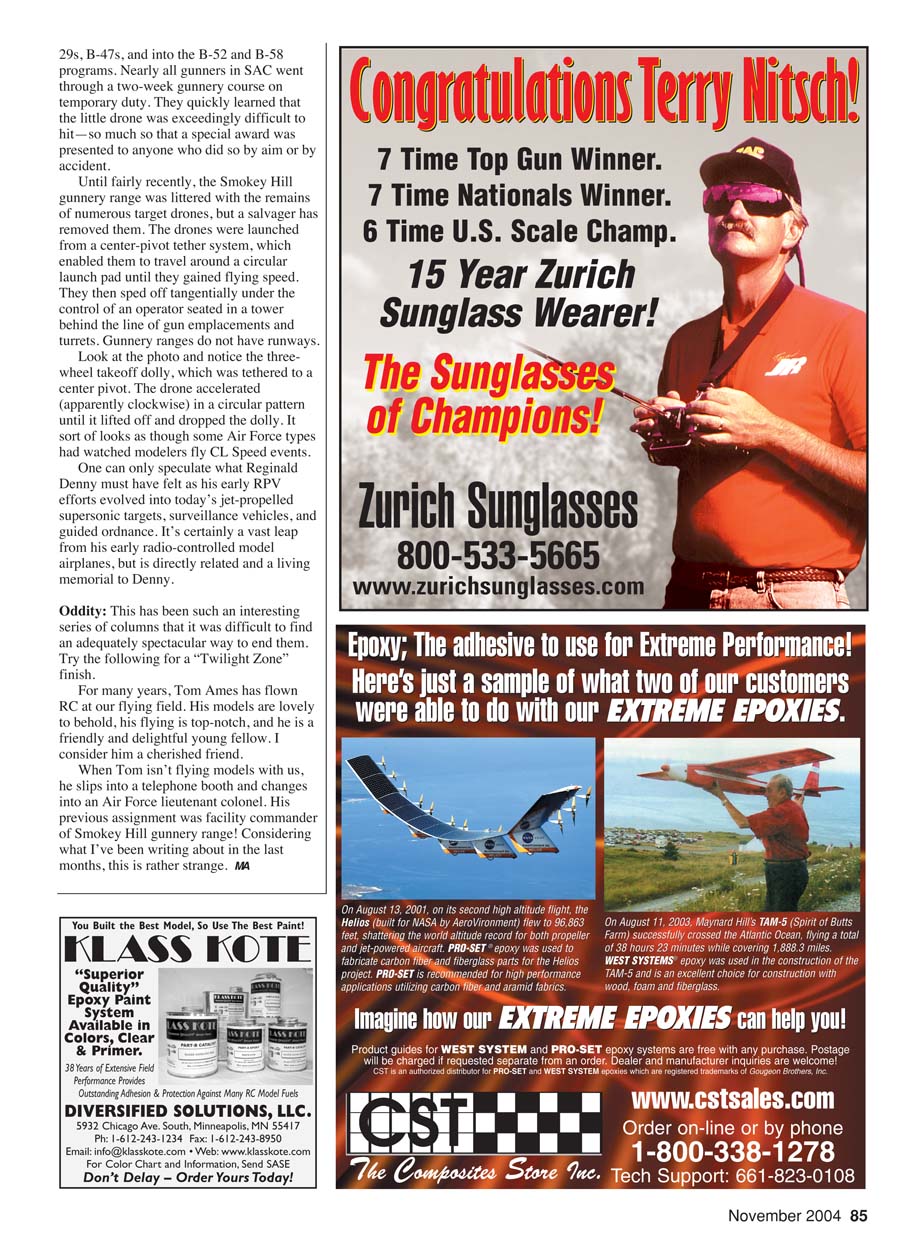
The photos of a typical transmitter and receiver, on display in the AMA museum, reveal how bulky and complex designs can get following military specifications. Of course, this equipment was designed well in advance of the transistor or integrated circuit. That may not be as far in the past as one would think; the early production B-52s used tube-type electronics, which were later replaced with much smaller and more reliable transistorized equipment during updates. Compare the equipment in the photos to contemporary gear and its comparatively low prices to appreciate what the last 60 years have brought forth in RC! Today's equipment totally exceeds even our wildest dreams of the 1950s or earlier. Reliable, compact, and not very expensive—it's a minor miracle!
Smokey Hole
One of the more dominant gunnery/bombing ranges in the Air Force inventory is fewer than 100 miles from where I am writing this. Smokey Hill Army Airfield was built in the 1940s as a crew training facility for B-29s, joining the Pratt, Great Bend, and Walker, Kansas, facilities a few months after their completion.
Among my older Air Force friends, the place was less than affectionately known as "Smokey Hole," associated, no doubt, with the severe teething pains of the early B-29s and the base’s later use, postwar, to train B-47, B-52, and B-58 crews.
The field’s name was changed to Schilling Air Force Base in the early 1950s and was later closed to become the Salina Municipal Airport. However, the gunnery range 15 miles to the west of the old base retains the old Smokey Hill (a local river) name, and it remains open to this day.
In the 1950s, the drone used at Smokey Hill was the Radioplane OQ-19D, which weighed 350 pounds and was constructed from aluminum. It spanned 8 feet and was powered by a McCulloch O-100-1 two-stroke, air-cooled, four-cylinder engine, enabling speeds of 200 knots at sea level. These were maintained and flown by the 802nd Air Division of the 40th Bomb Wing of Strategic Air Command (SAC).
The mighty little OQ-19D made it interesting for the gunners of B-29s and B-47s and into the B-52 and B-58 programs. Nearly all gunners in SAC went through a two-week gunnery course on temporary duty. They quickly learned that the little drone was exceedingly difficult to hit—so much so that a special award was presented to anyone who did so, by aim or by accident.
Until fairly recently, the Smokey Hill gunnery range was littered with the remains of numerous target drones, but a salvager has removed them. The drones were launched from a center-pivot tether system, which enabled them to travel around a circular launch pad until they gained flying speed. They then sped off tangentially under the control of an operator seated in a tower behind the line of gun emplacements and turrets. Gunnery ranges do not have runways.
Look at the photo and notice the three-wheel takeoff dolly, which was tethered to a center pivot. The drone accelerated (apparently clockwise) in a circular pattern until it lifted off and dropped the dolly. It sort of looks as though some Air Force types had watched modelers fly CL Speed events.
One can only speculate what Reginald Denny must have felt as his early RPV efforts evolved into today's jet-propelled supersonic targets, surveillance vehicles, and guided ordnance. It's certainly a vast leap from his early radio-controlled model airplanes, but it is directly related and a living memorial to Denny.
Oddity
This has been such an interesting series of columns that it was difficult to find an adequately spectacular way to end them. Try the following for a "Twilight Zone" finish.
For many years, Tom Ames has flown RC at our flying field. His models are lovely to behold, his flying is top-notch, and he is a friendly and delightful young fellow. I consider him a cherished friend.
When Tom isn't flying models with us, he slips into a telephone booth and changes into an Air Force lieutenant colonel. His previous assignment was facility commander of the Smokey Hill gunnery range! Considering what I've been writing about in the last months, this is rather strange. MA
Transcribed from original scans by AI. Minor OCR errors may remain.

