
Flying for Fun
D.B. Mathews
909 N. Maize Rd., Townhouse 734, Wichita KS 67212
THIS MONTH I'll play a bit of catch-up; that is, I'll take a look at several fun subjects that have been gathering dust while I wrote about other things. Each by itself doesn't justify a complete column but does deserve some space. I hope you will find these individual short subjects of some interest.
Wire Models
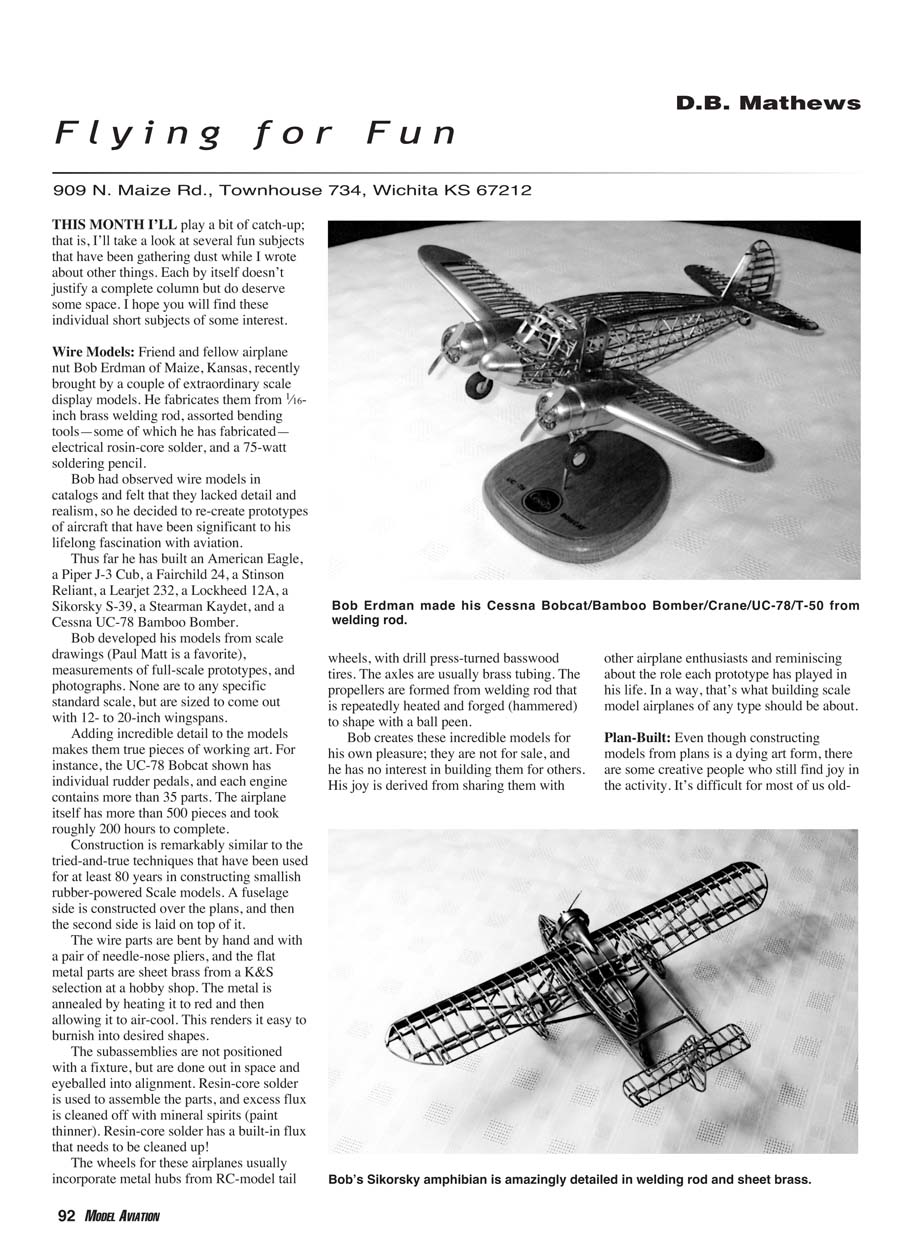
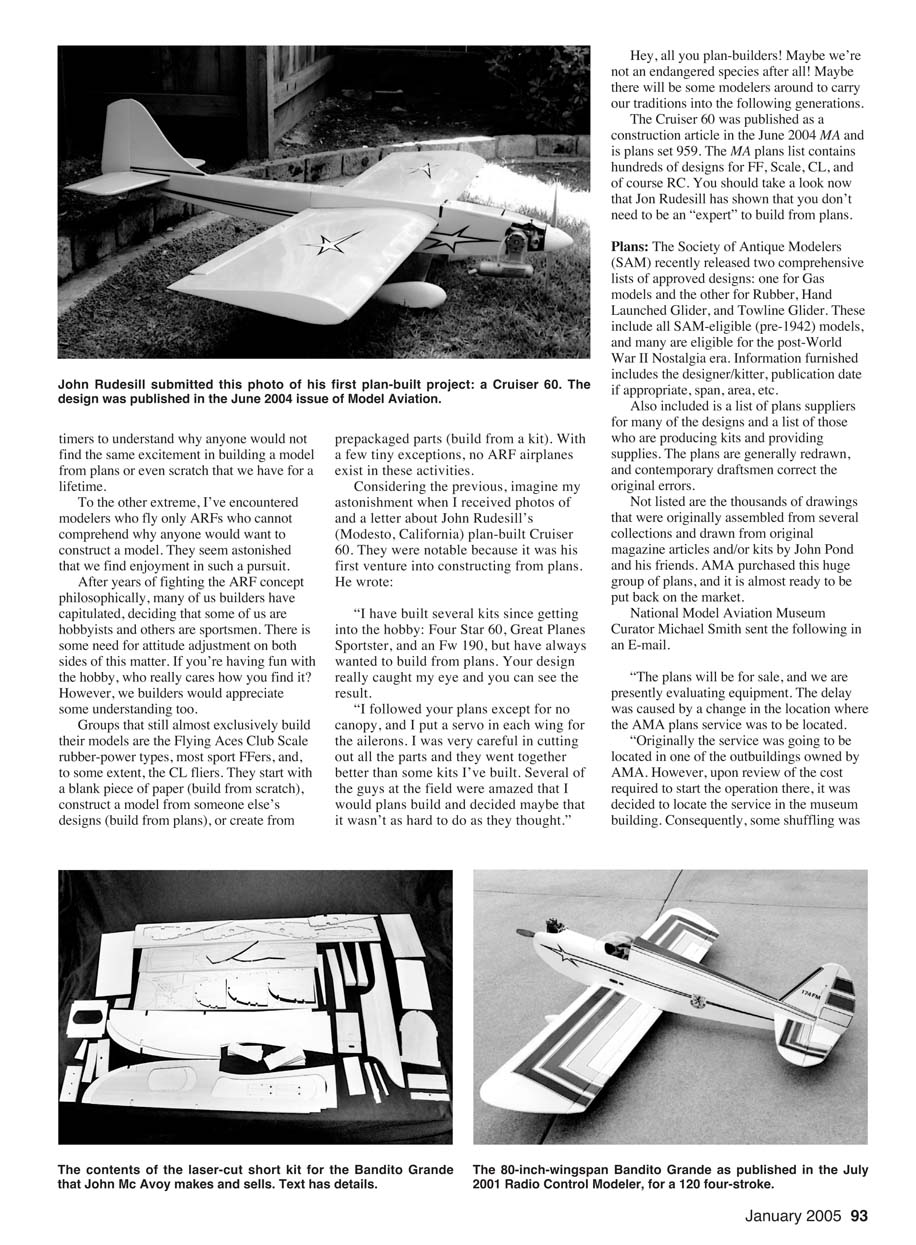
Friend and fellow airplane nut Bob Erdman of Maize, Kansas, recently brought me a couple of extraordinary scale display models. He fabricates them from 1/16-inch brass welding rod, assorted bending tools—some of which he has fabricated—electrical rosin-core solder, and a 75-watt soldering pencil.
Bob had observed wire models in catalogs and felt that they lacked detail and realism, so he decided to re-create prototypes of aircraft that have been significant to his lifelong fascination with aviation.
Thus far he has built:
- American Eagle
- Piper J-3 Cub
- Fairchild 24
- Stinson Reliant
- Learjet 232
- Lockheed 12A
- Sikorsky S-39
- Stearman Kaydet
- Cessna UC-78 Bamboo Bomber
None are to any specific standard scale, but are sized to come out with 12- to 20-inch wingspans.
Adding incredible detail to the models makes them true pieces of working art. For instance, the UC-78 Bobcat shown has individual rudder pedals, and each engine contains more than 35 parts. The airplane itself has more than 500 pieces and took roughly 200 hours to complete.
Construction is remarkably similar to the tried-and-true techniques that have been used for at least 80 years in constructing small rubber-powered scale models. A fuselage side is constructed over the plans, and then the second side is laid on top of it.
The wire parts are bent by hand and with a pair of needle-nose pliers, and the flat metal parts are sheet brass from a K&S selection at a hobby shop. The metal is annealed by heating it to red and then allowing it to air-cool. This renders it easy to burnish into desired shapes.
The subassemblies are not positioned with a fixture but are done out in space and eyeballed into alignment. Rosin-core solder is used to assemble the parts, and excess flux is cleaned off with mineral spirits (paint thinner). Rosin-core solder has a built-in flux that needs to be cleaned up!
The wheels for these airplanes usually incorporate metal hubs from RC-model tail wheels, with drill-press-turned basswood tires. The axles are usually brass tubing. The propellers are formed from welding rod that is repeatedly heated and forged (hammered) to shape with a ball peen.
Bob creates these incredible models for his own pleasure; they are not for sale, and he has no interest in building them for others. His joy is derived from sharing them with other airplane enthusiasts and reminiscing about the role each prototype has played in his life. In a way, that's what building scale model airplanes of any type should be about.
Plan-Built
Even though constructing models from plans is a dying art form, there are some creative people who still find joy in the activity. It's difficult for most of us old-timers, but maybe we're not an endangered species after all! Maybe there will be some modelers around to carry our traditions into the following generations.
The Cruiser 60 was published as a construction article in the June 2004 MA and is plans set 959. The MA plans list contains hundreds of designs for FF, Scale, CL, and of course RC. You should take a look now that Jon Rudesill has shown that you don't need to be an "expert" to build from plans.
Plans: The Society of Antique Modelers (SAM) recently released two comprehensive lists of approved designs: one for Gas models and the other for Rubber, Hand-Launched Glider, and Towline Glider. These include all SAM-eligible (pre-1942) models, and many are eligible for the post-World War II Nostalgia era. Information furnished includes the designer/kitter, publication date if appropriate, span, area, etc.
Also included is a list of plans suppliers for many of the designs and a list of those who are producing kits and providing supplies. The plans are generally redrawn, and contemporary draftsmen correct the original errors.
Not listed are the thousands of drawings that were originally assembled from several collections and drawn from original magazine articles and/or kits by John Pond and his friends. AMA purchased this huge group of plans, and it is almost ready to be put back on the market.
National Model Aviation Museum Curator Michael Smith sent the following in an e-mail:
"The plans will be for sale, and we are presently evaluating equipment. The delay was caused by a change in the location where the AMA plans service was to be located.
"Originally, the service was going to be located in one of the outbuildings owned by AMA. However, upon review of the cost required to start the operation there, it was decided to locate the service in the museum building. Consequently, some shuffling was required, and is now moving ahead."
SAM members can obtain the lists of approved designs from the organization at Box 60236, Saint Augustine, FL 32086. Watch this magazine for an announcement about the availability of the John Pond plans.
An Exception
Now that I’ve (I hope) clarified the various forms of model-building, it’s time to contradict myself—sort of. Short kits fall between plans and kits; they provide the shaped parts to match plans but have no hardware, sheet wood, or strip wood, as you find in regular kits.
This concept provides the “hard-work parts” for a published or commercial set of plans, yet it allows the builder to choose sheet and strip wood from a dealer’s stock or by mail order from one of the wood cutters. In this modern era of laser-cut parts, these short kits’ fit and finish are just short of miraculous.
Photos illustrate a short kit and a completed Bandito Grande, which was published in the July 2001 Radio Control Modeler. The kit is available from John McAvoy, 2027 62nd Loop SE, Auburn, WA 98092; Tel.: (253) 735-2988; E-mail: threshold1@earthlink.net. He is cutting kits for several other published designs.
One purchases the plans from the magazine, the short kit from John, the sheet wood, strip wood, and hardware elsewhere, and ends up with a novel model that is well outside the norm. There are many other short-kit suppliers; check out their ads in the magazines.
Regardless of the model’s pedigree, be sure to fly it for fun. MA
Transcribed from original scans by AI. Minor OCR errors may remain.

