
Flying for Fun
D.B. Mathews
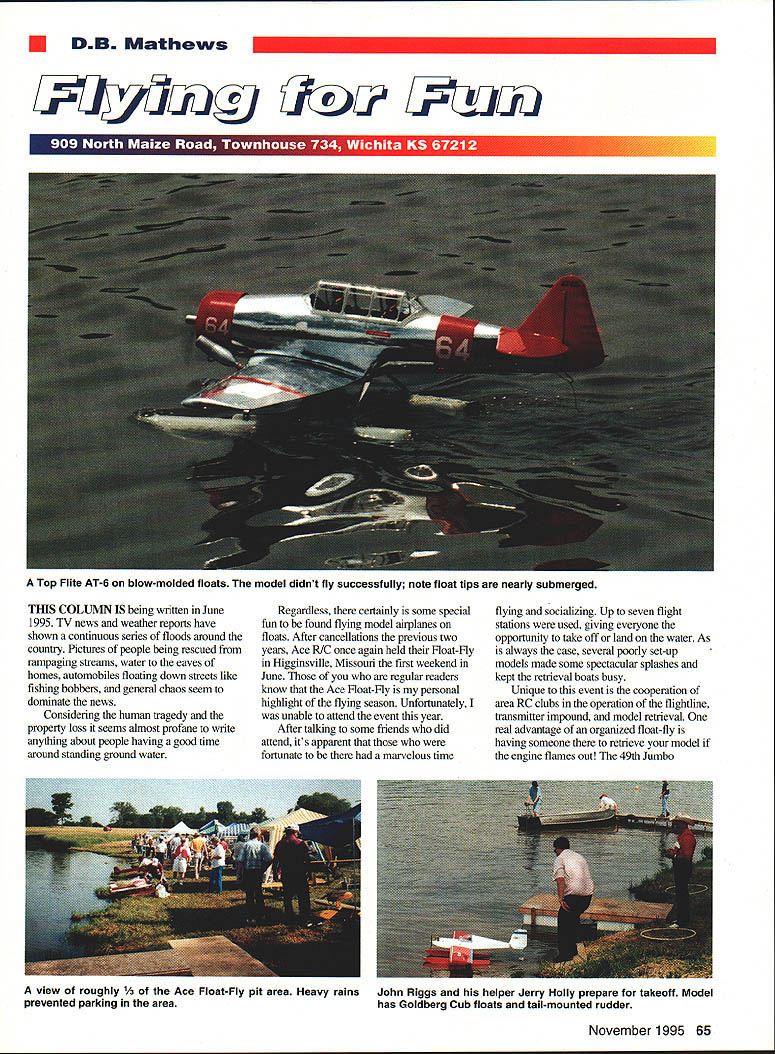
This column is being written in June 1995. TV news and weather reports have shown a continuous series of floods around the country. Pictures of people being rescued from rampaging streams, water to the eaves of homes, automobiles floating down streets like fishing bobbers, and general chaos seem to dominate the news. Considering the human tragedy and the property loss, it seems almost profane to write about people having a good time around standing ground water. Regardless, there certainly is some special fun to be found flying model airplanes on floats.
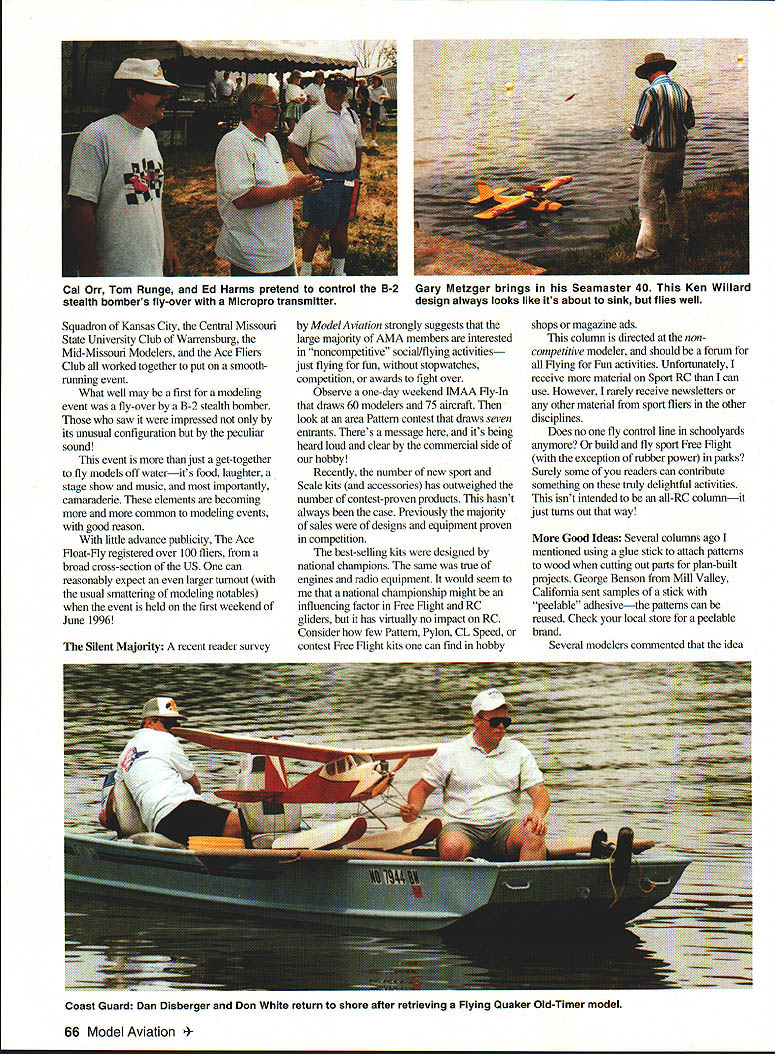
After cancellations the previous two years, Ace R/C once again held their Float-Fly in Higginsville, Missouri the first weekend in June. Those who are regular readers know the Ace Float-Fly is my personal highlight of the flying season. Unfortunately I was unable to attend this year, but friends who were there reported a marvelous time.
- Up to seven flight stations were used, giving everyone the opportunity to take off or land on the water.
- Several poorly set-up models made spectacular splashes and kept the retrieval boats busy.
- A B-2 stealth bomber fly-over (what may well be the first modeling-event fly-over by that aircraft) impressed attendees with its unusual configuration and peculiar sound.
Unique to this event was the cooperation of area R/C clubs in operating the flightline, transmitter impound, and model retrieval. One real advantage of an organized float-fly is having someone there to retrieve your model if the engine flames out. Clubs working together included:
- Squadron of Kansas City
- Central Missouri State University Club (Warrensburg)
- Mid-Missouri Modelers
- Ace Fliers Club
The event was more than just a get-together to fly models off water — it featured food, laughter, a stage show, music, and, most importantly, camaraderie. These elements are becoming more common at modeling events, and for good reason. With a little advance publicity, Ace Float-Fly registered over 100 fliers from a broad cross-section of the U.S.; one can reasonably expect an even larger turnout next year.
The Silent Majority A recent reader survey by Model Aviation strongly suggests that a large majority of AMA members are interested in noncompetitive social/flying activities—just flying for fun, without stopwatches, competition, or awards to fight over. Observe a one-day weekend IMAA fly-in that draws 60 modelers and 75 aircraft in the local area, while a Pattern contest in the same area draws seven entrants. There's a message here, and it's being heard loud and clear.
On the commercial side of the hobby, the number of new sport and scale kits (and accessories) has recently outweighed the number of contest-proven products. This wasn't always true: previously, the majority of sales were of designs and equipment proven in competition. The best-selling kits were often designed by national champions; the same was true of engines and radio equipment. A national championship could be an influencing factor, but Free Flight and RC gliders have virtually no impact on RC modeling sales.
Consider contest disciplines such as Pattern, Pylon, Control Line (CL), and Speed. Kits and equipment for these events are less visible in hobby shops and magazine ads than sport/scale items. This column is directed at the noncompetitive modeler and should be a forum for flying-for-fun activities. Unfortunately I receive little material from sport fliers in many disciplines. Does no one fly control line in schoolyards anymore, or build-and-fly sport free flight (with the exception of rubber-powered events in parks)? Surely some readers can contribute something delightful. This column isn't intended to be an all-RC column—it just turns out that way.
Good Ideas
Patterns and glue sticks
Several columns ago I mentioned using a glue stick to attach patterns to wood before cutting out parts for plan-built projects. George Benson of Mill Valley, California, sent samples of a peelable stick adhesive so the patterns can be reused. Check local stores for a peelable brand.
I neglected to mention that patterns can be easily duplicated at any copy center at very reasonable rates. Most contemporary copiers load from the top, enabling one to fold the drawings so the desired parts of the plans can be copied without cutting up the originals.
Toyo O' Glue Jr.
George also enclosed an adhesive stick called "Toyo O' Glue Jr." It can be used to coat the borders of a surface that will be covered with Japanese tissue. The borders are pressed down and the tissue water-shrunk. It works very well and is certainly a lot less fuss and bother than the old clear-dope technique.
Fuel tubing fix
Tygon fuel (and other) tubing often has an inside diameter large enough to fit over the fuel nipples on gas-burner engines and deliver sufficient fuel, but it's too large for a tight fit over standard brass tank tubing. As a consequence the fuel line can work off the tank plumbing and make a dangerous mess.
Dennis Richtenberg, who has run Quadra engines for many years, developed a sure-fire technique to prevent this problem: wrap the brass tubing with three or four loops of fine copper wire (the kind used on wire landing-gear joints), then build up a solder blob over the wire. When filed smooth, the fuel line will be tightly held over the brass tubing. I haven't tried this with easily ripped silicone line, but it works excellent for Tygon and neoprene materials.
Steve Wittman
Steve Wittman and his wife recently passed away in an aircraft accident. Steve was flying his latest design, the Q.O., when the aircraft broke up. He and his wife were en route to their home at Wittman Field in Oshkosh, Wisconsin, from their winter residence in Orlando, Florida. Steve was 92.
Steve's designs — Chief Oshkosh, Buster, Bonzo, Tailwind, V-Witt and others, including the Big X — incorporated pragmatic design philosophy with incredible flight efficiency. As a survivor of the Great Depression, Steve's designs were always simple and relatively low-tech, often utilizing used or salvaged components to hold down costs, yet they were highly competitive. His one-piece, all-metal landing gear developed for the Big X is still used by Cessna under license.
I published a Wittman Big X rubber-powered scale construction article in the December 1980 Flying Models and noted that Steve must have been the oldest motorsport competitor in history. He participated in air racing from the 1920s to the 1980s.
On a lighter note, several years ago the IMAA held its national fly-in at Wittman Field. One of the volunteers at the entrance didn't recognize Steve and his wife when they drove up—and charged them admission.
Transcribed from original scans by AI. Minor OCR errors may remain.

