
Flying for Fun
D.B. Mathews 909 North Maize Road, Townhouse 734, Wichita KS 67212
Travel Air
As the 20th century began, oil was discovered at El Dorado, Kansas. Eventually the oil field extended eastward more than 40 miles to the outskirts of Wichita; at the time it was the largest oil discovery in the U.S. As often happened, struggling oil investors became immensely wealthy very quickly. Some of that new wealth found its way into the then‑infant aircraft industry in Wichita. It's likely that if oil hadn't been found at El Dorado there would not have been airplanes in Wichita.
Wichita, a prairie city of about 300,000 people, has continued that entrepreneurial tradition ever since. Did you know Wichita is where these companies began?
- Coleman
- Pizza Hut
- Koch Industries
- Chance Industries
- Garvey Grain
- Rent‑a‑Center
- Mentholatum
- Cessna
- Beech
- Stearman (now a Boeing division)
- Lear
Until a few years ago, more than half the airplanes built in the world during any given year were built in Wichita (before the liability insurance crisis caused the demise of single‑engined private aircraft production).
In 1919 a group of newly wealthy oilmen and local businessmen formed the Wichita Airplane Company and hired Matty Laird to design an airplane. His design became the Swallow, a three‑place wooden‑framed biplane powered by a Curtiss OX‑5 inline engine. The design was a success and sold well.
In 1920 Laird hired Lloyd Carlton Stearman as a production worker to help build wings and fuselages. Walter Herschel Beech was employed as a part‑time demonstration pilot and general employee, doing jobs such as cleaning Cosmoline from crated engines and attending to customers who flew into the Swallow airport on North Hillside Avenue.
A disagreement with management led to Matty Laird's departure in 1923. In that year the 23‑year‑old Stearman was named chief engineer and charged with developing a new airplane. Beech and Stearman favored newer construction techniques (such as metal tubing), but management did not agree.
On January 26, 1925, Stearman and Beech joined forces with Clyde Vernon Cessna and a group of oilmen and businessmen to form Travel Air Manufacturing Company. Yes—Beech, Cessna, and Stearman worked for the same company at the same time.
In January 1927 Travel Air received large orders for Whirlwind‑powered monoplanes. The plant expanded and ran three shifts to meet deadlines for the monoplanes and the successful 2000‑series biplanes. Nearly at the same time a telegram arrived asking for a Whirlwind‑powered plane capable of a 45‑hour flight for a proposed New York‑to‑Paris flight, requesting price and earliest delivery date. With production capacity stretched to the limit, Beech and production foreman Bob Phelps turned down the sale — they couldn't spare the facilities and the venture seemed marginally financed.
Rejected by Travel Air, the telegram's sender turned to San Diego's struggling Ryan Aircraft. The prospective buyer was Charles Lindbergh; the aircraft subsequently became the Spirit of St. Louis.
The Mystery Ships
By 1928 Walter Beech had seen Cessna and Stearman leave to form their own companies; he was essentially in charge at Travel Air. Beech was a natural promoter and saw air racing as an extension of sales promotion. Travel Air aircraft were already successful racers — a Travel Air monoplane named Woolaroc won the Dole race to Hawaii, and the company's planes competed in closed‑course and cross‑country events.
Herb Rawdon, a young engineer at Travel Air, often wondered what it would take to build a civilian racing airplane that could beat the military's best. At the time the U.S. military routinely modified fighters, improved their engines, and dominated Unlimited closed‑course racing; their wins were almost a foregone conclusion.
Rawdon and fellow engineer Walter Burnham believed a carefully designed, all‑out performance civilian airplane could compete with the military — using considerably less power and at much lower cost. They developed preliminary designs and sketches at home, often working on kitchen tables. When they returned with drawings and data, Beech approved the project after convincing the Curtiss‑Wright corporate owners of the value of winning races.
The go‑ahead came in June 1929 — only ten weeks remained until the National Air Races. About 25 specially skilled craftsmen were assigned to a remote, guarded shop. Windows were painted over and security was tight; speculation ran high until the roll‑out in August.
When the red‑and‑black Model R (sometimes referenced as the R‑614K) first flew in August 1929 it caused a sensation. Compared to contemporary civilian aircraft, the Mystery Ship was revolutionary; its low‑wing, clean lines influenced later racing designs. Three versions were completed: a classic 420 hp Wright R‑975 radial version (often featured in models), an inline‑engined version with a 250 hp Chevrolet engine, and a 240 hp Wright Whirlwind B‑11 powered version.
At Cleveland the two low‑wing Model R racers were the center of attention. The Army and Navy brought modified Curtiss Hawks fitted with powerful radial engines. In the 1929 Thompson Trophy dash (50 miles around three pylons) on Labor Day, the Army's aircraft initially led, followed by the Navy. Then the little red Mystery Ship, piloted by Doug Davis, passed them on the second lap. Davis briefly thought he had cut a pylon and re‑circled it, possibly blacking out momentarily; after two fly‑arounds he pushed to full throttle and lapped Roscoe Turner's Lockheed Vega. The Mystery Ship finished comfortably ahead of the Curtiss Hawks — a dramatic civilian victory that drew Washington and media attention to America's air‑power shortcomings.
Six Model R aircraft were built, including one for Gen. Balbo, head of Mussolini's Italian Air Force. Parts of several of the six still exist. Frank Hawks' Texaco No. 13 hangs in the Museum of Science and Industry in Chicago. The Chevrolet‑engined version was later re‑engined and sold to Pancho Barnes (later of the Happy Bottom Riding Club near Edwards Air Force Base) and was displayed in the Tall‑Mantz collection in Orange County, California; Pancho's son purchased the airplane at the Tall‑Mantz dispersal sale and is restoring it.
A replica of the Travel Air Mystery Ship has been built and flown by Jim Younkin. Younkin also built a Mr. Mulligan replica. In 1979 the Mystery Ship replica flew back to Beech Field in Wichita to complete a historic circle and flew over Herb Rawdon's old operation.
The Model
Reviewing models of the Mystery Ship highlights a long‑standing distinction between professional and amateur scale modelers. Terms like sport, practical, fun, stand‑off, one‑eye, and squint have been used as euphemisms for nonprofessional scale models. Building a magazine‑quality scale masterpiece requires the equivalent of full‑time work or a commitment of every spare hour.
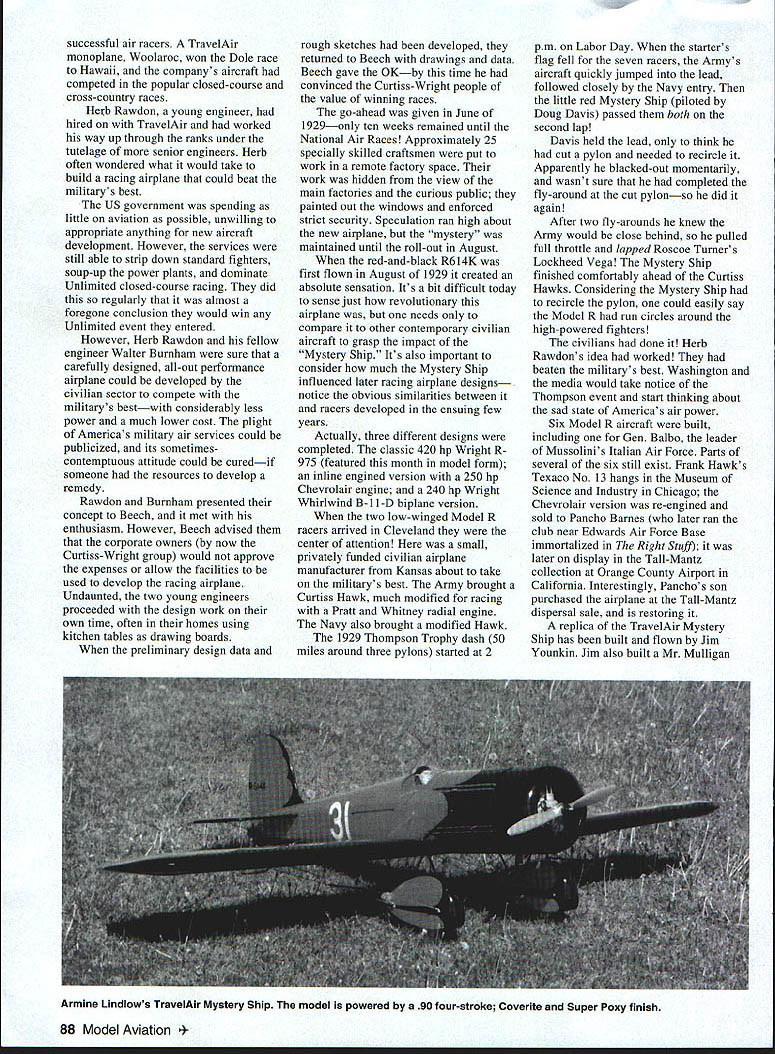
Armine Lindlow's Travel Air Mystery Ship is an amateur scale rendition built from scratch using R.S. Hirsch three‑views found in Ed Phillips' Travel Air: Wings Over the Prairie. Armine wanted a flyable, general‑purpose model that looked like the full scale; since he wasn't interested in competition, his design decisions were pragmatic rather than rule‑driven.
Armine's success is well documented. He often brings his Mystery Ship to a private flying site for personal enjoyment. The model is powered by a .90 four‑stroke engine, covered with Coverite, and painted with K&B Super Poxy. The cowl isn't fiberglass; it was fabricated from plywood and balsa rings with light plywood molded around them. The wheel pants are made from glued wood segments. Armine simplified the complex undercarriage wishbones, but with the pants installed the simplification is not obvious.
I have a personal rule: unless you're willing to repair or replace it, don't fly someone else's model. As a result, I haven't flown Armine's Mystery Ship, but he has flown it often and well.
Stand Up, Sit Down, Fight, Fight, Fight!
That old high‑school cheer came to mind when I read Managing Editor Jim Haught's comments in the September 1995 issue regarding my ergonomics piece. Jim builds his models standing up so he can watch sporting events on TV, pace the floor, and provide his own colorful commentary. If standing at the bench is what he needs to unwind, more power to him.
Might I suggest a brief brisk walk after work and before bench time? Many vigorous, healthy seniors are regular walkers or engage in strenuous activity; examples include Harry Truman, Bernard McFadden, Jack LaLanne, and others who have "aged well." Regular walking and short walks before and after bench sessions can improve concentration and manual dexterity.
Bob Angel, in the Central Coast Chapter Society of Antique Modelers (SAM) newsletter, related how regular walking has helped him stay fit and alert. He urged fellow modelers to take frequent breaks, stretch, and include brisk exercise as part of their routine.
A Final Word
Build and fly what gives you pleasure. If your goal is a model that looks right and flies well, a pragmatic approach is perfectly valid. If your goal is a magazine‑quality scale masterpiece, be honest about the financial, time, and workshop investment required. Either way, a little walking and common‑sense ergonomics will make the hobby more enjoyable and sustainable.
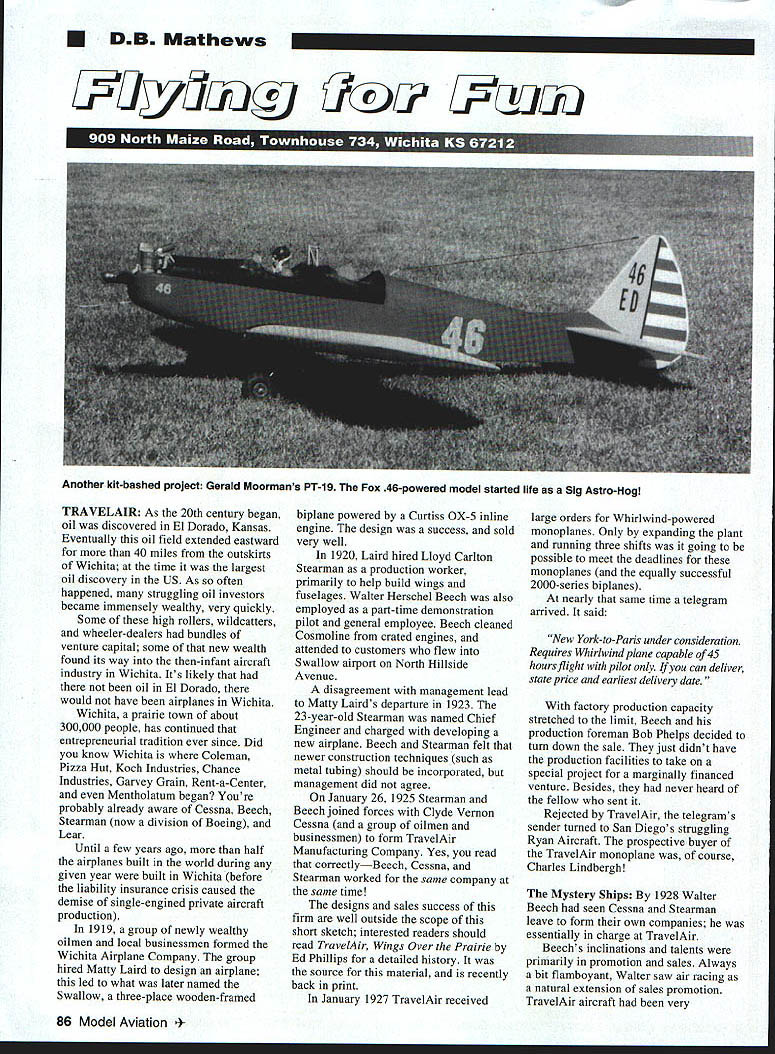
Transcribed from original scans by AI. Minor OCR errors may remain.

