
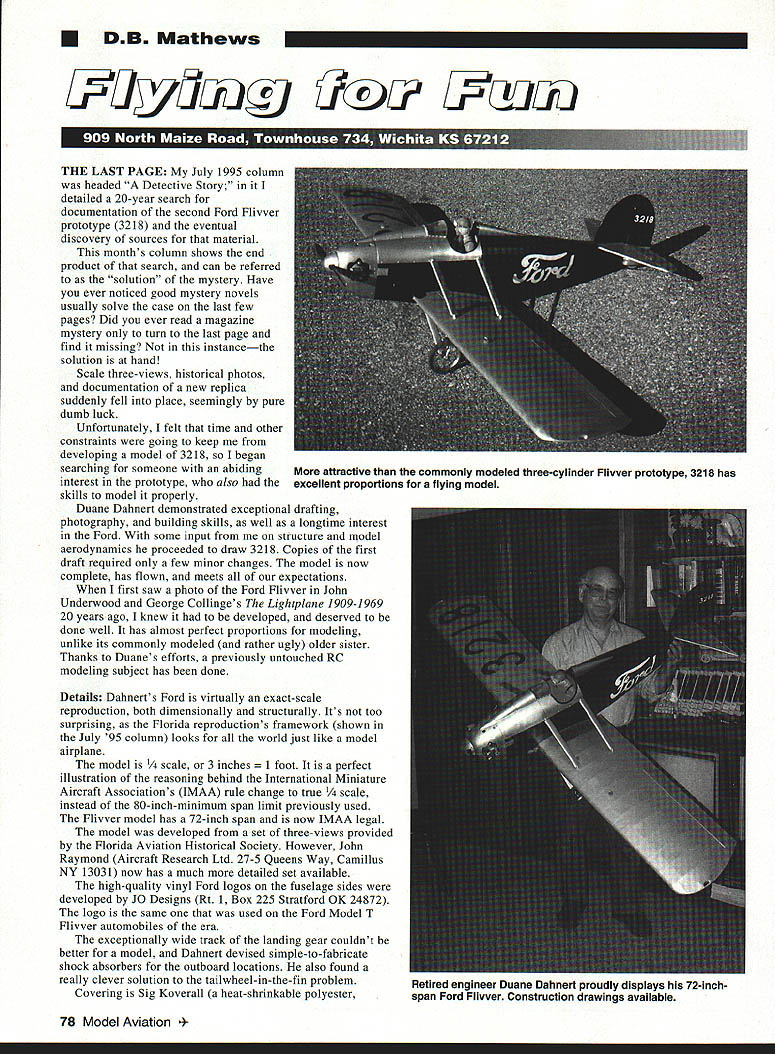
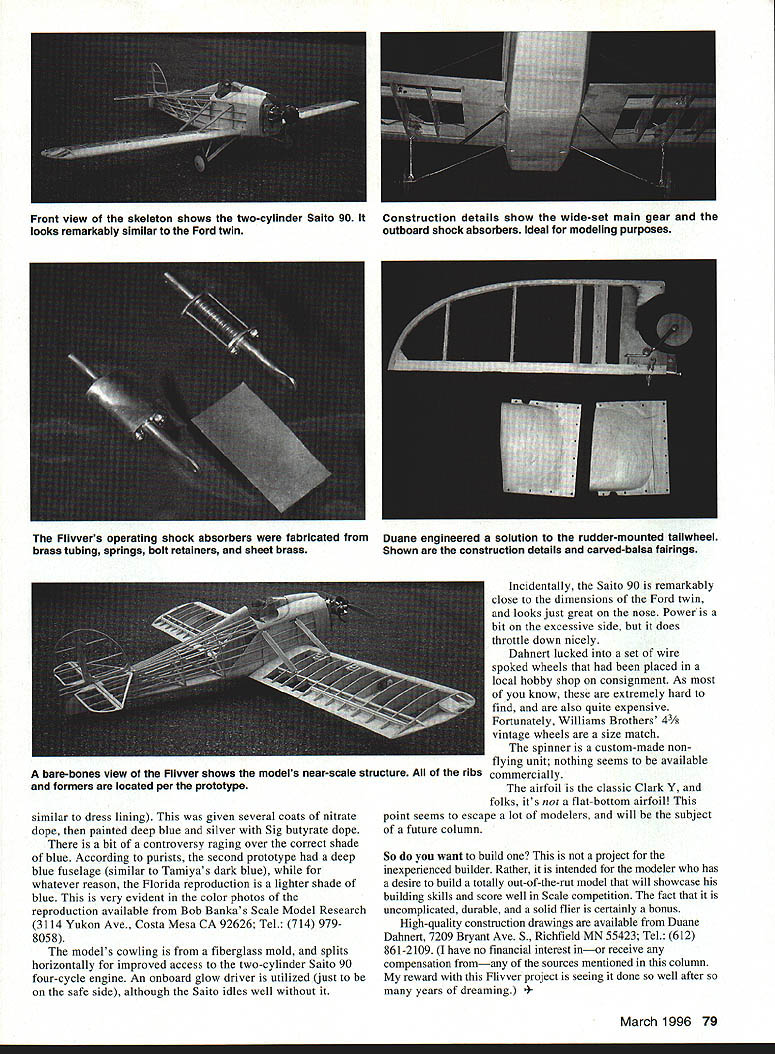
Flying for Fun
The Last Page
My July 1995 column was headed "A Detective Story;" in it I detailed a 20-year search for documentation of the second Ford Flivver prototype (3218) and the eventual discovery of sources for that material. This month's column shows the end product of that search, and can be referred to as the "solution" of the mystery. Have you ever noticed good mystery novels usually solve the case on the last few pages? Did you ever read a magazine mystery only to turn to the last page and find it missing? Not in this instance — the solution is at hand!
Scale three-views, historical photos, and documentation of a new replica suddenly fell into place, seemingly by pure dumb luck. Unfortunately, I felt that time and other constraints were going to keep me from developing a model of 3218, so I began searching for someone with an abiding interest in the prototype who also had the skills to model it properly.
Duane Dahnert demonstrated exceptional drafting, photography, and building skills, as well as a longtime interest in the Ford. With some input from me on structure and model aerodynamics, he proceeded to draw 3218. Copies of the first draft required only a few minor changes. The model is now complete, has flown, and meets all of our expectations.
When I first saw a photo of the Ford Flivver in John Underwood and George Collinge's The Lightplane 1909–1969 20 years ago, I knew it had to be developed and deserved to be done well. It has almost perfect proportions for modeling, unlike its commonly modeled (and rather ugly) older sister. Thanks to Duane's efforts, a previously untouched RC modeling subject has been done.
My reward with this Flivver project is seeing it done so well after so many years of dreaming. I have no financial interest in or receive compensation from any sources mentioned in this column.
The Replica and Development
Dahnert's Ford is virtually an exact-scale reproduction, both dimensionally and structurally. It's not too surprising, as the Florida reproduction's framework (shown in the July '95 column) looks for all the world just like a model airplane.
The model was developed from a set of three-views provided by the Florida Aviation Historical Society. However, John Raymond (Aircraft Research Ltd., 27-5 Queens Way, Camillus, NY 13031) now has a much more detailed set available.
The high-quality vinyl Ford logos on the fuselage sides were developed by JO Designs (Rt. 1, Box 225, Stratford, OK 24872). The logo is the same one that was used on the Ford Model T Flivver automobiles of the era.
The exceptionally wide track of the landing gear couldn't be better for a model, and Dahnert devised simple-to-fabricate shock absorbers for the outboard locations. He also found a clever solution to the tailwheel-in-the-fin problem.
Covering is Sig Koverall (a heat-shrinkable polyester), with lining given several coats of nitrate dope and painted deep blue with Sig butyrate dope. A bit of controversy is raging over the correct shade of blue. According to purists, the second prototype had a deep blue fuselage similar to Tamiya's dark blue; for whatever reason, the Florida reproduction is a lighter shade of blue, very evident in color photos. Reproduction drawings are available from Bob Bankas, Scale Model Research, 3114 Yukon Ave., Costa Mesa, CA 92626. Tel. 714-979-8058.
The cowling is a fiberglass mold that splits horizontally for improved access. The model is powered with a two-cylinder Saito 90 four-cycle engine. An onboard glow driver is utilized, just to be on the safe side, although the Saito idles well. Incidentally, the Saito 90 is remarkably close in dimensions to the Ford twin and looks just great on the nose. Power is a bit excessive — the model does throttle down nicely.
Dahnert lucked into a set of wire-spoked wheels placed on consignment at a local hobby shop. As you know, these are extremely hard to find and also quite expensive. Fortunately, Williams Brothers 4-3/4" vintage wheels are a size match. The spinner is a custom-made nonflying unit; nothing seems available commercially.
The airfoil is the classic Clark Y — it's a flat-bottom airfoil. That point seems to escape a lot of modelers and will be the subject of a future column.
Specifications and Notes
- Scale: 1/4 scale (3 inches = 1 foot)
- Wingspan: 72 inches — meets IMAA 1/4-scale rule (illustrates reasoning behind the International Miniature Aircraft Association's rule change to true 1/4 scale, instead of the previous 80-inch-minimum span limit)
- Source drawings: Florida Aviation Historical Society; more detailed set from John Raymond, Aircraft Research Ltd.
- Logos: Vinyl Ford logos by JO Designs (Rt. 1, Box 225, Stratford, OK 24872)
- Covering: Sig Koverall; nitrate dope lining; painted with Sig butyrate dope
- Cowling: Fiberglass mold, horizontally split for access
- Engine: Two-cylinder Saito 90 four-cycle; onboard glow driver used
- Wheels: Wire-spoked wheels; Williams Brothers 4-3/4" vintage wheels are a size match; custom nonflying spinner used
- Airfoil: Clark Y (flat-bottom)
Plans and Availability
High-quality construction drawings are available from Duane Dahnert:
- Duane Dahnert, 7209 Bryant Ave. S., Richfield, MN 55423. Tel. 612-861-2109.
This project is not intended for the inexperienced builder. It is aimed at the modeler who wants to build a totally out-of-the-kit model that showcases building skills and will score well in scale competition. It is an uncomplicated, durable, solid flier — certainly a bonus.
Transcribed from original scans by AI. Minor OCR errors may remain.

