
Flying for Fun
D.B. Mathews 909 North Maize Road, Townhouse 734, Wichita, KS 67212
Potpourri
Almost 40 years ago the Air Force sent me to southern Louisiana to be a tooth plumber. We were immersed in a French/English (Cajun)-speaking culture; it was highly enjoyable and enlightening.
The International Miniature Aircraft Association's (IMAA) Rally of Giants will be held in Lake Charles, Louisiana, June 13–16, 1996. Several AMA Nats have used this venue. Should you attend, do yourself a favor and travel a bit east to St. Martinville/Lafayette and try the local food and music.
One French word commonly used down there was potpourri (pronounced po-poor-ee), meaning "a mixture of pieces." Somehow over the years the term has become fashionable in English usage and commonly describes a smelly mixture of leaves and herbs in a glass container. This column is not about smelly stuff, but rather a collection of nonrelated pieces of information on modeling subjects. Ever wonder if that French term has any cultural connection to the term pot luck? At any rate, hopefully you will find something of interest below.
Microhenrys
Ed Henry's delightful modeling-related cartoons (seen monthly in Model Aviation) have been compiled into a softback book. There is something special about cartoon books; they provide fun reading even if you've seen the single cartoons before. Remember how much fun the compilations of Pogo, Li'l Abner, and Geech were?
Humor is cumulative: we start with a smile, progress to a chuckle, then a laugh, and perhaps burst into uncontrolled guffaws. This explains the appeal of the little book. Ed brings a special wry whimsy that is unusual and very original. The book is available from Ed Henry for $9.95 (plus $1.60 shipping and handling) at Box 581, St. Peters, MO 63376. It is delightful reading even for nonmodelers; the humor is universal and could be applied to fishing, golfing, or life in general.
Autogiros
A group of R/C autogiro enthusiasts from around the country will hold their second annual Research Trials in Phoenix, March 6–8. I had the pleasure of viewing a video from last year's event; it illustrated some widely — and wildly — different approaches to engineering and designing these novel models. Not surprisingly, many of the projects flew rather well.
These freewheeling-rotor models are of considerable interest to many modelers. For the doubters: just because you haven't seen one fly, don't presume this is an activity for experts only. The gestation has really just begun; there are modelers building and flying gyros all over the world. They are thinkers and innovators, but hardly "experts."
For more information on the event and to get on-line with developments call Jim Baxter at (509) 928-3144. Electronic access: CompuServe address 75277,3535; Internet: jimb@unixieway.com.
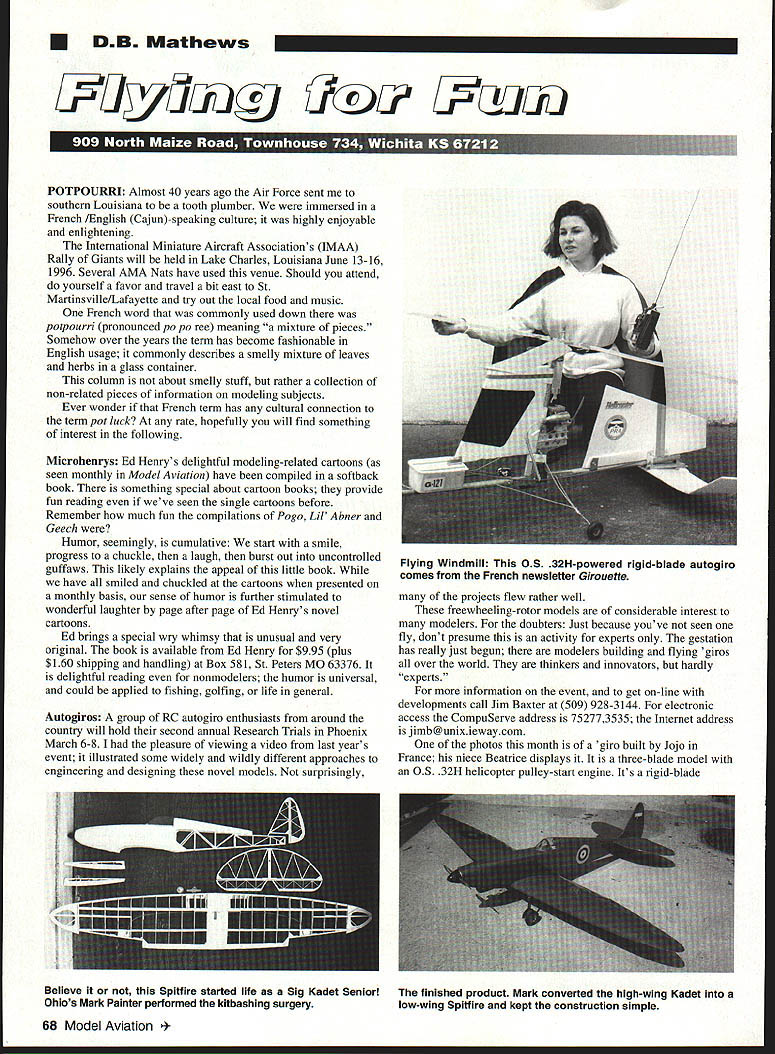
One of the photos this month is of a gyro built by Jojo in France; his niece Béatrice displays it. It is a three-blade model with an O.S. .32H helicopter pulley-start engine. It's a rigid-blade design.
Electrics
Another aspect of modeling that has attracted those who enjoy technical challenges is electric flight. Consider how much this subspecies has evolved over the last ten years. Not very long ago a successful flight of a battery-powered R/C model was notable. Today everything from tiny sport and free-flight models, to simple two-channel gliders, to very attractive scale models are successfully flown with electric motors.
One newsletter I receive is Charge Ahead from the Puget Sound Electric Model Flyers. The publication is closer to a technical journal than a traditional club newsletter. Each issue is loaded with contributions from readers across the nation: product reviews, technical articles (with math equations), and fly-in announcements. Frankly, Charge Ahead may be the definitive publication for those with an abiding interest in "dry-power" flight. Contact Ben Almojuela, 1941 6th Ave., Seattle, WA 98119 for subscription information.
KAPA
No, not a sorority. KAPA is an acronym that stands for Kits, Plans and Antiquities. The KAPA group's interests center around old model airplane kits, the firms and designers that produced them, and they publish a most-interesting newsletter loaded with historical material as well as classified ads for old kits and plans.
For example, the December 1995 issue contains a highly enlightening article by Alan Mironer on the history of the Miniature Aircraft Corporation of Staten Island, New York. Old-timers recall those exquisite and rather-expensive kits that were advertised with full-page ads in the modeling magazines. The KAPA article is accompanied by reproductions of some company ads and reduced plans for some of their kits. For the most part the company's offerings were largish rubber-powered models of popular scale subjects, available almost exclusively by mail from about 1930 to 1957.
To a more-experienced adult modeler it is apparent that the structures of the models were very complex and much too heavy to fly well, if at all. As a child in the '40s I considered these models the ultimate in attractiveness, but their $3 to $5 price range excluded most of us who were mowing lawns for 25 cents. Relative to earnings, they were actually quite expensive — inflation is a very ugly thing.
Those interested in old kits and manufacturers should contact Morris E. Leventhal at 1788 Niobe Ave., Anaheim, CA 92804 for subscription details and availability of back issues.
According to Mironer, the Miniature Aircraft Corporation was founded by K. H. Pouch in the early 1930s in the large eight-bay garage of his parents' home on Staten Island. The company's workforce usually consisted of one full-time and one half-time employee, often supplemented by the Pouch family gardener and, on Saturdays, Pouch's two young sons. It's a bit difficult for this country boy to envision an eight-car garage!
I mention this history to illustrate a point: almost without exception, the commercial side of our hobby has always consisted of small-scale businesses. As hobbyists, we tend to think of the business side as very lucrative, involving large factories and hundreds of employees. Such is not the case. Even the major manufacturers are rather small; the majority are "garage" operations. Other than those also in the toy business, no U.S. modeling manufacturer has more than 100 employees, and the majority employ less than 20.
We are fortunate that most of these businesses are run by modelers who are driven as much by product development, quality control, and service as they are by profit. Those of us who have been modelers for a long time can recall several instances where entrepreneurs bought highly respected companies only to quickly destroy them by compromising service and quality. When asking for giveaways for your next event, or when you're dealing with a warranty situation, be sensitive to the fact that you may be dealing with the owner — the company isn't Microsoft or General Motors.
A Better Way
Several columns back I mentioned the technique of using an ice pick to install eyelets in servo grommets. In a recent letter, Jerry Smith (author of the "For What It's Worth" column in Radio Control Modeler) pointed out that using a 5/64 ball driver (with all four eyelets on it) works much better.
If your club does one of those AMA Racer mass-launch (all-up/last-down) events for kids (or if you're helping fly one), there is a way to pack more winds in the rubber. Most free-flighters know how, but it seems black magic for many R/Cers.
Tips for increasing rubber winds:
- Spread a thin coat of engine exhaust residue (not fuel) on both sides of the loop. Exhaust residue is readily available and works as a rubber lubricant, but it will eventually damage the rubber if left on too long.
- Wind the motor and run out about 100 turns a couple of times.
- Remove the prop and stretch the rubber to about twice its relaxed length.
- Wind slowly and return the motor to original length as you add turns.
- Launch level with a smooth follow-through (like tossing a baseball, but not hard or upward).
These steps can increase the winds at least 50% and the model will fly much longer.
Bash 'Em
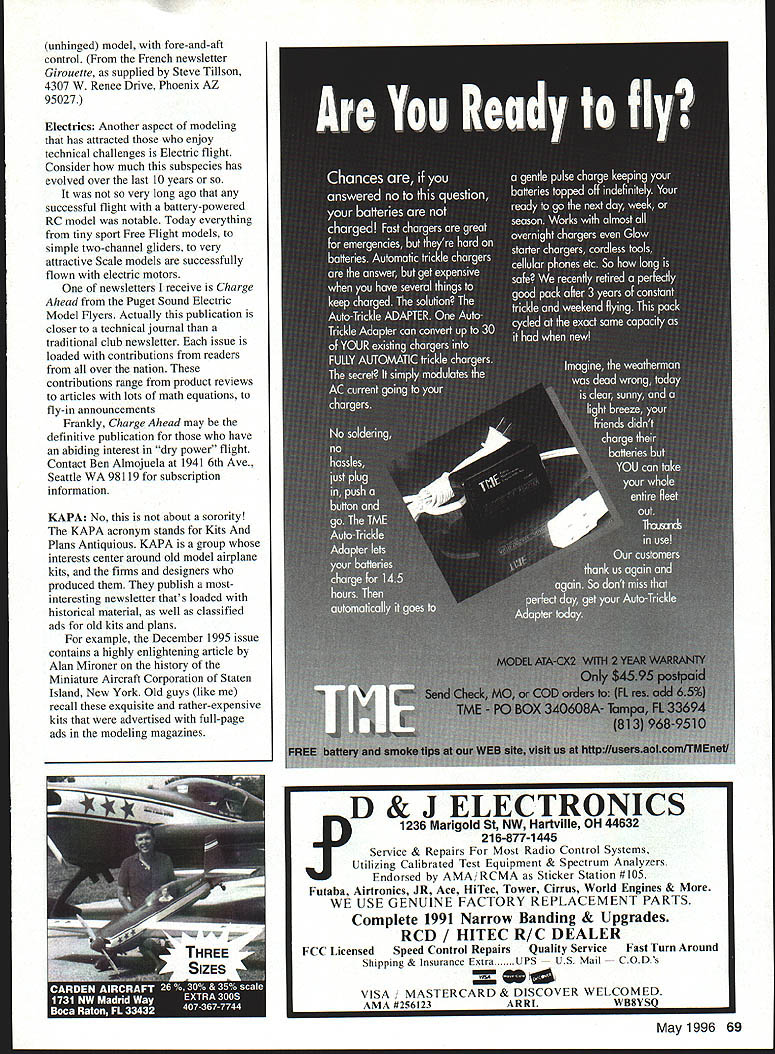
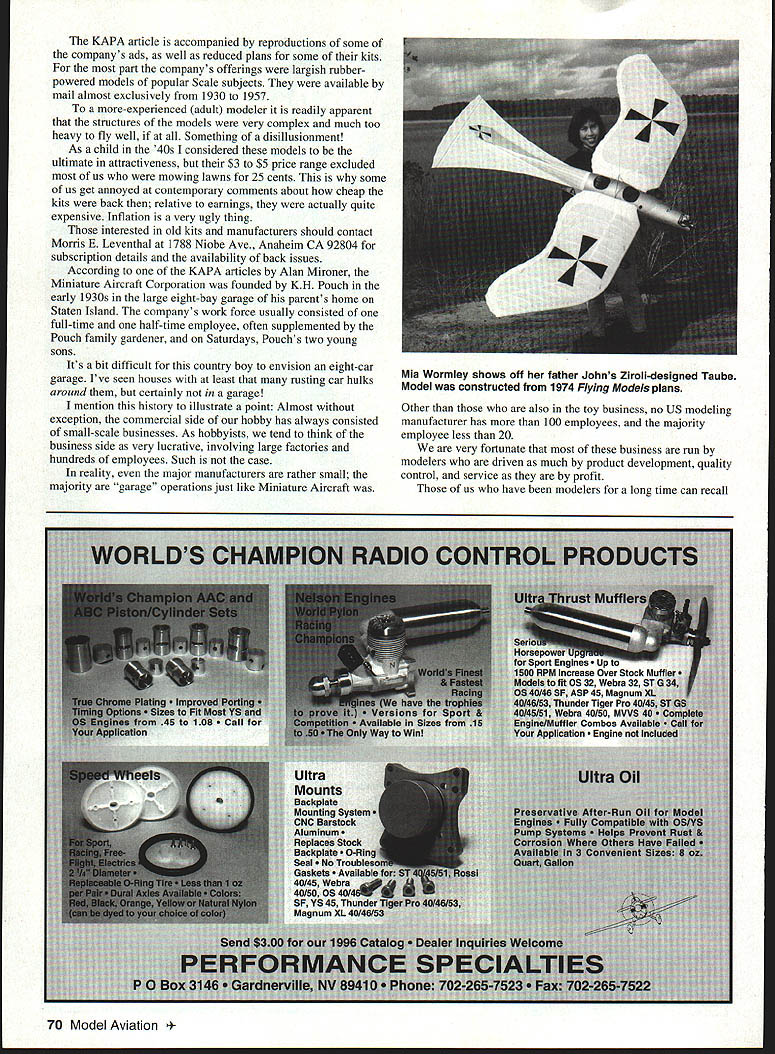
I seem to have become something of a "lightning rod" for kit modifications — that's great! Please continue to send photos. This month's model is almost unbelievable, so I included a structure photo to prove it.
Mark Painter of New Burlington, Ohio developed a Spitfire from a Sig Kadet Senior kit. He says that "since the only thing die-cut in the kit is the wing ribs, you can easily redesign and keep the construction simple, as in the original."
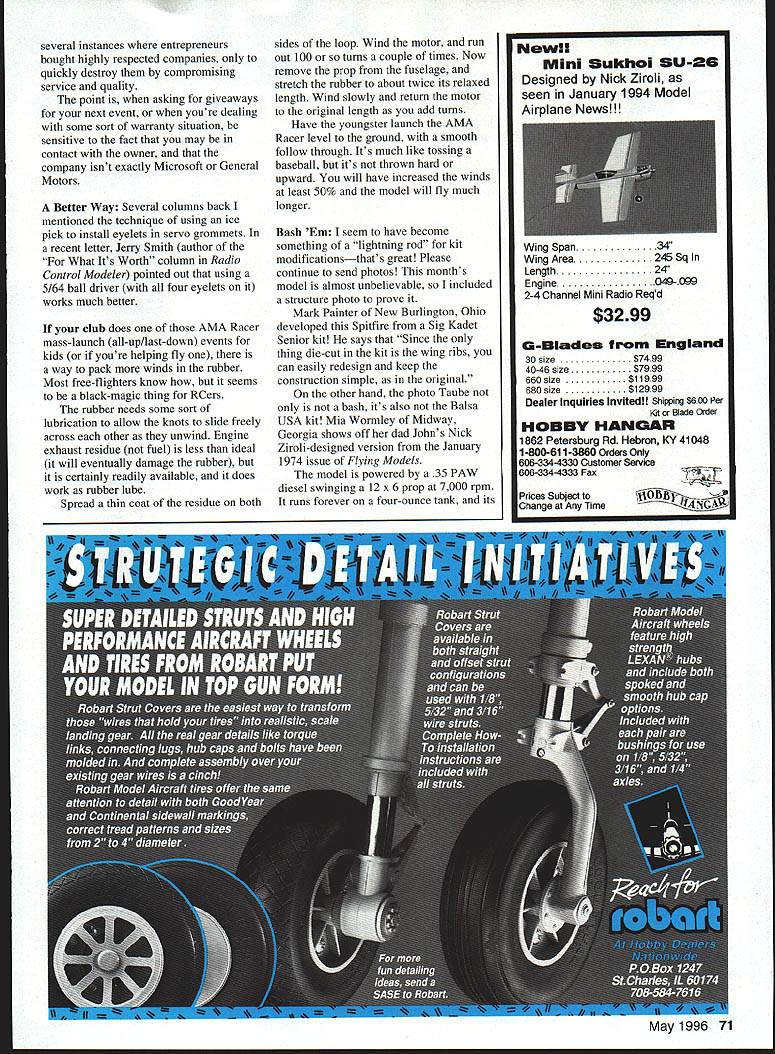
On the other hand, the photo Taube is not a bash and it's not the Balsa USA kit. Mia Wormley of Midway, Georgia shows off her dad John's Nick Ziroli-designed version from the January 1974 issue of Flying Models. The model is powered by a .35 PAW diesel swinging a 12×6 prop at about 7,000 rpm. It runs forever on a four-ounce tank; the total weight is a mere 6.5 pounds. A wing loading of 12 oz./ft.² is within the parameters needed to thermal the model. Covering is Sig Antique (semi-transparent) Supercoat film.
I'm not sure this version of the Taube is the same one Nick sells plans for, but Flying Models still offers the original plans (CF-321).
I find it odd that since WWII diesel engines have remained popular in Europe but have never really caught on in the U.S. After several long phone conversations with Bob Davis, we've concluded the single biggest factor may be fliers' insistence on using undersized (glow-size) props while expecting diesel engines to have the same power as glow engines of equal displacement. By their nature diesels have a lot more torque but lower rpm than comparable glow engines. They should use larger, lower-pitch props, and be thought of as at least a third more powerful for a given displacement. I have always preferred small-displacement diesels to their cantankerous glow equivalents. Try one — you'll like it.
Final Notes
Douglas Corrigan recently passed away at age 88. He became an instant folk hero in 1938 when he flew the Atlantic in an ancient (and nearly derelict) Curtiss Robin he had bought for $310. The CAA (now the FAA) had forbidden Corrigan from starting a trans-Atlantic flight from Long Island; they considered his Robin unsafe. As a result, Corrigan said he'd fly back to Long Beach, California — but the 31-year-old pilot landed in Ireland 28 hours (and 3,150 miles) later. Corrigan told the press that his compass was apparently inaccurate and that he "flew the wrong way." He stuck to his story his whole life — hence the legendary "Wrong Way Corrigan" nickname.
I can't wait for warmer weather and an opportunity to get out and fly for fun. You too?
Transcribed from original scans by AI. Minor OCR errors may remain.

