
Flying for Fun
909 North Maize Road, Townhouse 734, Wichita KS 67212
I have strong opinions about newcomers to the model airplane hobby. While some of my opinions are counter to those that are generally accepted, they are the result of more than 55 years of involvement in the hobby. I am certainly no "expert," but I do have experience on which I base my opinions.
In the January 1995 Newcomer issue of Model Aviation I attempted to draw a comparison between planting seeds and growing active participants in our hobby. In that column I tried to subtly suggest that it was unlikely that young people under 20 would develop anything beyond a temporary interest in modeling.
My premise was that recent empty-nesters, retirees, and father/son combinations possessed the necessary components for long-term active participation, but contemporary teenagers would likely be unable to overcome the built-in obstacles.
I suggested that clubs and individuals should promote modeling to youngsters, but should be sensitive to the fact that they were planting seeds that would most likely not bloom for many years.
I was of the opinion that modern teenagers are faced with nearly insurmountable obstacles and distractions that would make it highly unlikely they would become active modelers.
I have been proven wrong and I'm delighted to admit it!
Let's be honest; when most of us were teens there were no organized junior-high interscholastic sports, there was no Pop Warner football or Little League baseball, no television with 100 channels, no video games, no pressure to date. There were no labor laws that prevented us from getting part-time jobs; we could legally drive cars at a much younger age.
Our heroes were often inventors and scientists (not sports or music figures), and our society placed a high value on knowledge and education. Perhaps most importantly, the concept of "instant gratification" was more a matter of "finish what you start," "A job worth doing is worth doing well," and "I'll gather all the information I can about this and succeed."
Some Good News: It's entirely possible that what I am about to relate to you is not an isolated set of circumstances, but actually occurs frequently around the country. If these events are more common than I realize, they certainly are not documented in the modeling press as they should be.
There are 20 modelers here in Wichita who rent a grassy pasture and fly RC from it. They keep the field mowed and maintained. The group is diverse socially, vocationally, and in age; they're likely a microcosm of modeling in general.
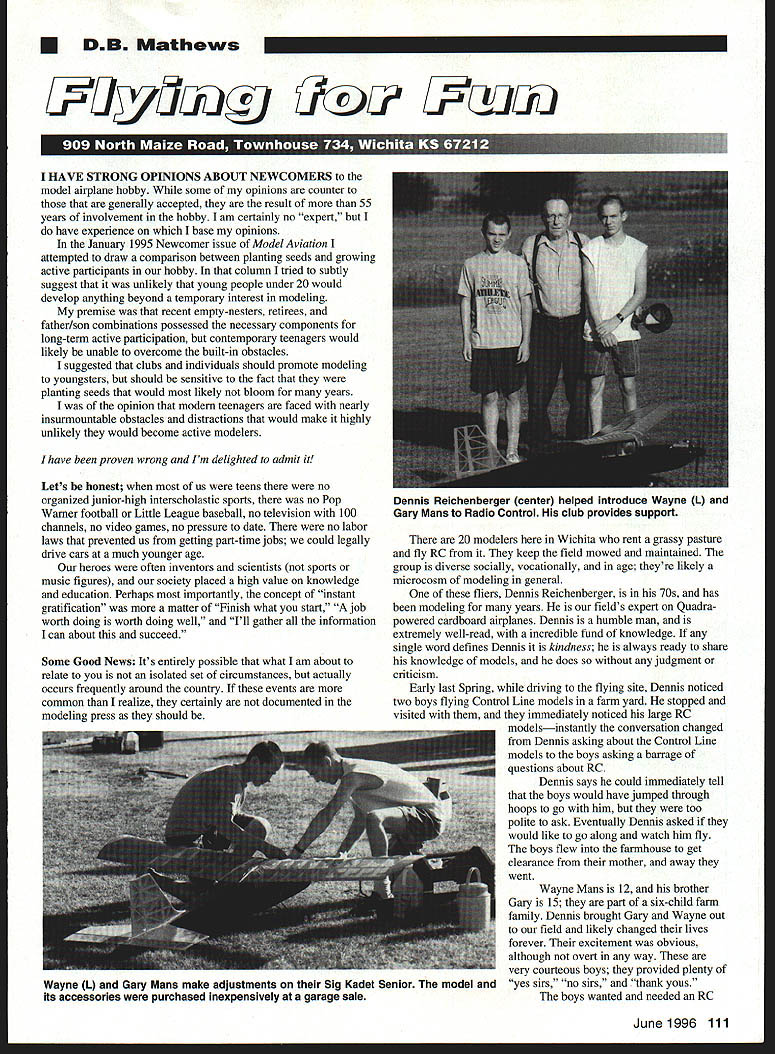
One of these fliers, Dennis Reichenberger, is in his 70s, and has been modeling for many years. He is our field's expert on quadra-powered cardboard airplanes. Dennis is a humble man and is extremely well-read, with an incredible fund of knowledge. If any single word defines Dennis it is kindness; he is always ready to share his knowledge of models, and he does so without any judgment or criticism.
Early last spring, while driving to the flying site, Dennis noticed two boys flying control-line models in a farm yard. He stopped and visited with them, and they immediately noticed his large RC models — instantly the conversation changed from Dennis asking about the control-line models to the boys asking a barrage of questions about RC.
Dennis says he could immediately tell that the boys would have jumped through hoops to go with him, but they were too polite to ask. Eventually Dennis asked if they would like to go along and watch him fly. The boys flew into the farmhouse to get clearance from their mother, and away they went.
Wayne Mans is 12, and his brother Gary is 15; they are part of a six-child farm family. Dennis brought Gary and Wayne out to our field and likely changed their lives forever. Their excitement was obvious, although not overt in any way. These are very courteous boys; they provided plenty of "yes sirs," "no sirs," and "thank yous."
The boys wanted and needed an RC.
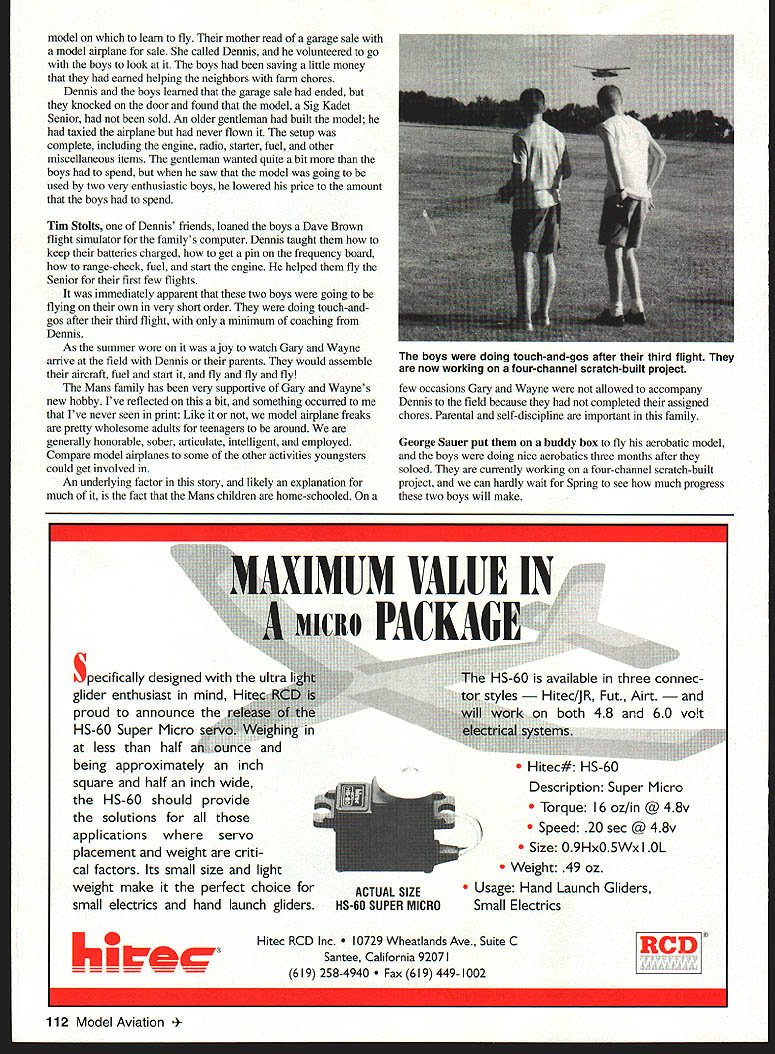
Their mother read of a garage sale with a model airplane for sale. She called Dennis, and he volunteered to go with the boys to look at it. The boys had been saving a little money that they had earned helping the neighbors with farm chores.
Dennis and the boys learned that the garage sale had ended, but they knocked on the door and found that the model, a Sig Kadet Senior, had not been sold. An older gentleman had built the model; he had taxied the airplane but had never flown it. The setup was complete, including the engine, radio, starter, fuel, and other miscellaneous items. The gentleman wanted quite a bit more than the boys had to spend, but when he saw that the model was going to be used by two very enthusiastic boys, he lowered his price to the amount that the boys had to spend.
Tim Stolts, one of Dennis' friends, loaned the boys a Dave Brown flight simulator for the family's computer. Dennis taught them how to keep their batteries charged, how to get a pin on the frequency board, how to range-check, fuel, and start the engine. He helped them fly the Kadet Senior for their first few flights.
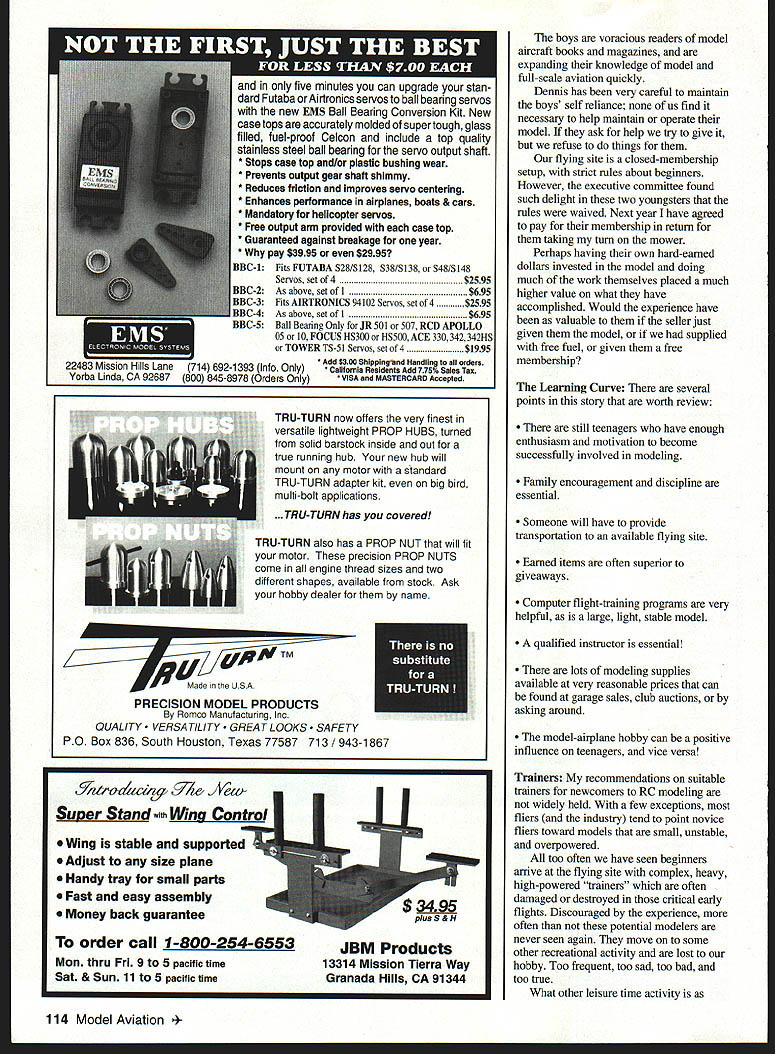
It was immediately apparent that these two boys were going to be flying on their own in very short order. They were doing touch-and-gos after their third flight, with only a minimum of coaching from Dennis.
As the summer wore on it was a joy to watch Gary and Wayne arrive at the field with Dennis or their parents. They would assemble their aircraft, fuel and start it, and fly and fly and fly!
The Mans family has been very supportive of Gary and Wayne's new hobby. I've reflected on this a bit, and something occurred to me that I've never seen in print: like it or not, we model-airplane freaks are pretty wholesome adults for teenagers to be around. We are generally honorable, sober, articulate, intelligent, and employed. Compare model airplanes to some of the other activities youngsters could get involved in.
An underlying factor in this story, and likely an explanation for much of it, is the fact that the Mans children are home-schooled. On a few occasions Gary and Wayne were not allowed to accompany Dennis to the field because they had not completed their assigned chores. Parental and self-discipline are important in this family.
George Sauer put them on a buddy box to fly his aerobatic model, and the boys were doing nice aerobatics three months after they soloed. They are currently working on a four-channel scratch-built project, and we can hardly wait for spring to see how much progress these two boys will make.
The boys are voracious readers of model aircraft books and magazines, and are expanding their knowledge of model and full-scale aviation quickly.
Dennis has been very careful to maintain the boys' self-reliance; none of us find it necessary to help maintain or operate their model. If they ask for help we try to give it, but we refuse to do things for them.
Our flying site is a closed-membership sport, with strict rules about beginners. However, the executive committee found such delight in these two youngsters that the rules were waived. Next year I have agreed to pay for their membership in return for their taking my turn on the mower.
Perhaps having their own hard-earned dollars invested in the model and doing much of the work themselves placed a much higher value on what they have accomplished. Would the experience have been as valuable to them if the seller just given them the model, or if we had supplied it with free fuel, or given them a free membership?
The Learning Curve
- There are still teenagers who have enough enthusiasm and motivation to become successfully involved in modeling.
- Family encouragement and discipline are essential.
- Someone will have to provide transportation to an available flying site.
- Earned items are often superior to giveaways.
- Computer flight-training programs are very helpful, as is a large, light, stable model.
- A qualified instructor is essential!
- There are lots of modeling supplies available at very reasonable prices that can be found at garage sales, club auctions, or by asking around.
- The model-airplane hobby can be a positive influence on teenagers, and vice versa!
Trainers
My recommendations on suitable trainers for newcomers to RC modeling are not widely held. With a few exceptions, most fliers (and the industry) tend to point novice fliers toward models that are small, unstable, and overpowered.
All too often we have seen beginners arrive at the flying site with complex, heavy, high-powered "trainers" which are often damaged or destroyed in those critical early flights. Discouraged by the experience, more often than not these potential modelers are never seen again. They move on to some other recreational activity and are lost to our hobby. Too frequent, too sad, too bad, and too true.
What other leisure-time activity is as beset with potential discouragement as RC modeling is? The new sail- or power-boat purchaser isn't likely to damage his new "toy" on its first outing; the new golfer or tennis player isn't going to return home with damaged equipment after the first day. Nor is the neophyte fisherman, hunter, jogger, or whatever so susceptible to early failure.
Imagine a student pilot who attempts to solo in a P-51 after eight hours of dual instruction! Often the student RC pilot is expected to make his first flights in a small, unstable, .40-powered model with a symmetrical airfoil, and a wing loading of 20 ounces per square foot (or worse). Is it any wonder these pilots crash so often?
Early success is of paramount importance to the neophyte RC flier. If he or she can get the first RC model into the air, make a few recognizable turns, and return the model to the ground in one piece, they'll be hooked. They will experience the exhilarating "high" of accomplishment that is unique to model building and flying.
Conversely, should the modeler's first flights lead to overwhelming difficulties, marginal stability, rapid velocity, or visual disorientation, the beginner will experience a great deal of discouragement.
I have frequently been criticized for recommending RC Old-Timers or powered gliders as entry-level models; the objection being that such super-stable models tend to teach bad flying habits, in that the pilot depends on the model to correct his mistakes.
My response is that any bad piloting habits can be corrected as the novice's level of confidence improves. No one says the entry-level flier will have his first model forever! The second model can be a more-conventional four-channel trainer. However, if the flier isn't successful with the first model, there won't be a second model!
In my opinion the ideal trainer should have a wing loading of 12 ounces per square foot (or less), and be large enough to be seen clearly. It should be powered by an engine that idles well. The model should have at least 5° of dihedral, a large stabilizer, long nose and tail moments, and sturdy landing gear (that can be easily repaired). Perhaps most importantly, the model should be easy to maintain, with all of the systems easily accessible.
- Several suitable Old-Timer conversions are available in kit form, and many others can be scratch-built from magazine plans.
- There are powered gliders in kit form, and some of the Two-Meter gliders are easily converted to power pods.
- Finally, there are a few trainer kits that are essentially Old-Timers in modern dress.
Water Log
It's time to put the floats on your favorite airplane, stock up on dry socks, and head to Higginsville, Missouri for the Ace Float Fly. The event will be held May 31–June 2. It's a perfect chance to fly for fun!
That's it for now. Beginner or expert, make sure you fly for fun.
- DB Mathews
Transcribed from original scans by AI. Minor OCR errors may remain.

