
D.B. Mathews
Flying for Fun
909 North Maize Road, Townhouse 734, Wichita KS 67212
The Good, Bad, and Ugly
THE GOOD, BAD, AND UGLY: Guess who's been reduced to watching old movies on cable? Recent eye problems have kept me out of the workshop and made it very difficult to read; it doesn't leave much else to do. Now there is a definition of boredom!
At any rate, this month's column will start with the ugly: when using one of those beautiful polished metal spinners from Tru-Turn it seems almost immoral to let them become dull and tarnished. Unfortunately, the nature of aluminum is to become oxidized when exposed to the atmosphere (that's why they are displayed in vacuum-sealed bags at the hobby shop).
Additionally, the usual abuses of fuel and exhaust residue, starter cones, and fingerprints lead to pretty ugly-looking spinners in a hurry.
I've tried polishing aluminum spinners with tripoli and jeweler's rouge, stainless-steel spoon cleaner, silver polish — with generally poor results. I noticed some tail wire braces on one of Marvin Reese's models and commented that he somehow had chrome-plated them. He responded that he used Simichrome polish on exposed metal parts with obvious good results.
So where do you buy it? Incredibly, I found it after some phone calls at a Harley-Davidson motorcycle dealership, though I'd suspect most any motorcycle shop would stock it.
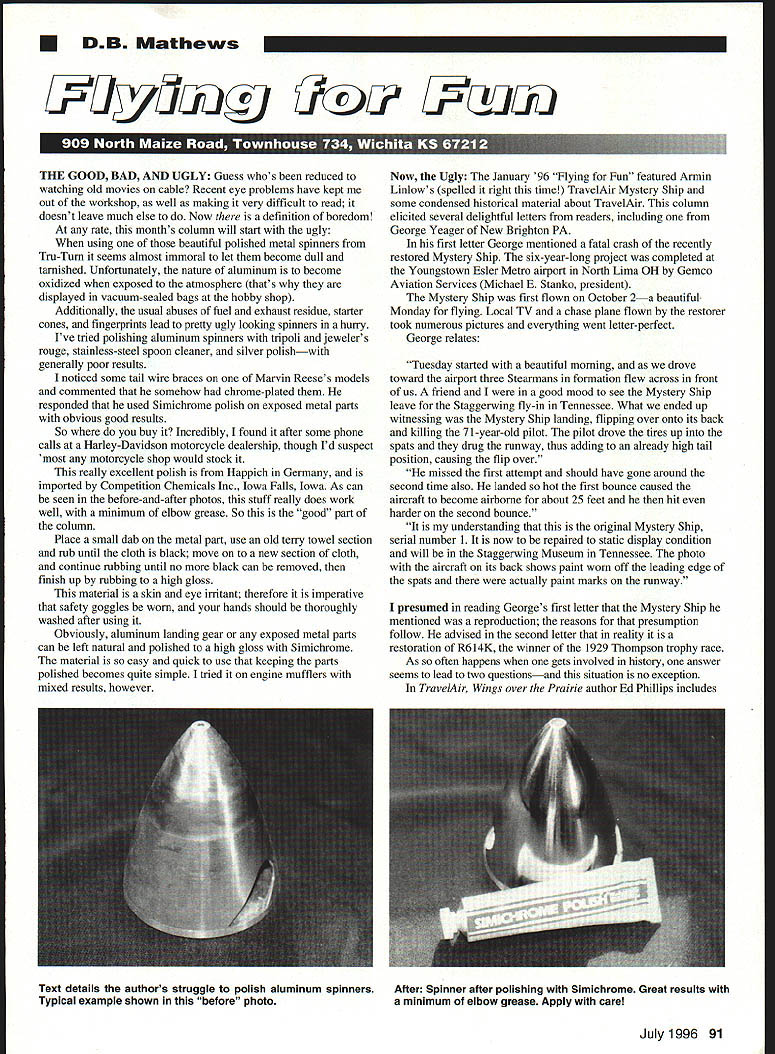
This really excellent polish is from Happich in Germany and is imported by Competition Chemicals, Inc., Iowa Falls, Iowa. As can be seen in the before-and-after photos, this stuff really does work well, with a minimum of elbow grease. So this is the "good" part of the column.
Place a small dab on the metal part, use an old terry towel section and rub until the cloth is black; move on to a new section of cloth, and continue rubbing until no more black can be removed; then finish up by rubbing to a high gloss.
This material is a skin and eye irritant; therefore it is imperative that safety goggles be worn, and your hands should be thoroughly washed after using it.
Obviously, aluminum landing gear or any exposed metal parts can be left natural and polished to a high gloss with Simichrome. The material is so easy and quick to use that keeping the parts polished becomes quite simple. I tried it on engine mufflers with mixed results, however.
The Ugly: The Mystery Ship Incident
Now, the ugly: The January '96 "Flying for Fun" featured Armin Linlow's (spelled it right this time) Travel Air Mystery Ship and some condensed historical material about Travel Air. This column elicited several delightful letters from readers, including one from George Yeager of New Brighton, PA.
In his first letter George mentioned a fatal crash of the recently restored Mystery Ship. The six-year-long project was completed at the Youngstown-Esler Metro Airport in North Lima, OH, by Gemco Aviation Services (Michael E. Stanko, president).
The Mystery Ship was first flown on October 2 — a beautiful Monday for flying. Local TV and a chase plane flown by the restorer took numerous pictures and everything went letter-perfect. George relates:
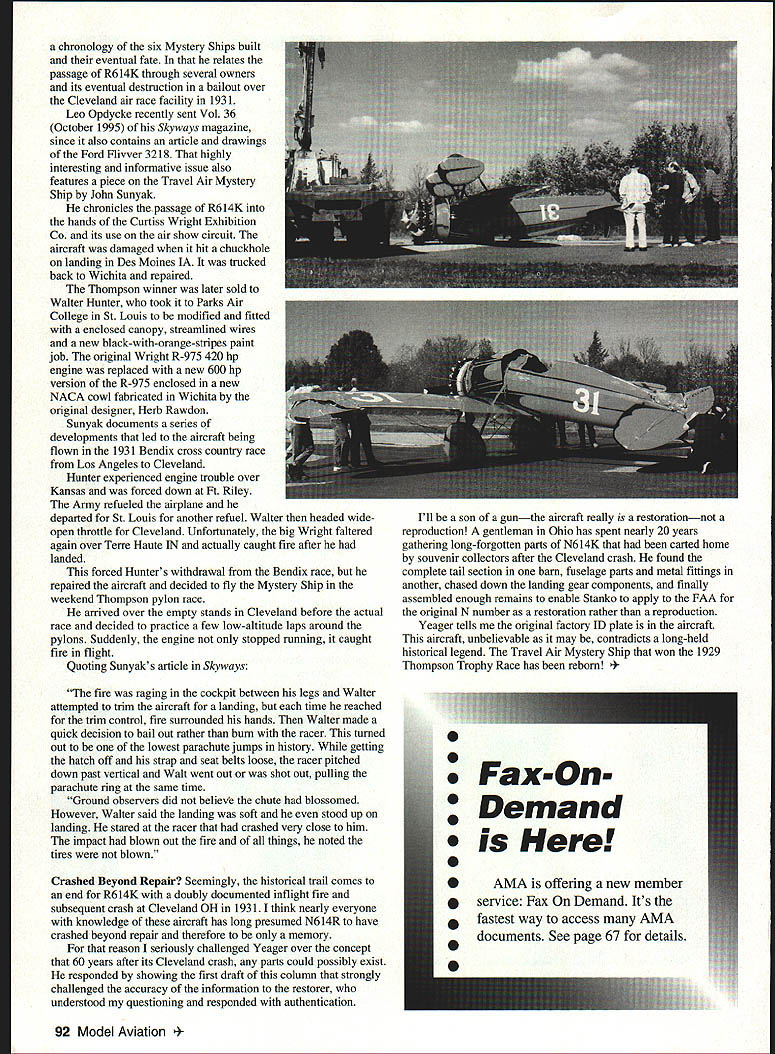
"Tuesday started with a beautiful morning, and as we drove toward the airport three Stearmans in formation flew across in front of us. A friend and I were in a good mood to see the Mystery Ship leave for the Staggerwing fly-in in Tennessee. What we ended up witnessing was the Mystery Ship landing, flipping over onto its back and killing the 71-year-old pilot. The pilot drove the tires up into the spats and they dragged the runway, thus adding to an already high tail position, causing the flip over."
"He missed the first attempt and should have gone around on the second time also. He landed so hot the first bounce caused the aircraft to become airborne for about 25 feet and then hit even harder on the second bounce."
"It is my understanding that this is the original Mystery Ship, serial number N614K. It is now to be repaired to static display condition and will be in the Staggerwing Museum in Tennessee. The photo with the aircraft on its back shows paint worn off the leading edge of the spats and there were actually paint marks on the runway."
I presumed in reading George's first letter that the Mystery Ship he mentioned was a reproduction; the reasons for that presumption follow. He advised in the second letter that in reality it is a restoration of N614K, the winner of the 1929 Thompson Trophy Race.
As so often happens when one gets involved in history, one answer seems to lead to two questions — and this situation is no exception. In Travel Air, Wings over the Prairie, author Ed Phillips includes a chronology of the six Mystery Ships built and their eventual fate. In that he relates the passage of N614K through several owners and its eventual destruction in a bailout over the Cleveland air race facility in 1931.
Leo Opdycke recently sent Vol. 36 (October 1995) of his Skyways magazine, since it also contains an article and drawings of the Ford Flivver 3218. That highly interesting and informative issue also features a piece on the Travel Air Mystery Ship by John Sunyak.
He chronicles the passage of N614K into the hands of the Curtiss-Wright Exhibition Co. and its use on the air show circuit. The aircraft was damaged when it hit a chuckhole on landing in Des Moines, IA. It was trucked back to Wichita and repaired.
The Thompson winner was later sold to Walter Hunter, who took it to Parks Air College in St. Louis to be modified and fitted with an enclosed canopy, streamlined wires and a new black-with-orange-stripes paint job. The original Wright R-975 420 hp engine was replaced with a new 600 hp version of the R-975 enclosed in a new NACA cowl fabricated in Wichita by the original designer, Herb Rawdon.
Sunyak documents a series of developments that led to the aircraft being flown in the 1931 Bendix cross-country race from Los Angeles to Cleveland.
Hunter experienced engine trouble over Kansas and was forced down at Ft. Riley. The Army refueled the airplane and he departed for St. Louis for another refuel. Walter then headed wide-open throttle for Cleveland. Unfortunately, the big Wright faltered again over Terre Haute, IN and actually caught fire after he had landed.
This forced Hunter's withdrawal from the Bendix race, but he repaired the aircraft and decided to fly the Mystery Ship in the weekend Thompson pylon race.
He arrived over the empty stands in Cleveland before the actual race and decided to practice a few low-altitude laps around the pylons. Suddenly, the engine not only stopped running, it caught fire in flight.
Quoting Sunyak's article in Skyways:
"The fire was raging in the cockpit between his legs and Walter attempted to trim the aircraft for a landing, but each time he reached for the trim control, fire surrounded his hands. Then Walter made a quick decision to bail out rather than burn with the racer. This turned out to be one of the lowest parachute jumps in history. While getting the hatch off and his strap and seat belts loose, the racer pitched down past vertical and Walt went out or was shot out, pulling the parachute ring at the same time.
"Ground observers did not believe the chute had blossomed. However, Walter said the landing was soft and he even stood up on landing. He stared at the racer that had crashed very close to him. The impact had blown out the fire and of all things, he noted the tires were not blown."
Crashed Beyond Repair?
Seemingly, the historical trail comes to an end for N614K with a doubly documented inflight fire and subsequent crash at Cleveland, OH in 1931. I think nearly everyone with knowledge of these aircraft has long presumed N614K to have crashed beyond repair and therefore to be only a memory.
For that reason I seriously challenged Yeager over the concept that 60 years after its Cleveland crash any parts could possibly exist. He responded by showing the first draft of this column that strongly challenged the accuracy of the information to the restorer, who understood my questioning and responded with authentication.
I'll be a son of a gun — the aircraft really is a restoration — not a reproduction! A gentleman in Ohio has spent nearly 20 years gathering long-forgotten parts of N614K that had been carted home by souvenir collectors after the Cleveland crash. He found the complete tail section in one barn, fuselage parts and metal fittings in another, chased down the landing gear components, and finally assembled enough remains to enable Stanko to apply to the FAA for the original N number as a restoration rather than a reproduction.
Yeager tells me the original factory ID plate is in the aircraft. This aircraft, unbelievable as it may be, contradicts a long-held historical legend. The Travel Air Mystery Ship that won the 1929 Thompson Trophy Race has been reborn!
Transcribed from original scans by AI. Minor OCR errors may remain.

