

Flying For Fun
Dr. D.B. Mathews
909 N. Maize Rd., Townhouse 734, Wichita, KS 67212
An idyllic Sunday
IDYLLIC. That's what I would call this Sunday. This story was written late on such an evening in July. I spent the day at a noncompetitive fun-fly held on a new buffalo-grass flying field in Clearwater, Kansas. What a truly wondrous day! Light, variable winds pushed growing, puffy cumulus clouds around a bright blue sky, and the temperature was ideal for lots of good old fun.
Around 40 fliers from the immediate area brought more than 70 model airplanes and just flew and flew. Every conceivable sort of fixed-wing RC model — from quarter scale to .10 cu. in. — was handled by fliers aged 14 to retirees with skills ranging from raw beginner to Master Pattern. All of these diverse factors blended into a glorious, fun-filled day.
I have a hunch I've described a picture that was duplicated in at least a hundred other areas of the country that day. I hope you had the opportunity to get out with your friends and fly for fun just as we did in Clearwater!
Semantics: "lifting" airfoils and tails
While visiting the other day with a flying buddy of some 40 years, it occurred to us how silly the terms "lifting airfoil" and "lifting tail" are. After all, aren't all airfoils lifting? Perhaps writers who use this redundancy really intend to say "high-lift." We've seen "lifting airfoil" used in reference to what, in reality, are undercambered airfoils. I've been guilty of referring to a flat-surfaced stabilizer as "nonlifting," and that is also technically incorrect. Any surface will lift if it moves through a fluid at sufficient velocity — consider the Frisbee or the flying stop sign!
Way-back-when material
Many readers have written very positive things about my "way-back-when" photos and stories, so I'll continue blending the old with the new as long as I receive appropriate material.
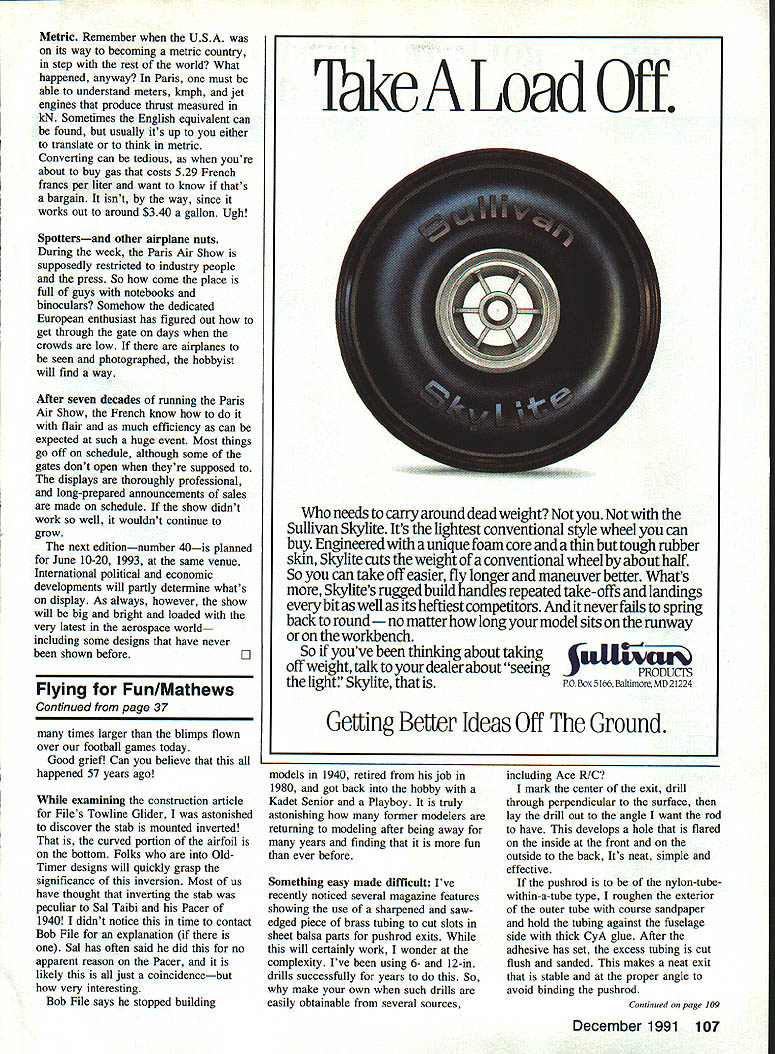
Bob File of Columbus, Ohio was kind enough to share some very interesting material. He built the KG-1 from drawings (he had to enlarge them, of course) that were published in Model Airplane News, April 1935. As readers are aware, collaboration between Joe Kovel and Charles H. Grant, editor of MAN, produced the KG-1 — the first gas-engine design published. File's version was built primarily of hardwood strip and balsa sheet, covered with silk and nitrate dope. He purchased at the local airport an original-power Baby Cyclone, 35 cu. in. Since the KG-1 weighed seven pounds, the Baby Cyclone could get the model to an altitude of about 200 ft after hand launch. The hand-launching photo shows the underpowered 10-footer. The Baby Cyclone was subsequently replaced by the larger, more powerful Brown Junior.
Towline glider record and the Goodyear dock
File set a national record with a towline glider at the 1934 Akron, Ohio Nationals; the design was published in MAN, February 1935. He noticed rising air currents around the windward side of the Goodyear dock. The model was towed up to about 80 ft, released, and soon over the top of the dock climbed to about 500 ft and took off cross-country toward the far edge of the airport. Thereafter it soon disappeared into the clouds. A couple of interesting points are obvious: encounter of ridge lift off a huge hangar dock, and the fact that a back-timer could follow the model in hot pursuit. Since File's glider was relatively small (36-in. wingspan), it is obvious he could not have kept sight otherwise, since its flight was timed at 23 minutes 13 seconds.
One can't help being impressed at the incredible size of the Goodyear blimp dock. The dock photo puts the company's buildings in Akron, Ohio, and the Navy dirigible docks at Lakehurst, New Jersey, and San Diego, California, in perspective; at those places large rain clouds would drift through open doors and rain would fall inside. These buildings were many times larger than the blimps flown over our football games today.
Good grief! Can you believe that this all happened 57 years ago!
Inverted stabilizer curiosity
While examining the construction article for File's Towline Glider, I was astonished to discover the stabilizer is mounted inverted — that is, the curved portion of the airfoil is on the bottom. Old-Timer enthusiasts will quickly grasp the significance of this inversion. Most of us have thought that inverting the stab was peculiar to Sal Taibi and his Pacer of 1940. I didn't notice this in time to contact Bob File for an explanation (if there is one). Sal has often said he did this for no apparent reason on the Pacer, and it is likely this is all just a coincidence — but how very interesting.
Bob File says he stopped building models in 1940, retired from his job in 1980, and got back into the hobby with a Kadet Senior and a Playboy. It is truly astonishing how many former modelers are returning to modeling after having been away for many years and finding that it is more fun than ever before.
Something easy made difficult: pushrod exits
I've recently noticed several magazine features showing the use of a sharpened and saw-edged piece of brass tubing to cut slots in sheet balsa parts for pushrod exits. While this will certainly work, I wonder at the complexity. I've been using 6- and 12-in. drills successfully for years to do this. So why make your own when such drills are easily obtainable from several sources, including Ace R/C?
My method:
- Mark the center of the exit.
- Drill through perpendicular to the surface.
- Then lay the drill out to the angle you want the rod to have and enlarge the hole accordingly.
This develops a hole that is flared on the inside at the front and on the outside to the back. It's neat, simple and effective.
If the pushrod is to be of the nylon-tube-within-a-tube type, I roughen the exterior of the outer tube with coarse sandpaper and hold the tubing against the fuselage side with thick CA glue. After the adhesive has set, the excess tubing is cut flush and sanded. This makes a neat exit that is stable and at the proper angle to avoid binding the pushrod.
Pushrod flex and remedies
Speaking of pushrods: the inner portion of nylon tube-in-a-tube pushrods is terribly flexible, and one must be careful so it does not flex under air loads. I frankly no longer use the inner portion, but have switched to using sections of 30-in. threaded rod with a solder link on the servo end and an adjustable link on the control horn end. Putting a fuselage crossbrace every six inches along the pushrod's length will usually give a very solid, nonflexing arrangement.
If the flexible nylon inner portion is used, use a longer section of threaded rod at both ends and brace the mid-portion of the setup well. If you can deflect the rods with your finger, they are too soft and will be a problem in doing aerobatics.
Eut Tileston: making Old-Timers winners
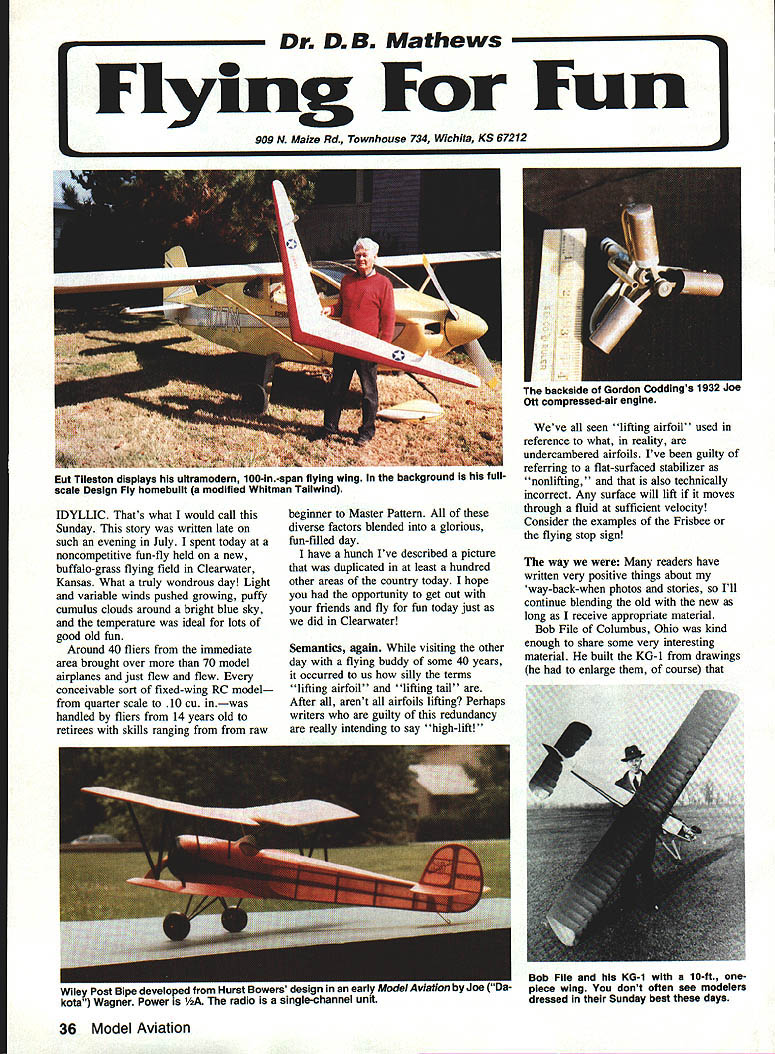
Eut Tileston has the uncanny ability to find obscure Old-Timer designs and turn them into winners. I ran photos years ago of Eut's fleet of New Cyclone Lancers of various sizes. Most of us dismissed the design as a cute sport Free Flight. Eut built them and won event after event with them.
There are some who believe Eut's success might have something to do with superb craftsmanship and flying rather than just power and plane selection. Regardless of the reasons, he remains a consistent winner in SAM (Society of Antique Modelers) events.
For those who looked at the photo of the flying wing and accepted it as an ultramodern design: gotcha! The model is a Frank Zaic (Jasco) kit from 1946. Eut doubled its original 50-in. span and added a radio (of course), but it is nonetheless a 45-year-old design. That is truly amazing and speaks well for the genius of Frank Zaic. Compare the wing of the contemporary Bird of Time RC sailplane to his Thermic series.
Compressed-air motors and Joe Ott's unit
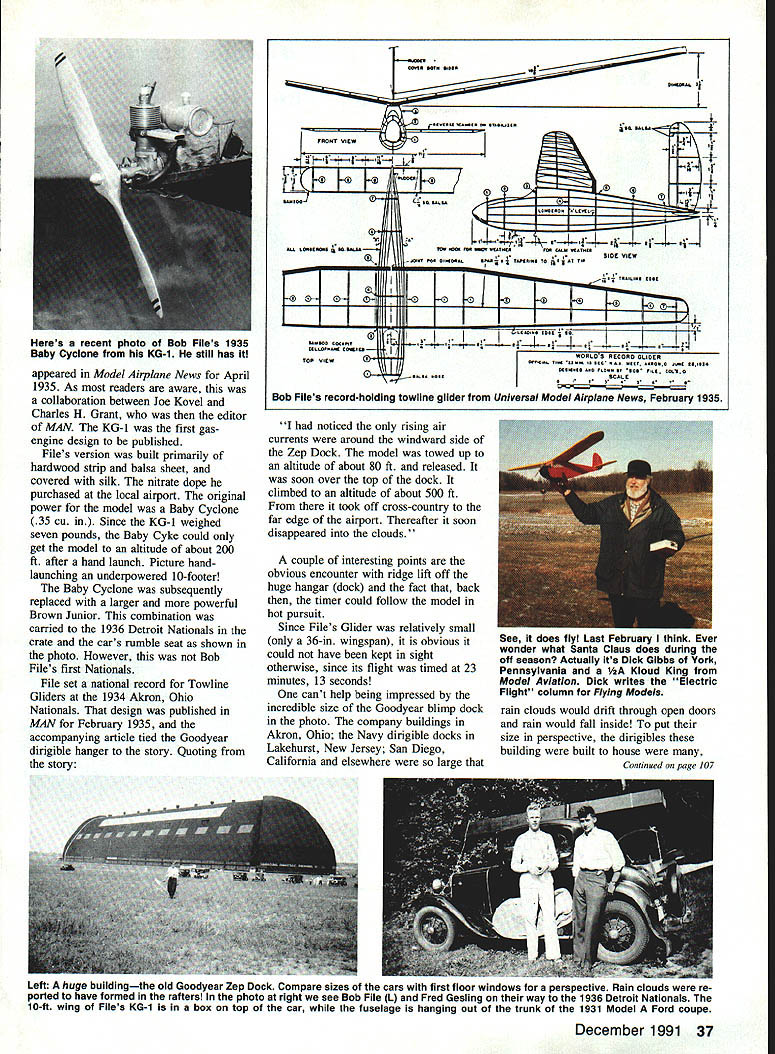
Gordon Codding of Kingman, Arizona shares a really odd power plant with us. Compressed-air motors were popular in the 1930s for use in models that fell between rubber-powered and internal-combustion units. Their placement was similar to the CO2 power units of today.
A compressed-air motor runs much like a steam engine in that a compressed gas is released on top of a piston, pushing it down until the gas escapes. In this case the compressed gas is generated by pumping a large cylindrical tank full of atmospheric air using a large tire pump. These tanks were usually made of thin brass and wound with wire for strength and safety, since they had to withstand about 100 psi.
These motors are simple, quiet, and relatively inexpensive. Unfortunately, not much power is available, necessitating model designs that are rather large and light. Compressed-air events are still flown at some SAM-type contests.
The Joe Ott compressed-air unit, as pictured, has a 1/2-in. bore and three cylinders. Gordon tells me that the cylinders are lipstick tubes, the pistons are lightweight aluminum, and the connecting rods are of a thick bronze spring material. The crankcase is made from the same brass as the cylinders, and the brass three-fingered spider holds the cylinders in an open configuration for lightness. The crankshaft is fabricated from a piece of aluminum tubing with a steel center shaft at the front for the propeller. Only 1/16 in. of the shaft is threaded, suggesting the use of rather thin, bentwood props.
In accordance with the "use what you have" engineering approach, the prop and shaft nuts, fore and aft, are from the binding posts of 1/2-volt doorbell batteries — the kind used by modelers for many years as booster (starting) batteries on ignition engines. The entire unit weighs just under two pounds and is said to swing a 15-in. prop of 18- to 20-in. pitch. These specifications are almost identical to the props used on Wakefield rubber jobs of the same period.
John Worth reported on an imported compressed-air motor in this magazine not long ago, indicating interesting results with this modern approach to an old concept. It uses a plastic soft-drink bottle for its air-storage tank.
In the era of the Joe Ott unit, soda came in returnable glass bottles. Lots of us raised the 10 cents for the purchase of Comet or Whitman kits by scrounging up empty glass bottles from ditches and alleys and returning them to the store for the deposit folks were required to pay in those days. (As a matter of interest, landfills and vacant lots weren't littered with aluminum and plastic soft-drink bottles when we were kids, were they? Think there might be a lesson here?)
O.O.S. — out of sight
What is O.O.S.? It's been a while since most of us have seen that term used, hasn't it? For the benefit of those who have never known the joy of Free Flight, "O.O.S." means "out of sight." Such a situation occurs when the model fails to dethermalize or hangs up in such a huge thermal it simply won't come down. It just flies off (or up) until it's O.O.S.
To everyone who has lost a model airplane from sight permanently, we dedicate the following from the "Canard Papers" by Tom Chipley.
Canard Papers — Tom Chipley
Canard: (ke-nard') n., a false story, report, or rumor, usually derogatory; hoax. From the French: duck ... to cackle = can + ard — how true, how true!
It is said that, someplace in the heart of the great African grassland, there is a place where the ground is covered with ivory and the skeletons of elephants who finally used up their allotted time in the Great Grass Eden ... someplace known only to the elephants, where they go to die. It is also said that this is only a myth. Elephants, when asked, remain stoically silent on the subject.
As a much younger person, I built and free flew tissue-covered models usually powered by Cox .049 engines with the throttle set for very low speed, since the planes were usually fairly light, and I had never heard of dethermalizers.
At that age I was impatient and impetuous. I would shop hurriedly for the kit I could afford that looked like it had the right amount of wing area, hustle it home on the bus, run from the bus stop to my house (about 1/4 mile ... but at the time it seemed so much longer), and begin pinning balsa down on the plans. I would then wax the paper to the plans to handle. I would blow on the Testor's #2 glue until I hyperventilated and got dizzy.
When the model was finished (or what I considered finished), I would carry the fuselage and wing separately on my bicycle (usually without falling over or breaking either major aircraft component) to a large grass-and-broom-straw field about a mile from the house. There I would find a relatively clear area, start the little Cox, twist the needle valve out until the engine spluttered, put the plane on the ground pointed into the wind, let go and hope for the best.
On the days when I was very lucky, I would have built enough warpage into one or more of the flight surfaces that the little plane would fly in circles in both the climb and glide and would actually return to the field ... or close enough.
Occasionally, however, I would have done things right for a change, and the plane would rise off the ground, climb strong and straight into a wind that had come all the way from the Atlantic Ocean for the occasion and carried the spirit of gull and pelican and albatross to lift and guide this youthful sprite of the air. After a few seconds, if all was really going well, the engine would lean out, and the ship would climb with a vengeance until I could not find it against the blue of the sky. And then it would be gone. The sound, the sight — gone from my world — perhaps to another.
Perhaps there is a place where free-flying models go to live among the air currents. For years I was not sure, but I hoped it was so.
Many years later, while walking with my old dog in another field and another time, as I watched the sunset turning the distant clouds magenta, my eye followed a speck that spawned similar specks as it moved closer. Tiny dots circling in the waning light of dusk — silhouetted against the deepening magenta-purple of the clouds on the horizon. Buzzards riding a thermal? Sure ... what else could it be?
But they looked longer than the buzzards — so distant were they that my eyes tried to sharpen the focus. And then the darkness settled down like a gray veil that folded back on itself until it shut off all the light, and the embers of burning clouds became black, and the first stars shone over my shoulder.
A friend, upon hearing this, admitted to a strange find. On a Sunday a few years past, he and some friends were flying gliders at the large grass parking lot for the football stadium. When the day was drawing and the planes were all rounded up, to the astonishment of the fliers there was one too many planes!
The odd one was a badly weathered, silkspan-covered Free Flight with a pair of cracked Trexler airscrews, and an engine so badly rusted they were not exactly sure of the make. He thinks it was a Brown Junior, however. It was so fragile that it began to break apart as they handled it.
One of the guys took it home but reported later that the plane was too far gone to salvage. My friend admits to wondering about where the plane came from, but when asked if he believed it possible for a plane to stay airborne for years, he smiled and shook his head slowly. But there was a light in his eye that spoke of ageless clouds and the unending ocean of the sky.
Another true story: Bob Grimes and the Bootstraps
To put some grim reality into the lovely words of Tom Chipley, here is another slant on the same subject. Bob Grimes of Huntsville, Alabama writes:
"In 1954, while stationed at Hamilton AFB, California, I got into RC. By the way, we were flying F-94Cs out of the 84th Fighter Interceptor Group. Our squadron insignia is the one Bob Violette has on his model F-86. To my knowledge the 84th never flew F-86s.
"Anyhow, I had an uncle who lived in Novato, California, north of San Francisco. When he told one of his employees that I was building an RC model, the employee said: 'Hey! I've got one of those in my attic that I found in a tree in my field.' He gave me the plane which turned out to be a Bootstraps. It was in pretty good shape except for a rusted O.K. .14 and a sloppily assembled Aerotrol receiver.
"Everything was mounted as shown in your October 1988 'RC Old-Timers' column. The plane was covered in blue silk for the fuselage and yellow on the wing and tail. I'm sure someone from the San Francisco area had headed north to find some level ground to fly the Bootstraps and had lost it in the process.
"When I moved out of the Air Force to Wichita, I took the Bootstraps back to Kansas. While an aero engineering student at Wichita University, I flew it numerous times as a Free Flight, as I couldn't afford the dry cells for my Citizens Band single-channel radio. It flew beautifully, with a scale-like climb. I would set the rudder for large circles, fill the tank with fuel, launch the plane, man the binoculars, and follow it in a car until it landed.
"After graduation from WU, I worked for Boeing's flight test section for a few years, then came back to work for NASA in 1961. I got back into RC at about that same time, and I'm still enjoying it. I retired three years ago and am fighting the obsession to treat modeling as a vocation rather than a hobby."
Is it possible this letter could jangle the memory of someone who might have lost the Bootstraps near Novato, California in 1954? Wouldn't that be wild?
On nitro and fuel
As everyone must be aware by now, an explosion at a major refinery has reduced the available supply of nitromethane in the U.S. by about 50%. My thought on this is simplistic, but consider: if each of us were to reduce the nitro content of our fuel by 50%, there wouldn't be a shortage. Somehow this idea must have a flaw, but if those who are accustomed to using 20% fuel were to use 10%, such a limited supply wouldn't be a problem, would it?
Finally
I just had to include the Santa photo of Dick Gibbs since this is the December issue and time for a traditional Merry Christmas and Happy New Year.
Transcribed from original scans by AI. Minor OCR errors may remain.

