
Flying for Fun
D.B. Mathews 909 North Maize Road, Townhouse 734, Wichita KS 67212
OXYMORONS
Webster defines an oxymoron as "A combination of contradictory or incongruous words." Some classic examples are:
- "military intelligence"
- "sanitary landfill"
- "new antiques"
- my pet, "converted rice"
Modeling also seems to have created its share of these contradictory phrases. The amusing aspect of this phenomenon is our tendency to verbalize and write them without much consideration.
I often catch myself saying and writing phrases that are rather embarrassing when I stop and think about them. As an example, "glow and ignition engines" doesn't hold up well to analysis. Don't glow plugs ignite the fuel/air mixture too? In reality we mean "glow and spark," don't we?
This leads into a pet oxymoron that is repeated in conversations between modelers and in the modeling press — "flat-bottomed Clark Y airfoils"!
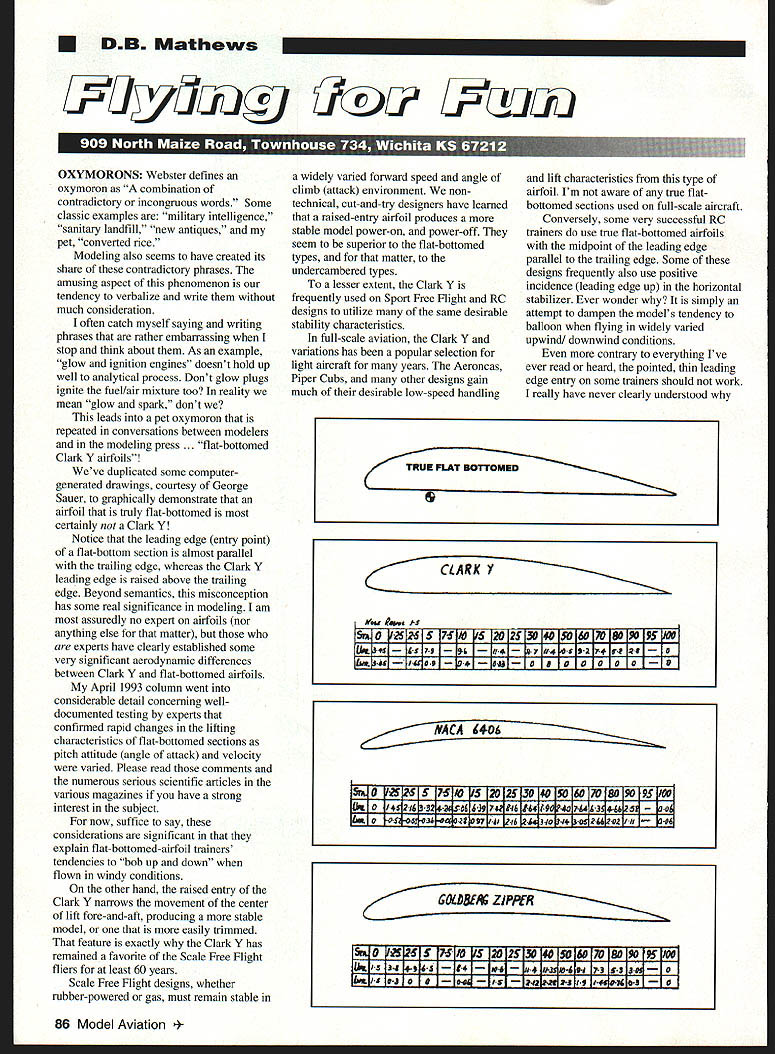
We've duplicated some computer-generated drawings, courtesy of George Sauer, to graphically demonstrate that an airfoil that is truly flat-bottomed is most certainly not a Clark Y.
Notice that the leading edge (entry point) of a flat-bottom section is almost parallel with the trailing edge, whereas the Clark Y leading edge is raised above the trailing edge. Beyond semantics, this misconception has some real significance in modeling. I am most assuredly no expert on airfoils (nor anything else for that matter), but those who are experts have clearly established some very significant aerodynamic differences between Clark Y and flat-bottomed airfoils.
My April 1993 column went into considerable detail concerning well-documented testing by experts that confirmed rapid changes in the lifting characteristics of flat-bottomed sections as angle of attack and velocity were varied. Please read those comments and the numerous serious scientific articles in the various magazines if you have a strong interest in the subject.
For now, suffice to say, these considerations are significant in that they explain flat-bottomed-airfoil trainers' tendencies to "bob up and down" when flown in windy conditions.
On the other hand, the raised entry of the Clark Y narrows the movement of the center of lift fore-and-aft, producing a more stable model, one that is more easily trimmed. That feature is exactly why the Clark Y has remained a favorite of the scale free-flight fliers for at least 60 years.
Scale free-flight designs, whether rubber-powered or gas, must remain stable in a widely varied forward-speed and angle-of-attack environment. We non-technical, cut-and-try designers have learned that a raised-entry airfoil produces a more stable model power-on and power-off. They seem to be superior to the flat-bottomed types, and, for that matter, to the undercambered types to a lesser extent.
To a lesser extent, the Clark Y is frequently used on sport free-flight and RC designs to utilize many of the same desirable stability characteristics.
In full-scale aviation, the Clark Y and its variations have been a popular selection for light aircraft for many years. The Aeroncas, Piper Cubs, and many other designs gain much of their desirable low-speed handling and lift characteristics from this type of airfoil. I'm not aware of any true flat-bottomed sections used on full-scale aircraft.
Conversely, some very successful RC trainers do use true flat-bottomed airfoils with the midpoint of the leading edge parallel to the trailing edge. Some of these designs frequently also use positive incidence (leading edge up) in the horizontal stabilizer. Ever wonder why? It is simply an attempt to dampen the model's tendency to balloon when flying in widely varied upwind/downwind conditions.
Even more contrary to everything I've ever read or heard, the pointed, thin leading-edge entry on some trainers should not work. I really have never clearly understood why they do work, but that they are successful is very obvious.
In fairness, I've used true flat-bottomed airfoils on several published designs, and now I really wish I had not. I can only excuse the fact by claiming ignorance and that they were designed many years ago.
The appeal of a true flat bottom lies in construction ease: one can lay down the trailing edge, capstrips, spars, sheeting, and leading edge flat before adding the ribs. However, it is also possible to construct a Clark Y in the same manner, with the exception of not adhering the front sheeting until the ribs are added and the leading edge is in place. It is even easier to wait until the panel is off the board before adhering the bottom front sheeting.
Parenthetically, the newer versions of one manufacturer's trainers and another's newer scale high-wing design use Clark Y–type airfoils. This surely says something!
At any rate, if a model has an airfoil that is flat fore-and-aft, it is most certainly not a Clark Y!
Another Oxymoron
We've also illustrated two other airfoil types (NACA 6406 and Goldberg's Zipper) that are subjected to an oxymoron. We tend to refer to any airfoil with undercamber as "high lift," which again doesn't stand up well to critical reflection.
At low airspeeds these airfoils do lift more than the Clark Y or symmetrical types, and back when full-scale airplanes took off at 60 mph, flew at 60 mph, topped out at 60 mph, landed at 60 mph, and stalled at 60 mph, such airfoils as the NACA 6406 worked admirably. However, as faster aircraft were developed, these sections became a real liability from the standpoints of drag, poor lift at speed, and critical stability. You'll not find such an airfoil on a modern, heavy, high-performance airplane simply because it likely would never get off the ground, and if it did, the aircraft would be dangerously unstable.
The Goldberg section is a classic example of a superb free-flight airfoil. It is designed to provide lots of lift at very slow forward speed in a gliding mode. At higher speeds, such as those at which contemporary competition RC gliders fly, this section does not provide as much lift as modern airfoils.
Such airfoils certainly do not provide "high lift" in all settings. They lift a lot at low airspeeds but not at high velocities. So calling these airfoils "high lift" is not really accurate; "undercambered" is likely much more appropriate.
A Lost Art
In researching this piece, I dug out a set of airfoil sections drawn by Paul Plecan for the 1943 Air Trails Annual. Illustrated are some airfoils that were in popular use back then but are seldom seen today, simply because the newer airfoils are superior for modeling use. However, he does show the Clark Y and notes it as superior for general model use, just as it still is.
As was the custom for many years, the drawings included coordinates to be used in enlarging the sections. These stations, measured front-to-back, were marked on a straight line from measured, factored points above and below. Once these were marked, a line was drawn between the points to develop the top and bottom outlines.
This took more than a little skill, and in the hands of most of us used up large chunks of time, often resulting in woefully inaccurate sections.
With the advent of copiers capable of enlarging and reducing drawings, and now computer-generated airfoil drawing programs, I seriously doubt anyone in his or her right mind would develop an airfoil drawing using coordinates. An art is lost—and good riddance.
Hopefully you have found some amusement in this little diatribe about nonsense terms. If you have some you've noticed in modeling, would you share them with us? Frankly, if you want to use the oxymorons mentioned, go right ahead; this is a hobby, not a course in English Comp.! No grade will be given—except, as always, you should be having fun.
Transcribed from original scans by AI. Minor OCR errors may remain.

