
Flying for Fun
D.B. Mathews 909 North Maize Road, Townhouse 734, Wichita, KS 67212
Although the cover date on this issue is May 1997, many of you will likely receive it in late March, so I made this an April Fools' column.
Gravity and Stuff
Everyone knows about Sir Isaac Newton and his adventures underneath a tree. Fortunately he chose to sit under an apple tree rather than a coconut palm. That experience led him to develop a series of mathematical calculations relating to gravitational forces—calculations that have bedeviled physics students ever since. Oddly, Isaac Newton became immortal for his contribution to mankind, while his brother Fig, a baker, has been all but forgotten.
Unfortunately, Newton's law of gravitation contains an error. Gravity is not distributed evenly above the Earth. Modelers are aware of this from observation rather than fancy mathematics.
Consider a hawk or an unpowered airplane gliding around the sky: inevitably it is being pulled back toward the Earth's surface. Suddenly the object begins to climb for no visible reason, defying Newton's laws. People watching the sky, including modelers, have seen objects such as trash or leaves rise and rise, sometimes out of sight. The explanation for this frequently observed phenomenon is obvious: the object has wandered into an area of little or no gravity—a gravity hole.
Dave Thornburg has written a book, Old Buzzard's Soaring Book, about soaring without grasping the existence of gravity holes. Instead, he and many others credit the random ascension of various objects to rising columns of hot air. That explanation is not supported by fundamental logic: if hot air alone caused things to rise, nothing would stay on the ground in the world's hot‑air capital, Washington, D.C.—the sky would be completely darkened with floating red tape and shredded documents. The truth obviously involves gravity holes.
When a hole is created, the removed material must be disposed of somewhere, so for every gravity hole there must also be a gravity dump. Dumps are areas of very dense gravity that pull objects downward with intense force. While gravity holes seem to move about space with ease and can be rather elusive, gravity dumps are always created under trees and on the surfaces of flying fields. This explains why model airplanes land in trees and behave oddly over landing sites.
I realize this is mind‑boggling, and I won't ask you to accept it without study. Observe the models at your flying field and you will quickly agree.
Smoke
This piece of "scientific" information is not original, and I don't know where I first read or heard it: electric devices are powered by smoke. Electrical energy moves the smoke around inside the mechanisms in order for them to function. If, for any reason, the smoke escapes, the device stops working—so, "Don't let the smoke out."
(Yes, this is tongue‑in‑cheek.)
Gotcha
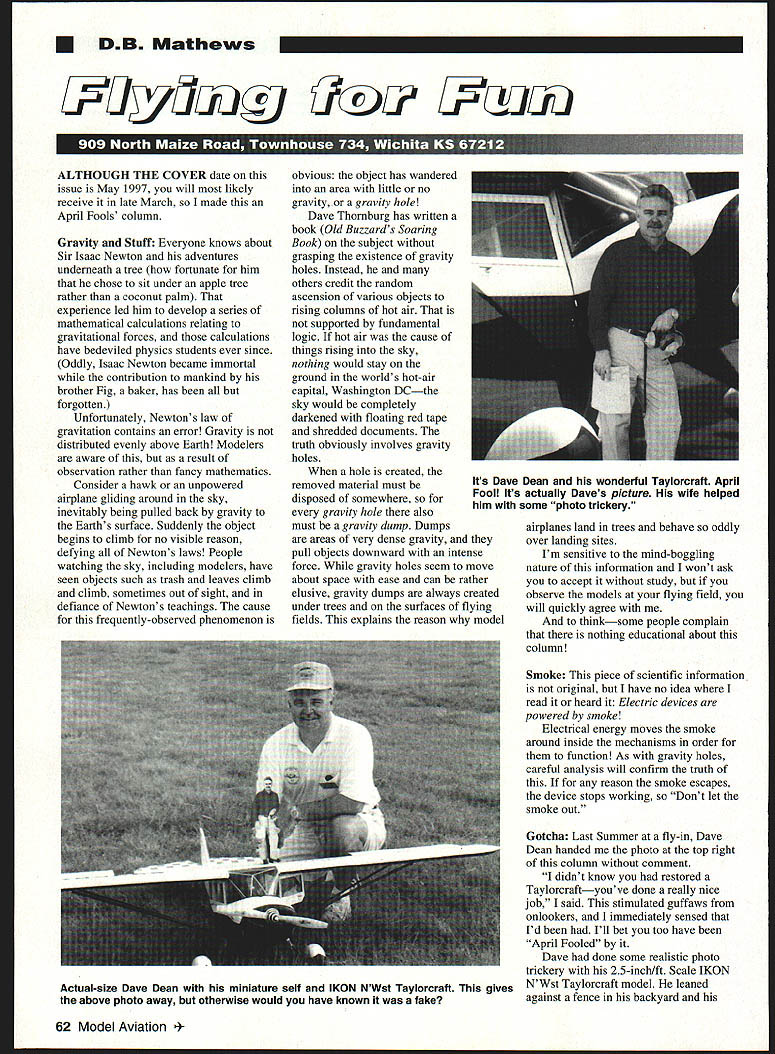
Last summer at a fly‑in, Dave Dean handed me a photo without comment. I remarked, "I didn't know you had restored a Taylorcraft—you've done a really nice job." Onlookers guffawed and I immediately sensed I'd been had.
Dave had done realistic photo trickery with his 2.5‑inch-per-foot scale Taylorcraft model. He posed against a fence in his backyard while his wife took the picture. He then enlarged the photo, pasted it onto lite‑ply, carefully cut out the image, and colored the cut edges black with a Magic Marker. The cutout placed against the model produced a remarkable three‑dimensional appearance—the second photo proved the first was fake. I doubt you would have known without the reveal.
I've also been amazed at the current state of computer imaging. A television special showed George Lucas' Industrial Light & Magic work on the new 101 Dalmatians movie: they generate crowd scenes by digitally reproducing a puppy's image and rearranging its spots—the single puppy becomes many dogs. That's certainly much simpler than attempting to get 100 pups to move the same direction on cue. I guess the old saying "seeing is believing" is no longer accurate.
Transcribed from original scans by AI. Minor OCR errors may remain.

