
Flying for Fun
D.B. Mathews 909 North Maize Road, Townhouse 734, Wichita KS 67212
Modeling columns have often discussed the structured portions of the hobby and recruitment of newcomers. My intent here is to welcome new modelers and to offer something that experienced modelers can pass on to increase newcomers' long-term enjoyment of the hobby—one cardinal rule for operating engine-powered model airplanes: do not get your body parts entangled in spinning propellers.
Propeller hazards
Many people have seen modelers (newcomers and experts alike) injured by props. Anyone with common sense can recognize the potential for injury from a rotating propeller blade. With the noise, heat, exhaust smoke, and propwash blowing away, warnings printed on blades advising that propellers can cause harm may seem superfluous. Whether model aircraft propellers are 5 x 4 or 26 x 8, they are potentially dangerous.
Protocol
In common medical usage, protocol is a deliberate, well-considered plan of action that is to be repeated precisely in a given situation. Experienced modelers should develop engine-operation protocol to pass along to newcomers. That involves three steps:
- Assess the potential hazards.
- Develop a plan of action to best avoid the hazards.
- Execute that plan intelligently.
The "Safety Comes First" column has reported many terrible injuries to hands, arms, and other extremities. Modelers who have been in the hobby for any length of time have probably witnessed painful injuries and may have had close calls themselves. It is our obligation to relate some of these horror stories to newcomers so they understand the real danger.
Why safety features aren't enough
Trendy painted propeller tips and remote needle valves may induce a false sense of security and may actually increase the danger for the inexperienced. Over the years, Top Flite nylon props were white, Tornado's props were yellow, and small 1/2A engines have had remote needle valves for decades. Many modelers have been injured despite these "safety" features.
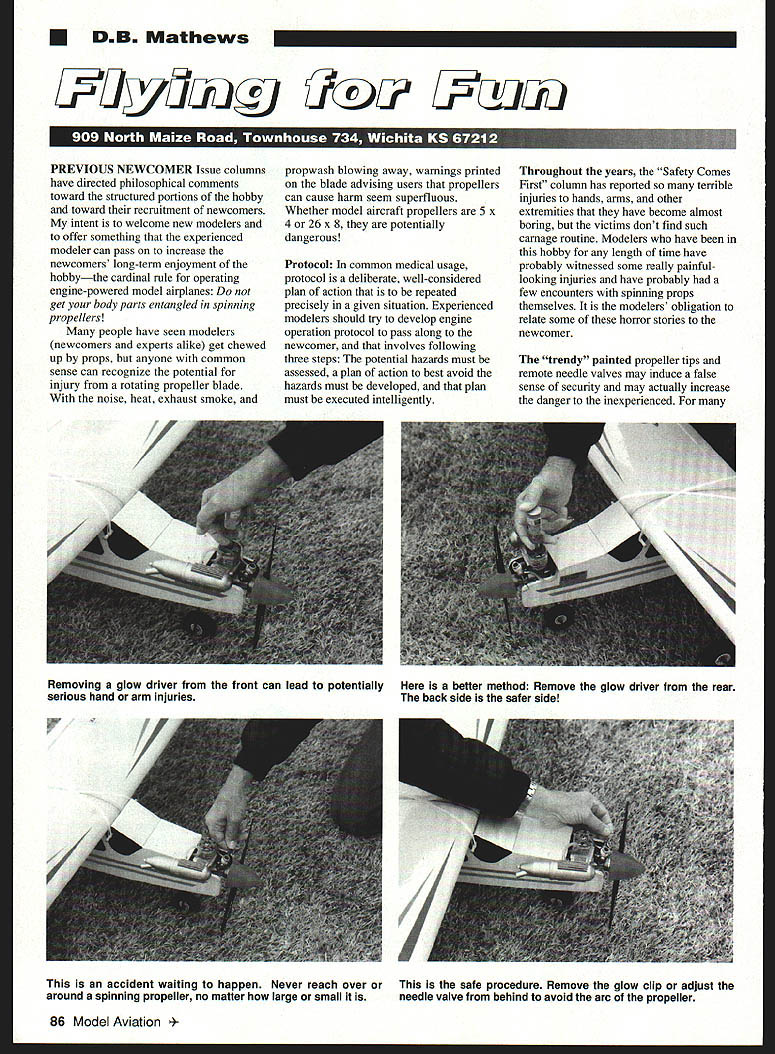
A common risky behavior is reaching up, over, around, or behind a spinning propeller to remove a glow clip or adjust a needle valve. People taught junior-high woodworking never reach across a running table saw blade—saws don't move; model aircraft do. I don't have statistical data, but I'll bet at least 90% of prop injuries result from reaching through the prop arc. Taking unnecessary risks is a sign of bravado or immaturity; the intelligent modeler assesses a propeller's danger and avoids it.
To get a sense of the awkwardness, stand a magazine on its end, place a piece of paper on the other side, pick up a pencil, and attempt to sign your name reaching across the magazine. It's awkward—and the magazine isn't spinning, nor are you juggling a transmitter in one hand while kneeling on the ground. That little drama can have a very unhappy ending; do not join the cast.
Common practices and where injuries occur
- Power free-flighters often adjust engines from the rear.
- Sport fliers who fly models with large engines sometimes adjust needles while the engine is running because the carburetor jets are inaccessible from the front.
- Control-line (CL) fliers usually have a pit man remove the plug clip and adjust the needle from behind while holding the model.
- RC sport fliers are frequently the ones injured. Tractor (puller) propellers are designed so the back side is the safer side because it tends to push fingertips away.
Despite the variety of techniques, prop injuries still happen across all disciplines.
Simplified, essential protocol
Insist that newcomers follow these simple rules:
- Start engines from the front.
- Remove the glow driver (plug clip) from the rear.
- Adjust the needle valve from behind to avoid the propeller arc.
Start engines from the front and adjust them from the back—it's a small discipline that greatly reduces risk.
Transcribed from original scans by AI. Minor OCR errors may remain.

