
Flying for Fun
D.B. Mathews 909 North Maize Road, Townhouse 734, Wichita, KS 67212
Why not?
My challenge and the resultant success of Duane Dahnert's Ford Flying Flivver (March 1996 issue) has led me to toss out another scale subject that is worthy of attention. As is the case with many longtime modelers, I have a list of unusual subjects and projects I'd like to build “someday.” Scale designs seem to accumulate that modelers wish someone would kit, or at least develop for publication.
The Piper Skycycle is near the top of my list. I've even suggested it to a couple of the fiberglass aftermarket providers, but neither of them knew the prototype, so they had no interest.
Skycycle Background
As it became increasingly likely that the Allies were going to win WWII, various aircraft manufacturers began to plan for the drastic reduction of military contracts.
In anticipation of the massive explosion in civilian flying, many aircraft companies began to assign development of civilian designs to small groups of engineers. This use of “strategic” personnel was in violation of War Department rules, so some groups were forced to design at home, after hours, or clandestinely at work.
North American assigned a four-place aircraft seating concept to its California plants and a two-place concept to its Texas division. The Navion was chosen, causing the Texas team to split off to form Globe Aviation and develop its Swift.
Beechcraft came up with the Bonanza; Cessna, the 120/140; Culver, the Super V; Republic, the Sea Bee; Stinson, the 150 series; Aeronca, the Sedan and the Champ; and Aero, the Ercoupe. Though falling terribly short of the “airplane for every family” dream, all were at least moderate commercial successes.
Among the less successful were the WACO Aristocraft pusher, the Douglas twin-engine single-pusher Cloudster, Meyers 120, Johnson Rocket, Piper Sky Sedan, Rawdon T-1, Consolidated Aircar, and Cessna's helicopter.
In the November 1945 Model Airplane News, Robert McLarrin's Skycycle write-up predicted 500,000 private aircraft by 1955! The postwar aviation boom became a bust. By 1952 far more workers were being laid off than hired, and many manufacturers were closed or were merged into new entities.
Many returning GIs who started flying lessons under the GI Bill were turned away when Congress withdrew that portion of the benefits in response to media criticism from Fulton Lewis Jr., Drew Pearson, etc. The GIs could not afford to continue pursuing the dream of flying.
By the late 1950s, millions of people were flying for the first time — commercially, not privately. Pleasure-flying one's own airplane became only a fond memory for all but the wealthy. Usually, business aircraft are the only small aircraft flying.
Skyrocketing liability insurance costs, increasingly restrictive and annoying regulations, aging, and other factors have made modelers out of a large number of private fliers.
Minifighters
The same dream of a single-place businessman's airplane that had intrigued the Ford Motor Co., and led to its Flying Flivver (July 1995 column), appeared to be even more attractive for the postwar era.
The Piper Skycycle is a contemporary of other single-place designs, such as the Lockheed Lil' Dipper, Luscombe Model 10, and the Mooney Mite. While Piper, Lockheed and Luscombe concluded that the single-place market did not exist and directed their resources at more conventional aircraft, Mooney entered production. After selling only a handful of Mites, it also abandoned the concept.
Models
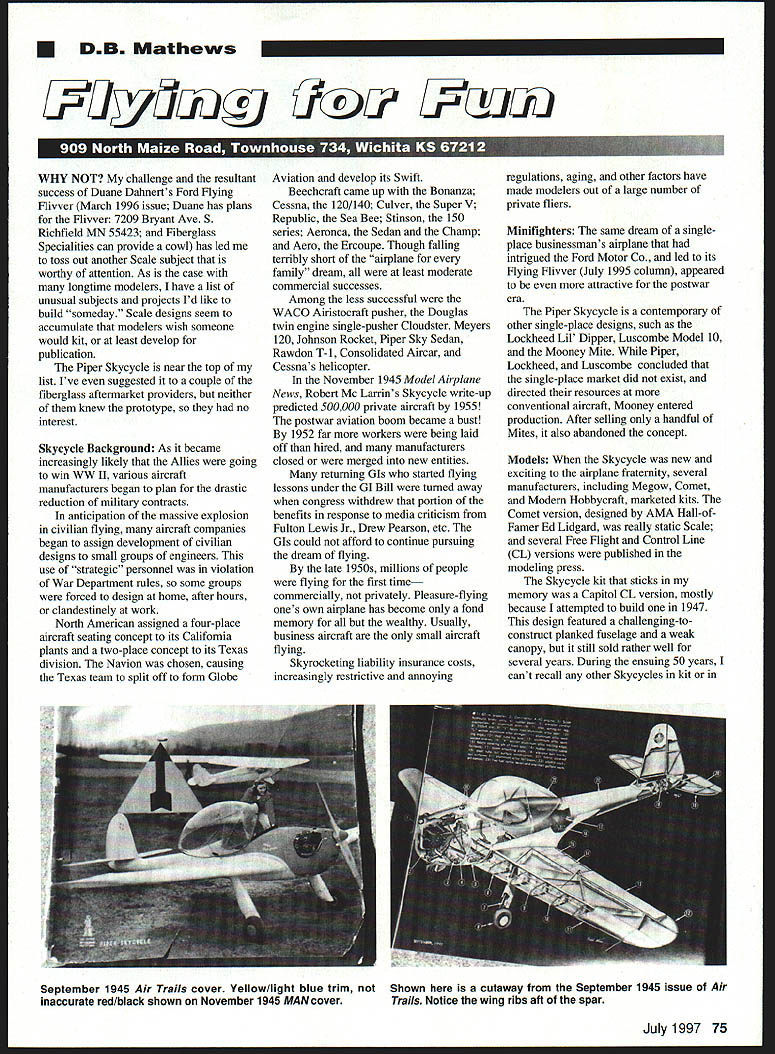
When the Skycycle was new and exciting to the airplane fraternity, several manufacturers, including Megow, Comet, and Modern Hobbycraft, marketed kits. The Comet version, designed by AMA Hall-of-Famer Ed Lidgard, was really static scale; several free flight and control-line (CL) versions were published in the modeling press.
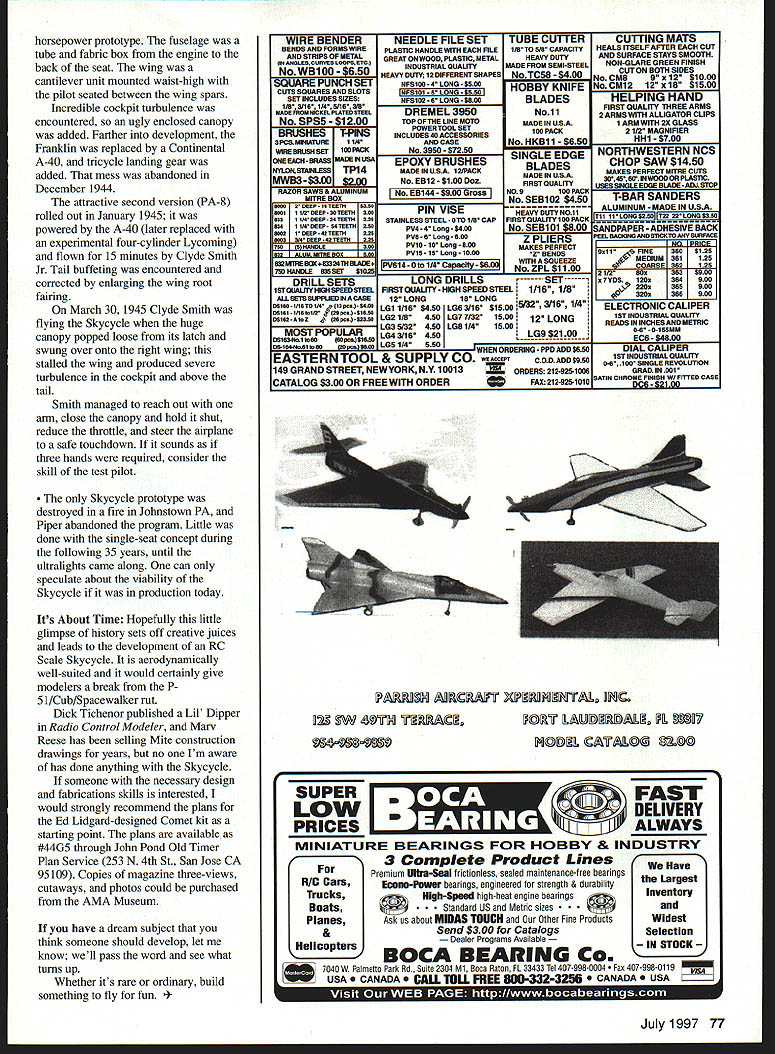
The Skycycle kit that sticks in my memory was a Capitol CL version, mostly because I attempted to build one in 1947. This design featured a challenging-to-construct planked fuselage and a weak canopy, but it still sold rather well for several years. During the ensuing 50 years, I can't recall any other Skycycles in kit or in published form, and I haven't seen a photo of one in years.
Why no one has developed a modern commercial RC Skycycle is an intriguing question. While scratch-building a prototype appears challenging, a good kit would not be, and I think it would be attractive to many modelers. The fuselage and huge wing fillets could be best duplicated in fiberglass, and contemporary vacuum-forming could produce a nice canopy. The remainder of the structure would be quite straightforward.
Another coincidence
Sometimes the world seems very small; about a year ago Bob Erdman came to my dental practice as a new patient, and while we were getting acquainted, we quickly found a common interest in airplanes. As the conversation progressed, he said, "I know you've never heard of it, but I've been working on a Piper Skycycle replica for over five years." Imagine my response.
Bob indicated that early in his project he'd been able to contact Neil Carlson, who had been involved in development of the original Skycycle for Piper. Carlson had many of the original drawings and a wealth of information, and he had helped Erdman considerably on his replica project.
While I was reading the letters from Carlson to Erdman, I learned several things:
- Many people who know about the Skycycle can quickly point out that the center fuselage was actually a drop fuel tank from a Grumman Bearcat; however, it was not a riveted aluminum structure as I'd always presumed.
- Those drop tanks were manufactured by Columbia Rope Co. of Auburn, NY; they consisted of sisal rope fiber and a heat-bonded plastic (Durabond?). It was most likely the first use of plastics for a civilian aircraft structure.
- The canopy was manufactured by Rohm and Haas of Philadelphia. Carlson recalls it as an extensively modified Consolidated PBY Catalina part.
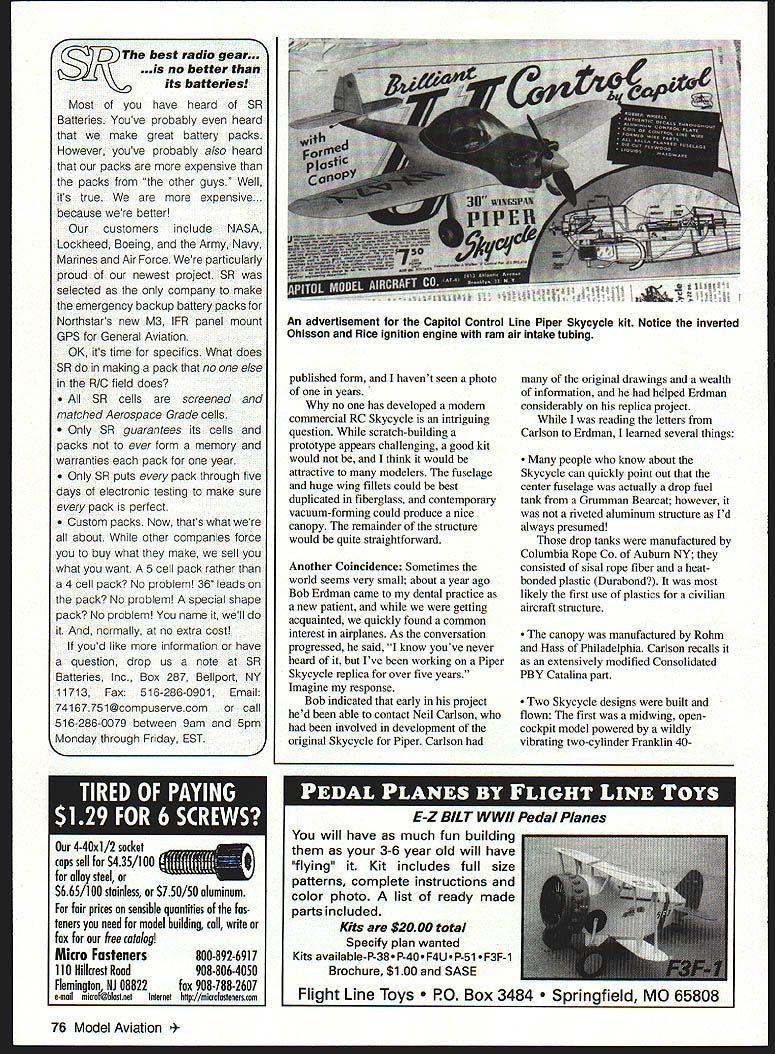
- Two Skycycle designs were built and flown. The first was a midwing, open-cockpit model powered by a wildly vibrating two-cylinder Franklin 40-horsepower prototype. The fuselage was a tube-and-fabric box from the engine to the back of the seat. The wing was a cantilever unit mounted waist-high with the pilot seated between the wing spars.
Incredible cockpit turbulence was encountered, so an ugly enclosed canopy was added. Farther into development, the Franklin was replaced by a Continental A-40, and tricycle landing gear was added; that mess was abandoned in December 1944.
The attractive second version (PA-8) rolled out in January 1945; it was powered by the A-40 (later replaced with an experimental four-cylinder Lycoming) and flown for 15 minutes by Clyde Smith Jr. Tail buffeting was encountered and corrected by enlarging the wing root fairing.
On March 30, 1945, Clyde Smith was flying the Skycycle when the huge canopy popped loose from its latch and swung over onto the right wing; this stalled the wing and produced severe turbulence in the cockpit and above the tail. Smith managed to reach out with one arm, close the canopy and hold it shut, reduce the throttle, and steer the airplane to a safe touchdown. If it sounds as if three hands were required, consider the skill of the test pilot.
- The only Skycycle prototype was destroyed in a fire in Johnstown, PA, and Piper abandoned the program. Little was done with the single-seat concept during the following 35 years, until the ultralights came along. One can only speculate about the viability of the Skycycle if it were in production today.
It's about time
Hopefully this little glimpse of history sets off creative juices and leads to the development of an RC scale Skycycle. It is aerodynamically well-suited and it would certainly give modelers a break from the P-51/Cub/Spacewalker rut.
Dick Tichenor published a Lil' Dipper in Radio Control Modeler, and Marv Reese has been selling Mite construction drawings for years, but no one I'm aware of has done anything with the Skycycle.
If someone with the necessary design and fabrication skills is interested, I would strongly recommend the plans for the Ed Lidgard-designed Comet kit as a starting point. The plans are available as #4465 through John Pond Old Timer Plan Service (253 N. 4th St., San Jose, CA 95109). Copies of magazine three-views, cutaways, and photos could be purchased from the AMA Museum.
If you have a dream subject that you think someone should develop, let me know; I'll pass the word and see what turns up.
Whether it's rare or ordinary, build something to fly for fun.
Transcribed from original scans by AI. Minor OCR errors may remain.

